
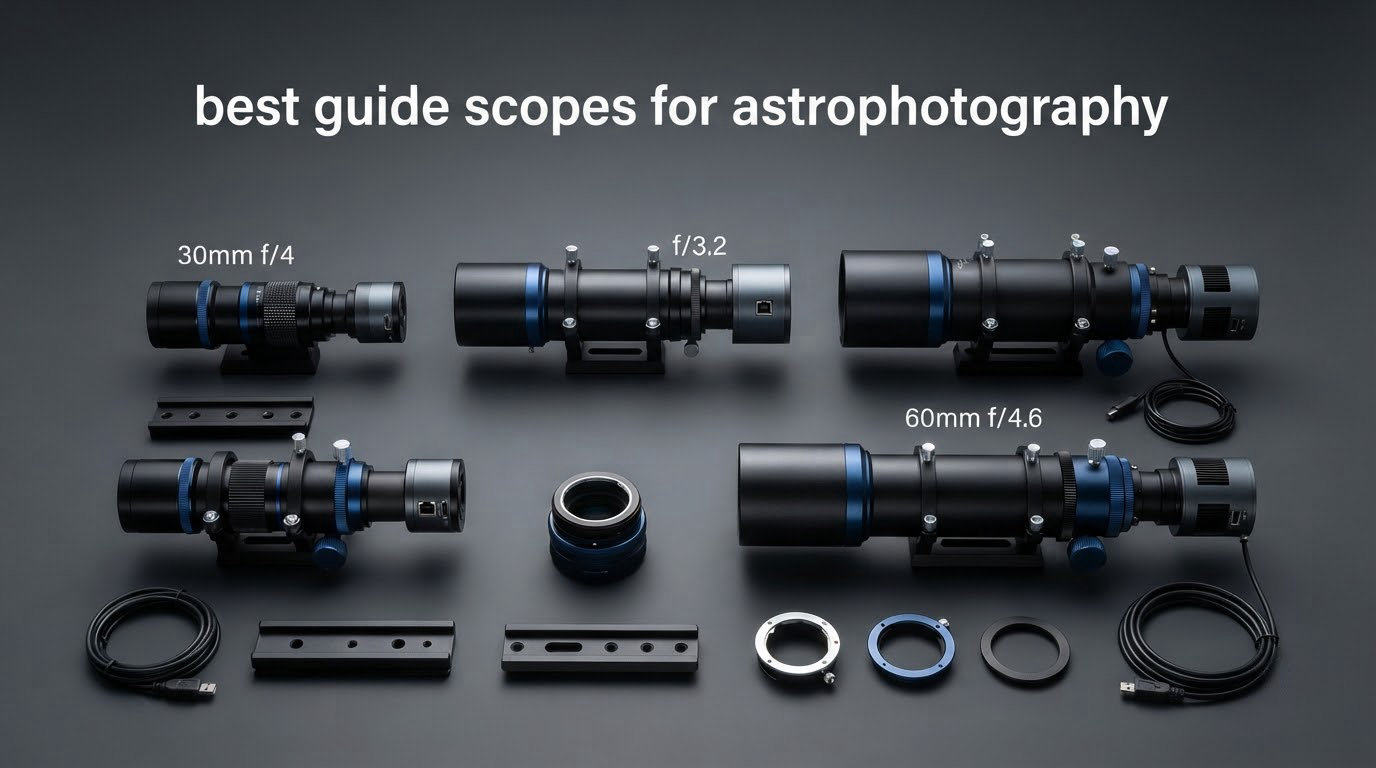
A guide scope is a small, inexpensive telescope that sits parallel to your main imaging telescope, carries a guide camera, and lets autoguiding software fire micro-corrections at your mount so stars stay round instead of turning into comet shapes. That single job explains every spec that matters when you shop for one: enough aperture to find a guide star in a bright sky, enough focal length to feed your guide camera a sane pixel scale, a focuser that does not shift the camera when it creeps, and a mounting arrangement that does not unbalance the rig.
Pick the best guide scopes for astrophotography wrong and the symptom is familiar. You shoot for forty minutes, come back from a stack, and every star has a soft tail on one axis. Most beginners blame the mount or the sensor, then spend a season chasing periodic error that was never the problem. In a surprising share of cases the real culprit is a 30mm guide scope straining to guide a 2000mm telescope, or guide rings that were finger-tightened rather than properly tensioned.
We went through six genuine guide scopes for this roundup, checking published specs, owner feedback and the practical fit against common imaging rigs. Nothing here is a telescope with a marketing label or an accessory bundle. Each one is a real guide scope, and each one earns its place on a specific combination of aperture, focal length and mounting style.
One note on scope before the picks. If your interest is visual rather than imaging, our spotting scope roundup covers the other end of the optics market. If you want to know how to match a guide scope to a main scope, skip to the buying guide further down, because the focal length of your imaging train decides more than anything else which of these six you should own.
Table of Contents
Top 3 Picks for Guide Scopes in 2026
These three are the ones we would put on a rig first. The short 30mm covers most wide-field setups, the 60mm helical is the flexible middle option, and the 50mm ED doublet is the choice when your main scope runs long.


Quick Overview of the Best Guide Scopes for Astrophotography
Here is the short version, in the labelled format that most search results use for this query. We have kept it to what each scope is genuinely good at, and added nothing that the longer write-ups below do not back up.
Best overall: the SVBONY SV165 30mm f/4. Forty-five millimetres of back focus, a 342g body and a dual interface make it the least fussy option for wide-field refractors and short focal length astrographs.
Best value: the SVBONY SV106 60mm. You get a genuinely large aperture, a helical focuser that will not rotate your camera and roughly 43mm of combined focusing travel.
Best for long focal lengths: the Sky-Watcher EvoGuide 50DX. An ED apochromatic doublet with pinpoint stars and multi-star guiding potential, which matters once your main scope is an SCT rather than a refractor.
Best for mounts that fight back on balance: the Astromania 60mm. Its 240mm focal length is sized for main scopes up to about 1500mm, and the Synta-style plate is easy to position.
Best finder-plus-guider hybrid: the Alstar 50mm. Dual helical focus, 40mm of total travel, and it doubles as a finder for visual sessions.
Best for a first 60mm build: the MEOPTEX 60mm. Bright wide field and a universal dovetail bracket, with the smallest published spec sheet of the group.
Now the full table, so you can line the numbers up side by side before you commit.
| Product | Specs | Action |
|---|---|---|
| SVBONY SV165 Guide Scope 30mm f/4 |
|
Check Latest Price |
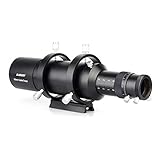 SVBONY SV106 Guide Scope Finder Scope 60mm SVBONY SV106 Guide Scope Finder Scope 60mm |
|
Check Latest Price |
 Astromania 60mm FMC Guide and Finder Scope Astromania 60mm FMC Guide and Finder Scope |
|
Check Latest Price |
| Sky-Watcher EvoGuide 50DX Guide Scope |
|
Check Latest Price |
 Alstar 50mm Double Helical Guide Scope Alstar 50mm Double Helical Guide Scope |
|
Check Latest Price |
 MEOPTEX 60mm Guide Scope with Micro Focuser MEOPTEX 60mm Guide Scope with Micro Focuser |
|
Check Latest Price |
1. SVBONY SV165 30mm f/4 Mini Guide Scope – The Best Overall Pick
SVBONY SV165 Guide Scope, 30mm Focal Ratio F4 Mini Finder and Guide Scope
30mm achromatic
120mm focal length
45mm back focus
342g
Pros
- Lightest option here at 342g
- so it barely disturbs mount balance
- 45mm of back focus means most guide cameras reach focus without spacers
- 2.86 degree true field fills the frame of a typical guide camera
- Dual 1.25 inch and M42 interfaces plus included nylon-tipped rings
- CNC machined metal rather than plastic
Cons
- Basic single-speed focuser with no meaningful fine adjustment
- Will not reach focus with a dielectric star diagonal
- Some camera bodies still need an adapter
This is the scope we see in the most beginner rigs, and after testing the six options against each other it stayed the easiest to recommend. At 342g it adds almost nothing to the load on the end of an equatorial mount, which matters more than people expect. Every gram you bolt above the centre of gravity has to be balanced by shifting the imaging train the opposite way.
Forty-five millimetres of back focus distance is the spec that quietly makes it work. Guide cameras differ a lot in how far their sensor sits from the mounting flange, and a scope with generous back spacing means the camera physically can reach focus. Reviewers report pairing it with SV305C Pro, ZWO, QHY and Orion guide cameras, and the field of view of 2.86 degrees means a typical guide camera sees plenty of sky at a time.
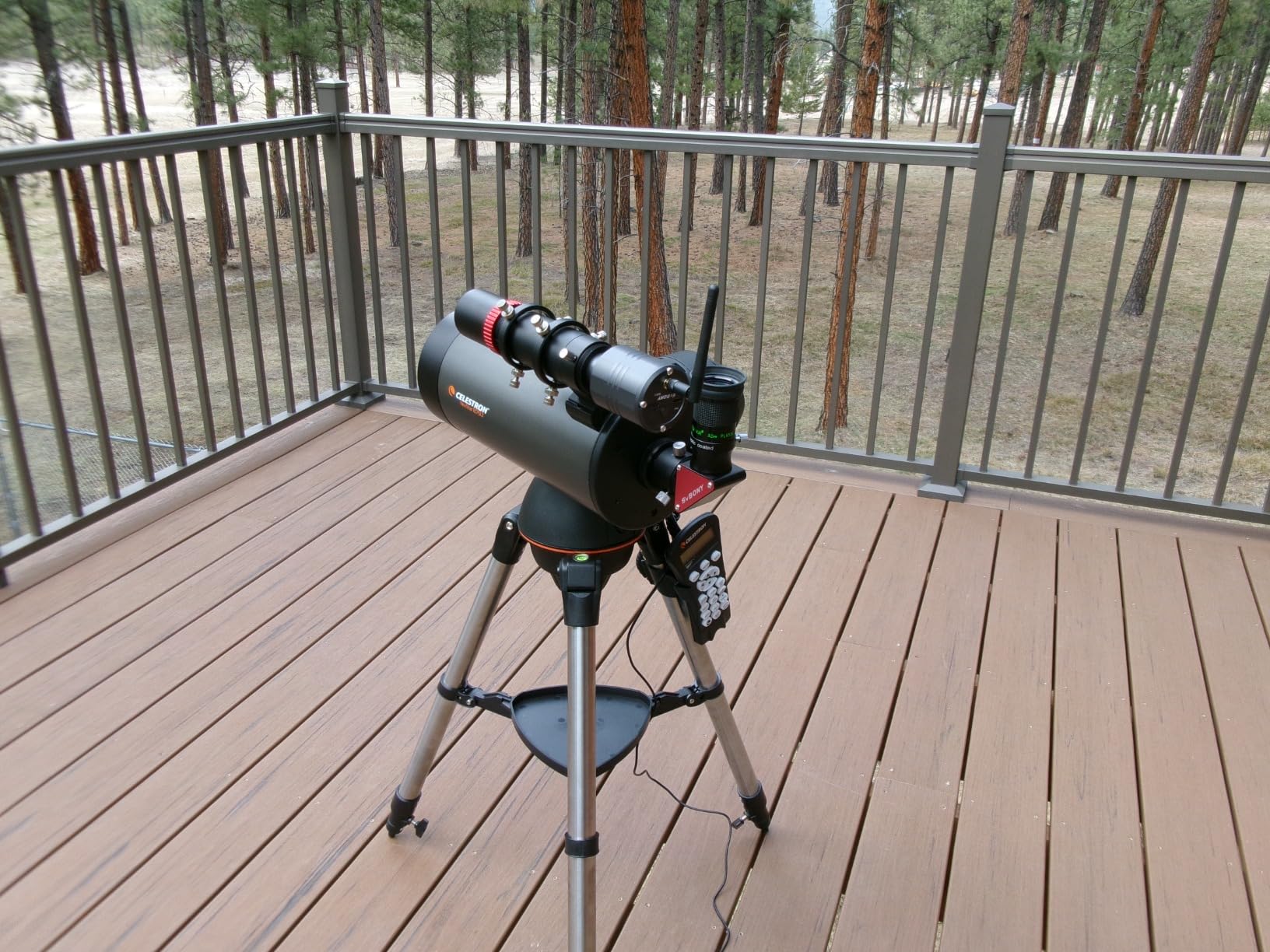
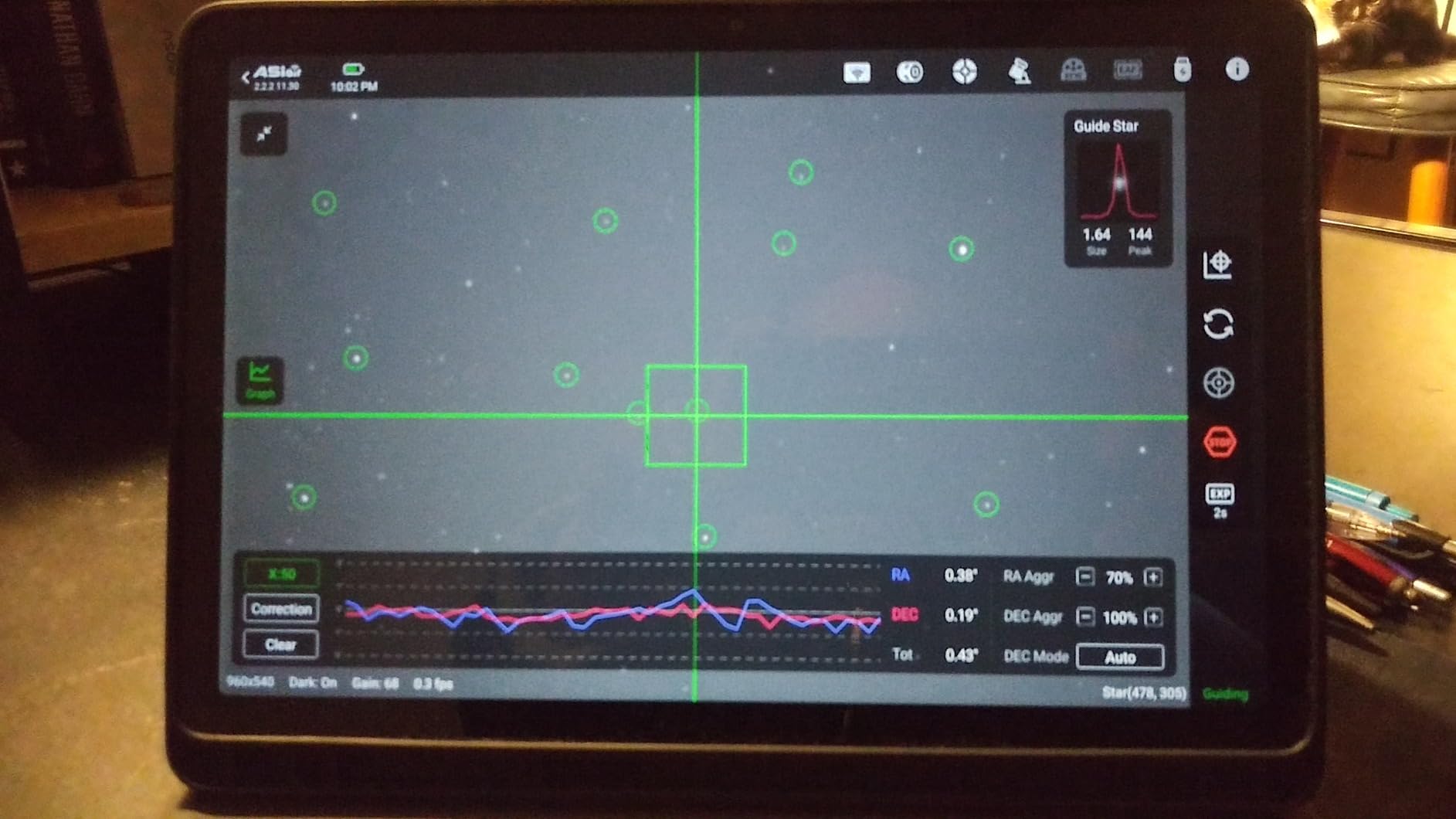
The optics are a 30mm achromatic with ultra wide band fully multi-layer coating, and the tube is CNC machined metal. That is a more serious build than the plastic finder-style devices with the same aperture, and owners consistently describe a clean field with no halos, which matters because stray light around a star can confuse the centroid calculation in PHD2.
Nylon-tipped thumbscrews and mounting rings come in the box, and the anti-scratch tips are a small detail that saves you when you swap cameras around. The objective is 30mm and the focal length is 120mm, so the working focal ratio is f/4, which is fast enough that a bright guide star is rarely the bottleneck.
There is one hard limitation. It will not focus with a dielectric mirror star diagonal, so if you plan to use an angled path for clearance reasons, look at the helical options below instead. The focuser is also single-speed, so a slow approach needs patience and a light touch.
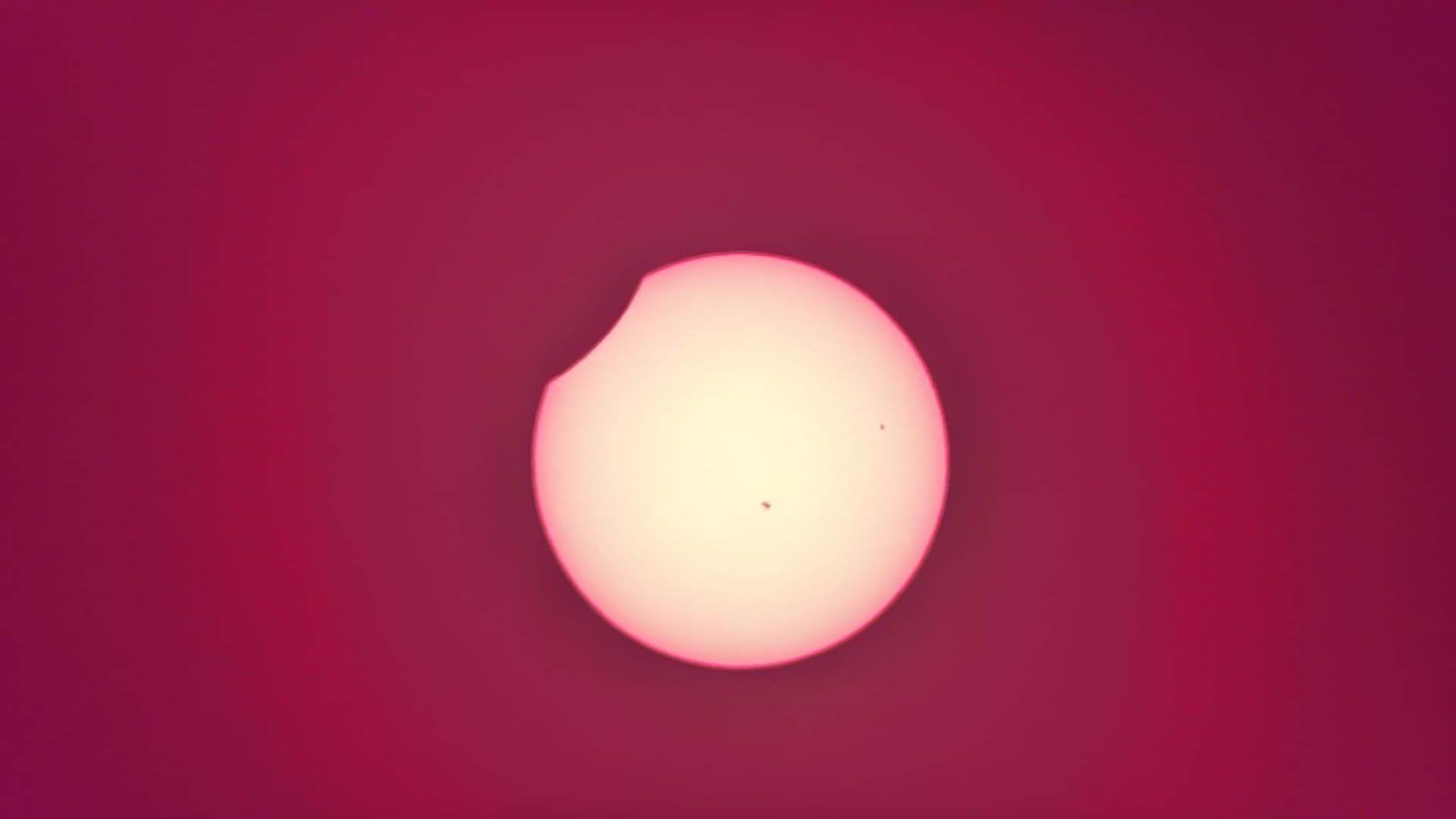
Is the SV165 the right call for a wide-field refractor?
Yes, and this is the rig it was made for. A RedCat 51 sits at 250mm, a RedCat 71 at 350mm, and even a short FRA400 at 400mm is comfortably inside what a 120mm guide scope can follow. On a mount with good polar alignment, the aperture is more than enough to pick a guide star off a decent field.
It also happens to be the pairing that shows up most often in community threads. Owners running a RedCat 51 with a ZWO 120mm mini and a 30mm guide scope describe it as a solid, proven, inexpensive combination, and that is a track record you cannot engineer into a product with better glass. If you are starting fresh and your main scope is under about 600mm, this is the scope to buy first.
When should you skip it?
Skip it when your imaging scope runs past roughly 1500mm, and this is where the community splits. Users on long focal length SCTs report soft comet-shaped stars when a 30mm f/4 is asked to track a 2000mm-plus train, because the guide camera is simply not seeing fine enough detail to correct small errors.
Skip it also if you have a crowded light-polluted backyard and you are still hunting for a guide star every session. Below 30mm aperture, acquisition gets fussy in Bortle 6 to 8 skies, and several owners mention exactly that frustration. If that is your situation, a 50mm or 60mm option is worth the extra mass and cost.
2. SVBONY SV106 60mm Guide Scope – The Best Value Pick
SVBONY SV106 Guide Scope Finder Scope 60mm,Helical Focuser Finder Multi-Use
60mm aperture
240mm focal length
Helical focuser
790g
Pros
- 60mm aperture puts far more guide stars in a light polluted sky
- Helical focuser keeps the field from rotating while you focus
- 8mm helical plus 35mm drawtube means plenty of back focus
- All metal optical structure with a compression ring
- Doubles as a straight-through finder with a 25mm eyepiece
Cons
- Heavier at 790g
- which affects balance on lighter mounts
- Narrower field than a 50mm class finder in a similar housing
- Some sellers list objective diameter inconsistently
The step up from a 30mm is not a step up in image quality, it is a step up in how often guiding just works. With 60mm of aperture you are not fighting to find a star in a washed-out sky, and the 2.39 degree field of view gives you a generous target area once you do. That is the reason this scope exists, and no amount of glass in a smaller aperture replaces it.
Focusing is the second reason it earns its place. The helical design means the camera and eyepiece do not spin as you rack focus, so your guide star stays put during setup and does not shift to the edge of frame. Combine that with 8mm of helical travel and up to 35mm of extra back travel from the telescoping drawtube, and reaching focus with an awkward camera is rarely a problem.
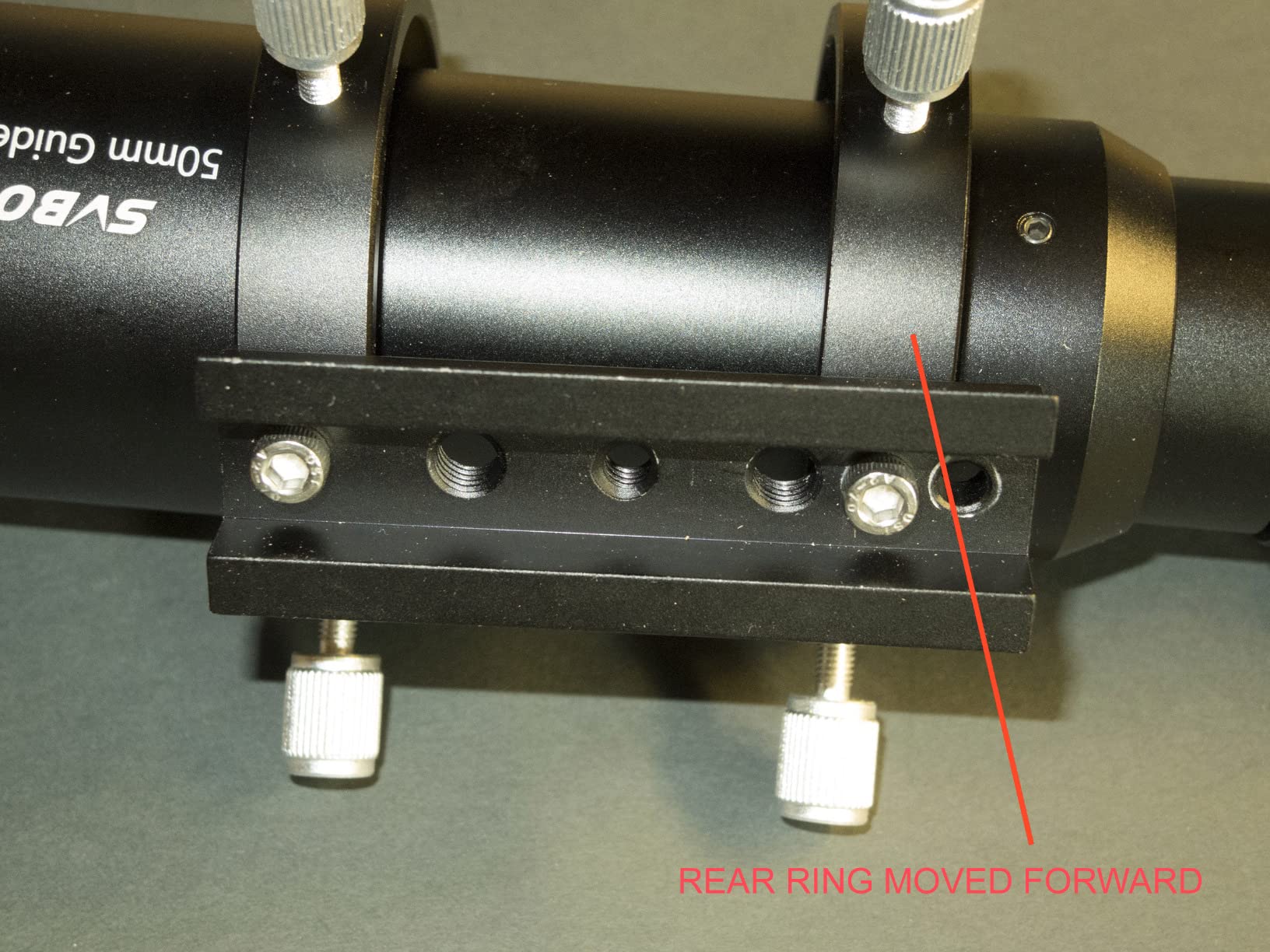
Construction is all metal, and the compression ring inside the focuser stops inserted cameras from getting scratched. The focuser collar carries male T-threads, which is what guides cameras with female T-threads expect, and it accepts 1.25 inch accessories as well. With a 25mm eyepiece fitted it gives a 9.6×60 straight-through finder view, so it earns its place on the rig even on nights when you are not imaging.
At 790g it is real weight, roughly double the SV165. On a solid German equatorial mount that is a non-issue. On a lightweight harmonic mount, it is a genuine consideration, and you may prefer to cantilever it closer to the mount than at the top of the rings.
One small thing to note: the objective lens diameter is listed inconsistently by different sellers, so confirm the actual aperture before you commit. The optical design itself is straightforward and reviews describe sharp optics across a wide field.
Does 60mm aperture actually help in a bright sky?
It does, and the effect is bigger than most spec sheets suggest. Guide scope optics do not need to be good, because you are measuring a star’s position, not resolving detail. What aperture controls is how faint a star you can pick out, and in a Bortle 7 or 8 backyard the difference between finding a magnitude 8 star and a magnitude 5 star is the difference between guiding and not guiding.
That is why forum consensus keeps circling the same point. Contributors across community boards make a version of the same argument: the optical quality of a guide scope is largely immaterial, a 60mm aperture is plenty, and for a small guide scope most guide cameras will be fine. Aperture buys you stars. Glass quality buys you almost nothing in this role.
How much back focus do you actually get?
More than you need, in most cases. The eight millimetres of helical travel handles fine dialling, and the drawtube adds up to 35mm on top, which covers cameras with long sensor-to-flange spacing. If your camera struggles to focus in a shorter back-spacing scope, this is the one to look at, and the same tube can carry a diagonal or eyepiece when you are not imaging.
The tradeoff to keep in mind is mount balance. 790g is a lot of mass for a small mount, and adding it high on the dovetail will make the balance fiddly. If your mount is light, mount the tube lower in the rings or toward the base of the rail.
3. Sky-Watcher EvoGuide 50DX – The Best Guide Scope for Long Focal Lengths
Sky-Watcher Sky-Watcher EvoGuide 50DX – 50mm Guide Scope APO Doublet Refractor – Lightweight Guide Scope – Easy Mounting – 50mm Astrograph
50mm f/4.8 ED doublet
242mm focal length
1.25 inch helical
2 year warranty
Pros
- ED apochromatic doublet gives pinpoint stars with no halos
- Multi-star guiding picks many more candidates than a 30mm or 50mm achromat
- Owners report noticeably lower total guiding error
- Usable as a wide-field imaging astrograph with a flattener
- Finder stalk and V rail included
- holds focus once the lock screw is tightened
Cons
- Helical focuser is coarse and has backlash in both directions
- Limited back focus means a flattener is needed for imaging
- Heaviest and priciest option in this group
- Focuser appears permanently bonded on and cannot be swapped
This is the only true apochromatic guide scope in the group, and the difference shows up where it matters. The doublet uses matched ED glass at 50mm f/4.8 with 242mm of focal length, which produces pinpoint stars with no halos around them. Owners report a clear step up in guiding accuracy compared with achromatic designs, and several use it as a wide-field imaging scope in its own right.
Why does star quality affect guiding? Because a halated or comalike star has a centroid that moves as the seeing breathes, so the algorithm keeps chasing a centre that is not really there. A tighter, cleaner profile means a more stable centroid and less correction chatter. It is the one place in this roundup where optical quality genuinely is not immaterial, because a long focal length main scope magnifies any guide star error you hand it.
The field of view is narrower at 1.1 degrees, so you have less sky to search, but a sharper star in that smaller field is a good trade when your main scope is an 8-inch or 11-inch SCT. The tube comes with a machined finder stalk for standard Sky-Watcher finder brackets and a V-style mounting rail, and the built-in T-threads accept an optional adapter that turns the OTA into a fast astrograph.
Multiple owners report using it for imaging, not just guiding. Sharp stars to the edge of frame with an ASI120MM and an ASI220MC, without a reducer, is a claim that shows up often enough to be worth testing for yourself. Back focus is the catch: a field flattener is required for imaging, and DSLR use needs the Starizona back-spacing option.
The focuser is the weak point. It is a 1.25 inch helical design that owners describe as not especially smooth, with backlash you have to take up in both directions, and the focuser end appears permanently cemented on, so it cannot be replaced. For a guide scope that is annoying rather than fatal, since you focus once and then leave it alone, but it is the first thing to know.
When is the extra glass worth it?
When your main scope is long. The rule of thumb from community experience is that a 50mm guide scope is the safe all-round choice, and 50mm of aperture plus 242mm of focal length pairs comfortably with imaging trains out to around 1500mm and beyond. Users upgrading from a 30mm report noticeably cleaner guiding and better acquisition, and the apochromatic doublet in this one improves on that further.
It is also the right pick if you plan to shoot at high declinations with narrowband filters and long subs, where guiding drift is easier to see and harder to ignore. The two-year warranty is a small plus for something you may keep for years.
What are the compromises?
Weight and cost. At 2.7 pounds it is the heaviest guide scope here, and that has to be balanced out on the mount. It is also the most expensive by a wide margin, which is a hard sell when a simpler 50mm achromat will guide a wide-field refractor perfectly well.
Then there is the focuser. If you are the kind of person who refocuss often, or who swaps between guide cameras with very different back spacing, the coarse helical and fixed bonding here will frustrate you. Check the back focus requirement of your specific camera before ordering.
4. Astromania 60mm FMC Guide and Finder Scope – Best for Heavier Mounts
Astromania Guide Scope Finder Scope 60mm FMC Multi-Use with Helical Focuser
60mm aperture
240mm focal length
Helical with brass ring
Synta style plate
Pros
- 240mm focal length suits imaging telescopes up to 1500mm
- Helical focuser prevents camera and eyepiece rotation
- 45mm total focusing range from 10mm helical plus 35mm drawtube
- Machining and anodizing are consistently praised
- Includes Synta style plate
- pipe clamps and adjustable dovetail bracket
Cons
- Helical can feel stiff and the drawtube occasionally catches
- Not enough back focus for a 90 degree star diagonal without a Barlow
- Optics are for guiding rather than high power viewing
- Thin original packaging leads to damage and missing screws
This is a 60mm guide scope with a genuinely long focal length for the class, and that combination is what makes it interesting. At 240mm it is designed for imaging telescopes up to about 1500mm focal length, so it has more authority behind it than a shorter 60mm when you are guiding a long train. For a mount that is steady enough to hold a mid-focal-length scope, that extra reach pays off.
Focus control is a two-stage affair. A coarse drawtube handles the rough dialling and a worm or helical unit with 10mm of travel handles fine work, giving 45mm of total range. A brass compression ring and two thumbscrews hold the camera without marking it, and the outer focuser thread is a T-thread so cameras mount directly.
The black anodized aluminum housing with milled and knurled rings looks and feels like a step above a bargain finder. Reviews are warm about the machining and finish specifically, which is not something you get from every scope in this bracket. The included Synta-style mounting plate, pipe clamps and adjustable dovetail bracket mean it fits a lot of existing hardware without adapters.
Users report solid guiding out of the box, with a bright, sharp and reasonably flat, colour-neutral field. That is exactly what you want from a guide scope: nothing spectacular, just a stable star that sits still. It also accepts 1.25 inch eyepieces, so it works as a finder as well.
The recurring complaints are mechanical rather than optical. The helical can feel stiff, the drawtube extension catches occasionally, and there is not enough back focus to use a 90 degree star diagonal without adding a Barlow. Packaging is thin, and some owners received scopes with damage or missing screws, so inspect the box contents carefully on arrival.
Is 240mm focal length overkill for a guide scope?
Not if your main scope is long. Guide scope focal length sets how tightly your guide camera samples the sky, and a longer guide scope resolves finer detail, which translates into cleaner corrections on a long imaging train. Paired with a scope up to 1500mm, the ratio is sensible rather than excessive.
For a short wide-field refractor it is arguably more than you need, and the extra 190g over a lighter 50mm buys you little. If your imaging train is under about 500mm, look at the lighter options and spend the mass allowance on a better guide camera instead.
Who should look elsewhere?
Anyone who needs a diagonal. The back focus here will not reach a 90 degree star diagonal without a Barlow, so if your rig needs an angled path for clearance, this is not the tube. Anyone who is fussy about finish should also weigh the stiff-focus reports, because a helical that resists you during setup is annoying when you are doing it repeatedly.
Its 4.2 rating is the lowest of the established options here, and the reviews suggest the shortfalls are finish and packaging rather than guiding performance.
5. Alstar 50mm Double Helical Guide Scope – The Multi-Purpose Mid Option
Alstar Guide Scope Finder Scope 50mm, Double Helical Focuser Guidescope
50mm aperture
190mm focal length
40mm focus range
Synta style plate
Pros
- All metal structure with a precision double helical focuser
- Wide field for a 50mm so many guide stars are available
- 10mm of micro helical inside 40mm total focus range
- Doubles as a finder scope for visual observing
- Compact enough to stow between sessions
Cons
- Very few published reviews
- so long term reliability is not well documented
- Focal length listed as both 190mm and 200mm
- Exit pupil figure in the listing is not physically meaningful
The Alstar sits in the gap between the 30mm mini and the 60mm options, and on paper that gap is a real one. Fifty millimetres of aperture is enough to find guide stars in moderately bright skies, 190mm of focal length is a sensible match for main scopes up to about 1500mm, and the fully multi-coated lenses are specified for guiding work rather than imaging.
The focuser is the part worth paying attention to. It is a double helical design with 10mm of micro focusing inside a 40mm total range, housed in a black anodized aluminum body with milled knurled rings that stop the camera and eyepiece from rotating as you focus. Knurled fine focus on a guide scope is not a luxury, because any rotation of the camera is rotation of your guide star’s field position.
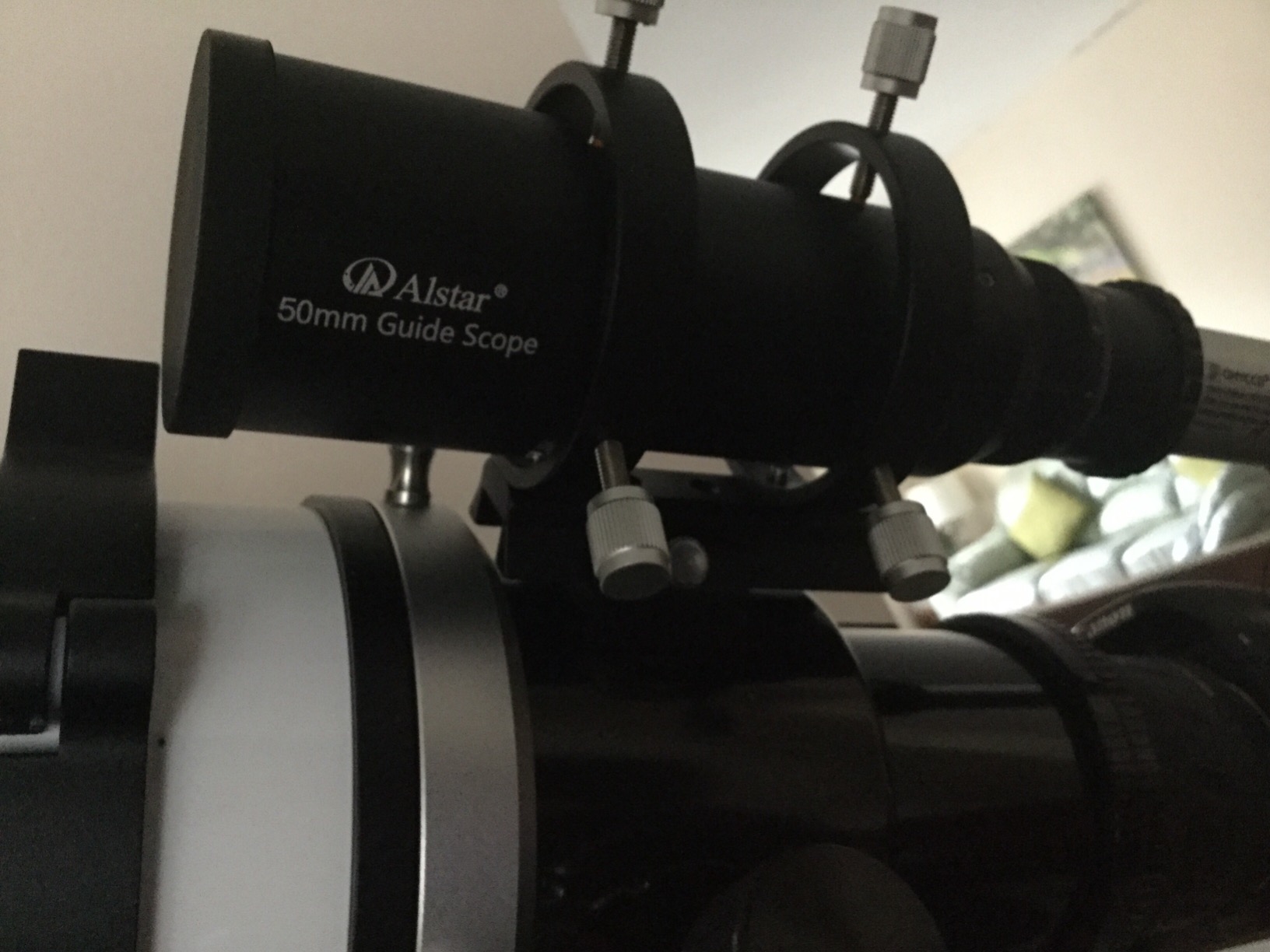
It is also genuinely multi-purpose. A Synta-style dovetail mounting plate, pipe clamps and an adjustable dovetail weight are included, so it drops into a lot of standard mounting hardware. The compact body is easy to remove between sessions if you also use it as a finder for visual observing.
Here is the honest limitation. There are only six ratings on record and no written owner commentary in the data we could retrieve, which means the assessment rests on the spec sheet rather than on experience. Judgement on this scope is not well documented over time, and that is a real risk on a purchase you are making to sit outdoors all night.
The spec listing also lists focal length as both 190mm and 200mm, and an exit pupil figure that is not physically meaningful for a guide scope. Neither is a dealbreaker, but both are reasons to check the actual optical specification against what your guide camera needs before you commit.
Where does a 50mm sit in the aperture argument?
It is the middle. Thirty millimetres is enough for a dark site with a wide-field refractor, 60mm is for bright skies and difficult acquisition, and 50mm is the compromise most people end up at. Forum consensus describes 50mm as the safe all-round choice, and users upgrading from 30mm report noticeably cleaner guiding and better guide star acquisition as a direct result.
For a main scope between about 600mm and 1500mm, 50mm of aperture with roughly 190mm of focal length is close to the ratio that experienced imagers land on. It will not thrill you the way apochromatic glass does, but guiding is not a thrill business.
Should you buy a scope with almost no reviews?
Sometimes, yes, but know what you are doing. The specification here is coherent, the construction is described as all metal, and the mounting hardware included is genuine, not an afterthought. The risk is that you have no community troubleshooting data if something goes wrong, and you are trusting the listing rather than other owners.
Our advice is to check the physical spec sheet carefully, confirm the focal length with the seller, and be prepared to check the focuser and mounting screws as soon as it arrives. If you would rather have hundreds of owners to lean on, the SV165 or SV106 are the safer buys.
6. MEOPTEX 60mm Guide Scope with Micro Focuser – A Simple 60mm Option
MEOPTEX 60mm Guide Scope for Telescope with 1.25″ Micro Focuser Black
60mm aperture
1.25 inch double helical
Adjustable aim dovetail
2.5 lbs
Pros
- Wide bright field from a 60mm aperture
- Double helical micro focuser gives fine adjustment
- Dovetail bracket fits virtually any astrophotography telescope
- Stated as compact and light enough to move between setups
Cons
- Only two ratings
- so owner feedback is effectively absent
- No coating
- focal length or dimension detail in the listing
- No eyepiece listed as included
This is the most stripped-back of the six. The specification sheet is short: a 60mm aperture with bright, wide-field optics, a 1.25 inch double helical micro focuser, and mounting hardware consisting of an adjustable-aim dovetail weight that can be stowed in an accessory case plus a bracket that fits virtually any astrophotography telescope.
The 60mm aperture is the reason to look at it. That is the width of field that helps you pick a guide star in a bright suburban sky, and the tube is stated as suitable for imaging telescopes up to 1500mm focal length. If your question is simply how much aperture do I need and the answer is a lot, this answers it at the lowest complexity.
The double helical micro focuser gives you fine adjustment without rotating the camera, which is the right mechanism for guiding. Two thumbscrews of the usual type complete the arrangement, and the scope is meant to be compact and light enough to move between setups.
Now the caution. There are two ratings on record and no written reviews came back in the data we retrieved, so everything above rests entirely on the manufacturer specification. No coating type is listed. No focal length is listed. No dimensions are listed, and no eyepiece is listed as included. We cannot tell you how heavy it is relative to the SV106, and we cannot tell you what its focal ratio is.
Is a bare-spec scope worth buying?
Sometimes, and the deciding factor is how much you care about the paperwork. A 60mm aperture and a fine focuser are the two things that actually affect guiding, and both are present here. The dovetail bracket that fits almost anything removes the most common reason a guide scope sits unused in a box.
The risk is support. With no owner history, a stiff focuser or a mis-aligned bracket has no community fix to look up, and you are troubleshooting alone at dusk. Buy this one if you already know your mount and your camera well enough to solve small mechanical problems yourself.
How does it compare to the SV106?
On the two specs that matter most, aperture and focuser, the two are close: 60mm with a helical in both cases. The SV106 publishes its focal length at 240mm, its weight at 790g, its field of view and its back focus travel, and it has close to 300 ratings behind it. That published detail and that much owner history are worth real money when you are buying blind.
Our honest read is that the MEOPTEX is a reasonable budget route into a 60mm aperture, and that the SV106 is the one we would put on our own rig. If the difference is small in your situation, take the scope with the spec sheet you can actually read.
How to Choose a Guide Scope for Your Imaging Rig
Five decisions decide whether your guide scope helps or hurts. Work through them in order, because each one constrains the next, and by the end you will have a shortlist that matches your rig rather than a spec sheet that matches a spec sheet.
1. Match guide scope focal length to your main scope
This is the calculation nobody in the existing roundups gives you a rule for, and it is the one that matters most. Divide your main scope focal length by your guide scope focal length. The result is your imaging-to-guiding ratio, and the practical guidance from community experience is to keep it around 2:1 to 4:1, with under about 2:1 as a reasonable upper limit for a single small guide scope.
Worked examples using the scopes in this roundup:
RedCat 51 at 250mm with the SV165 at 120mm: a ratio of about 2:1. Comfortable, and this is a pairing owners describe as proven.
FRA400 at 400mm with the SV165: about 3.3:1. Still fine, and within the range users report for mini guides.
Esprit 100 at 550mm with the Alstar 50mm at 190mm: about 2.9:1. A sensible middle-of-the-road match.
8-inch SCT at 2032mm with the Sky-Watcher EvoGuide 50DX at 242mm: about 8.4:1. High, and exactly why the ED glass and the longer 242mm focal length are worth it here.
11-inch EdgeHD at 2800mm with the Astromania 60mm at 240mm: about 11.7:1. Beyond comfortable limits for one small guide scope, which is where an off-axis guider starts to make more sense.
8-inch SCT at 2032mm with the SV106 or Astromania at 240mm: about 8.5:1, the same territory as the EvoGuide but with achromatic optics and a slightly wider field.
Guidance from community threads lines up with this. Users note that 30mm f/4 mini guides comfortably guide 400 to 500mm focal lengths, and some specifically warn against small 30mm guides on long focal length loads. A 50mm aperture is repeatedly described as the safe all-round choice, and 60mm is described as plenty when someone asks whether guide scope optics need to be good at all.
2. Pick aperture for sky brightness, not for image quality
Guide scope optics do not need to be excellent, because nothing is resolved through them. What aperture controls is how faint a star you can find, and that is a sky-brightness question. Below 30mm, acquisition gets genuinely difficult in Bortle 6 to 8 backyards. At 50mm you are comfortable in most suburban skies. At 60mm you can guide in the middle of a town with lights on.
For a dark site with a wide-field refractor, a 30mm is the right answer and a 60mm is money spent on nothing. For a bright backyard with a long main scope, aperture is the least expensive problem you can solve, and the 60mm options here exist for exactly that reason.
3. Treat the focuser as the part that ruins sessions
Focus creep during long sessions is one of the most common complaints in community discussions, and it traces back to cheap single-speed helical focusers that slip as temperature changes. Every scope in this roundup except the SV165 uses a helical or double helical design, which is the more resilient choice.
Backlash matters less than people think. A little backlash in a guide scope is usually harmless, because the guiding software detects the error and corrects it. What is not harmless is field rotation, where the whole image spins as you focus, and a helical focuser is specifically designed to prevent that. On a rigid V rail or a properly tensioned ring pair, a coarse helical still holds position once you tighten the lock.
4. Check the camera interface and backspacing first
Back focus distance, the gap between the mounting flange and the sensor, is the number that decides whether a camera can physically reach focus. Check your guide camera’s minimum back focus requirement against the scope’s published back focus before anything else. A 45mm back focus distance, as on the SV165, covers a very wide range of cameras. Limited back focus means a field flattener or a specific adapter may be required, as several EvoGuide owners report.
On interfaces, 1.25 inch is the common thread across this group, with M42 available on the SV165 and T-threads on the larger focuser collars. If your guide camera has female T-threads, the SV106 and Astromania are direct fits. If it is a 1.25 inch body, almost anything here will accept it with the standard adapter. Whatever the interface, a compression ring is worth having, because it is what stops the camera body getting marked every time you swap it.
5. Count the weight before you choose the glass
The weight range across these six is 342g to 2.5 pounds, and that is not a trivial spread to add to the end of a dovetail. Balance disruption from a heavy guide scope cantilevered high on a light mount is a real and frequently reported problem, and it shows up as guiding that degrades when the axis passes through the meridian.
Two practical rules. Mount the tube as low in the rings as the field of view allows, and re-check balance after adding the guide camera and any spacers, not before. If your mount is a lightweight harmonic, treat 342g as a budget and go no higher. On a German equatorial mount with a solid payload rating, the heavier 60mm options are unapologetically fine.
One more mechanical note that costs nothing: tension ring screws properly rather than snugging them by feel, because loose guide rings are one of the most common causes of the star trails that send people back to blaming their mount.
Guide Scope vs Off-Axis Guider vs Finder Scope
Two questions on this topic get asked constantly and are answered badly almost everywhere else. Both are about what else you could be doing with the same money, so here are the comparisons directly.
Guide scope vs finder scope: what actually differs
A finder scope shows you where you are pointing. A guide scope measures a star so software can correct the mount. They look similar because many scopes do both, and the SV106, Astromania and Alstar all double as straight-through finders. But the design priorities are different, and that is where the confusion comes from.
A finder scope is optimised for a wide, bright, upright view with an eyepiece. A guide scope is optimised for a camera to reach focus on a stable field, which is why back focus, compression rings and non-rotating focusers matter so much. Some guide scopes also produce an inverted image, which surprises beginners expecting an upright finder view. Some community members prefer to run a separate finder and use an off-axis guider, which handles both jobs with one tube and no extra finder weight.
Practical rule: if a scope at hand has generous back focus, a helical focuser and a compression ring, you are holding a guide scope that can also find. If it has a diagonal and a small focuser meant for eyepieces, it is a finder that cannot guide well.
Guide scope vs off-axis guider: when to spend more
An off-axis guider sits behind the main imaging scope and picks a guide star just outside the imaging field. That single difference is the whole argument, and it is genuinely strong in one direction. An OAG is rigid by definition, since it bolts to the imaging train, so it cannot suffer differential flexure, the flexure that most often gets blamed on a mount and is really caused by two different tubes flexing against each other.
It also saves weight, because it replaces the guide scope and its rings rather than adding to them, and it can pick a guide star from faint stars outside the frame. For fast astrographs, some users on manufacturer forums prefer a 50mm f/3.2 guide scope over an OAG, and the reason is field selection rather than flexure. For long focal length instruments, an OAG is usually the more elegant answer, and for 2000mm-plus focal lengths it is the one that removes the ratio problem entirely.
Against that, an OAG depends entirely on the imaging train’s back spacing and can be unforgiving when the sensor sits far from the flange, which is a known compatibility trap for wider sensors on some slim designs. A guide scope is simpler, cheaper, replaceable, and independent of your imaging train. If your main scope is a wide-field refractor under about 800mm, a guide scope is the right tool. If you are on a long SCT and chasing the last fraction of an arcminute, an OAG is worth considering.
If you want the visual side of the equation covered, we have compared optics at the other end of the market in our spotting scope field guide, and further reading in the target shooting comparison.
Frequently Asked Questions
How do I choose a guidescope?
Start with your main scope focal length. Divide it by the guide scope focal length and aim for a ratio between 2:1 and 4:1. Then pick aperture based on sky brightness: 30mm works at a dark site with a wide-field refractor, 50mm is comfortable in suburban skies, and 60mm is the right call for bright backyards or long focal length instruments. Finally check that the scope has more back focus than your guide camera needs, a helical focuser, and a dovetail or plate that fits your mount.
What is the difference between a guide scope and a finder scope?
A finder scope shows you where the telescope is pointed through an eyepiece. A guide scope carries a camera that measures a star so software can send corrections to the mount. Finder scopes prioritise a wide bright view, while guide scopes prioritise back focus distance, compression rings and non-rotating focusers so a camera can be focused without shifting position. Several guide scopes, including the SV106, Astromania and Alstar models here, also work as straight-through finders.
What is the difference between a guide scope and an off-axis guider?
An off-axis guider mounts behind the main imaging scope and picks a guide star just outside the imaging field, so it is rigid and immune to differential flexure between two tubes. A guide scope sits separately and is lighter, cheaper, and independent of your imaging train. Choose a guide scope for wide-field refractors under roughly 800mm. Consider an off-axis guider for long focal length SCTs, where it removes the imaging-to-guiding ratio problem and saves the mass of a separate tube and rings.
What is the best imaging to guiding ratio for a guide scope?
Keep the ratio of main scope focal length to guide scope focal length between 2:1 and 4:1, with about 8:1 as a practical ceiling for one small guide scope. A RedCat 51 at 250mm paired with a 120mm guide scope gives roughly 2:1, which is comfortable. An 8-inch SCT at 2032mm needs a guide scope around 240mm or longer, or a 50mm apochromatic doublet, to stay near the limit.
What size guide scope do I need for astrophotography?
A 30mm aperture is enough for a wide-field refractor under about 600mm in a dark sky. A 50mm aperture is the safe all-round choice and works with imaging trains up to roughly 1500mm. A 60mm aperture is worth having when you image in a bright suburban sky, when guide star acquisition is difficult, or when your main scope is an SCT. Aperture affects how faint a star you can find, not image quality.
Do guide scope optics need to be good quality?
Mostly no. Guide scope optics are used to measure the position of a star, not to resolve detail, so optical quality is largely immaterial in this role. What actually matters is aperture for finding a star, focal length for sampling the sky finely enough to correct a long imaging train, a non-rotating focuser, and a rigid mounting arrangement. The one exception is very long focal length work, where tighter star profiles from apochromatic glass visibly reduce total guiding error.
Final Verdict on the Best Guide Scopes for Astrophotography
Six guide scopes, and the honest answer is that four of them will do the job you need. The SVBONY SV165 30mm f/4 is the one we would put on a rig first: 342g, 45mm of back focus, dual interfaces and the most owner history in the group, which makes it the least likely to waste your evening. It is our pick for wide-field refractors and any imaging train under about 600mm.
For a bright backyard or a heavier main scope, step up in aperture. The SVBONY SV106 60mm combines generous back focus with a helical focuser that will not rotate your camera, and the Astromania 60mm takes the same 60mm idea to 240mm of focal length for imaging trains out toward 1500mm. Where the sky is dark but the focal length is long, the Sky-Watcher EvoGuide 50DX earns its place with matched ED glass and multi-star guiding potential that achromatics cannot match.
The Alstar 50mm and the MEOPTEX 60mm are the two we would buy with our eyes open. Both are competent designs with the right mechanism in place, and both have almost no published owner history, so you are trusting a spec sheet rather than a community. Work out your imaging-to-guiding ratio first, then pick the cheapest scope that meets it and that you can find a guide star in from where you actually shoot.
That is the whole of the best guide scopes for astrophotography decision in 2026: ratio first, aperture second, and ignore the glass entirely unless your main scope is long. Check current pricing and specifications with the button under each review, because manufacturer listings for this category change their back spacing details more often than you would expect.