
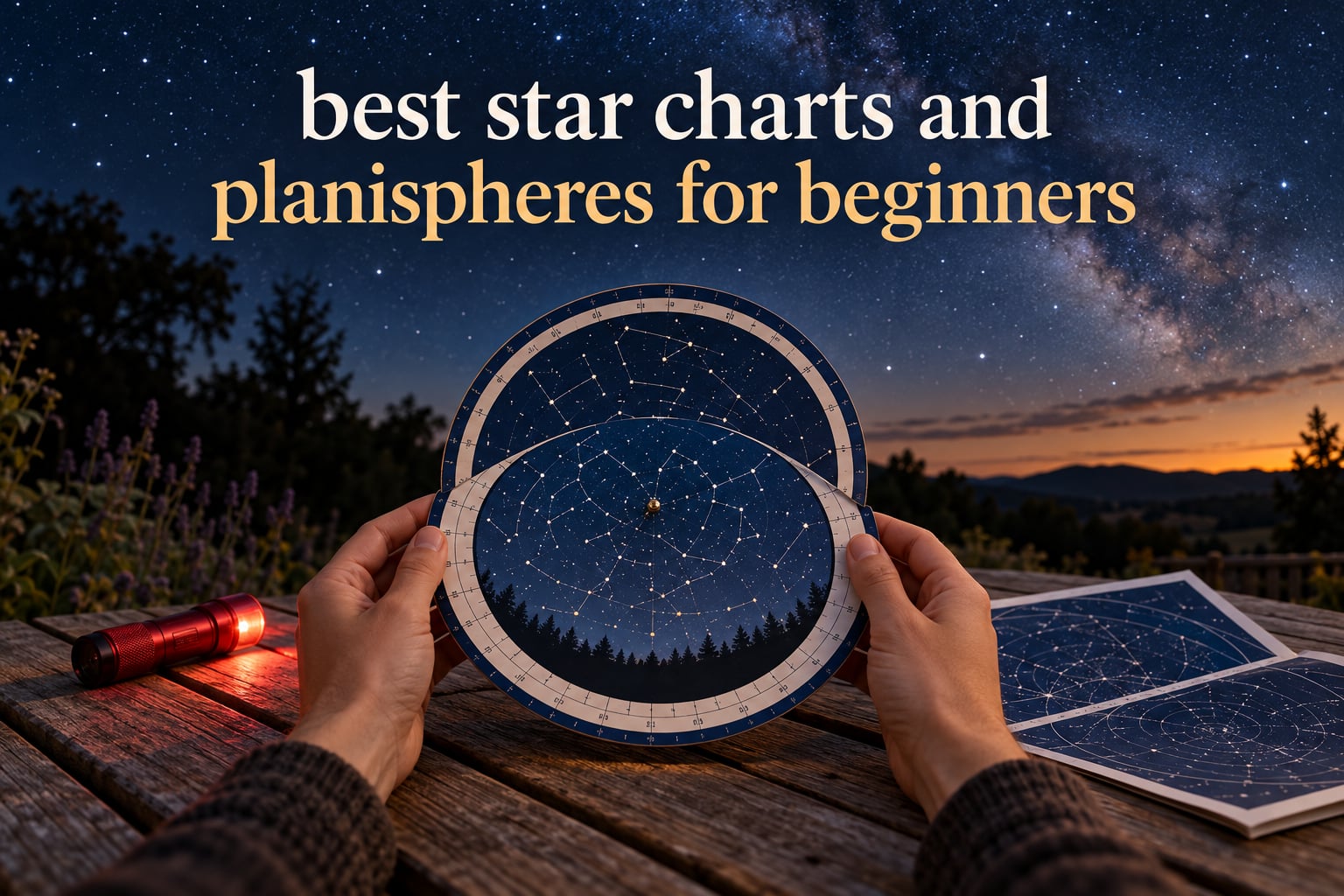
The first night out with a telescope is usually a disappointment. You point the thing at a random patch of sky, see a grey smudge or nothing at all, and decide astronomy is expensive and hard. The problem is almost never the scope. Nobody taught you the sky first, and a phone screen of red symbols is no substitute for knowing what is actually overhead.
That is what a planisphere is for, and why the best star charts and planispheres for beginners sit at the top of every starter kit we have assembled. A planisphere is a physical, battery-free reference showing the whole visible sky for tonight, past and future, from your part of the world. It works at a dark site where a phone is useless, it survives dew, and it teaches you the slow motion of the sky instead of handing you a target list.
We spent six weeks working through twelve of the most-reviewed charts, planispheres and beginner field guides on the market, comparing night readability, latitude coverage, material and how much detail each shows before it overwhelms a new observer. Only a few of these are true rotating planispheres, several are printed guides that pair well with one, and one is a decorative wall map people keep mistaking for a working chart. This roundup tells you which is which.
Table of Contents
What Is a Planisphere (and Why Every Beginner Needs One)
A planisphere is a circular star chart made of two rotating discs on a shared pivot: an inner dial printed with the night sky, and an outer dial marked with months, days and hours. Turn the inner dial until today’s date lines up with the current time, and the open window shows which constellations, bright stars and the Milky Way are above your horizon right now.
For a beginner it does three things no phone app does. It shows the whole sky at once rather than one object at a time, it works with wet hands and no signal, and it teaches relative motion, because you can turn the dial forward and watch Orion rise. That last habit is what stops you hunting blindly with a new telescope.
Worth separating three terms that get used interchangeably. A planisphere is the rotating disc device. A star chart is a flat printed map of a season or region. A star atlas is a bound book of detailed charts that assumes you already know what you are looking at. Beginners want the first two, and only later the third.
Top 3 Picks for Beginners (October 2026)
These are the three we would hand to someone starting from zero this 2026.
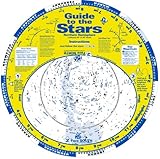
Guide to the Stars
- 16 x 16 inch format
- Compact 3-page quick reference
- 5th edition revised 2019

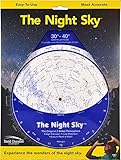
The Night Sky 30-40 North
- Rotating wheel for 30-40 degrees north
- Durable plastic build
- Milky Way printed
All 12 Star Charts and Planispheres Compared in 2026
Every product below appears in the same order as the individual write-ups, with the spec that matters most to a beginner called out first.
| Product | Specs | Action |
|---|---|---|
| Guide to the Stars |
|
Check Latest Price |
| Star Finder! Step-by-Step Guide |
|
Check Latest Price |
| The Night Sky 30-40 North |
|
Check Latest Price |
 National Geographic Stargazer’s Atlas National Geographic Stargazer’s Atlas |
|
Check Latest Price |
 Celestron Sky Maps Seasonal Charts Celestron Sky Maps Seasonal Charts |
|
Check Latest Price |
 Collins Planisphere by Wil Tirion Collins Planisphere by Wil Tirion |
|
Check Latest Price |
 Miller Planisphere Star Finder Large Miller Planisphere Star Finder Large |
|
Check Latest Price |
 Peterson Field Guide to Stars and Planets Peterson Field Guide to Stars and Planets |
|
Check Latest Price |
 DK Starfinder Complete Beginners Guide DK Starfinder Complete Beginners Guide |
|
Check Latest Price |
 The Stargazer’s Guide to the Night Sky The Stargazer’s Guide to the Night Sky |
|
Check Latest Price |
 Night Sky Folding Pocket Guide Night Sky Folding Pocket Guide |
|
Check Latest Price |
 The Constellations Glow-in-the-Dark Star Map The Constellations Glow-in-the-Dark Star Map |
|
Check Latest Price |
1. Guide to the Stars – The Oversized Quick Reference
Guide to the Stars
16 x 16 inch format
3-page quick reference
5th edition, 2019
#2 in Stars & Planets Field Guides
Pros
- Largest review history in this roundup at more than 2000 ratings
- 82 percent five-star ratings
- Readable at arm's length under a head torch
- No batteries
- no app
- no account
Cons
- Just 3 pages
- so a lookup aid rather than a course
- 16 inch width needs both hands or a flat surface
- Planetary information dates from the 2019 revision
With more than 2,000 ratings and 82 percent five-star scores, this is the most battle-tested reference in our comparison. It measures 0.13 by 16 by 16 inches, which sounds contradictory until you hold it: a flat card-sized guide you can lay on a car roof or hold in two hands.
Our favourite thing is what it leaves out. No galaxies, no nebulae you will never see from a suburban sky, no faint smudges that send beginners hunting for twenty minutes. It gives you the bright framework of the sky, which is exactly the layer you need first.
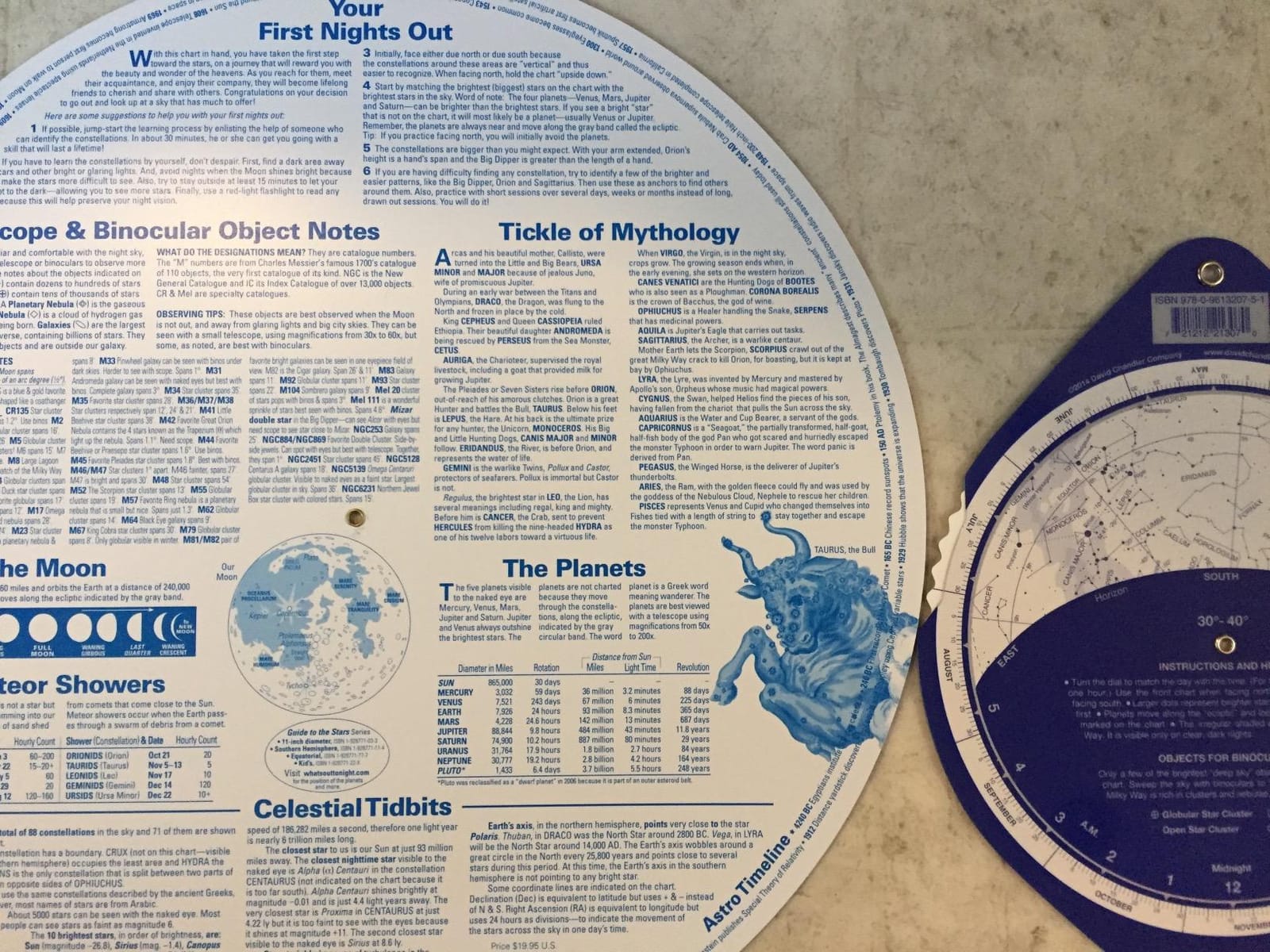
It does not teach motion, though, because a static reference cannot be rotated forward to show the sky turning through the night. Plan the same limitation into your expectation and it stops being a flaw.
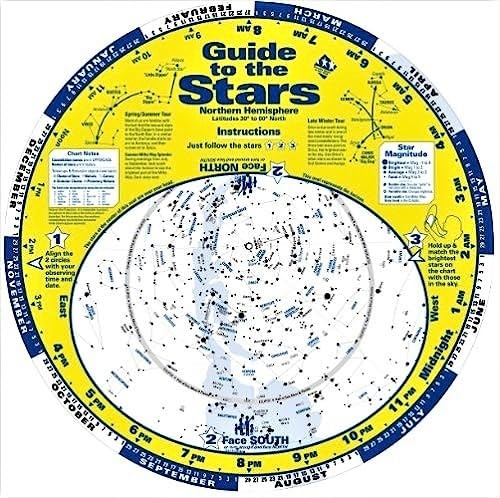
Why it suits a total beginner
There is no setup, no alignment and no learning curve. You open it, you look, you recognise something, and owners describe it as dependable and compact.
Where it falls short
At three pages it is a quick-reference card rather than a course, and the 2019 revision means planetary details are ageing. Keep it at home or in the car, and add a rotating wheel when you want to learn the sky’s motion.
2. Star Finder! A Step-by-Step Guide to the Night Sky – The Family Favourite
Star Finder!: A Step-by-Step Guide to the Night Sky
128 pages
Reading age 6 and up
Season-by-season steps
DK Children flexibound
Pros
- Genuinely step-by-step beginner instruction
- 82 percent five-star ratings across 1600+ reviews
- Illustrations children as young as 8 actually use
- Excellent gift that pairs well with a planisphere
Cons
- Not a comprehensive survey of the night sky
- Skips constellation mythology and history
- Not designed for telescope target hunting
If the person learning is under about twelve, or if you are teaching, this is the one we recommend. It walks through the sky season by season and uses constellations you can already recognise as signposts to everything else, which is a far smarter route than starting with coordinates.
Reviewers describe it as easy and fun without technical jargon, and parents and teachers mention using it with children as young as eight. At 8.7 by 11.14 inches and 128 pages it is a comfortable bedside book rather than a field item.
It also settled a sequencing argument for us. A book like this tells you what to look for; a planisphere tells you where to look right now. Used together they close the gap that stops most beginners.
Why it suits families and classrooms
A child can work through a season unaided, and the illustrations show what each constellation should actually look like, which turns recognition from luck into skill. At 4.7 stars from 1,641 ratings, satisfaction is as high as anything we tested.
Where it falls short
Owners flag that it is not comprehensive and leaves out the history and mythology behind constellation names. It is also explicitly not built for locating objects with a telescope, so buy it to learn the sky and add a planisphere to know where to point.
3. The Night Sky 30-40 Degrees North – The Best Rotating Planisphere for Most Beginners
The Night Sky 30°-40° (Large; North Latitude)
Rotating wheel for 30-40 N
Large plastic, 8 x 10 inch pack
Dark print on white background
Milky Way plus object key
Pros
- The design most reviewers return to
- 83 percent five-star ratings
- Durable plastic with clear wheel cover and storage sleeve
- Dark stars on a light background read far better at night
- Handles dew and damp without damage
Cons
- Print is small and the laminate catches reflections
- Stick figures do not match the real constellations
- Only labels the roughly 20 brightest stars
- Useless outside the 30-40 degree north band
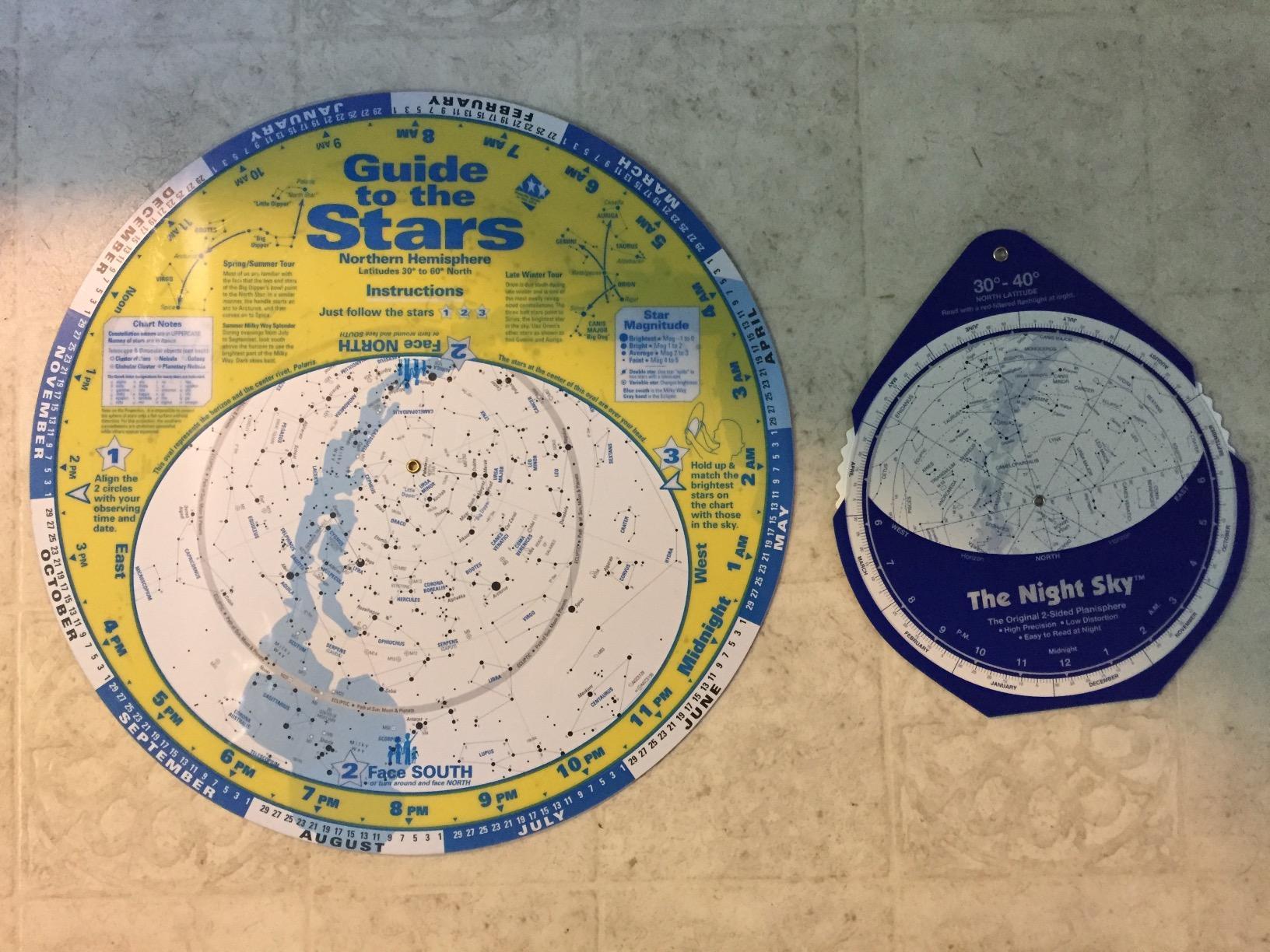
This is the genuine mechanical planisphere most people mean, and it turned our own team from phone-scrolling into sky-reading. You rotate the inner disc until the date meets the hour on the outer ring, hold it overhead with the marked end pointing north, and the window shows the sky in front of you.
Reviewers praise the black stars on a white background more than anything else, because that layout stays readable under a red head torch where a white-on-black chart turns to glare. Plastic construction is the other repeated theme, and outdoors it is the one that matters: on r/telescopes, dew and water resistance is the most-endorsed reason to pick plastic over cardboard.
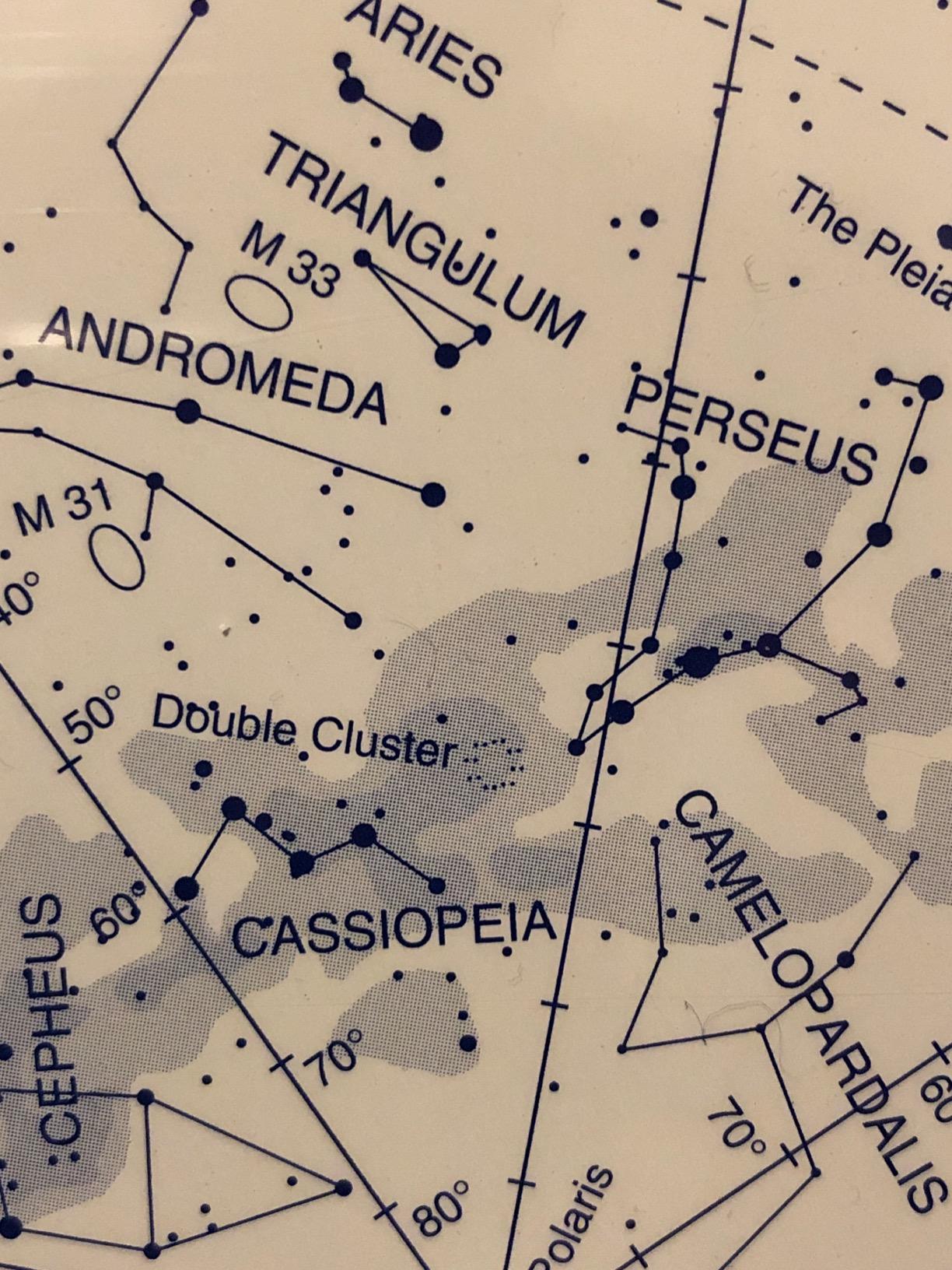
The Milky Way is printed on the wheel with a key for planets, nebulae and other objects, packaged in 8 by 10 inches with a reusable sleeve and clear protective cover. Honest limits: the print is small, the laminate throws reflections, and the stick figures do not always resemble what you see.
Why it suits a beginner
It teaches motion, not just contents. Turning the disc from 9pm to 1am and watching Orion climb is the single best teaching moment in this roundup, and the plastic body survives being carried in a car and used with cold or wet hands.
Where it falls short
Check your latitude first. This edition covers 30 to 40 degrees north, and the regretful reviews almost always come from the wrong band. The vague directions also put people off, so practise indoors under a lamp before your first trip out.
4. National Geographic Stargazer’s Atlas – The Heaviest, Most Beautiful Reference
National Geographic Stargazer’s Atlas: The Ultimate Guide to the Night Sky
432 large-format pages
Star maps for both hemispheres
10.59 x 13.86 inch format
Weighs 6.69 lb
Pros
- Highest average rating in this roundup at 4.8
- 89 percent five-star ratings
- Oversized pages with large detailed maps and photographs
- Covers planets
- moons
- galaxies and deep-sky objects
- Reads as a coffee-table book as well as a reference
Cons
- Weighs nearly 7 pounds
- too heavy to carry into a field
- Detailed plates can overwhelm a total beginner
- Some copies arrive scratched or delaminating
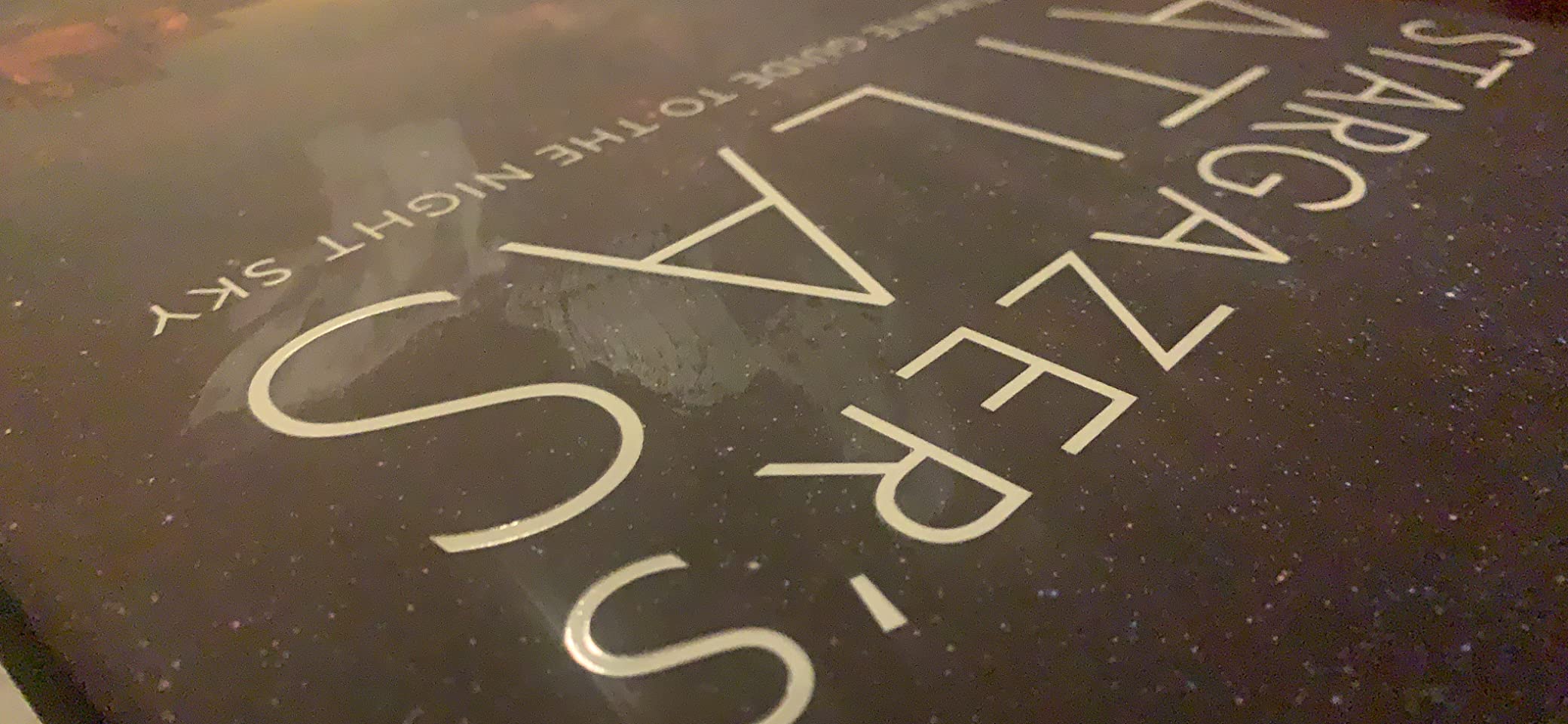
This is not a planisphere and it is not portable. It is 432 pages of large-format star maps, planet maps, cosmology and stellar life cycles, weighing 6.69 pounds, and it earned the highest average rating in our set at 4.8 stars.
What it does brilliantly is show you what things look like. Separate star maps for the northern and southern hemispheres mean the book works for readers outside North America and Europe, and the oversized pages carry detailed photographs of planets, galaxies and the night sky.
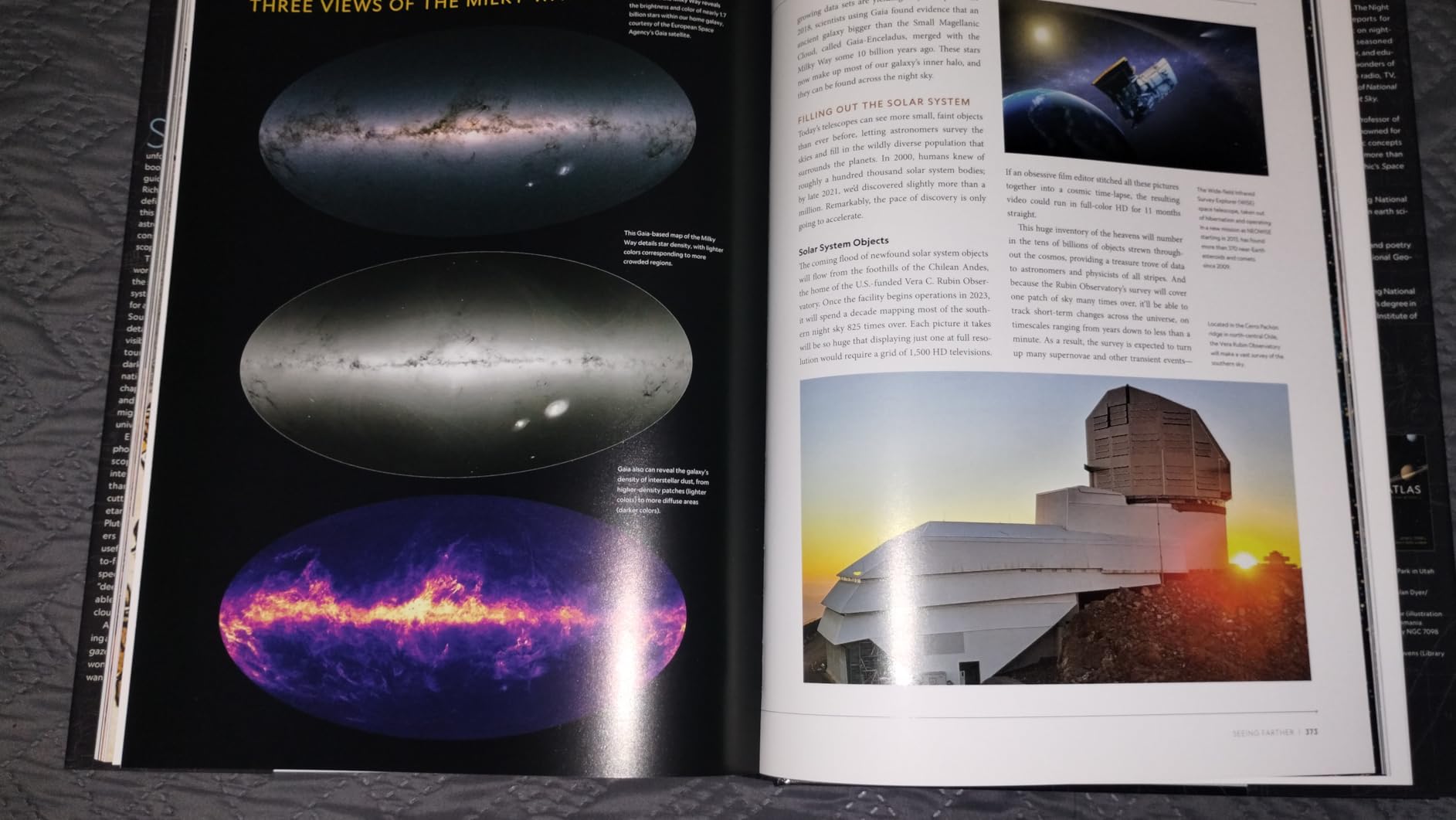
Reviewers treat it as a display piece and a browsing book as much as an observing reference, which is where the 89 percent five-star share comes from. It was published in 2022, so old-edition data is not the problem here.
Why it suits a beginner
It answers the first question every beginner asks, which is what am I actually looking at. Seeing a rendered image beside the chart turns a fuzzy smudge into a recognisable target, and it makes an excellent second purchase six months in.
Where it falls short
At nearly seven pounds it is unwieldy in the field, and the sheer volume of imagery can overwhelm someone who has not identified a single constellation. Buy it for motivation and understanding, and keep it at home.
5. Celestron Sky Maps – The Glow-in-the-Dark Seasonal Set
Celestron Sky Maps – Seasonal Star Charts for Stargazing
Glow-in-the-dark planisphere
Four seasonal deep-sky charts
11.61 x 13.78 inch coated card
Spiral bound, lies flat
Pros
- Glow-in-the-dark wheel gives an instant readout for any date and time
- Four seasonal charts highlight the best deep-sky objects
- Heavy card with protective overcoat built for years of use
- Spiral binding lets the charts lie flat while observing
Cons
- Northern Hemisphere only
- Chart detail is shallower than a dedicated atlas
- Paper construction needs keeping dry
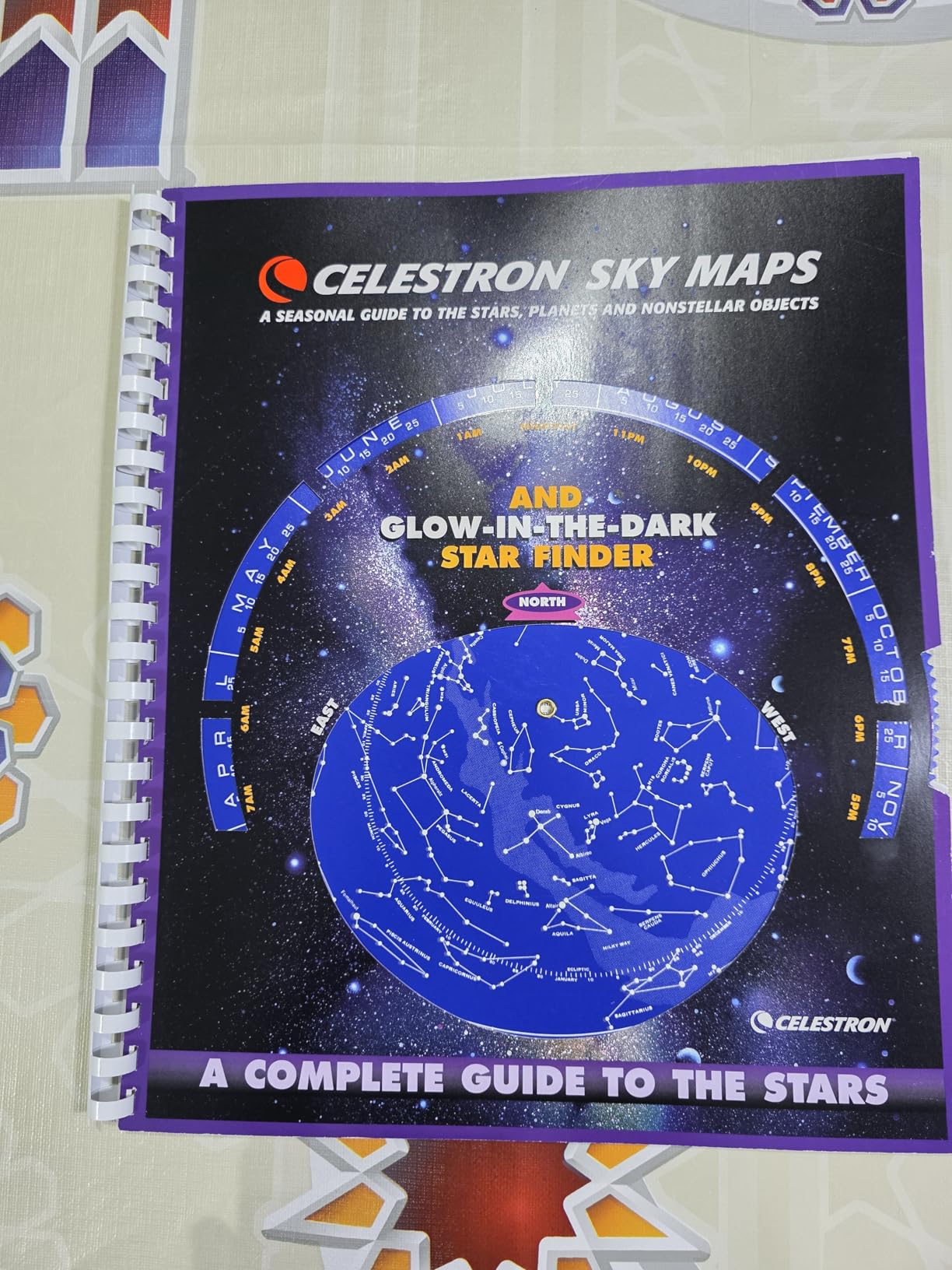
Celestron built this set around one idea: charge the planisphere under a lamp, take it outside, and the dial glows. For kids, for a first session, and for anyone who does not want to hold a torch over their own chart, that is a real advantage.
Around the planisphere sit four seasonal star charts highlighting the best deep-sky objects for summer, winter, spring and autumn. The coated heavy card and the plastic spiral binding let the pages lie flat on a car roof or picnic table, and the set holds number 3 in Stars and Planets Field Guides across 474 ratings with 72 percent five-star scores.
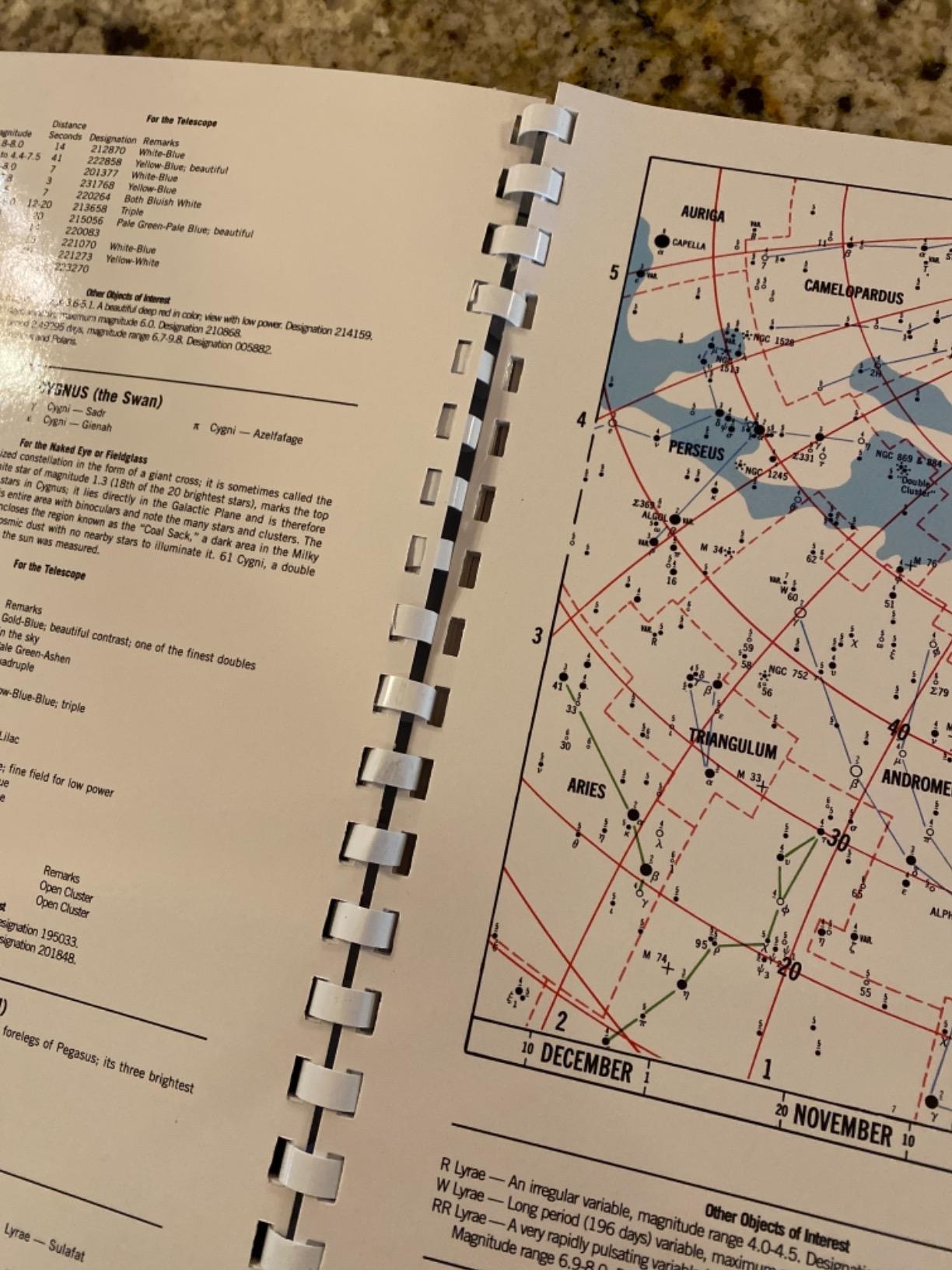
The honest drawback is hemisphere: this set is Northern Hemisphere only, which rules it out entirely for southern readers. Reviewers also note the chart detail is shallower than a dedicated atlas would give you.
Why it suits a beginner
The glow function removes the hardest part of reading a chart in the dark, which is doing it by torchlight without spoiling your night vision. Your eyes need roughly twenty minutes to reach full dark adaptation, so cutting light spill during that window is worth more than it sounds.
Where it falls short
It is paper, so it is the option here you must keep away from dew and damp, exactly the weakness observing communities warn about with coated stock. Southern Hemisphere readers should look elsewhere on this list.
6. Collins Planisphere by Wil Tirion – Cartography From the Professionals
Planisphere
Rotating planisphere
72 pages
By Wil Tirion, Storm Dunlop and the Royal Observatory Greenwich
8.26 x 11.69 inch format
Pros
- Cartography from a renowned chartmaker and the Royal Observatory Greenwich
- 76 percent five-star ratings across 351 reviews
- Works for children and adults in one volume
- Compact at 72 pages
Cons
- Latitude-specific
- so confirm your band before buying
- Rotating disc leaves less room for teaching text
When you want a planisphere drawn by people who make star charts professionally, this is the one. It comes from Wil Tirion, Storm Dunlop and the Royal Observatory Greenwich, packaged as a 72-page book with a rotating planisphere for identifying constellations by date and time.
It holds 4.6 stars from 351 ratings with 76 percent five-star scores, and the format suits a family learning together, since the material works for both a child and an adult.
Our take is that this is the tidiest answer to a specific problem: the mechanical dial that shows the whole sky tonight, plus enough printed material to explain what you have just found.
Why it suits a beginner
The date and time dial is the core beginner tool, and this version pairs it with explanatory text rather than leaving you to decode naked labels. Steady satisfaction rather than superlatives is exactly what you want from a first reference.
Where it falls short
Reviewers insist on one point: it is latitude-specific, and buying the wrong band is the most common purchase mistake in this category. Check yours before ordering, because no amount of good design rescues a chart printed for the wrong part of the world.
7. Miller Planisphere Star Finder, Large 40 Degree – The Classroom Favourite
Celestial Products Miller Planisphere Star Finder, Size Large – Model 40 Degree – for latitudes 35N to 45N
10.5 inch diameter
Made in the USA
Plastic discs, model CLP-MPC40
Covers 35N to 45N
Pros
- Durable plastic discs rather than cardboard
- described as a lifetime tool
- 10.5 inch diameter shows the sky horizon to horizon
- Includes many Messier objects missing from cheaper wheels
- Proven in classrooms by high school astronomy teachers
Cons
- Plastic coating glares under direct light
- Covers latitudes 35N to 45N only
- Learners need indoor practice before first use
This is the simplest possible interface: dial the date, dial the time, read the sky. At 10.5 inches in diameter it shows the sky horizon to horizon, which is more than the small pocket wheels manage.
What separates it from budget wheels is the object list. Reviewers single out the many Messier objects included, exactly what buyers of cheaper planispheres find missing, and high school astronomy teachers are named repeatedly as users.
The durability claim comes from owners, who describe the plastic discs as a lifetime tool. That matters because a cardboard wheel that warps after one damp evening is dead money.
Why it suits a beginner
There is nothing to learn beyond two dials, and reviewers recommend practising indoors first, then switching to a red light outdoors. It also bridges toward a telescope, since the Messier objects it prints are the same targets a small Dobsonian or refractor shows first.
Where it falls short
The band is 35 to 45 degrees north, the plastic coating glares under a direct light, and at 10.5 inches it is a garden or car-roof tool rather than a hiking one. Angle your torch rather than shining it straight on.
8. Peterson Field Guide to Stars and Planets – The One-Volume Reference
A Peterson Field Guide To Stars And Planets: The Complete Astronomy Guide with Atlas Charts, Monthly Sky Maps, and Solar Eclipse Coverage
592 pages in 4.5 x 7.25 inch format
52-chart Wil Tirion atlas
Monthly charts for both hemispheres
Ten-year planet tables
Pros
- A full astronomy library in one portable volume
- 52-chart Wil Tirion sky atlas with notes on each chart
- Monthly charts
- finder charts and a ten-year planet table
- Cited by professional astronomers as a quick-lookup reference
Cons
- 1999 edition
- so planetary tables and some plates are dated
- 592 pages is denser than a first read
- Occasional delivery damage from packaging
Reviewers call this a desert island book, and after reading it we understand why. At 4.5 by 7.25 inches and 592 pages, it compresses a 52-chart Wil Tirion atlas, monthly sky charts for both hemispheres, finder charts, a ten-year planet table, a lunar atlas, eclipse coverage and constellation history into something genuinely portable.
Professional astronomers are cited as recommending it as a quick-lookup reference, and the colour plates and Hubble imagery are why people keep it for decades.
The honest problem is age. This 4th updated edition dates from 1999, so the planetary position tables and some plates have aged even though star positions drift only very slowly.
Why it suits a beginner
It answers the questions that come up in month two, not month one, and having northern and southern monthly charts in one volume makes it the safest single purchase for a household with observers in different hemispheres.
Where it falls short
At 592 pages it is denser and less welcoming as a first read than a short beginner guide. Buy it for the atlas and the lore, start with something lighter, and do not plan a specific planet hunt from the printed tables.
9. Starfinder: The Complete Beginner’s Guide – Chart Plus Planisphere in One Book
Starfinder: The Complete Beginner’s Guide to Exploring the Night Sky
Includes a large planisphere for 35 N
128 pages, hardcover
Illustrated constellation guide
12.01 x 11.89 inch format
Pros
- Bundles a large easy-to-use planisphere with constellation explanations
- Illustrations show how each constellation should look
- Reference section per constellation and per month
- Used in beginner astronomy classes and homeschool work
Cons
- Planet position data only runs to 2019
- Planisphere fixed at 35 degrees north
- Constellations are not in alphabetical order
This is the most complete beginner package in the roundup. You get a large planisphere set for 35 degrees north inside a 128-page hardcover guide, and the illustrations are drawn to show what each constellation actually looks like, the detail that speeds up identification more than anything else we tested.
Each constellation and each month gets its own reference section at the back, and teachers and homeschool families name it specifically. It holds 4.6 stars from 201 ratings with 76 percent five-star scores.
Two drawbacks recur. The printed planet position data runs only through 2019, and the planisphere inside is fixed at 35 degrees north, so accuracy drops the further you live from that band.
Why it suits a beginner
It solves sequencing in one purchase: the chart tells you where to look, the illustrated pages tell you what you are looking at once you find it. It is the one we would hand to a family teaching several children of different ages.
Where it falls short
Verify your latitude against the fixed 35 degree planisphere, and note that constellations are not indexed alphabetically, so lookups slow you down until you learn the system.
10. The Stargazer’s Guide to the Night Sky – Planisphere in the Back Cover
The Stargazer’s Guide to the Night Sky (with FREE Stargazer’s Planisphere!)
240 pages
Stargazer's planisphere in the back cover
About 150 photographs
By Dr. Jason Lisle
Pros
- Clear explanations written for the non-astrophysicist
- Includes a stargazer's planisphere with the book
- Full-colour star charts and around 150 photographs
- Glossy pages that hold up to years of handling
Cons
- Written from a creationist perspective
- Heavier and bulkier than slim field guides
Dr. Jason Lisle wrote this for people who have never done astrophysics, and reviewers describe the writing as clear and easy to follow. What surprised us is the planisphere built into the back cover, which turns a reading book into a working reference.
It carries full-colour star charts and roughly 150 photographs across 240 pages, covering moon phases, solar eclipses, planets and how to find them, with glossy pages reported to survive years of travel and self-contained chapters you can check one topic in.
It sits at 4.7 stars from 177 ratings with 88 percent five-star scores. The caveat that matters to some readers is the creationist framing, which is either the reason to buy it or a reason to skip it.
Why it suits a beginner
It bundles a planisphere with genuinely readable instruction, a rare combination here, and colour photographs show you the difference between Saturn and a nearby star before you go looking for it.
Where it falls short
Know what you are buying: several reviewers explicitly note the creationist perspective, and if that framing is not for you the same chart quality exists elsewhere. It is also bulkier than the slim pocket options.
11. Night Sky Folding Pocket Guide – The One That Goes in Your Bag
Night Sky: A Folding Pocket Guide to the Moon, Stars, Planets and Celestial Events (Earth, Space and Culture)
Folds to 4 x 8.25 inches
12 laminated panels
Second edition, 2017
Reading age 10 and up
Pros
- Folds to a slim card that fits a pocket or small bag
- Concise panels covering the Moon
- stars
- planets and celestial events
- Second edition keeps the cycle data current relative to most rivals
- 80 percent five-star ratings
Cons
- Too compact for detailed learning
- Small panels are best used alongside a larger guide
Everything else on this list is something you take to the car. This one goes in your jacket. It folds down to 4 by 8.25 inches and opens into 12 laminated panels covering the Moon, stars, planets and annual celestial events.
It is a quick reference rather than a learning resource, and reviewers treat it that way, as a take-along companion. The 2017 second edition keeps its cycle data current relative to most rivals, which is the thing that usually dates a pocket astronomy card.
At 4.7 stars from 172 ratings and 80 percent five-star scores, satisfaction is high, and the reading age runs from ten upward, so younger children will need help.
Why it suits a beginner
It solves the specific annoyance of a phone screen at a dark site. A folded card in a pocket works, needs no charge and does not light up your face, and it still teaches you the monthly rhythm of the sky.
Where it falls short
Reviewers are consistent that it is too compact for detailed learning and the panels are small, so it works best alongside a larger guide. If you own only one item, buy a rotating planisphere; if you already have one, this is the bag companion.
12. The Constellations Glow-in-the-Dark Star Map – A Night Light, Not a Chart
The Constellations Glow-in-The-Dark Star Map (Northern Hemisphere)
24 x 28.5 inch coated wall map
Major Northern Hemisphere constellations
Glows for many hours after lamp light
Rolled in a tube
Pros
- Doubles as a night light and an educational display
- Constellation lines fade while stars and the Milky Way stay visible
- Works as a bedroom or classroom teaching aid
- Major year-round constellations for North America
- Europe and Asia
Cons
- Static map
- cannot be rotated for a date and time
- No planets
- Moon or deep-sky objects
- Northern Hemisphere only
- Lowest rating in this roundup at 4.1
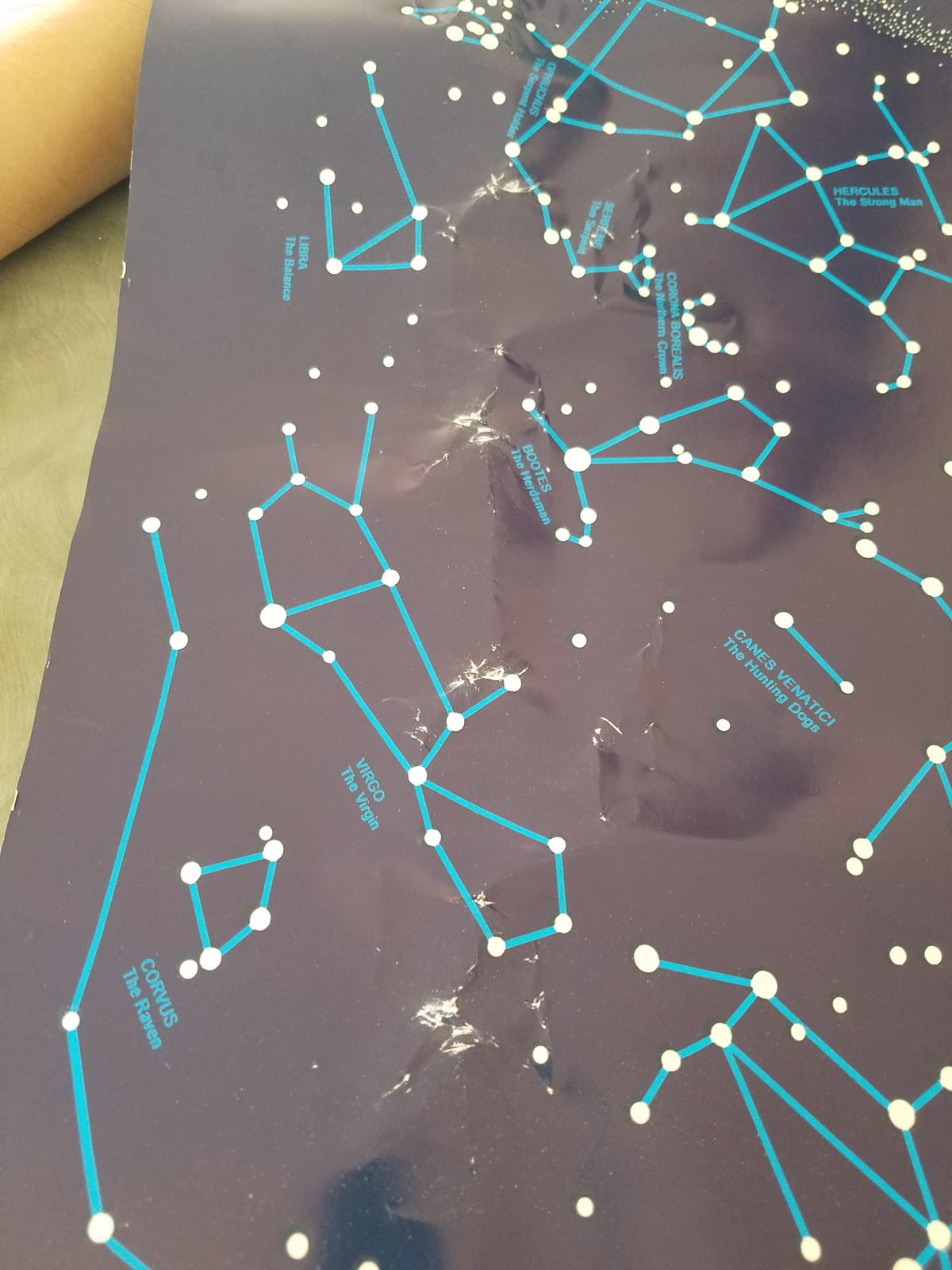
We include this one with a clear warning, because it is the most commonly mistaken product in the category. It is a 24 by 28.5 inch glow-in-the-dark wall map, not a working planisphere. It cannot be rotated for a date and time, so it will never tell you what is overhead tonight.
What it does well is be a night light. It glows for many hours after lamp exposure, and the effect is charming: constellation lines fade away while the stars and the Milky Way stay visible, so a child’s ceiling becomes a real star field.
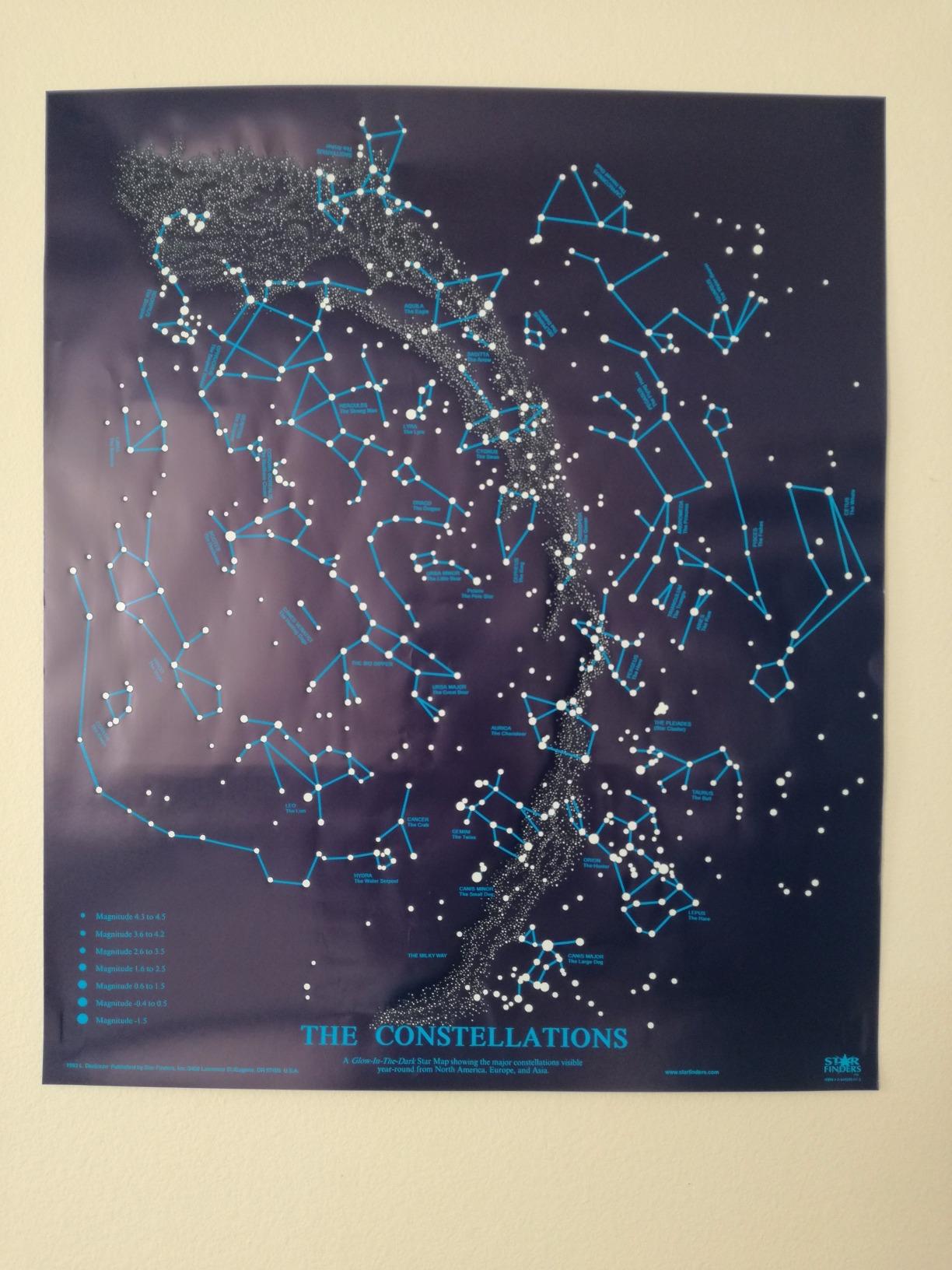
It shows the major constellations visible year-round from North America, Europe and Asia, is made in the USA, and is supplied rolled in a heavy-duty tube. Its 4.1 rating is the lowest in this roundup, and the 8 percent one-star share points straight at the cause: buyers who expected a planisphere.
Why it suits a beginner
Use it as a bridge, not a tool. A child who has memorised the shape of Orion from a glowing wall map will find that shape in the sky on their first real night out, which is a genuine shortcut to confidence.
Where it falls short
It is decorative, and it omits planets, the Moon and any deep-sky objects. Pair it with a real planisphere from this list and it becomes a good teaching aid rather than a substitute.
How to Use a Planisphere in Six Steps
Set the date, set the time, orient it, match the horizon, identify one thing. Six steps, about two minutes, and the confusion that stops most beginners on night one disappears.
Work indoors first. Lay the chart on a table under a lamp and practise before you go out. Reviewers recommend exactly this, and it is where people who bounce off planispheres give up.
Set the date. Rotate the inner disc until today’s date meets the reference mark.
Set the time. Keep turning until the correct hour on the outer ring lines up with the date. The scale runs the full 24 hours, so dawn sessions work as well as midnight ones.
Orient it. Hold the chart over your head with the end marked north pointing true north. The stars at the bottom of the viewing window should match the stars in front of you.
Match the horizon. Rotate your body, not the chart, until the window edge lines up with your real horizon. Most orientation mistakes are simply a wrong facing direction.
Identify one thing, then stop. Name a single constellation, find it and pack up. Beginners who try to catalogue the whole sky in one session give up; beginners who find one object come back.
Wait about twenty minutes before you start, and use a red head torch rather than your phone. Your eyes need roughly that long to reach full dark adaptation, and a white screen resets the whole process.
How to Choose the Right Planisphere for Your Latitude
Match the latitude band or the chart will lie to you. Planispheres are printed for specific northern bands, southern editions are separate, and the wrong band is the most common purchase mistake in this category.
Find your latitude first. Search your town name plus the word latitude, or read it from any mapping site, then pick the band containing your number or the closest one. Northern bands commonly start at 30 degrees, so very low latitudes need a southern or equatorial edition instead.
Specific examples from this roundup: The Night Sky 30-40 Degrees North covers 30 to 40 degrees north, the Miller Planisphere Star Finder Large 40 Degree covers 35 to 45 degrees north, DK’s Starfinder ships with a planisphere fixed at 35 degrees north, and the Celestron seasonal set is Northern Hemisphere only.
The reason this matters is that the night sky turns on an axis through your local celestial pole, and every planisphere is a projection drawn for one latitude. Move far from it and the constellations stretch and skew away from the pole, which is the distortion that two-sided projections were designed to reduce.
How Accurate Is a Planisphere in 2026?
A planisphere built recently is accurate to roughly a decade or two for star positions, and that is plenty. Stars barely move in a human lifetime, with the slow drift that matters running about one degree every 72 years.
What does need updating is the planets, the Moon’s phases and any printed eclipse dates, because those cycle over years. A chart printed in 2013 will send you looking for Jupiter in the wrong part of the sky.
For beginners this is a non-issue. You are learning shape, position and motion, and the planets are keyed on the wheel anyway. Buy the most recent edition you can find and do not stress about the publication date.
Planisphere vs. Star Atlas vs. Phone App
For a beginner, the planisphere wins. The atlas and the app both come later, and the honest comparison is about what each is actually good at.
The strongest argument for the physical wheel comes from people who use both: on Stargazers Lounge, users say a planisphere is easier and more useful at a dark site because it shows the Milky Way and all the stars at once. On r/telescopes, another user describes modern software as so feature-rich compared to starting with a planisphere and paper sky maps. Both are true, and they describe different jobs.
Planisphere: the whole sky for tonight, in your latitude, with no light and no screen. This is the learning tool.
Star chart or guide: the explanation layer, showing what a constellation should look like and why it is named that way.
Star atlas: detailed charts for faint objects once you know the bright stars. The Peterson Field Guide in this roundup is the bridge version.
Phone app: precision, red-light modes and telescope control, plus a white screen that destroys dark adaptation and a battery that dies in the cold.
Free software such as Stellarium is what the forums offer beginners with no planisphere at all, and it costs nothing. We would still buy the card first, because the muscle memory of holding the sky in your hands is what you are actually learning.
Buying Guide: What Actually Matters for a Beginner
Four things decide whether a star chart works for you: material, print contrast, latitude band and size. Ignore everything else. Here they are in priority order.
Material, first. Plastic discs survive dew, condensation and damp grass; cardboard and coated paper do not. This is the most-endorsed factor in every observing community we read, and it is why we ranked two plastic wheels above paper sets. A laminated folding card is the compromise, surviving a jacket pocket better than a wet lawn.
Print contrast, second. Dark stars on a light background read far better at night under a red torch than white stars on black. The 30-40 degree Chandler wheel gets repeated praise for exactly this, while laminated plastic models get criticised for glare when a torch hits them square on. Angle the light rather than pointing it straight down.
Latitude band, third. Check it every single time. There is no partial credit for a beautiful chart printed for the wrong hemisphere.
Size, fourth. Around 10 to 11 inches is the sweet spot: readable at arm’s length, small enough to hold overhead. Jumbo wall-sized charts are wonderful in a classroom and useless on a walk to a dark site.
On budget, the pattern we see is consistent: a first planisphere and a beginner guide together are the sensible starting kit, and neither needs to be expensive to work. We are careful about kit creep here, because the same rule shows up across our other beginner buying guides, from ukuleles for beginners to acoustic guitars for beginners and guitar amps for beginners: start with the tool that teaches you, not the one that impresses you.
One more warning. Do not buy an 18-inch Messier-level wheel as a first purchase. Those are full of faint deep-sky objects a beginner cannot see and has no framework to find, and they are the second most common beginner mistake after the wrong latitude, right behind buying a telescope before learning the naked-eye sky.
If you are not ready to buy anything, the free route works surprisingly well. Printable planisphere templates exist from in-the-sky.org, and monthly evening sky maps are published free online. The community advice on r/Astronomy is consistent: learn the sky first, get binoculars, join a local club, and go to a star party. A hand-held tool like a beginner metal detector follows the same principle, in that a simple, reliable instrument beats a feature-heavy one you give up on.
Frequently Asked Questions
What is the best star chart for a beginner?
The best star chart for a beginner shows only naked-eye stars, uses dark print on a light background for night readability, and is made of plastic so dew does not ruin it. Pair a rotating planisphere for the whole sky with an illustrated guide showing what each constellation should look like.
What is the best planisphere to buy?
The best planisphere to buy is a plastic rotating wheel matched to your latitude band, sized around 10 inches, printed with dark stars on a white background. In this roundup the Guide to the Stars leads on review history and readability, The Night Sky 30-40 Degrees North on rotating-wheel design, and the Miller 40 Degree model on classroom durability.
How accurate is a planisphere?
A current planisphere is accurate to roughly a decade or two for star positions, more than a beginner needs since stars barely move in a human lifetime. Printed planet positions, Moon phases and eclipse dates do go stale, so buy the most recent edition and treat the planets as approximate.
How do you use a star chart?
Set the date on the inner disc, set the time on the outer ring, then hold the chart overhead with the end marked north pointing north. Turn your body until the viewing window lines up with your real horizon, and match the stars printed at the bottom of the window to those in front of you. Practise indoors first.
How do I find my latitude for a planisphere?
Search your town or city name followed by the word latitude, or check any mapping site, and note the degrees north or south. Then choose the planisphere whose stated band contains your number, or the nearest one. Northern bands commonly start at 30 degrees, so very low latitudes need a southern or equatorial edition instead.
Do I need a planisphere or can I just use my phone?
You can learn the sky with an app, and free software such as Stellarium costs nothing, but a planisphere still wins for a beginner. It works with no battery and no signal, it survives dew, and it teaches you the motion of the sky. A phone screen also gives off white light that resets your dark adaptation.
What size planisphere should a beginner buy?
Around 10 to 11 inches across is the best starting size, big enough to read at arm’s length under a head torch and small enough to hold overhead. Jumbo charts are excellent for classrooms and walls but awkward to carry, and very small pocket wheels are hard to read under the stars.
Should I buy a planisphere or a star atlas first?
Buy the planisphere first, then a star atlas once you can name the bright constellations without help. A planisphere shows the entire sky for tonight and teaches motion; an atlas assumes you already know what you are looking at and shows far more objects than a beginner can see.
Conclusion: Start Tonight, Not in the Shop
Start with the Guide to the Stars if you want the most readable single reference on the market, a true rotating wheel if you want to learn how the sky moves, or a step-by-step illustrated guide if you are teaching a child. Whatever you choose, check the latitude band before you buy, favour plastic over cardboard, and plan your first session as a twenty-minute wait followed by one identified constellation.
That is the whole beginner’s method, and it works. The best star charts and planispheres for beginners are not expensive, complicated or fragile. They simply show you the sky for tonight in a way that survives the cold, the damp and your own enthusiasm for scrolling a screen. Go outside, wait for your eyes to adjust, find one constellation, and come back tomorrow.