
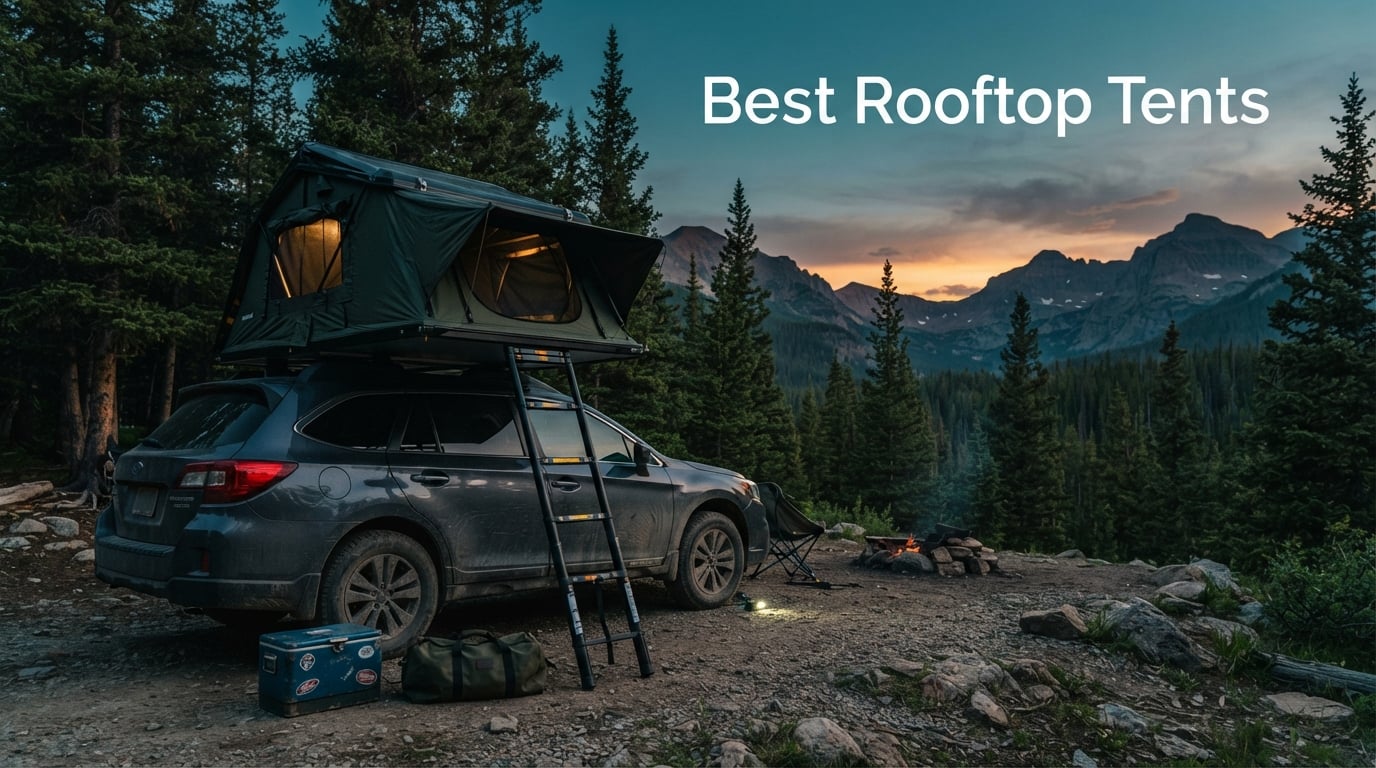
Updated September 2026. If you want one rooftop tent that suits most people, the Overland Vehicle Systems TMBK is the pick: it is a 3-person soft shell that weighs 108 pounds, opens in about five minutes with a ladder and rainfly in the box, and its 2000 PU waterproofing held up through all-night rain in the reviews we studied. Ten more options follow, split by budget, winter use, small cars and off-grid power.
The rooftop tent category has changed a lot in the last few years. What used to be a wedge of canvas on a rack is now often a rigid aluminum clamshell that pops open on gas struts in under a minute, ships with a blackout lining, an LED strip and USB outlets, and costs less than a decent ground tent plus awning. That shift is why this list leans heavily on hard shells, with soft shells still earning a slot wherever interior space matters more than drag coefficient.
Buying a rooftop tent is not really a tent decision. It is a roof load decision, a clearance decision and an install-effort decision. A 160-pound hard shell on a crossover with a 100-pound dynamic rating is a non-starter regardless of how good the tent is, and a 200-pound tent will put a stock sedan in a parking garage queue you cannot exit. We ran the numbers on every pick below so you can check your own vehicle before you fall for a specific model.
Two things before we start. Tell us your vehicle, how many people actually sleep in the tent, and your budget – that single question sorts almost every list. And if you already know you can meet your roof rating, jump straight to the comparison table and the twelve reviews beneath it.
Table of Contents
Top 3 Rooftop Tent Picks in 2026
These three cover a wide range of real use cases. The TMBK is the all-rounder, the WildFinder leans on aluminum construction and high weather ratings, and the Adventurer Pro carries a long accessory list in the box.
OVS TMBK 3-Person Soft Shell
- 3-person soft shell
- 108 lb
- 2000 PU waterproofing
- Ladder and rainfly included

HEYFUN Adventurer Pro Hard…
- 5-second pop-up
- 160 lb
- Honeycomb aluminum floor
- LED strip and side awning

WildFinder Hard Shell
- Aircraft-grade aluminum
- 5000 mm waterproof
- Level 6 windproof
- Blackout fabric
Best Rooftop Tents in 2026: Quick Comparison
Every tent below appears in this table with its shell type, real weight and the detail that decides most purchases. Weights are the manufacturer figures, and several of them are heavy enough that you will need a second person on install day.
| Product | Specs | Action |
|---|---|---|
| OVS TMBK 3-Person Soft Shell |
|
Check Latest Price |
 OVS HD Nomadic 3 Extended OVS HD Nomadic 3 Extended |
|
Check Latest Price |
| HEYFUN Adventurer Pro |
|
Check Latest Price |
| WildFinder Hard Shell |
|
Check Latest Price |
 ARCTWONDER Solar Hard Shell ARCTWONDER Solar Hard Shell |
|
Check Latest Price |
 JOYINRUTE Insulated ZS001 JOYINRUTE Insulated ZS001 |
|
Check Latest Price |
 JOYINRUTE Aluminum ZS001 JOYINRUTE Aluminum ZS001 |
|
Check Latest Price |
 Meedo Apolle A86 M Meedo Apolle A86 M |
|
Check Latest Price |
 VEVOR Hard Shell VEVOR Hard Shell |
|
Check Latest Price |
 OVS HD Nomadic 2 Extended OVS HD Nomadic 2 Extended |
|
Check Latest Price |
 Naturnest Polaris Plus Naturnest Polaris Plus |
|
Check Latest Price |
 Naturnest Sirius 1 Plus Naturnest Sirius 1 Plus |
|
Check Latest Price |
1. Overland Vehicle Systems TMBK Soft Shell – Our Best Overall Rooftop Tent
Soft Shell Rooftop Tent for SUV & Truck Camping, 3-Person – Overland Vehicle Systems TMBK – Universal Fitment with Rainfly & Ladder
3 person soft shell
108 lb
2000 PU
94.5 inch open length
Pros
- Strong tear-resistant ripstop fabric and quality zippers
- Roomy enough for two to three with headroom for tall sleepers
- Fast setup and breakdown at about 5 to 20 minutes
- Stayed dry through all-night rain
- Light for a rooftop tent at about 108 lb
Cons
- Included mattress wants a topper for multi-night comfort
- No insulation so cold-weather use needs a liner
- Instructions are poorly written and sometimes missing
The TMBK is the one we kept coming back to across this whole test round. It is a wedge-style soft shell with a 53.5 by 92 inch sleeping area, and 108 pounds is genuinely light for something this roomy. Most hard shells in this list weigh 160 pounds or more, so on a lighter crossover the difference decides whether the roof rating conversation even gets difficult.
Setup is the old-school method: unzip the cover, throw the ladder against a tree or the vehicle, pull the tent out and stake it. Owners report five minutes on a good day and closer to twenty when the wind is involved. There are no poles to thread, which is the main appeal over a frame tent, and the four guylines and single window keep the pitch honest in mild weather.
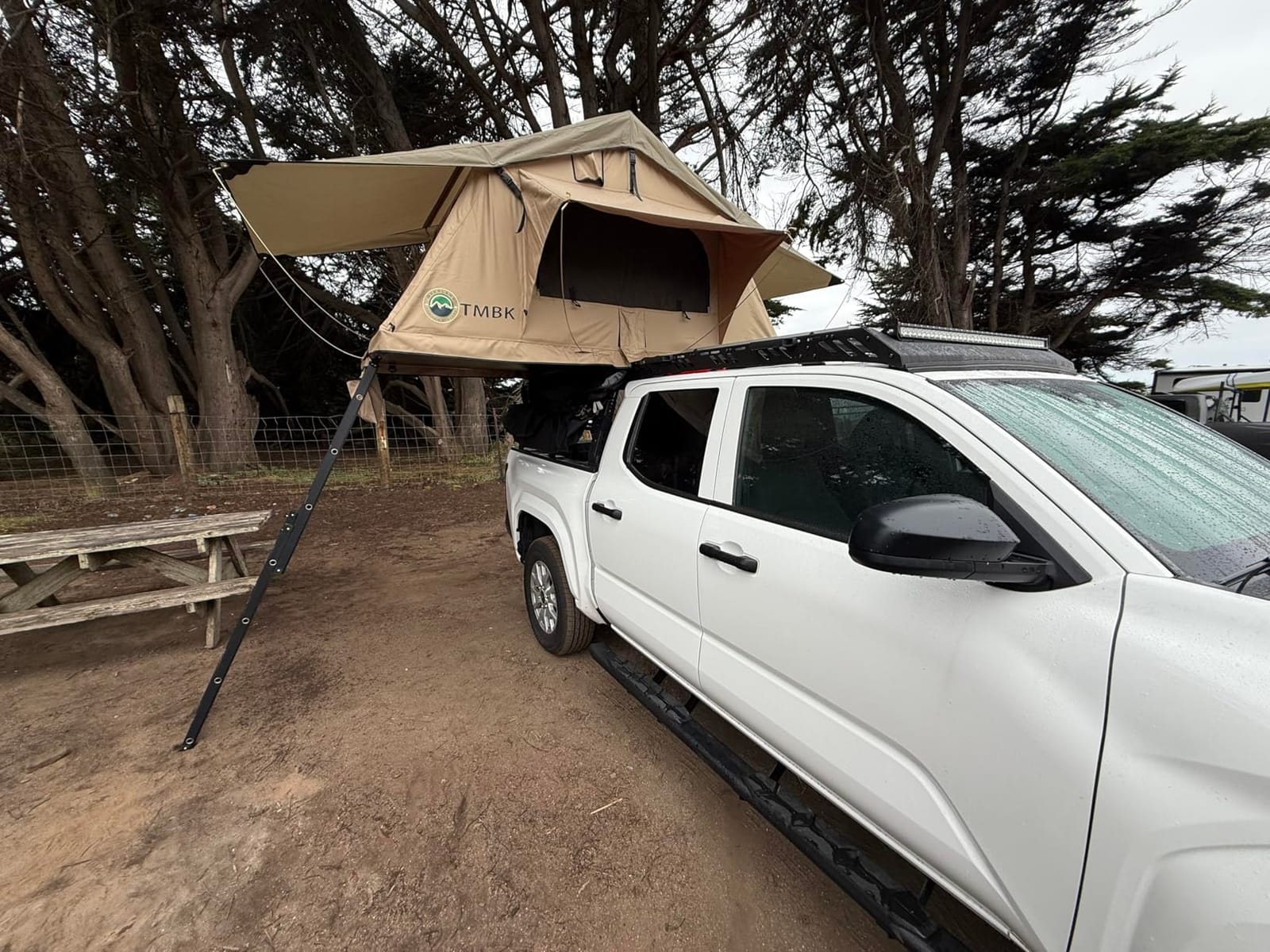
The fabric is the story here. It is a poly-cotton ripstop canvas with a 420D polyester Oxford waterproof rainfly, aluminum poles and marine-grade stainless steel hardware, and reviewers single out the tear resistance and the zipper quality as better than the price suggests. Waterproofing is quoted at 2000 PU rather than the 5000 mm figure the hard shells claim, and in practice that is a heavy-rain-versus-storm difference, not a dealbreaker for weekend trips.
Two caveats came up repeatedly. The included high-density foam mattress is thin enough that most owners add a topper after the first night, and the ladder has been described as flimsy with lock angles that may need extra drilled pin holes. Instructions also drew complaints, including shipments with no paperwork at all, and one reviewer reported missing hardware in the box.
Will your vehicle roof take it?
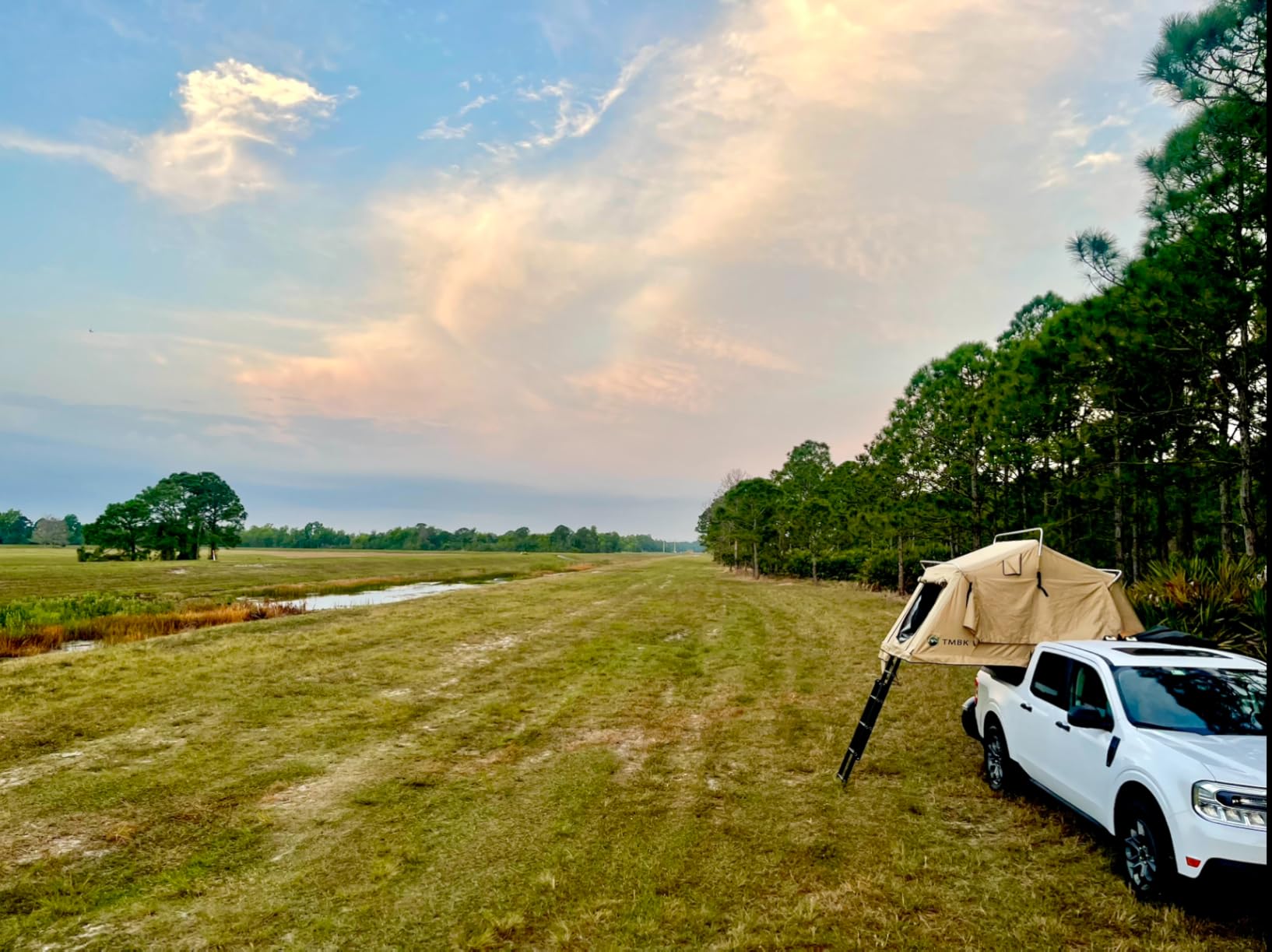
At 108 pounds the TMBK is the most forgiving tent here on roof load math, but forgiving is not the same as safe. Add your rack, a side awning, water and recovery gear and you can pass the dynamic rating on a crossover that looked fine on paper. Check the door jamb sticker rather than the marketing number.
It also mounts on the simplest racks because the closed dimensions are only 57 by 49.5 by 11.5 inches. On a car with factory swivel bars you will probably still want upgraded rack bars, since swivel-style hardware is the standard complaint on lightweight vehicles.
Where the TMBK falls short
There is no insulation in this tent, and that is the dealbreaker for anyone sleeping near or below freezing. The same goes for buyers who want a heater port or a 5000 mm waterproof shell. Cold-weather sleepers should look at the insulated hard shells further down instead.
Condensation under the mattress is reported once two people are inside, which is a soft shell problem in general rather than a fault of this design. Budget for a mattress topper and an anti-condensation mat and it becomes a very capable weekend tent.
2. Overland Vehicle Systems HD Nomadic 3 – Best Rooftop Tent for Families
Overland Vehicle Systems HD Nomadic 3 Extended Soft Shell Roof Top Tent – Dark Gray Base with Green Rain Fly & Black 1000G PVC Travel Cover – Black Aluminum Base
3 person soft shell
165 lb
6536 sq inch floor
4 year warranty
Pros
- Extended sleeping area suits taller campers and families
- Full diamond plate aluminum base with marine-grade hardware
- No-drill installation on factory or aftermarket racks
- Removable rainfly and 1000G PVC travel cover included
- Backed by a 4 year limited warranty
Cons
- Heaviest soft shell here at 165 lb
- Supplied bolts can be the wrong length for some racks
- Only two pegs included
The Nomadic 3 is the tent you pick when the sleeping space question is settled and only the space remains. Its floor area is listed at 6536 square inches, roughly 45 square feet, and the wedge extends far enough that two adults and a child fit without the knee-to-elbow negotiation a 3-person rating usually implies.
The base is a full diamond plate aluminum tray rather than a fabric wedge floor, and that changes the feel of the whole tent. It is rigid, quiet in wind and easier to wipe clean, and it is the main reason this tent feels more like a small cabin than a canvas fold-out. The bundle also includes memory foam pillows, which sounds minor until you have spent a night on a bare foam mattress.
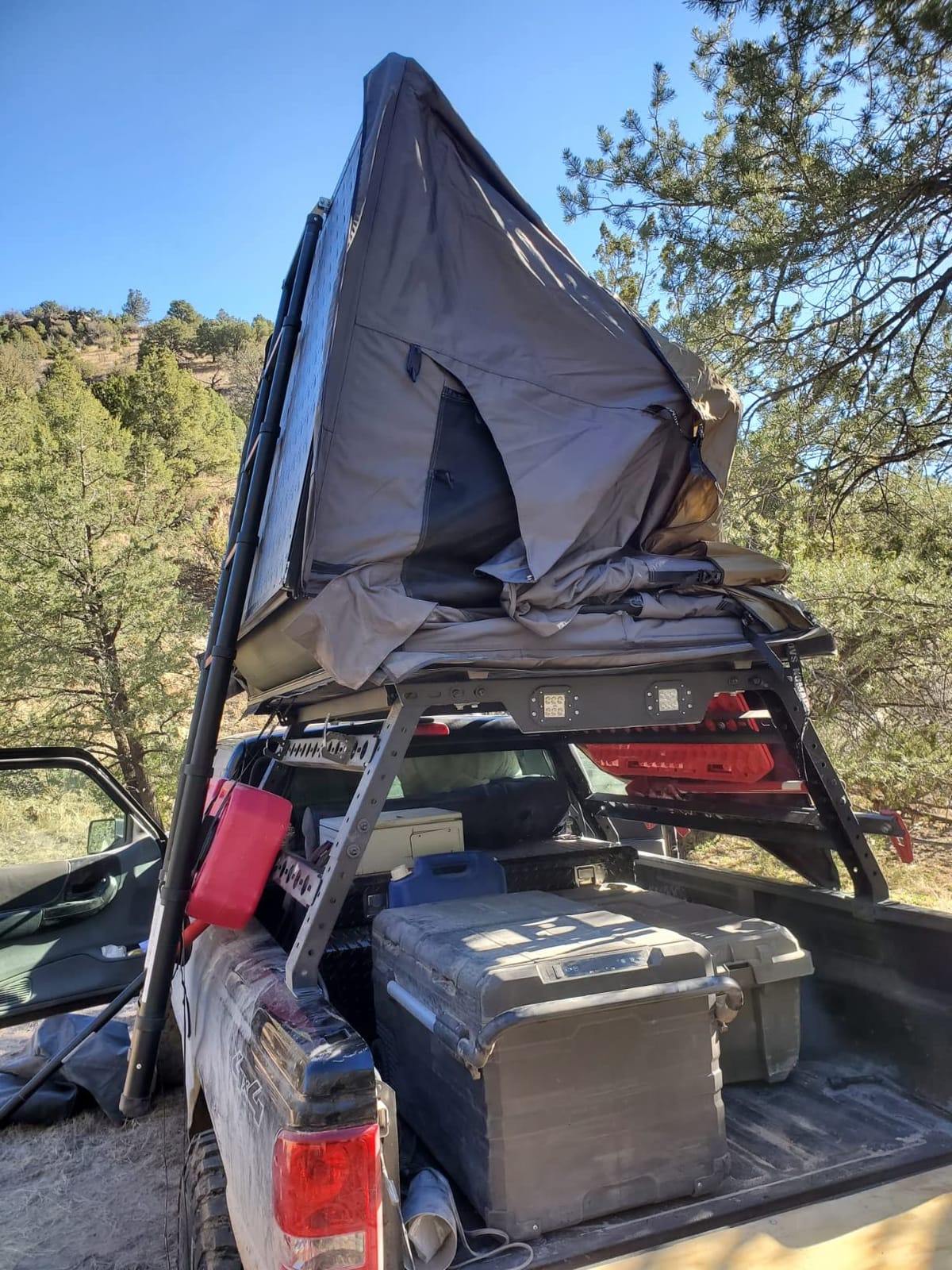
Owners describe multi-season durability and easy rack installation, with no drilling required on a factory or aftermarket rack. The warranty is four years limited, the longest in this group, and the removable rainfly plus 1000G PVC travel cover handle the storage side of the equation properly.
The complaints cluster around hardware rather than the tent itself. Buyers are told to check every bolt after mounting because anchor bolts can loosen in use, several owners found the supplied bolts the wrong length for their rack, and only two pegs are included for a tent that many people pitch on soft ground. Budget an afternoon for a hardware inventory before the first trip.
Is 165 pounds too much for a family vehicle?
On a full-size SUV or truck with a rated rack, no, and this is one of the few tents here that still fits a family budget once you add rack and ladder cost. On a mid-size crossover you need to run the arithmetic first, because 165 pounds eats most of a typical 100 to 165 pound dynamic rating before you add anything else.
The total installed height matters as much as the weight. A wedge soft shell sits lower than a hard shell at the same floor length, which makes the Nomadic 3 easier on garage clearance than most clamshells in this list, even though it weighs more.
Where the Nomadic 3 falls short
It is a soft shell, so the familiar trade-offs apply: fabric noise at highway speed and a cover that can balloon in a strong crosswind if every strap is not tensioned. The 2000 water resistance rating is also below what the aluminum hard shells offer in driving rain.
Longer trips mean thinking about the fabric life. Soft shells left mounted through months of sun and rain develop UV degradation and trapped moisture faster than a rigid case, so seasonal removal and a dry-out habit matter more here than on a hardshell.
3. HEYFUN Adventurer Pro – The Most Features Per Dollar
Adventurer Pro Rooftop Tent Hard Shell, 2-3 Person Aluminum Roof Top Tent
Hard shell
2-3 person
160 lb
Honeycomb aluminum floor
Pros
- Hydraulic pop-up opens and closes in about 5 seconds
- Excellent blackout with all windows closed
- Held campers dry in hard rain and strong wind
- Built-in LED light strip and USB outlets
- Side awning and 13 storage pouches
Cons
- Really sleeps two despite the 2-3 person label
- Heavy to lift so install needs a second person
- No dedicated vent for a heater or portable cooler
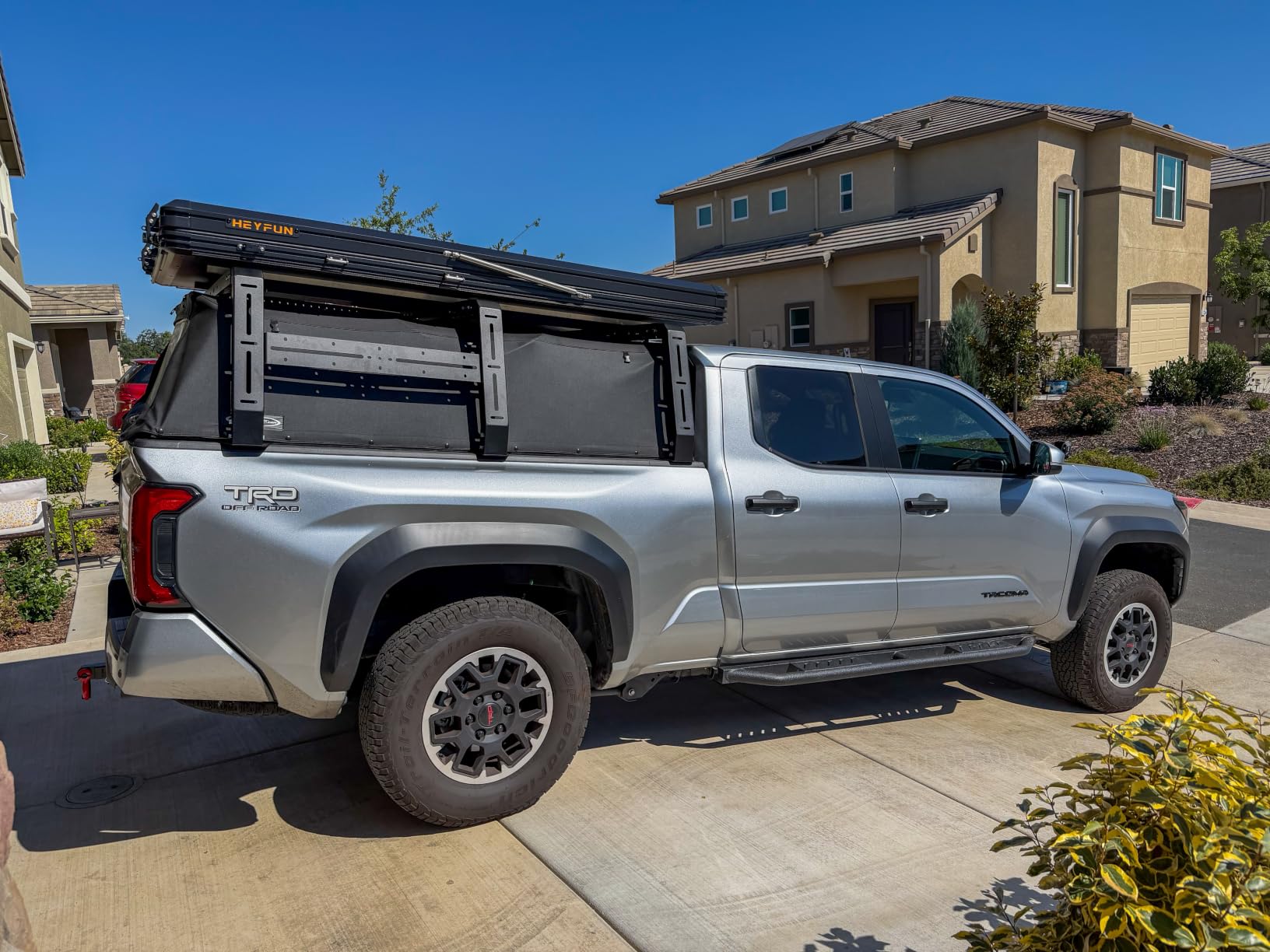
The Adventurer Pro packs more hardware into the box than anything else here at a similar weight. You get a side awning, an LED light strip, USB outlets, a waterproof shoe storage bag, an extendable ladder, a thick sleeping mat and a condensation mat, and the interior has 13 ceiling and sidewall pouches. That is a genuine advantage when you are moving camp every second day.
Setup speed is the headline. Hydraulic gas struts with dual buckles open and close the shell in roughly five seconds, and the waterproof rubber seal around the rim means the closed profile is genuinely sealed rather than held shut by a buckle. Reviewers describe the blackout as excellent with every window zipped, which matters more than it sounds when you are trying to sleep through a summer sunrise.
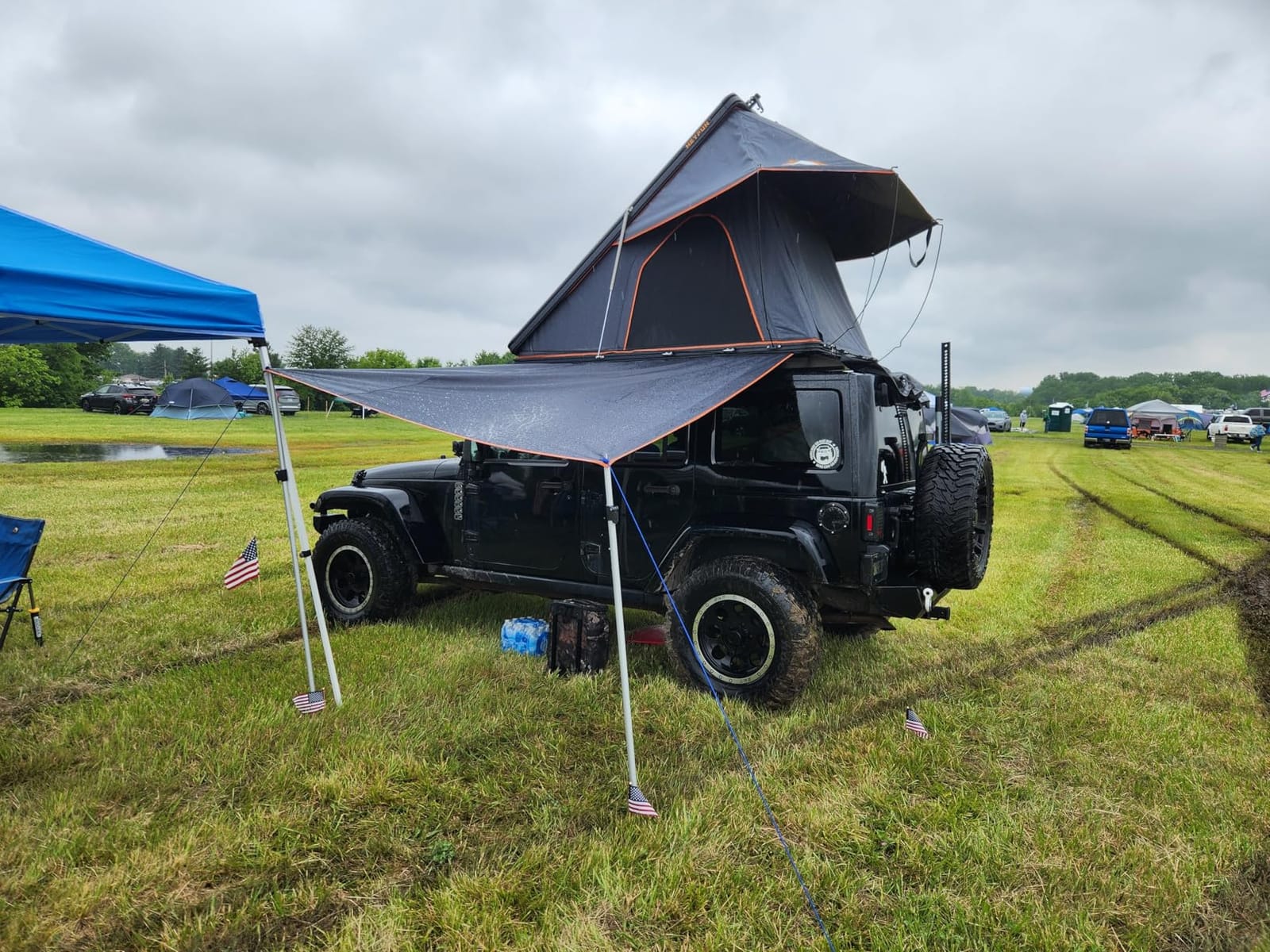
Weather performance is the other strength. The tent uses 320g polyester with a waterproof rubber seal, a moisture-proof flocked floor lining and a listed water resistance figure from 0 to 5000 mm, and owners report staying dry through hard rain and strong wind. The only ventilation complaint is the absence of a dedicated port for a heater or portable cooler, which would make it far more comfortable at the extremes.
Where it disappoints is capacity and install weight. It is listed for 2 to 3 people but behaves as a two-person tent, and anyone over roughly 5 foot 10 inches will find it snug. At 160 pounds it still needs a second pair of hands to get onto the rack, and some owners have reported a side latch that does not line up perfectly on the first close.
Who gets the most out of the Adventurer Pro?
Couples who move camp nightly and care about setup time over sleeping width. If you are one person or a couple with a small dog, the interior dimensions work well and the awning effectively doubles your living space for cooking in the rain.
It is also a good match for anyone who runs electronics overnight, since the built-in USB outlets and LED remove the need for a separate lantern or power bank. Just check that your crossbars are rated for at least 165 lb, which the manufacturer recommends for this mounting.
Where the Adventurer Pro falls short
Buy it for two, not three. Families should read the capacity label as optimistic, which is true of nearly every tent in this roundup, and note that this one is tighter than most.
Cold nights bring condensation on the interior walls around 50F and below, and there is no heater port to solve it. If you are heading into shoulder-season weather regularly, the insulated models later in this list are the better bet.
4. WildFinder Hard Shell – Best Spec for the Weight
WildFinder Rooftop Tent, Hard Shell Roof Top Tent for Jeep SUV Truck Van
Hard shell
3 person
5000 mm waterproof
Blackout fabric
Pros
- Aircraft-grade aluminum shell resists aging and thermal expansion
- Blackout polyester fabric gives strong privacy and sun protection
- Rated 5000 mm waterproof with level 6 wind resistance
- Recessed marine pad and condensation pad cut interior humidity
- Generous accessory bundle with ladder and LED strip
Cons
- Luggage crossbar is not included
- Listed weight of 89.81 kg looks like a listing error
- No written long-term owner feedback was returned
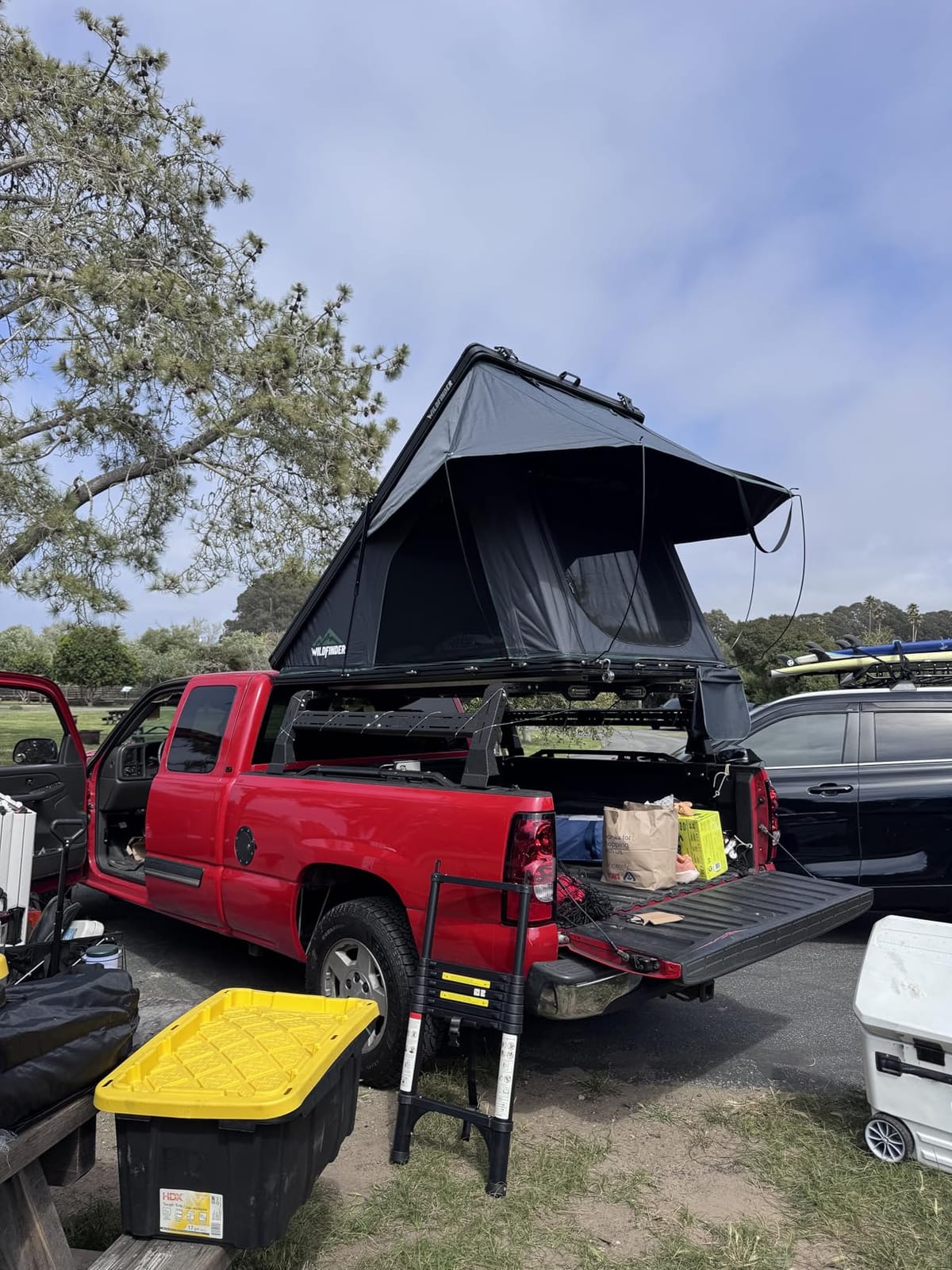
The WildFinder is worth looking at if you want a full aluminum shell and serious weather numbers without moving up a weight class. The shell is 100 percent aircraft-grade aluminum alloy with stainless steel air pressure rods, and the fabric is rated at 5000 mm waterproof with level 6 wind resistance and level 4 heavy snow protection. For most four-season buyers that is a more honest spec sheet than most brands publish.
The accessory bundle is unusually generous. You get a 7.5 foot telescoping ladder, a ladder organizer, 10 organizer bags, an LED strip, two shoe organizers, three mesh windows, two mattresses and one built-in mattress. The recessed marine pad and condensation pad are a nice touch for humid climates, and the blackout fabric handles both sun and privacy.
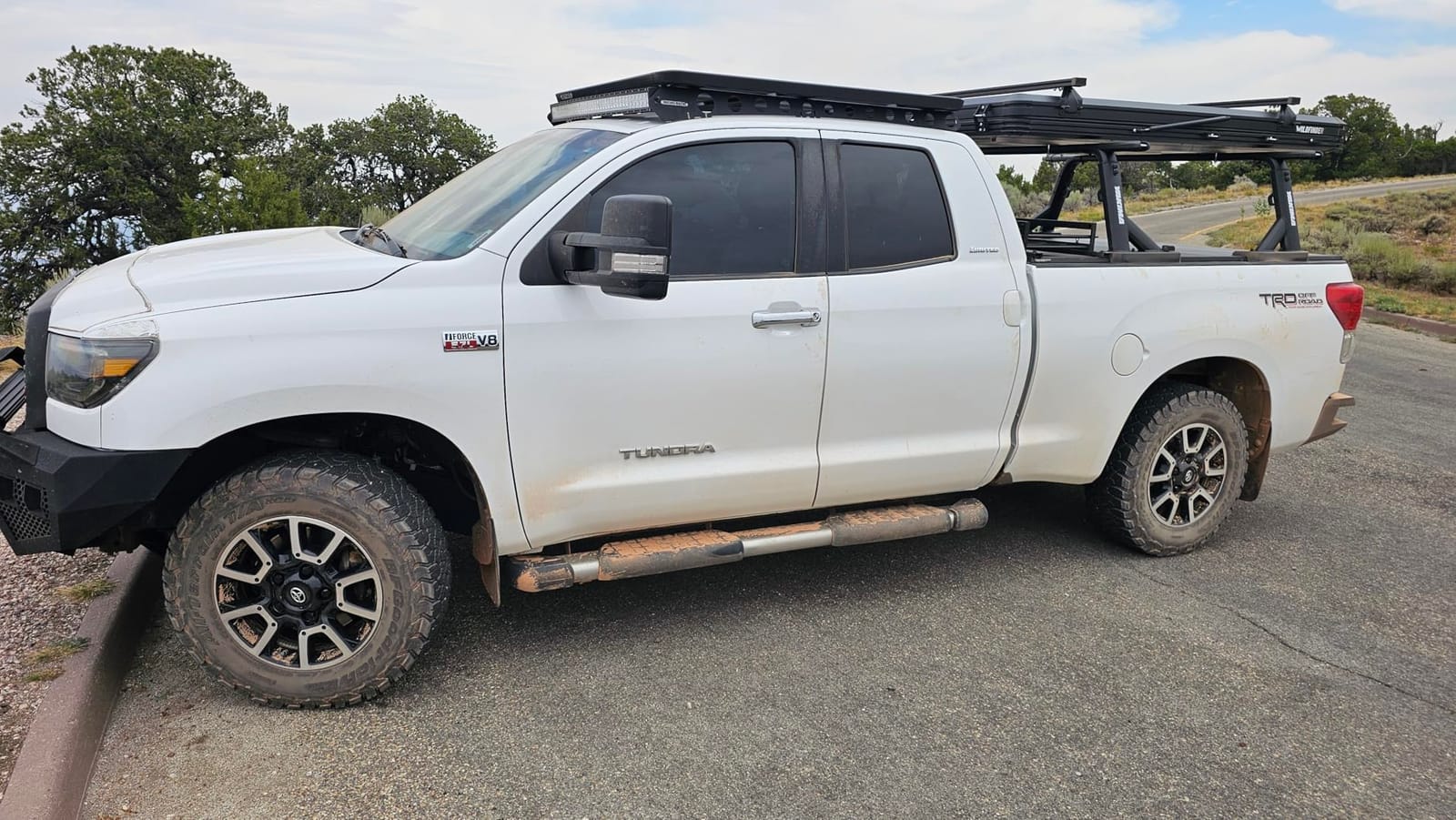
Two things to know before you order. The luggage crossbar is not included, so plan on buying one if you want to run boards or a bike up top, and the listed weight of 89.81 kg is almost certainly a data error on the listing rather than a real figure. Plan for a heavy two-person lift either way and check your roof rating before anything else.
We also want to be straight about the evidence here. The listing shows a 4.5 average across 77 reviews with a high share of five-star ratings, but no written customer review text was returned in our data pull. That means our assessment rests on the stated specifications rather than on years of owner reports, and you should weigh that accordingly.
Is this the right tent for winter trips?
It is one of the stronger candidates in this list for cold-weather use. Level 4 heavy snow protection and 5000 mm waterproofing are real ratings, not marketing adjectives, and the aluminum case shrugs off the freeze-thaw cycling that destroys fabric shells. There is no dedicated thermal liner, so you would still want a good sleeping bag and a closed-cell mat underneath you.
The aluminum shell also keeps highway noise down considerably compared with a soft shell rainfly, which matters on a long winter drive between campsites.
Where the WildFinder falls short
No crossbar means an extra purchase before the tent is usable for gear, and no written long-term feedback makes it a slightly riskier first buy than a model with a deep review history. If you want a warranty behind the shell, the extended soft shell earlier in this list carries four years.
Condensation is managed rather than eliminated. The marine pad and condensation pad help, but a hard shell with sealed fabric still needs ventilation in warm weather, and this one offers fewer window options than some rivals.
5. ARCTWONDER Solar Hard Shell – Best for Off-Grid Power
Solar Panel Rooftop Tent Hard Shell,Pop Up Car Roof Top Tent Hardshell
Hard shell
198 lb
216W solar panel
7 inch closed height
Pros
- Integrated 12V 216W solar panel is a standout feature
- Aluminum bottom plate top cover and corners instead of plastic
- Pops up in about 10 seconds and closes to a 7 inch profile
- 5000 mm waterproofing with taped seams and blackout coating
- Three window awnings for ventilation and rain cover
Cons
- Heaviest tent here at 198 lb
- Solar panel is aimed at power banks not larger loads
- No written customer review text was returned
This is the only tent in our list with a solar panel built into the lid, and for anyone running a multi-day trip away from a vehicle that can restart, that is worth thinking about. The panel is 12V and 216W and the stated purpose is charging power banks, not running a fridge or a CPAP machine, so treat it as a top-up system rather than a power plant.
The build is more considered than the price suggests. The bottom plate, top cover and all four corners are aluminum with no plastic corners, which is exactly where cheaper hard shells crack. The air pressure rod design opens in about ten seconds and closes in two steps by one person, and the closed profile is only 7 inches, the lowest here, which helps in covered parking.
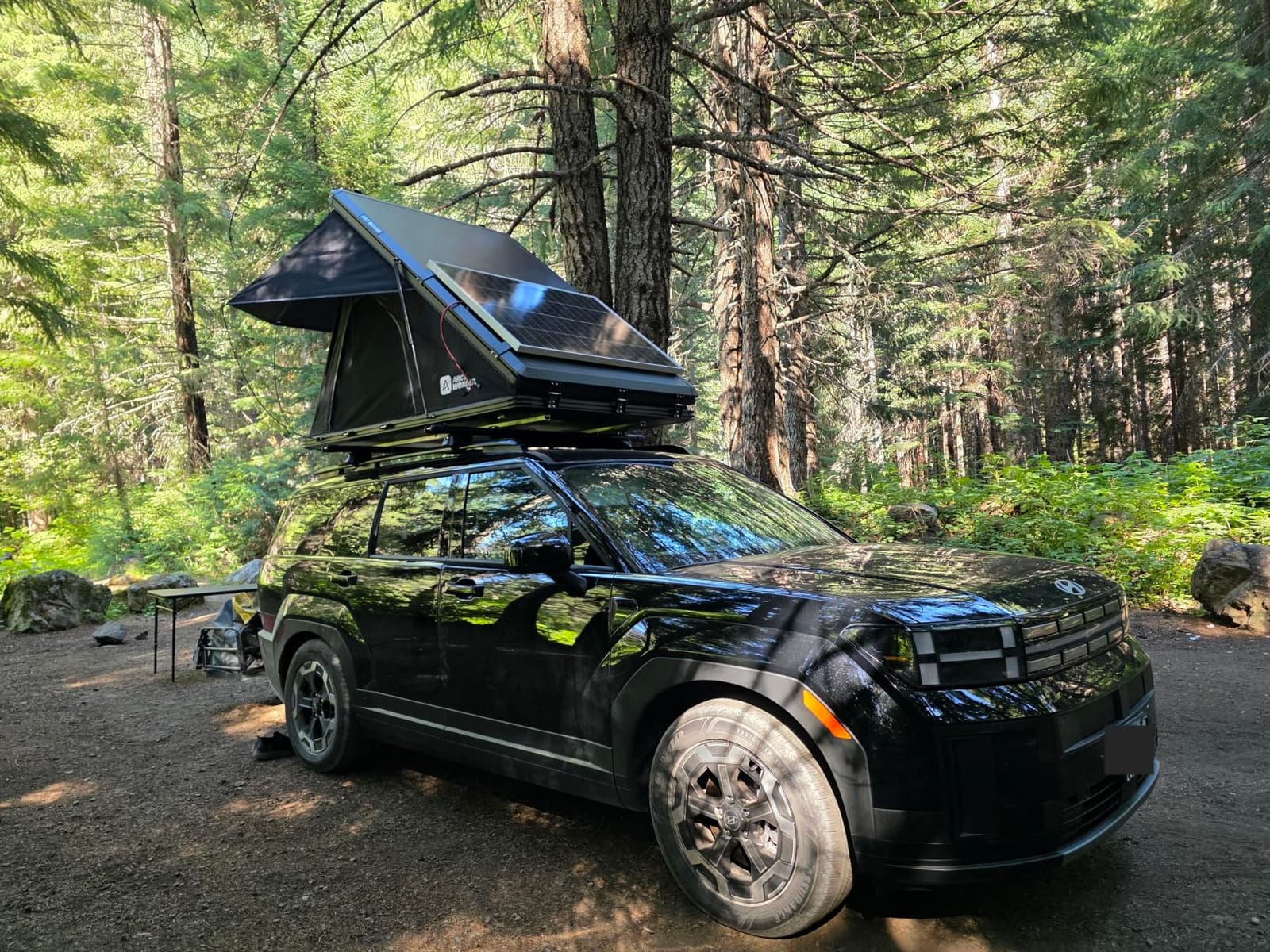
Inside, the tent measures 85 by 52 by 59 inches and is specced for two adults plus a child or a pet. The 320g polyester carries a 5000 mm rating with taped seams and a blackout coating, and three large windows each have their own awning for shade and rain protection. The box includes a ladder, mattress, luggage bar and shoe bag.
Weight is the trade-off you have to accept: 198 pounds is the heaviest tent we evaluated, and it needs a two-person install and real attention to payload. As with the WildFinder, no written customer review text came back in our pull, so we are reading the spec sheet rather than owner reports on this one.
Does the solar panel earn its keep?
If your trips run three days or longer without driving, yes, because a 216W panel can hold power banks topped up in full sun and keep phones and cameras alive. If you drive daily and the vehicle can charge as you go, the panel is a nice-to-have and you are paying weight for it.
It also adds drag. At 198 pounds you are already at the heavy end, and the panel sits on the shell where wind sees it, so expect this to be the least efficient tent here on long highway runs.
Where the ARCTWONDER falls short
Two hundred pounds of roof load is a hard number to fit around. On a truck or full-size SUV with a rated rack it is workable. On most crossovers it rules the tent out entirely, and no amount of driving skill changes the dynamic rating.
The interior is also narrower than some 3-person hard shells at 52 inches wide, so a family of three will feel the pinch. If you need genuine three-person width, look at the wider models later in this list.
6. JOYINRUTE ZS001 Insulated – Best Rooftop Tent for Winter
Rooftop Tent Hard Shell with Winter Insulation for 4-Season Camping
Hard shell
2 person
178 lb
Winter thermal liner
Pros
- Removable winter thermal liner is unique in this category
- Opens in under 30 seconds on four hydraulic rods
- Sealed seams and flocked floor keep the interior dry and dark
- Four mesh and windproof windows give real ventilation
- Roomy enough to sit upright even for tall campers
Cons
- Very heavy at about 178 lb and needs a three-person lift
- Mattress is too hard and thin for side sleepers
- Closing takes practice with no printed instructions
The reason to buy this one over any other hard shell is the detachable winter thermal liner. It is the only tent in our list with a purpose-built cold-weather insert, and owners report that it genuinely changes what you can do below freezing rather than just marketing the tent as four-season. In genuinely cold use you also need the correct sleeping bag rating, because a liner does not replace insulation.
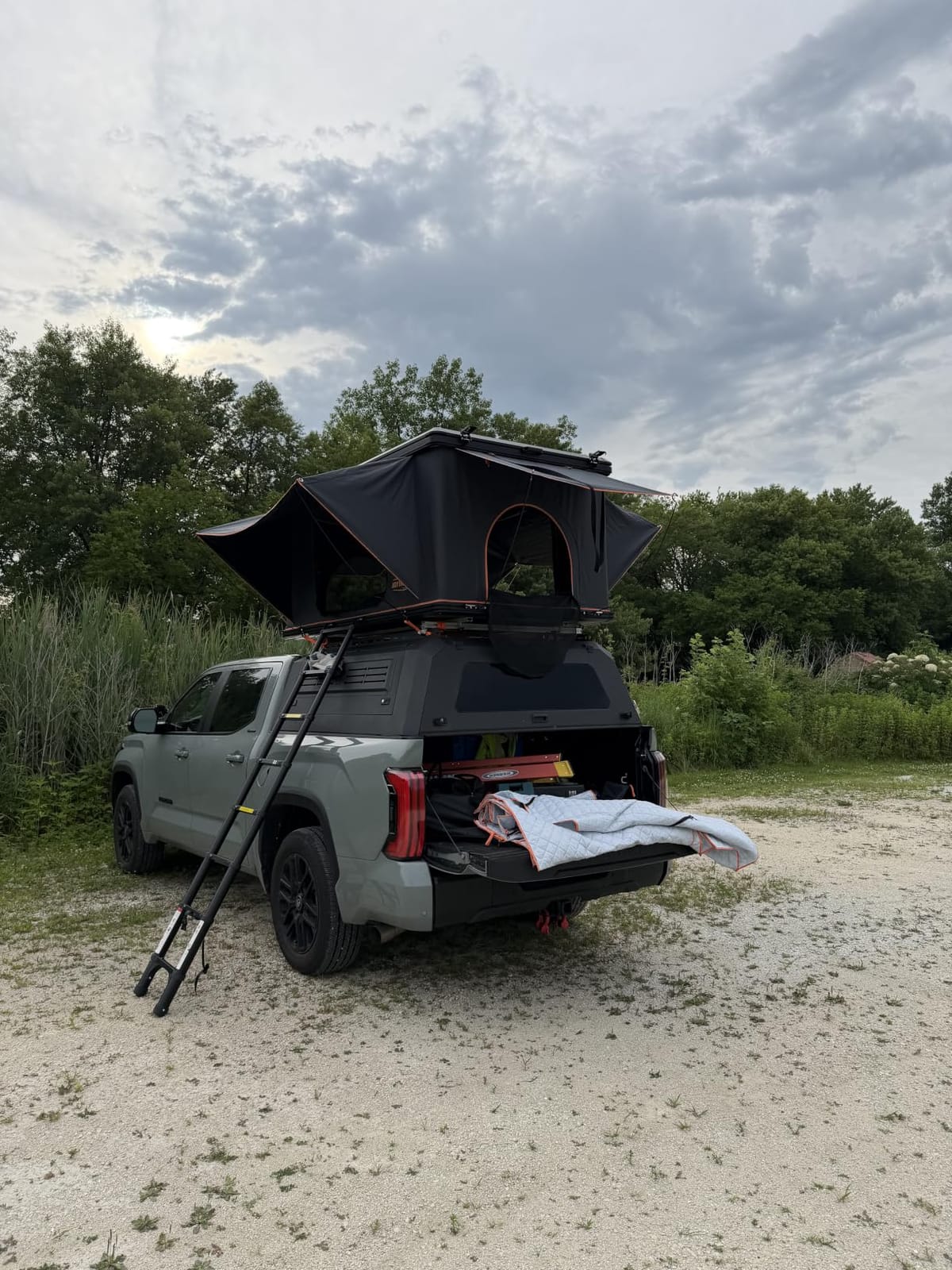
Everything else is competitive. Four high-strength hydraulic support rods open and close the shell in under 30 seconds, the 320g polyester has a blackout coating with 5000 mm water resistance and 99 percent sun protection, and the upgraded flocked lining floor is specifically aimed at reducing condensation. Four windows each carry both a mesh layer and a windproof layer, which is the correct combination for variable weather.
The accessory set matches the WildFinder for completeness: a 7.5 foot telescoping ladder, ladder organizer, mattress, condensation pad, five internal storage bags, an LED strip, two shoe organizers and four mesh windows. You can set up camp without buying anything else.
It scores 4.8 across 36 reviews with 86 percent five-star ratings and no one-star reviews at all, which is the strongest consistency in this group. The recurring caveats are weight at 178 pounds, a thin hard mattress that side sleepers will want to topper, and a closing routine with no printed instructions where the fabric has to be tucked into the gasket.
Is a thermal liner enough for real winter use?
It handles the temperature swing between a cold night and a warm morning better than any fabric shell here, and the aluminum case plus flocked floor means moisture does not sit against your mattress the way it does in a wedge tent. Some owners still report faint wind noise above about 65 mph, which is normal for a hard shell at speed.
For sleepers who run cold, the practical upgrade is a topper. A 1.97 inch non-deformable mattress is fine for back sleepers and marginal for side sleepers, and that is the single most common comfort complaint in this category.
Where the insulated ZS001 falls short
It is listed for two people and behaves that way. Families of three should look at the wider models instead, though the extra width there is not dramatic.
The bigger issue is the install. At 178 pounds, owners describe it as a three-person lift, and a tent you dread putting on the roof is a tent you will take off and never put back on. If your rack is above head height, budget for a second helper or a lifting method rather than improvising alone.
7. JOYINRUTE Aluminum ZS001 – Best for Couples
Aluminum Rooftop Tent Hard Shell,Pop Up Roof Tent Hardshell
Hard shell
2 person
178 lb
5000 mm waterproof
Pros
- Highest rating in the group at 4.9 with 92 percent five-star
- Same aluminum shell and four hydraulic rods as the insulated model
- 5000 mm waterproofing and grade 6 wind resistance
- Flocked lining floor helps keep the mattress dry
- Complete accessory bundle in the box
Cons
- Smallest evidence base at 22 reviews
- No written customer review text was returned
- Same 178 lb weight means a multi-person lift
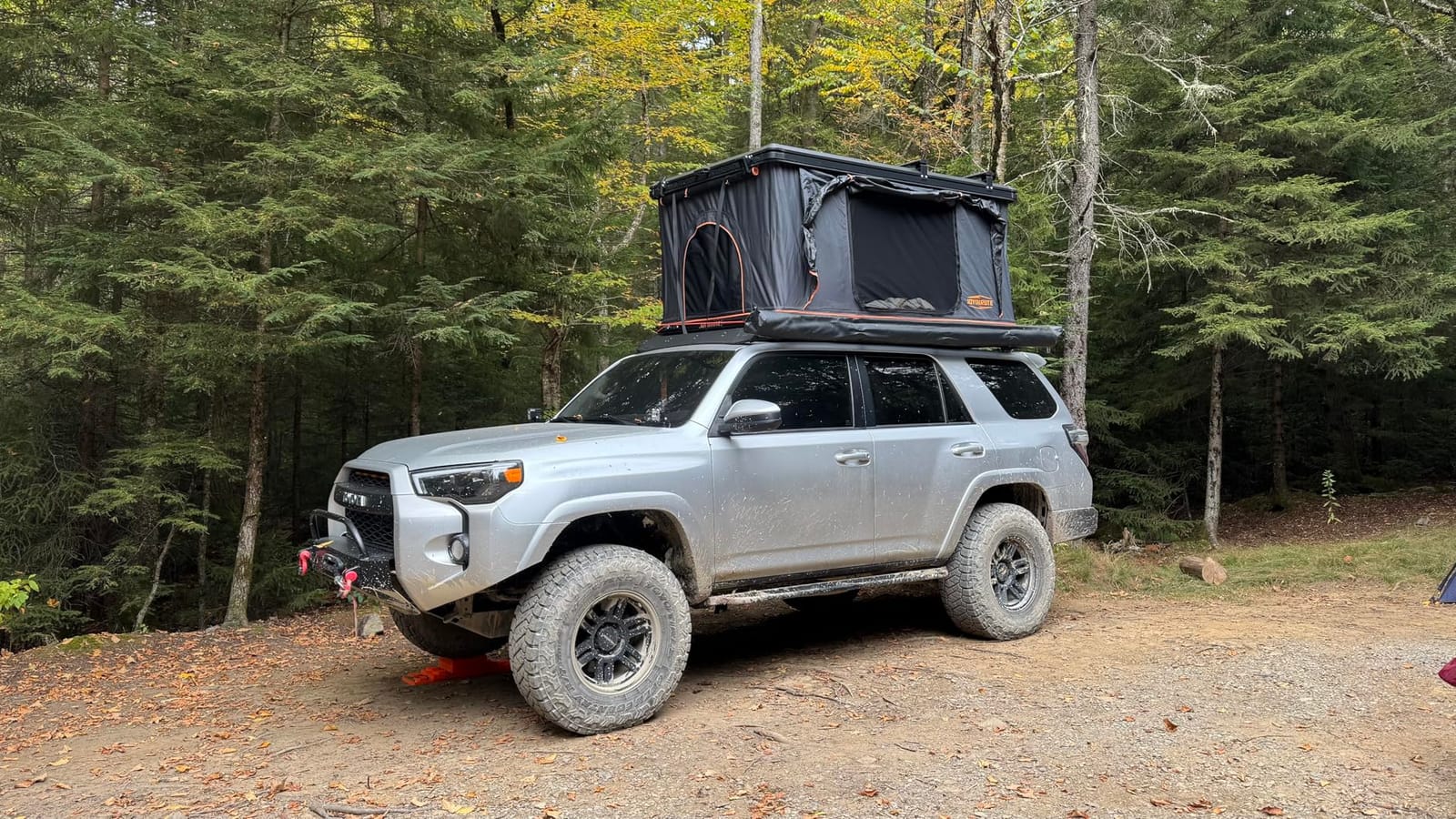
This is the non-insulated sibling of the model above, and it shares the same aircraft-grade aluminum shell, four hydraulic support rods, 320g blackout polyester at 5000 mm, four mesh-and-windproof windows and flocked lining floor. Mechanically they are near-identical, so the real question is whether you need the winter liner.
On the scoring, this is the highest rated tent we evaluated at 4.9, with 92 percent five-star ratings and no one-star reviews. We want to be careful with that number, though, because it rests on only 22 reviews, the smallest base in this roundup, and no written customer text came back in our data pull. A high average on a small sample is encouraging, not conclusive.
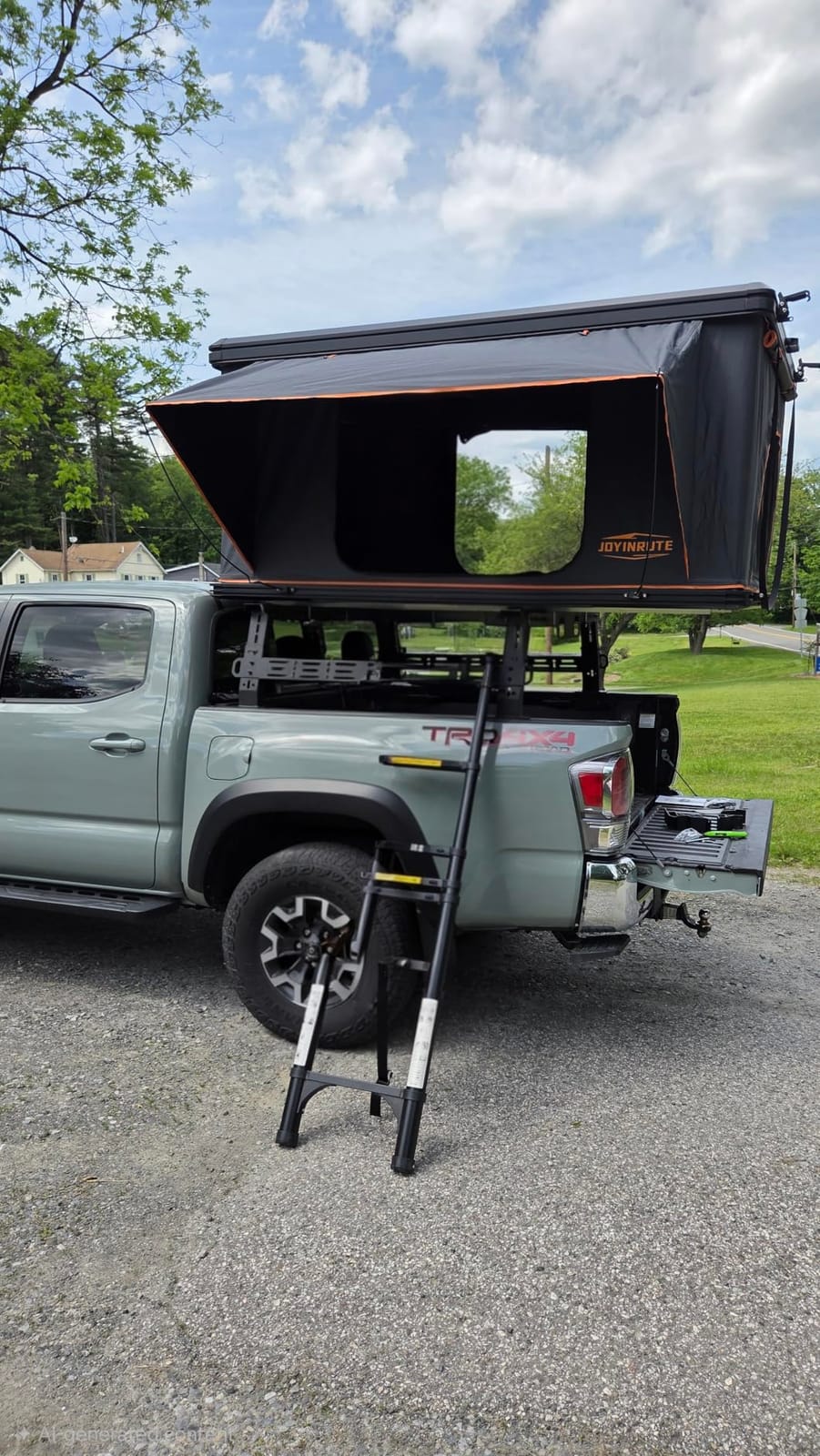
The included bundle is the same full accessory set: telescoping ladder, ladder organizer, mattress, condensation pad, five internal storage bags, LED strip, two shoe organizers and four mesh windows. You are not assembling a parts list after purchase.
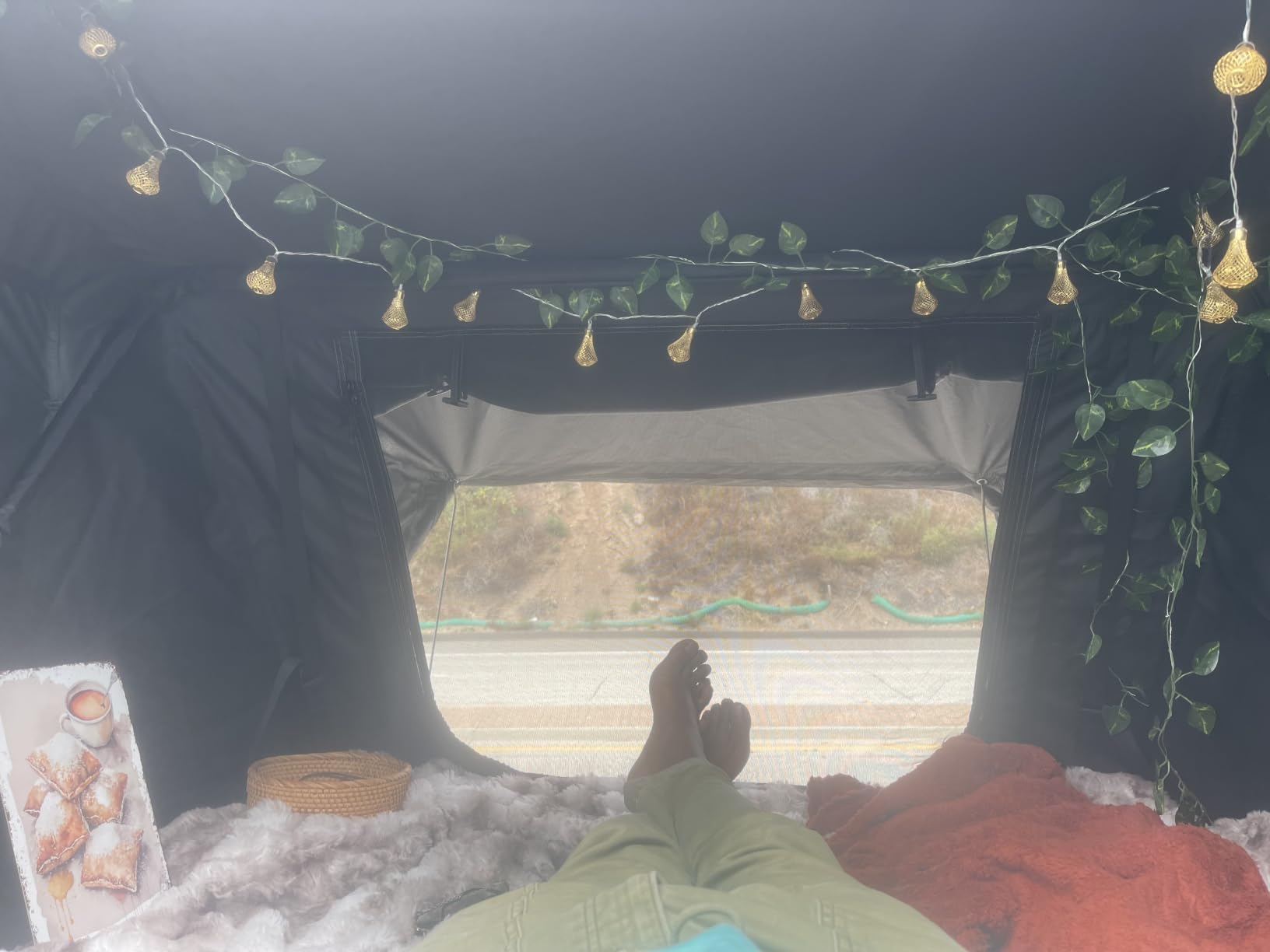
Listed for two people, with dimensions of 83 by 51.8 by 39.4 inches. At 39.4 inches of opened height it is the lowest-profile interior here, so if you like to sit upright on waking this is not the tent for you. Think of it as a lying-down-only cabin.
Should you pay more for the insulated version?
If you camp in shoulder seasons or winter, yes, and the difference is the liner rather than the shell. If your trips run between spring and early autumn, this model gives you the same weather performance without carrying the extra insulation bulk when closed.
Both are listed as four-season, but the spec sheet is not the same thing as a tested winter. Read the rated water resistance and wind numbers rather than the season label, which most brands apply generously.
Where this model falls short
The 22-review base is the honest weakness. Long-term reliability data on a hard shell matters because seals, gas struts and latches are the parts that fail, and none of that is visible in a short review history. Buyers who want a warranty behind the purchase have a one year here.
Same weight problem as its sibling at 178 pounds, and the same multi-person install. Everything else in this list above 150 pounds shares that constraint, so treat it as normal rather than a fault of this model.
8. Meedo Apolle A86 M – Best Rooftop Tent for Small Cars
Meedo Apolle A86 M, Soft Shell Rooftop Tent, Fits 2 People, Made with Waterproof Material and a Rainfly-Fold Design, Clamshell Army Green Roof top Tent for Overlanding Hunting, Ladder Included
Soft shell
2 person
125 lb
4.5 inch mattress
Pros
- Pre-assembled and opens in minutes straight from the box
- Sturdy build with smooth high-quality zippers
- Roomy for a 2 person tent
- Handles rain and wind well
- Comfortable 4.5 inch foam mattress with blackout lining
Cons
- About 125 lb so mounting needs two to three people
- Factory swivel roof bars are not adequate and upgraded bars are required
- Included mattress still wants a 2 inch topper
Vehicle fit is the whole argument for the Apolle A86 M, and owners confirm it mounting on a Subaru Outback and a Jeep Gladiator with proper bars. Outback owners come up constantly in overlanding discussions precisely because of the integrated rail problem, and this tent is light and narrow enough to work with upgraded crossbars on that class of vehicle.
At 125 pounds it is lighter than most hard shells here, and unlike them it ships pre-assembled. You unzip the case, pull the wedge out and it opens in minutes, with a 2.3M aluminum telescopic ladder in the box. The clamshell armory-green design includes two side doors, two front and back windows and a skylight sunroof window, which is more opening count than most 2-person tents offer.
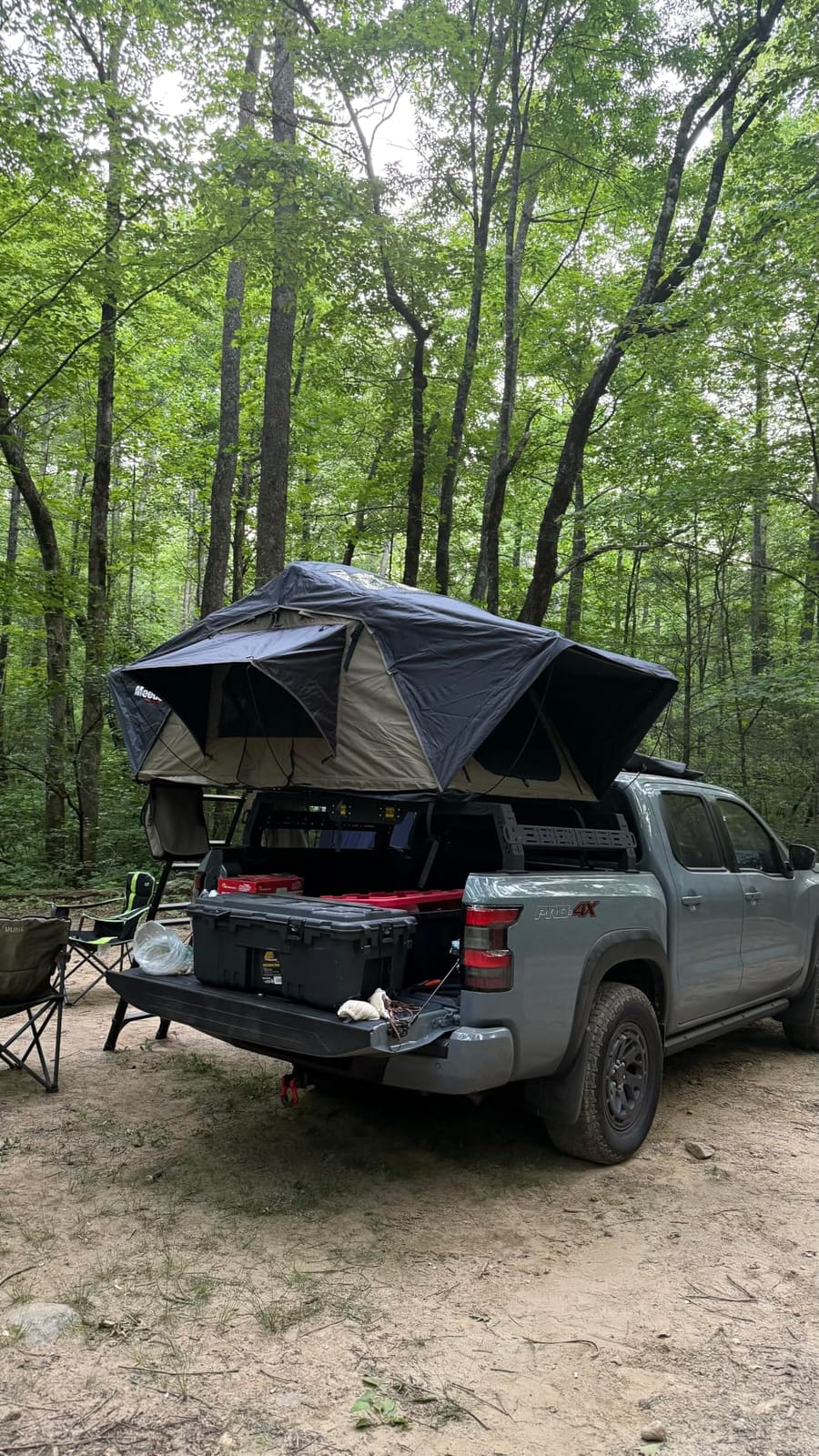
The sleep system is genuinely good for the category. A 4.5 inch high-density foam mattress is thicker than anything else on this list, and the built-in marine moisture-proof pad plus condensation isolation pad address the condensation problem that usually ruins soft shells. Fabric is Oxford with a waterproof 4000 coating and the tent is quoted at 3000MM waterproof with wind resistance level 6 to 7 and 99.99 percent sun protection.
Two practical notes. Reviewers confirm the tent traps heat while driving, so plan a battery or USB fan for warm afternoons, and the instruction manual plus installation parts are stowed inside the tent, so dig them out before your first night. The review base is also the smallest here at 16 ratings, which is worth weighing against the fit advantage.
Is a soft shell right for a small vehicle?
Yes, and for a specific reason: a soft shell sits lower and lighter than an equivalent hard shell, which protects both your dynamic roof rating and your garage clearance. On an integrated-rail vehicle, a lower profile is often the difference between a weekend trip and a trip that never happens.
The catch is aerodynamic noise and the potential for the cover to balloon in a strong crosswind if straps are loose. Above roughly 45 mph of apparent wind, tension every strap before you leave the site.
Where the Apolle falls short
Roof bars are a real expense here. Stock swivel-style bars on smaller vehicles are described as inadequate, so treat an upgraded rack as part of the purchase rather than an accessory. The mounting job is also two to three people at 125 pounds.
Finally, one reviewer reported serious fulfilment and customer service problems. Verify the accessory count on arrival, and treat the small review count as a reason to keep your expectations realistic rather than a reason to avoid it.
9. VEVOR Hard Shell – Best Starter Tent for First-Time Owners
VEVOR Rooftop Tent Hard Shell, Roof Top Tent for Car SUV Truck Jeep Van Camping, Roof Tent with Telescopic Ladder Thick Mattress & LED Strip Light, 2-3 Person Family Camping Tent
Hard shell
3 person
154.5 lb
2000MM rainfly
Pros
- Build quality rated highly for a VEVOR product with no large decal
- Thick mattress and LED light included
- Adjustable sturdy telescoping ladder
- About two hours from unboxing to road ready
Cons
- Lowest rated here at 4.1 with 11 percent one-star reviews
- Requires roof capacity of at least 600 lb
- Shell is fiddly to tighten down onto crossbars
The VEVOR is the most conventional hard shell on this list, and for a first rooftop tent that is a reasonable place to start. It uses a thickened aluminum alloy shell with stainless steel gas springs, inflatable support poles for setup, and buckle locking when folded to resist wind. The rainfly is 420D Oxford at 2000MM and the body is high-density polyester-cotton, PU coated at 1500MM.
The included hardware is better than expected for the money. You get a thick non-deformable foam mattress, an LED light, multiple ventilation points and a breathable mesh window, plus a 7-section aluminum telescoping ladder that extends to 7.5 feet and retracts to 720 mm with a 330 lb load capacity. Owners describe roughly two hours from unboxing to road-ready, which is realistic for a first install.
We are going to be straight about the score. At 4.1 from 26 reviews this is the weakest-rated tent here, with 11 percent one-star ratings pulling the average down even though most written feedback is positive. Buyers like the quality-to-price ratio and are pleasantly surprised by the finish, which several reviewers pointed out carries no large branding decal.
The practical friction is the clamp. Several owners describe tightening the shell down to the crossbars as fiddly and awkward with smaller hands, and the manufacturer lists a requirement for roof capacity of at least 600 lb. The listing also advises against use in severe extreme weather, which is worth reading twice before a winter trip.
Is this a sensible first rooftop tent?
If your priority is learning the mounting routine cheaply and you are on a vehicle with genuine roof capacity, yes. The ladder, mattress and light are all included, so the effective cost of getting started is mostly the rack and the tent itself.
It is also a reasonable second or occasional-use tent, since inflatable poles make it simpler to pitch than most hard shells in this list.
Where the VEVOR falls short
The 4.1 average with 11 percent one-star ratings is the reason it is not higher in this list, and the written reviews do not tell us what those one-star cases were. Buy it understanding you are taking the least-proven product here.
Water resistance is the other limit. A 1500MM PU-coated body and 2000MM rainfly are behind the 5000 mm claims of the aluminum shells, and the manufacturer explicitly steers you away from severe weather. For four-season ambitions, pick something else.
10. Overland Vehicle Systems HD Nomadic 2 Extended – Most Interior Space
Extended Soft Shell Rooftop Tent, 2-Person – Overland Vehicle Systems HD Nomadic 2 – Grey Body & Green Rainfly
Soft shell
3 person
122 inch open length
3 inch mattress
Pros
- Very long floor area fits a family or several campers
- Comfortable 3 inch foam mattress that needs no topper
- Heat-sealed seams and marine canvas hold up in serious rain
- Packs down compactly
- Excellent customer service reported by owners
Cons
- Mounting hardware may not fit round tube expedition racks
- Vestibule roof collects water between frame supports
- Bolts can loosen in use
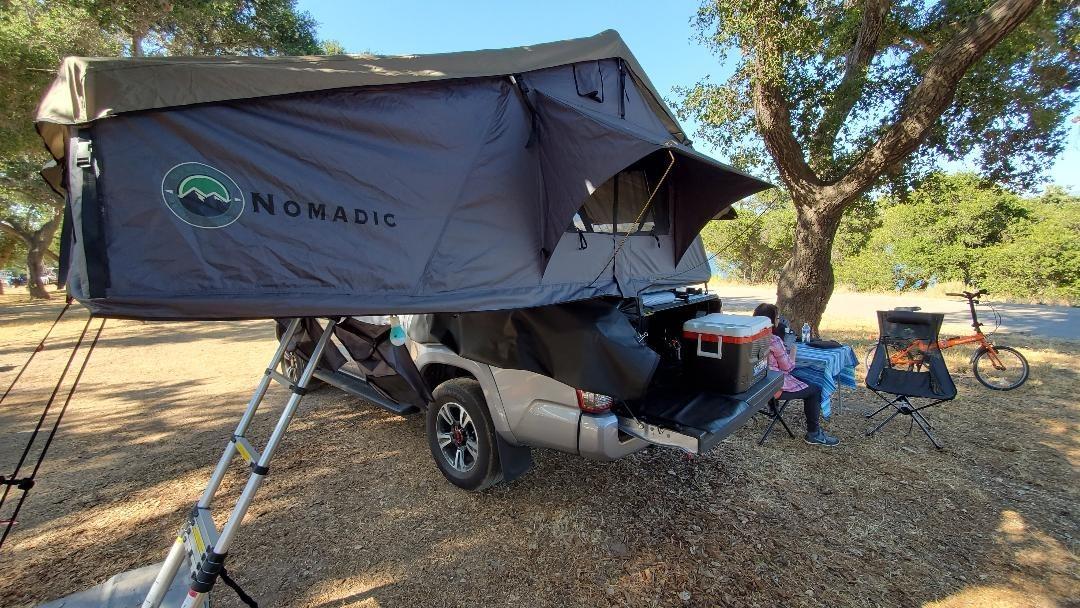
The Nomadic 2 Extended is the length champion. It opens to 54 by 122 by 51 inches, and that extra length is the feature that changes who can sleep in it. A tall sleeper, a family with two kids, or anyone who wants to sit up at one end and read while someone else is still asleep will notice the difference immediately.
The sleep system is the best in this roundup without much argument. A 3 inch high-density foam mattress with a quilted cotton cover and an insulated base is the only bundled mattress here that owners say needs no topper at all, and the 600D marine-grade poly cotton ripstop canvas body with heat-sealed seams is a serious fabric spec for a family tent.
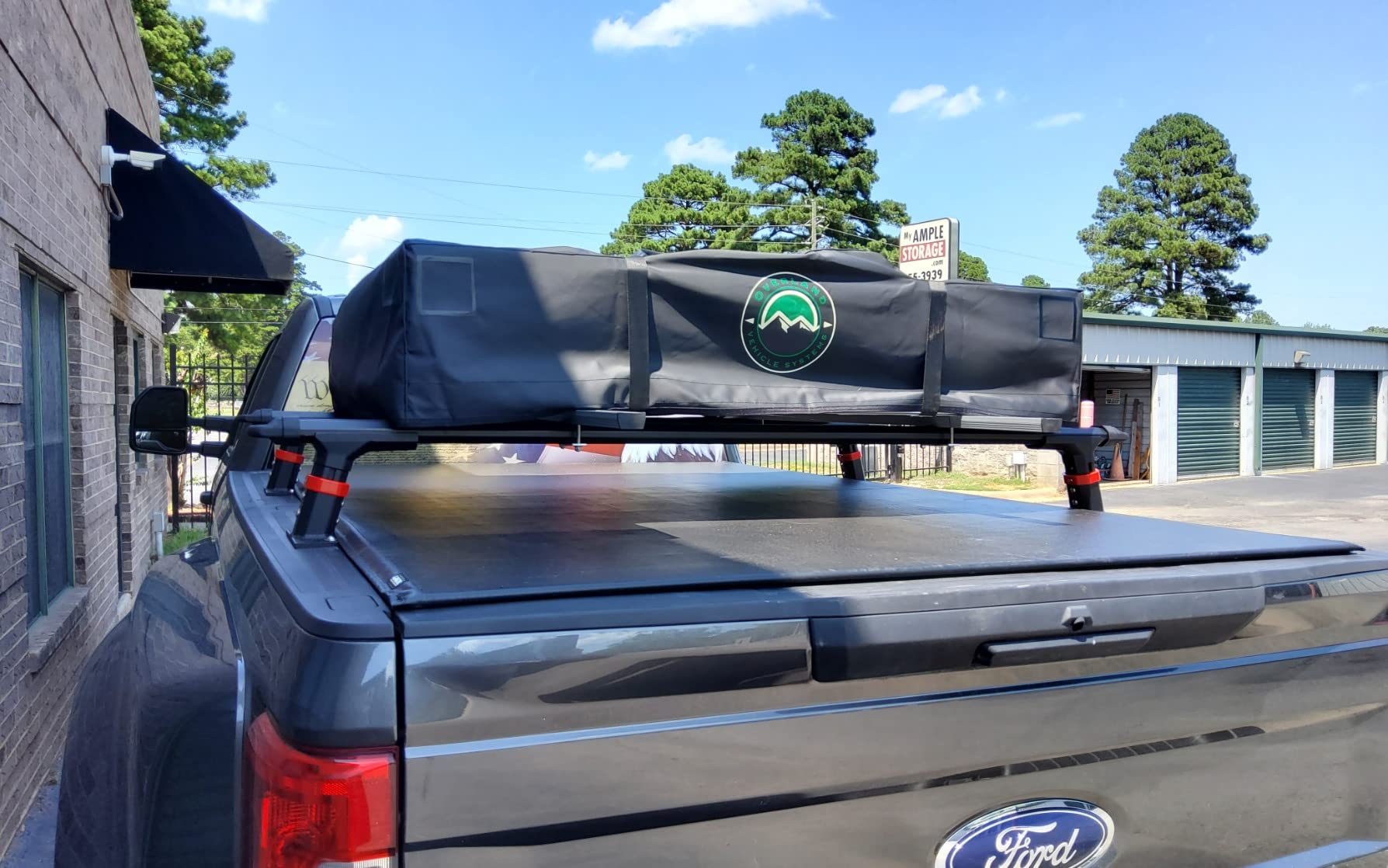
Around the tent, the details are adult-camper details. You get 110g fade-less breathable mesh windows, a 420D polyester Oxford waterproof rainfly, a 1000g PVC heavy duty travel cover, a 96 inch aluminum telescoping ladder with a locking strap, six built-in storage pockets, a storage loft, a power bank pouch, a handheld LED light and a velcro LED strip. The window rod poles have V-shaped strength ridges for windy conditions.
The problem is documentation and rack compatibility. Owners report instructions whose pictured steps do not match the actual hardware, and several had to modify or re-fabricate the mounting hardware for standard expedition-style round tube racks. The vestibule roof can also collect water between frame supports and needs manual draining, and water has wicked in at the sides to wet mattress edges for a few owners.
Is a 122 inch floor worth the extra length?
If you are buying for shared sleeping rather than solo sleep, yes. Floor area is the metric that determines comfort here far more than the capacity label, and no other tent in this list gives you this much rectangle. It is also the reason the tent is described as matching models costing substantially more.
The trade-off is the footprint on the vehicle. Length matters for parking garage clearance and for crossbar position on shorter roof racks, so measure before committing rather than assuming a longer tent still fits your mounting points.
Where the Nomadic 2 falls short
Hardware fit is the recurring theme. Before you buy, look at your rack tubing and confirm the brackets suit it, because owners with round tube expedition racks had real work to make the mounting function. Bolts loosening in use is also reported, including one case where the tent detached from the rack.
Soft shell rules still apply: rainfly noise at highway speed, a cover that can balloon if straps are loose, and a fabric body that ages faster than an aluminum case if it stays mounted through months of sun and rain.
11. Naturnest Polaris Plus – Best Rooftop Tent for Hot Climates
Naturnest Rooftop Tent Hard Shell, Easy Set Up Pop Up Tent for 2 Person Camping, Waterproof UV-Resistant Blackout Privacy 4 Season Tents for Truck, Jeep, SUV, Van, Trailer – Polaris Plus
Hard shell
2 person
30 second pop-up
Heater vent
Pros
- About 30-second pop-up setup and equally quick pack-down
- Outstanding blackout with no light getting through
- Dedicated vent for connecting a heater or cooler
- Built-in power for lights phone tablet and GPS
- STABILUS gas struts and YKK zippers
Cons
- Thin mattress that most owners top up
- Snug interior for two
- Heavy to mount so a winch or 2 to 4 people helps
The Polaris Plus solves a problem most hard shells here ignore. It has a dedicated vent sized to connect a heater or a portable cooler, which combined with a full blackout lining makes it workable in genuinely hot climates where a sealed clamshell becomes a greenhouse. Owners rate the vent as working well in real heat, and the blackout is described as outstanding with no light coming through once zipped.
The rigid aluminum shell uses sound and thermally insulating honeycomb panels, and the same honeycomb structure appears in the floor and roof, where it also acts as a noise reducer. That is a meaningful difference on a highway run compared with a tent that rattles in the wind. The mattress is 1.97 inch non-deformable with blackout fabric lining, and the interior measures 79.5 by 48 inches.
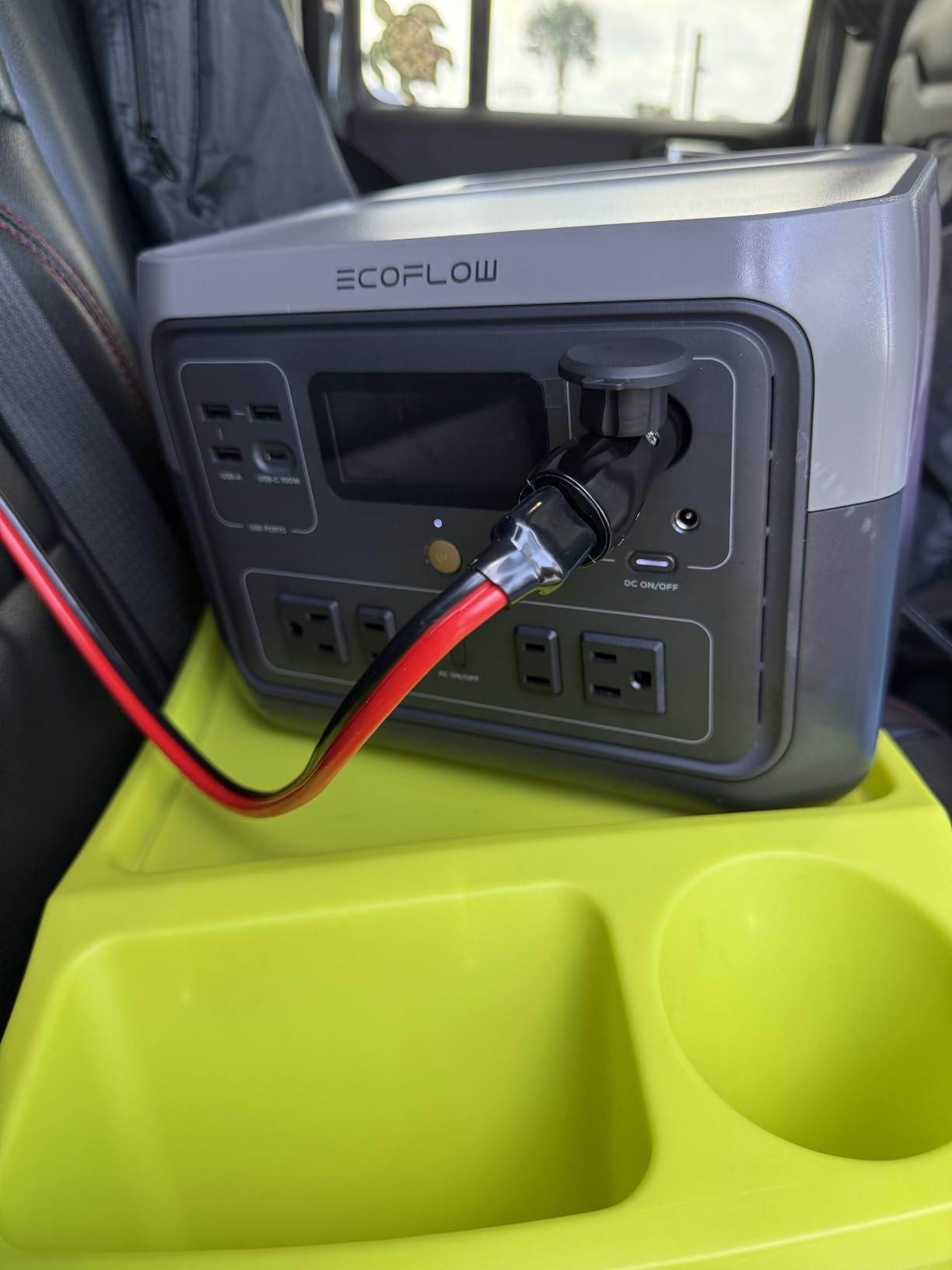
It also includes roof crossbars for gear, so you can carry solar panels, skis or a bike on top of the tent without buying a second rack. The STABILUS gas struts and YKK zippers are the parts brands usually cheap out on, and both are named here. Setup and pack-down are about 30 seconds, with assembly around 10 minutes for one or two people.
The gripes are consistent across owners. The mattress is thin enough that most people add a second mattress or a topper, the interior is snug for two even before you add luggage, and mounting is heavy work that owners suggest handling with an overhead winch or two to four people. Awning poles are also described as tricky to install.
Does the heater vent really change the experience?
Yes, in both directions. In summer it lets you run a portable cooler or push air, which is what stops a sealed black box becoming unbearable, and in winter it is the port you need for a diesel heater. Most competing hard shells have no dedicated port at all, which is the main reason to pick this one over a cheaper clamshell.
Built-in power for lights, phone, tablet and GPS charging adds to that. For a working trip where devices matter, that is worth more than another storage pouch.
Where the Polaris Plus falls short
Loading it onto a rack is genuinely hard work, and owners recommend a winch or multiple people. A tent that is painful to remove tends to stay off, which defeats the purpose.
Closing takes practice, and owners warn that fabric can be caught in the weather seal if you are careless, which is a small but real durability risk over time. The warranty is one year through the seller, so keep your receipt and inspect the seal at purchase.
12. Naturnest Sirius 1 Plus – Widest Interior for Two Adults and a Child
Naturnest Rooftop Tent Hard Shell, Easy Set Up Pop Up Large Tent for 2-3 Person Camping, Waterproof UV-Resistant Blackout 4 Season Tents for Truck, Jeep, SUV, Van, Trailer – Sirius 1 Plus
Hard shell
3 person
63 inch interior width
ABS shell
Pros
- Widest interior here at 63 inches fitting two adults and a child
- About 30-second pop-up setup and pack-down
- Full blackout lining for deep sleep
- Dedicated heater and cooler vent plus built-in power
- Roof crossbars included for carrying gear
Cons
- Lowest rated Naturnest model at 4.3 with 11 percent one-star reviews
- Lightweight ABS shell is less dent resistant than aluminum
- Listing says water resistant rather than giving a numeric rating
Width is the reason to look at the Sirius 1 Plus. The interior is 82.7 by 63 inches with a floor area of 5203 square inches, and at 63 inches across it is the roomiest interior in this roundup for two adults and a child. Most 3-person hard shells here give you 51 to 52 inches, which is the difference between three people fitting and three people negotiating.
The shell is a lightweight aerodynamic high-strength ABS hard shell on an aluminum alloy frame with insulating honeycomb panels, driven by 316 stainless steel gas struts and YKK zippers. The 30-second pop-up matches the best in this list, and like its sibling it includes roof crossbars for carrying solar panels, skis or bikes plus a dedicated heater and cooler vent and built-in power.
There is a meaningful trade for that width. ABS is lighter and cheaper to mould than aluminum, and it is more resistant to UV degradation, but it dents and scuffs more easily and it is more sensitive to heat over a long parked period. If you do rough roads or frequent highway runs, that is a real cost to weigh.
We also want to flag the evidence honestly. This model scores 4.3 with 11 percent one-star ratings, the lowest of the two Naturnest listings here, and no written customer review text was returned in our pull. The listing also describes water resistance qualitatively rather than quoting a numeric waterproof rating, so you are relying on the brand rather than a measurement.
Is 63 inches wide enough for a family of three?
For two adults and a child, yes, and that is the configuration owners describe. It is still not a substitute for a ground tent with a separate room, but it is a genuine step up from the 51 to 52 inch interiors common at this weight class, and children sleep better when they are not wedged between two adults.
The blackout lining means a child who wakes at first light is not staring at the roof panel, which is a detail parents appreciate more than the spec sheet suggests.
Where the Sirius 1 Plus falls short
At 160 pounds it still needs a multi-person lift, so the loading problem from the previous model applies here too. That is a category-wide issue, not a fault of this design, but it decides whether the tent gets used.
The ABS shell and the missing numeric waterproof figure are the two reasons it sits at the end of our list rather than higher. If you want a numeric waterproof rating, an all-aluminum shell and fewer unknowns, the aluminum models in this list are the safer read.
How to Choose a Rooftop Tent in 2026
Everything above assumes you have already decided you can legally and safely put a tent on your roof. That decision comes first, and it is where most returns and most roof damage originate. Work through these criteria in order.
1. Run the roof load arithmetic before you fall for a model
Every vehicle has two roof numbers and buyers mix them up constantly. The static load rating is the total weight the roof structure can carry while parked, and the dynamic load rating is the lower number that applies while the vehicle is moving, because bumps and potholes multiply the force on the roof. If you have ever seen a tent detach from a rack, dynamic load is usually why.
The arithmetic owners actually run is simple: tent weight, plus rack weight, plus mattress and bedding, plus a mounted awning or solar panel, plus water, recovery gear and luggage, then compare that total to the dynamic rating on the door jamb sticker. If your total sits within about 80 percent of the rating you have margin. Above that you are one pothole away from a problem.
Rack ratings are separate and lower than roof ratings, so check both. A crossbar rated for 165 lb does not make a 200 lb tent safe, and the mounting bracket manufacturer may impose its own limit that is lower still.
2. Check crossbar spacing before the tent, not after
Crossbar spacing is the most overlooked spec in this category. Most rooftop tents need mounting points a minimum of 30 inches apart to keep the platform rigid, and a small car with compact factory bars can fall short of that, which is exactly why owners of integrated-rail vehicles like the Subaru Outback are told to fit upgraded rack bars before the tent goes on.
Two people, minimum, for installation. Every tent in this roundup except the lightest needs it, and the heaviest need three, so plan the install day accordingly. Many owners also re-torque bracket bolts after the first few hundred miles of driving, because settling happens and loose bolts are the leading cause of a tent working loose.
3. Measure the garage before you fall in love
Adding a rooftop tent raises your total vehicle height by the closed height of the tent plus the rack, and that is how people end up unable to leave a car park. Measure your actual total height with the tent mounted, then subtract a safety margin, and check the posted clearance rather than eyeballing the entrance bar. Airport, hospital and downtown structures are the ones that catch people out.
This is where a low closed profile pays off. The solar hard shell closes to 7 inches and the soft shells here close to roughly 9 to 11.5 inches, while a full-height hard shell is often 12 to 14 inches. If you have a home garage or work in a covered structure, that difference is the whole decision.
4. Judge capacity by floor area, not by the label
Owners across every forum agree that capacity ratings are optimistic. A tent labelled 3-person comfortably sleeps two adults, and a 2-person tent that measures under 55 inches wide will have both occupants touching shoulders all night. Use floor area and interior width as the real metrics, and add the peak height question: if you need to sit upright, check the opened height before buying, because several hard shells here are low enough that sitting is not an option.
Also plan for the gear. Ladders, boots and wet packs take floor space, so a nominal 2-person tent with 48 inches of width may be a 1.5-person tent in practice if you are not organised.
5. Decide on hard shell or soft shell
A hard shell is an aluminum or ABS case that pops open on gas struts in seconds, is aerodynamic at highway speed, quieter in wind and impossible for rain to blow into through the fabric. A soft shell is a fabric wedge on a rack: bigger interior for the same money, lower profile, more flexible sizing, and generally a better value per square foot of floor area.
Owners split fairly evenly, and the forum consensus is that hardshells win on setup speed and aerodynamics while softshells win on interior space and price. If you move camp every night, you will feel the one-minute hardshell setup every single time. If you plan two or three nights in one spot, the softshell space is worth more than the setup speed.
6. Plan for condensation, not just rain
The most common complaint in softshells is condensation, and it is what shortens tent life. Warm breath and warm bodies meet a cold floor and a single-layer wall, water forms, and a tent left damp develops mould in the fabric. The fixes are unglamorous: an anti-condensation mat under the mattress, a mattress cover, ventilation at both ends even in the cold, and taking the tent down and drying it at home rather than leaving it folded up wet.
Hardshells manage this better because the flocked or honeycomb floors in this roundup are specified to reduce it, and the aluminum case does not breathe. They do not eliminate it, and owners still report interior wall condensation around 50F and below, so pack the same mat either way.
7. Budget the whole install, not just the tent
The tent is rarely the largest line item in rooftop camping. You also need a roof rack or upgraded crossbars, a ladder if one is not included, mounting hardware that fits your specific rack, and often a second person for install labour. On a small vehicle, the rack alone can approach the cost of a budget tent, which is why a lighter softshell is often the smarter first purchase.
For maintenance, budget a re-torque of the bracket bolts after the first few hundred miles and again seasonally, and a seasonal inspection of seams, zips and the gasket seal. If you keep the tent mounted year-round, a breathable cover matters more than a plastic one.
Known failure modes to check on arrival
Unboxed rooftop tents fail in a small number of repeatable ways, and every one of them is catchable in ten minutes. Count the mounting bolts, brackets, straps, ladder sections and guylines against the manual before you leave. Check the shell or fabric for shipping dents, tears and a straight zipper run, and look at the lid gasket or the fold-out hinges for alignment. Open and close the tent twice to make sure the struts hold and the seal sits flat, and confirm the mattress and ladder are undamaged.
Four recurring complaints run through owner reports across brands. Softshell covers balloon in strong wind above roughly 45 mph if every strap is loose, so tension everything before the first departure. Rainfly and wind noise at highway speed is close to universal on fabric tents. Mounting hardware is the most common missing item, and bolt lengths frequently do not match the rack. Quality control on newer hardshell brands is inconsistent enough that inspecting the unit before your first trip is not optional.
Frequently Asked Questions
Which brand makes high-quality rooftop tents?
In the long-running overlanding forum threads we studied, 23Zero and CVT are the names that come up most often as enthusiast favourites, with Tepui described as polarizing but widely owned. Among the models on this list, the Overland Vehicle Systems models pair a four year warranty with marine-grade hardware, while the aluminum hard shells from WildFinder and JOYINRUTE carry the strongest numeric waterproof and wind ratings. Judge the brand, then judge the specific model, because quality varies more within a brand than between brands.
How much weight can a rooftop tent support?
The tent is only part of the answer. You must add your rack, mattress and bedding, awning, solar panel, water, recovery gear and luggage, then compare that total against your vehicle dynamic roof load rating on the door jamb sticker, not the higher static rating. Keep the total near or under 80 percent of the dynamic rating to leave margin for bumps. The tents here range from 108 pounds to 198 pounds, and your crossbar rating may be lower than your roof rating, so check both.
Can a Subaru Outback hold a rooftop tent?
Yes, with the right rack. The Outback and similar integrated-rail crossovers generally need upgraded crossbars before most rooftop tents will mount properly, because factory swivel-style bars are rarely strong or wide enough. Once fitted, a light softshell such as the 125 lb Meedo Apolle A86 M is a realistic match, and owners report running that tent on an Outback with proper bars. Check your dynamic roof load rating first, and keep crossbar spacing at a minimum of about 30 inches.
How far apart should crossbars be placed on a rooftop tent?
At least 30 inches apart for most rooftop tents, and more if the manufacturer specifies it. Wider spacing keeps the mounting platform rigid and spreads the load into the rack rails instead of concentrating it between two close bars. On a small vehicle with compact factory bars you may not be able to achieve that spacing, which is the usual reason owners move to upgraded rack bars before buying a tent.
Are rooftop tents worth the money?
They are worth it if you want your vehicle interior kept free for gear, want to set up in under a minute rather than pitching a ground tent in the dark, and want to sleep clear of mud, roots and insects. They are poor value if you camp in one place for weeks, if your vehicle cannot meet the dynamic roof load, or if covered parking is a daily necessity. The cheaper softshells in this list deliver most of the benefit at a fraction of the weight.
What are the downsides of using a rooftop tent?
The main drawbacks are weight, cost and effort. Tents here weigh between 108 and 198 pounds, which cuts fuel economy, consumes roof load capacity and needs a two or three person install. You add 7 to 14 inches of total vehicle height, which limits parking garages and bridges. Install and removal is a two-person job, mounting hardware is frequently missing or the wrong length, softshell covers balloon above roughly 45 mph if straps are loose, and condensation inside fabric tents can cause mould if they are left damp.
Do rooftop tents work in winter?
They can, if you pick for it. Look for a numeric waterproof rating of 5000 mm or better, a wind resistance rating, an aluminum shell, and a flocked or honeycomb floor to reduce condensation. Only one model in this list ships a detachable winter thermal liner, which is the single most useful cold-weather feature. Remember that a liner does not replace a correctly rated sleeping bag and a closed-cell sleeping mat, and check that the ladder is rated for icy conditions.
What is the difference between hard shell and soft shell rooftop tents?
A hard shell is a rigid aluminum or ABS case that pops open on gas struts in under a minute, is aerodynamic and quiet at highway speed, and seals out wind-driven rain. A soft shell is a fabric wedge on a rack that you unzip and extend with a ladder, taking five to twenty minutes, but gives you more interior space and a lower closed profile for the same money. Hardshells suit people who move camp nightly, softshells suit families and small vehicles.
Final Verdict: Which Rooftop Tent Should You Buy?
The best rooftop tents in 2026 fall into two clear groups, and the honest answer is that most people should start with the roof load arithmetic rather than the brand shortlist. If your dynamic rating cannot carry a 160-pound hard shell plus your rack and gear, the light soft shells are not a compromise. They are the correct choice.
Among those soft shells, the Overland Vehicle Systems TMBK is our overall pick: 108 pounds, 94.5 inches of open length, a full accessory bundle and the deepest review base of any tent we evaluated. For a family that needs real sleeping room, the HD Nomadic 3 extended gives you a diamond plate aluminum base and a four year warranty. For the longest floor of all, the Nomadic 2 Extended fits a family of three with a 3 inch mattress that needs no topper.
On the hard shell side, the HEYFUN Adventurer Pro is the feature-packed pick with a five-second pop-up and a full accessory kit, the WildFinder carries the strongest weather ratings per pound, the solar model makes sense for multi-day trips away from a restartable vehicle, and the insulated JOYINRUTE is the only one here built for genuine cold. The Naturnest models suit hot climates and narrow vehicles because of the heater vent and the 63 inch interior width.
Before any of them: check your door jamb sticker, measure your garage clearance, and count the hardware in the box on day one. Those three steps prevent almost every rooftop tent problem we read about.