
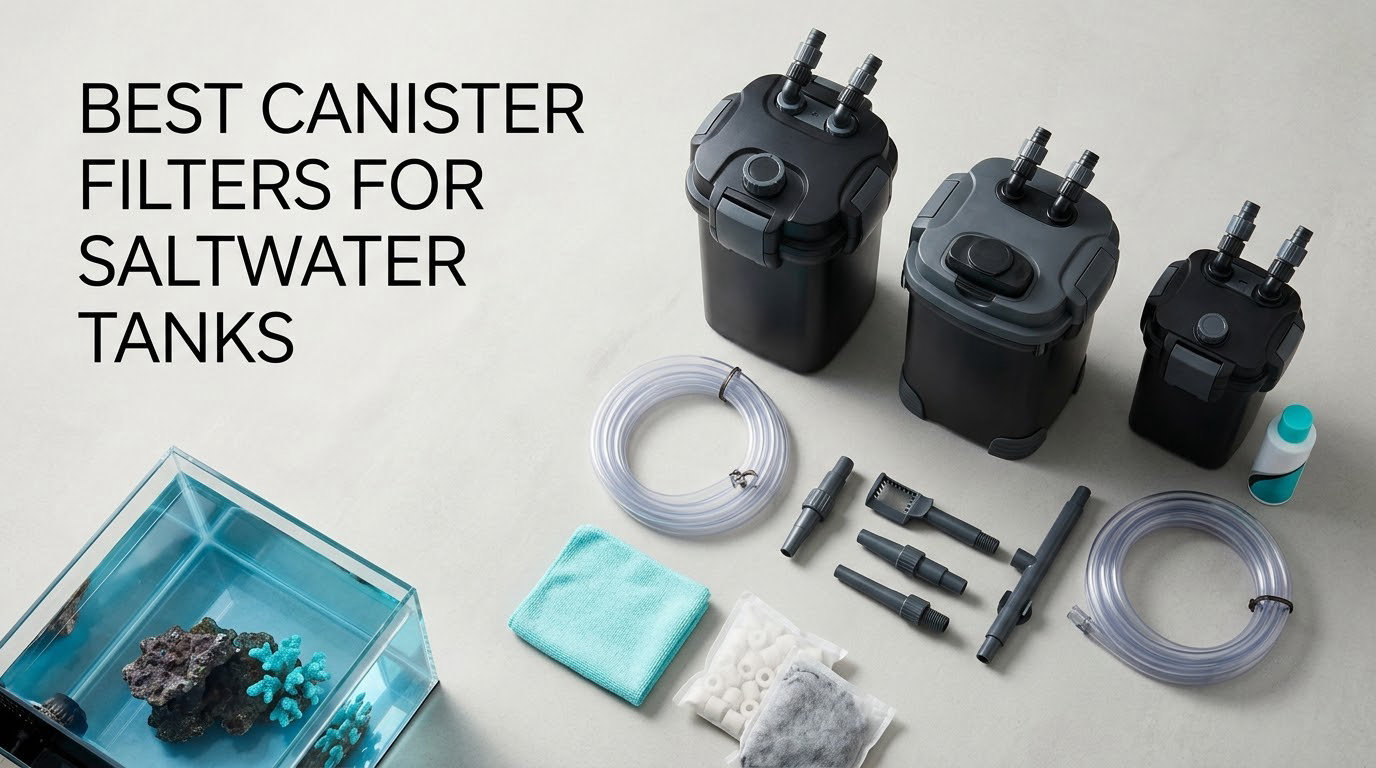
Every saltwater keeper eventually gets into the same argument with a forum thread: should a canister filter have any business in a marine tank at all? Experienced reef keepers tend to answer no, and pointing to a sump. Newer keepers often see a canister advertised for tanks up to 100 gallons and wonder why the hobby pushes them toward a more complex install.
Both sides are partly right, and that is the reason the best canister filters for saltwater tanks get recommended here with conditions attached. A canister is genuinely excellent on fish-only and fish-only-with-rock systems, where it delivers large media capacity in a small footprint and runs quieter than a hang-on-back. It is a poor choice as the only filtration on a coral reef, because a closed reef tank with no water changes turns a neglected canister into a nitrate and phosphate trap. It works well as a supplement sitting alongside a sump, refugium or skimmer.
What follows is a saltwater-first look at ten canister filters, sized by reef turnover tiers instead of the freshwater 4x rule that most canister guides use. We focused on the things that decide whether a canister survives in marine water: published flow at head height, media basket count and configurability, how quietly it runs in a living room, and whether the media can be pulled weekly without flooding your cabinet.
Budgets in this hobby run toward gear first and water changes second, which is how filters get undersized. If you are planning new equipment, our saltwater gear picks guide covers the other side of the setup. For filtration specifically, read the sizing section before you buy, not after.
Table of Contents
Are Canister Filters Good for Saltwater Tanks?
The honest answer is a tiered yes. Canister filters work well in saltwater, and they are arguably the best-looking, quietest option for a fish-only or FOWLR display tank that has no sump. Keepers on r/ReefTank report running canisters on FOWLR systems for years without incident, and one long-running thread describes an older EHEIM handed down and still going. That community endorsement is genuine and it is why several models below are rated by their manufacturers for both freshwater and saltwater.
Where the consensus turns is coral. Canisters are the weak point in a reef tank because they hold a lot of detritus in a confined space, and a reef tank exports nutrients through water changes that most keepers do not perform often enough. reefs.com puts it plainly: on a fish-only tank there is no problem with a canister, on a reef there are better choices. Fishlore compresses the whole failure mode into a phrase keepers use often, calling canister filters nitrate factories.
Our rule after weeks of working through setups: a canister is right for a fish-only or FOWLR tank under roughly 100 gallons, right as a secondary polish-and-flow stage on a reef, and wrong as the sole filtration on a mixed reef or SPS display. If you have a nano under 30 gallons, a canister is usually more equipment than the job needs.
There is one more consideration specific to marine water: what happens when the power goes out. A canister without a sump is your only filtration, and it has to prime again by hand before the tank is safe. That single fact drives most of our recommendations below.
Top 3 Canister Filter Picks for Saltwater Tanks (October 2026)
These three cover the realistic range of marine canister use: a mid-size workhorse for FOWLR tanks, a high-capacity value pick for large systems, and the biggest flow number in the group for anyone running two of them as a pair. The first is the one we would put on most fish-only saltwater displays.

Fluval 407
- Rated to 100 gallons
- Quiet self-priming startup
- Single-handle EZ-Lift media baskets

Penn-Plax Cascade 1500
- 350 GPH rated flow
- Five stackable media baskets
- Rotating 360-degree valve taps

The Fluval 407 earns the top slot on the combination that actually matters in a marine tank: a 4.4 average across a very large review base, a manufacturer rating to 100 gallons, and the simplest weekly media change of any canister in this group. The Cascade 1500 gives you five baskets instead of three and more raw flow for the money. The FX6 is the pick if you are building a large display and want the highest rated flow available here.
All 10 Canister Filters Compared in 2026
Every filter below is included with its own flow rating, media configuration and reef use case. Flow figures are manufacturer published values at zero head height, so read the sizing section further down before treating them as delivered flow.
| Product | Specs | Action |
|---|---|---|
| Fluval 407 Performance Canister Filter |
|
Check Latest Price |
| Penn-Plax Cascade 1500 Canister Filter |
|
Check Latest Price |
 Marineland Magniflow 400 GPH Canister Marineland Magniflow 400 GPH Canister |
|
Check Latest Price |
 Marineland Magnum 290 GPH Polishing Canister Marineland Magnum 290 GPH Polishing Canister |
|
Check Latest Price |
| Fluval FX6 High Performance Filter |
|
Check Latest Price |
 EHEIM Classic Canister Filter 2213 EHEIM Classic Canister Filter 2213 |
|
Check Latest Price |
 Penn-Plax Cascade 700 Canister Filter Penn-Plax Cascade 700 Canister Filter |
|
Check Latest Price |
 SunSun HW-304B Pro UV Canister Kit SunSun HW-304B Pro UV Canister Kit |
|
Check Latest Price |
 Aqueon QuietFlow Canister Filter Aqueon QuietFlow Canister Filter |
|
Check Latest Price |
 SunSun HW-3000 PRO UV Canister SunSun HW-3000 PRO UV Canister |
|
Check Latest Price |
Two quick notes on the table. The Fluval 407 and the Penn-Plax Cascade 1500 are the two most proven units here by review volume, while the SunSun HW-3000 PRO and the Aqueon QuietFlow have thinner review histories and we treat their specs accordingly. And the Cascade 700 shares its listing ratings with the rest of the Cascade series, which makes its owner feedback harder to read model by model.
Canister vs Sump vs HOB for Reef Tanks
This is the question that fills SERP positions one through five with forum threads, so we are going to answer it directly instead of dodging it. A sump is the better primary filter for a coral reef. A canister is the better choice for a fish-only or FOWLR tank, and a useful addition to a sump-equipped reef. A hang-on-back is a reasonable budget compromise, not a serious saltwater primary.
Why the sump wins on reef: it moves the same water with far more media volume in a wet or dry chamber, it gives you a place to hang a protein skimmer and a refugium, and it keeps detritus in a place you can siphon without opening a canister in a cabinet full of electronics. A canister concentrates the same detritus in a small canister that sits in the same space. In a system with no water change routine, that concentration is exactly how you get a nitrate problem.
Why a canister still wins in marine tanks: media capacity per unit of floor space, quietness, and no water level requirement. A sump needs a stand cut for it and a plumbing plan. A canister slides under almost any stand, pulls from any tank depth, and on the Fluval and Penn-Plax models the valve taps and lift-lock clamps mean a two-minute swap of a floss bag. For a fish-only display where nobody is dosing two-part and nobody is chasing phosphate, that convenience is worth more than a skimmer you do not need.
The hybrid is where most experienced saltwater keepers land in practice. A reef with a sump can run a canister purely as a polisher and to add circulation, with a small bag of floss on top and carbon below it. Just size it for that job, not as your primary bio filter, and clean it weekly.
One more reef-specific note: never rinse biological media in tap water. Chlorine kills the nitrifying bacteria you spent months building, and a single careless rinse can trigger an ammonia spike in a closed system with no water change buffer.
1. Fluval 407 – Best Overall for Fish-Only and FOWLR Saltwater Tanks
Fluval 407 Performance Canister Filter – For Aquariums Up To 100 Gallons
Rated to 100 gallons
eTEC pump
9.7 lb, 19.29 in tall
Self-priming startup
Pros
- Very quiet
- many owners report barely audible running
- Powerful flow and pressure that clears a tank within hours
- Quick-disconnect valves and lift-lock clamps make cleaning simple
- EZ-Lift center-handle baskets give one-finger media access
Cons
- Recurring impeller cover disengagement reported by long-term owners
- Included carbon and floss pouches are half-size versus standard Fluval media
- Occasional humming audible in a very quiet room
The Fluval 407 is the canister we put on most fish-only saltwater displays, and the reason is not the flow number. It is that a 4.4 average across more than ten thousand reviews is the most proven combination of rating and volume in this group, and the media change takes about as long as it takes to make coffee. The 407 ships with a self-priming sequence that gets you back to filtration without refilling the canister.
Owners repeatedly report that they cannot hear it. Several describe running it in the same room as a television and forgetting it was there, and others note that the flow is strong enough to clear visibly cloudy water within hours of installation. That combination of silence and power is the whole reason a canister beats a hang-on-back in a fish-only system.
One point worth planning around: several owners of tanks under about 70 gallons note that it is larger than they needed. The filter is rated to 100 gallons, so on a smaller FOWLR you are over-provisioned on flow. That is not a problem in a fish-only tank, but it is a reason to step down a model if your display is under 50 gallons.
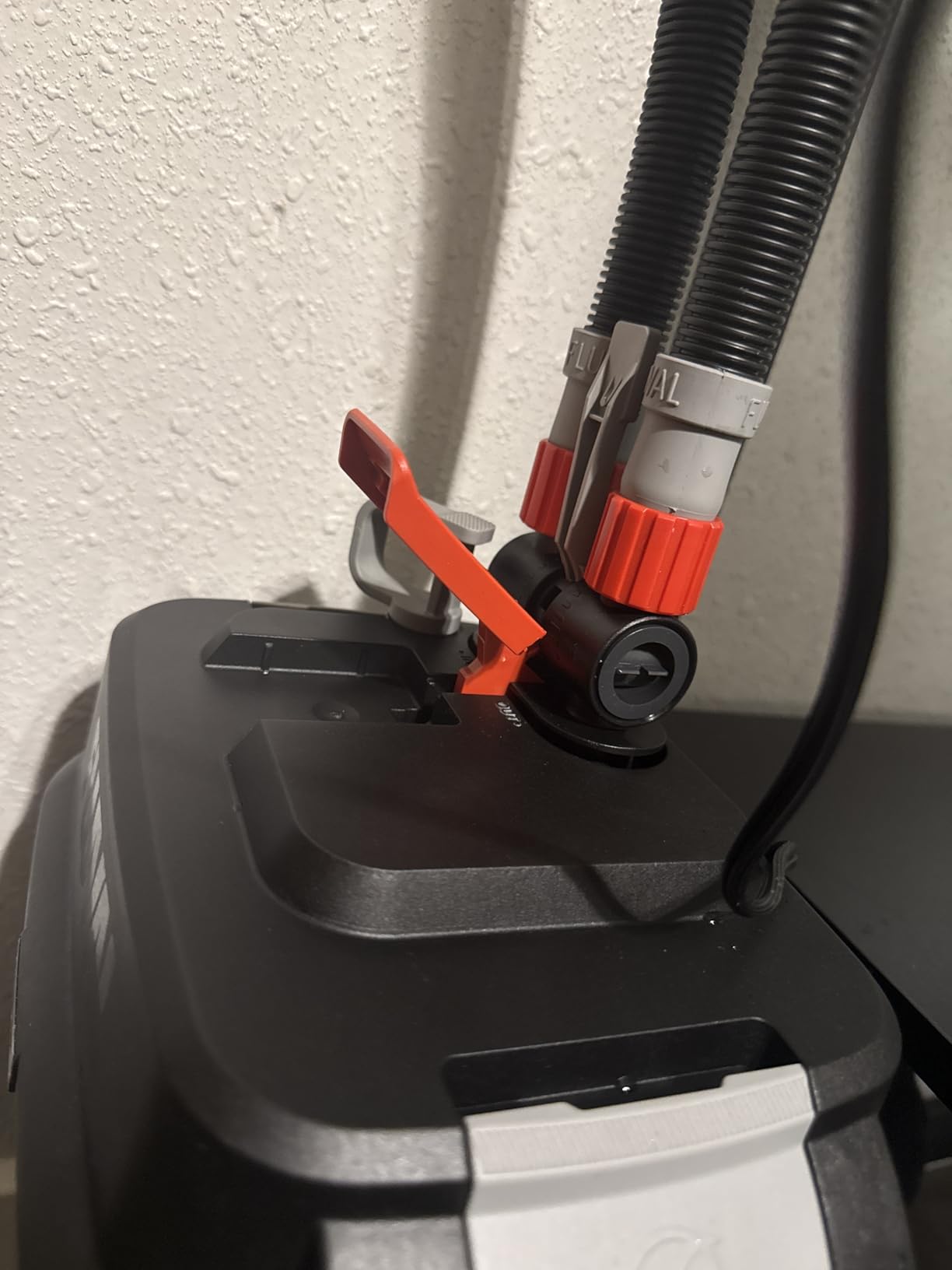
The reliability story is the part to read carefully. A repeating complaint runs through long-term owner reports of the impeller cover disengaging, which kills filtration and can force a motor head replacement. That is not a universal failure, and the 4.4 average reflects that most units run for years, but if you already run a sump, a canister failure has less consequence than it would otherwise.
Media is a cheaper story. The included carbon and floss pouches are described by buyers as half-size compared to standard Fluval media, and some describe the shipped media as second-market. Budget for a full set of proper Fluval carbon and filter floss rather than planning around what is in the box. The EZ-Lift baskets with center handles make that swap fast.
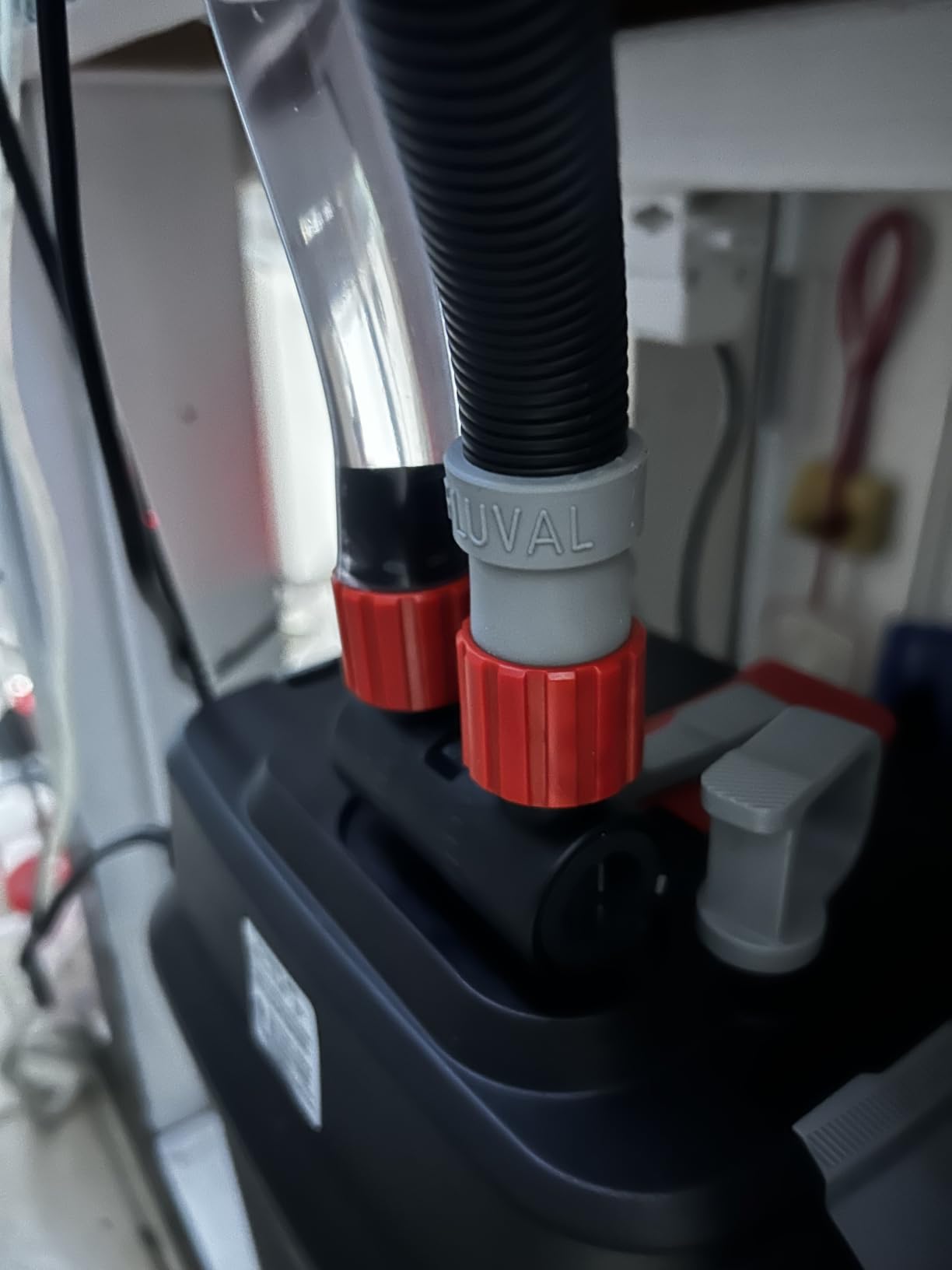
Prime it in the cabinet, not in the sink, and confirm the hose routing before you fill it. The quick-disconnect valves and lift-lock clamps are the two features that make this the least annoying canister to service weekly, and in saltwater that matters more than any headline spec.
What a 407 does well in a marine system
Rated to 100 gallons and manufacturer-built for it, the 407 covers a FOWLR display or a 55 gallon reef running as a supplement. The quiet operation is the decisive factor in a living space, and 10025 reviews is a large enough sample that the noise consensus is trustworthy rather than anecdotal.
The weekly service loop is the real advantage. A floss bag on the top basket, a coarse sponge below it, ceramic rings at the bottom, and a two-minute swap once a week is a routine you will actually keep. Canisters that turn into nitrate factories are usually canisters that are too much work to clean.
Where it falls short
The impeller cover disengagement reports are the main risk, and the thin instruction manual makes first assembly and startup more fiddly than it should be. If you are running this as your only filtration on a live system, have a backup plan for a power cut.
It is also simply large for tanks under 50 gallons. Measure the space under your stand before ordering, and decide whether a smaller model gives you the same quiet operation without the spare capacity you will not use.
2. Penn-Plax Cascade 1500 – Best Value for Larger Saltwater Systems
Penn-Plax Cascade 1500 Canister Filter, 350 GPH for Tanks Up to 200 Gallons
350 GPH rated flow
Rated to 200 gallons
15 lb, 20.5 in tall
45.5W power draw
Pros
- High 350 GPH throughput for large systems
- Five stackable baskets with built-in handles allow generous media layouts
- Rotating 360-degree valve taps simplify routing in tight cabinets
- Manufacturer rated for both freshwater and saltwater
Cons
- Bulky 20.5 inch height can be tight under some stands
- Higher power draw than the smaller Cascade models
The Cascade 1500 is the pick when you want maximum media configurability in a large fish-only or FOWLR tank. Five stackable media baskets is one more than anything else in this roundup, and in a saltwater canister that is not a small thing, because each stage is another place to keep detritus out of your biological media.
It is explicitly rated by the manufacturer for freshwater and saltwater, which removes the guesswork. The 350 GPH rating handles tanks up to 200 gallons, which puts it in range for a big FOWLR display or as a supplement on a reef where you want flow and a place to run GFO.
Owners highlight the five-basket layout and the 360-degree rotating valve taps, which is a genuinely clever feature in a cabinet. You can point the intake and outlet in any direction without fighting stiff hose, which matters more in a stand full of sump plumbing than any spec sheet suggests.
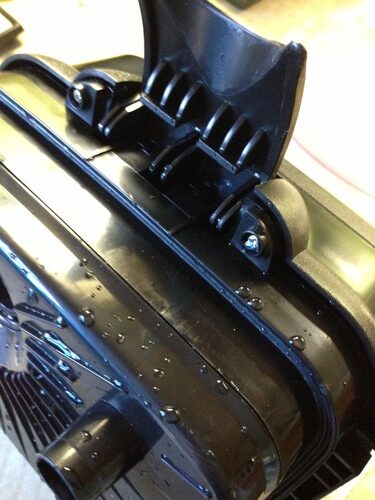
It comes with a full media package: floss pads, a coarse bio-sponge, a carbon bag, a spray bar and clamps. For a first marine canister, that is a complete stack on day one rather than an afternoon of separate purchases.
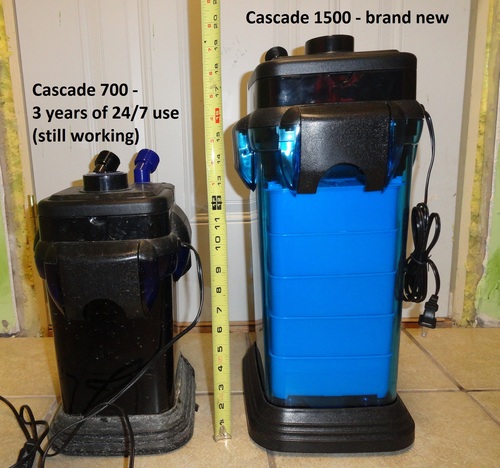
The tradeoff is physical. At 20.5 inches tall and 15 pounds, it is one of the taller units here, and owners specifically call out that the height is tight under some stands. Measure the vertical clearance of your cabinet opening, not just the footprint, before you commit.
The 45.5W power draw is higher than the smaller Cascade models, which matters for anyone running on a UPS for outage protection. If you are planning for outages, the wattage figure is a real input into how long your backup will carry the tank.
When the five-basket layout earns its keep
On a large FOWLR tank, media capacity is what keeps detritus out of the biological stage. Five baskets let you run a pre-filter, a fine floss bag, a carbon or GFO bag, a coarse sponge and a bio stage without stacking anything awkwardly or overfilling a single tray.
That matters more in marine water because there is rarely a dedicated refugium doing the nutrient export. A skimmer helps, but a canister with room for chemical media is doing real work in a closed system.
What to watch for before buying
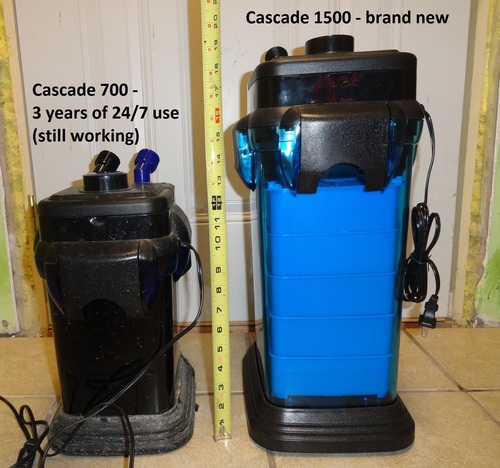
Height is the dealbreaker risk. If it does not fit under your stand, the 700 model at 15 inches gives you similar valve and clamp features in a smaller footprint, at the cost of two baskets instead of five.
The higher wattage draw also means this is not the unit to put on a small UPS if outage runtime is your priority. Plan a small battery backup and a manual prime instead.
3. Marineland Magniflow 400 GPH – Best for a Complete Out-of-the-Box Media Stack
Marineland Magniflow 400 GPH Canister Aquarium Filter
400 GPH three-stage flow
Rated to 100 gallons
19.27 lb, 18 in tall
Quick-prime button
Pros
- Clears cloudy water within days of installation per owners
- Very quiet compared with hang-on-back filters
- Generous included media package of foam
- carbon
- bio-balls and ceramic rings
- Stack N Flo trays force water through each layer in sequence
Cons
- Documented gasket and seal leak issues under the lid handles
- Supplied plastic hose clamps are weak
- rigid outflow tubing makes placement awkward
The Magniflow is the canister to look at if you want a complete working media stack without buying media separately. It ships with filter foam, activated carbon bags, bio-filter balls, ceramic rings and polishing pads, and the Stack N Flo trays force water through each layer in sequence, which is the arrangement you want in a marine canister.
At 400 GPH it is rated for freshwater or saltwater tanks up to 100 gallons. Owners frequently report dramatic clearing of chronic cloudy water within days, and many first-time canister owners say it solved persistent cloudiness and ammonia problems on systems that had been struggling with a hang-on-back.
It is also consistently described as very quiet for its class. The quick-prime button fills the chamber for self-priming startup, and the lift-off canister lid opens for media access without a full teardown, which is the feature that matters most for a weekly saltwater cleaning habit.
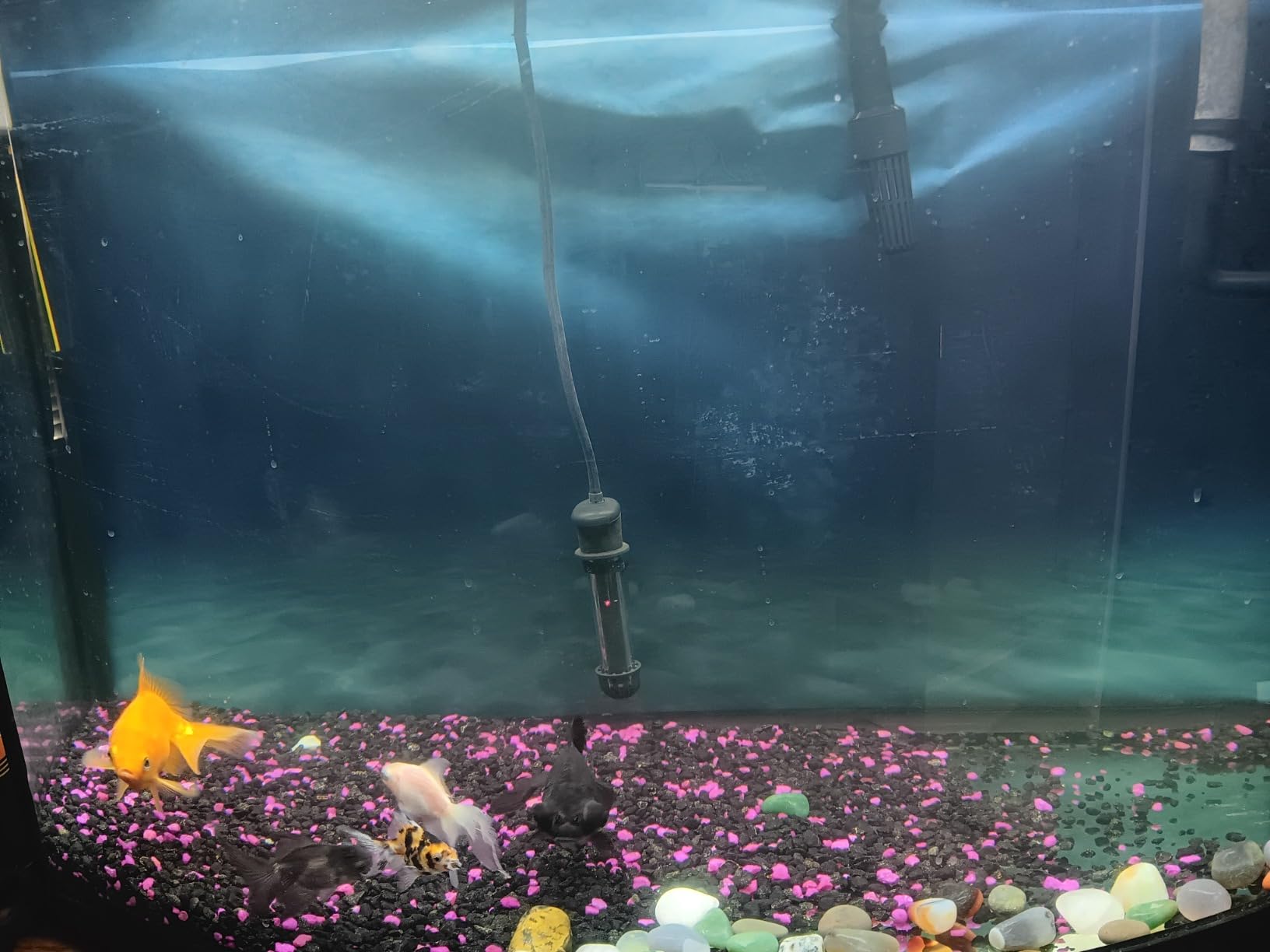
The dominant complaint is sealing, and it is specific enough that you can plan around it. Multiple reviewers document persistent leaks from under the lid handles, and the supplied plastic hose clamps are frequently described as weak. Replace the supplied clamps with metal ones before you fill the canister.
Getting replacement gaskets and seals has also been a frustration, particularly on units described as nearly new. The permo-elastic style sealing arrangement means you should inspect the gasket every time you open it and replace it rather than trying to reseal a tired one.
Outflow placement is another real-world niggle. The rigid tubing makes the return awkward to aim, and the discharge mount uses a single suction cup, so plan a stable position for the spray bar rather than assuming it will hold anywhere you put it.
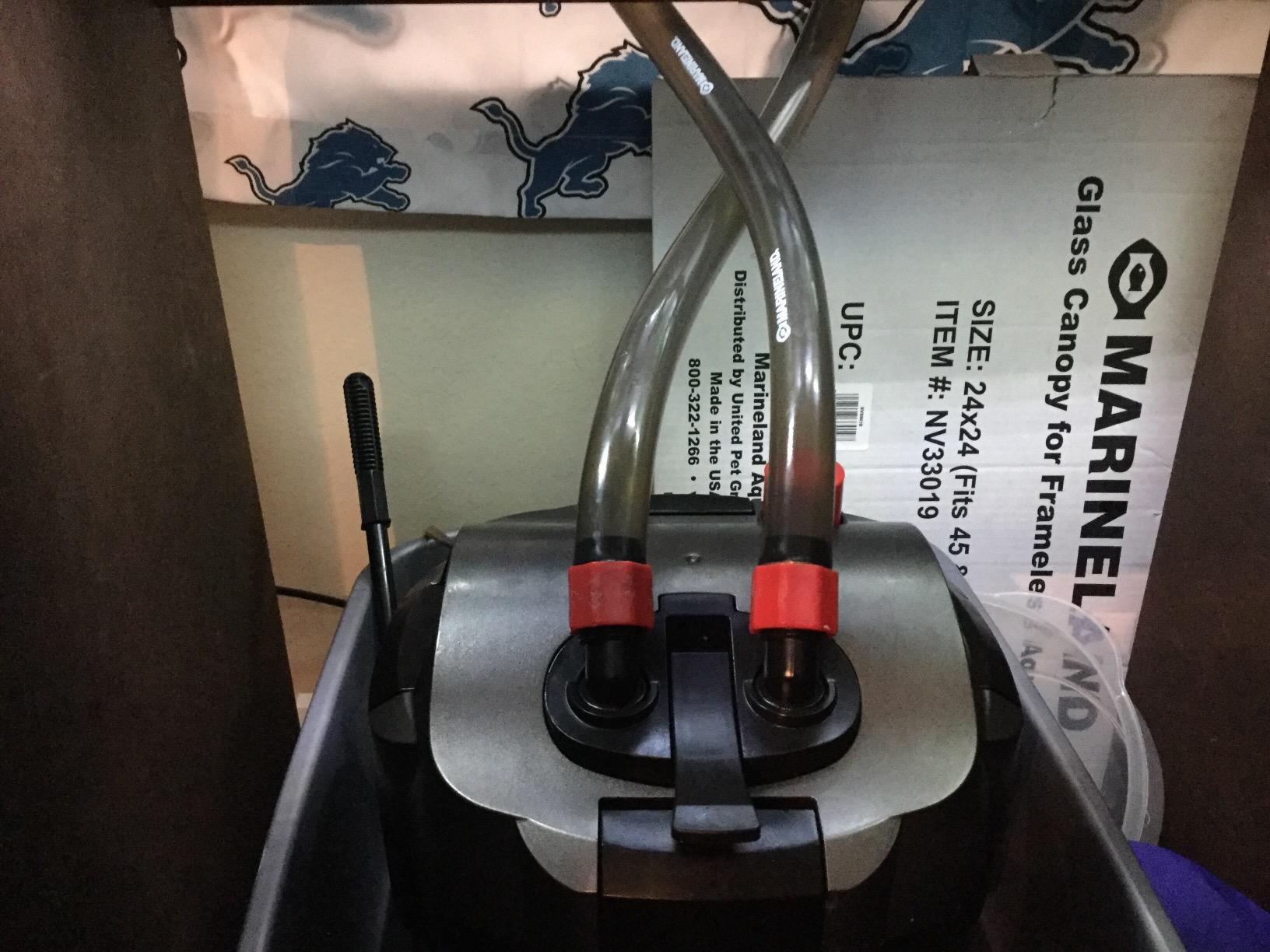
Why the included media matters for a reef
For a first marine canister, a unit that arrives with a full stack lets you get filtration running on day one instead of running a half-empty canister for a week. The media it includes is enough for mechanical, chemical and biological staging in the correct order.
Media flexibility is decent too. Owners report the trays accept most standard filter bags, so you can move to GFO or reef-grade carbon later without a hardware change.
Where the Magniflow frustrates owners
Leaks from the lid handles are the dealbreaker risk in a saltwater setup, because your stand is the electronics cabinet. Fix the clamps up front, check the gasket on every service, and keep a towel within reach for the first week.
Some units also produce microbubbles or a rattling prime pump. In a display tank that is visible and distracting, so have a plan to break siphon on the return line if you see it.
4. Marineland Magnum 290 GPH – BUDGET PICK for Polishing and Small Systems
Marineland Magnum 290 GPH Polishing Canister Aquarium Filter
290 GPH turnover
Submerged motor needs no priming
2.91 lb, 9.88 in tall
Two refillable chambers
Pros
- Compact and lightweight footprint relative to its flow rate
- Submerged motor removes the need for external priming
- Included micron cartridge for water clarity
- Refillable chambers accept carbon or custom media
Cons
- Polishing-oriented design rather than high-flow circulation
- Small canister body limits total media volume
- Micron cartridge consumables add ongoing cost
The Magnum is not a reef circulation filter and we want to be clear about that. It is a compact polishing canister that sits in the category of finishing a system rather than driving filtration for it, and it earns its place on the list because it solves one specific problem cheaply: putting a fine polish stage on a smaller display tank.
At 290 GPH it is rated for aquariums up to 97 gallons, but the honest use case is smaller. The two refillable chambers take carbon or custom media, and the included micron cartridge does the fine water-clarity work that a coarse sponge cannot.
What makes it convenient in a marine system is the internal submerged motor. There is no external priming stage, so after a power cut or a service you can get it running again in a fraction of the time a siphon-primed canister takes. That single feature is why it earns its spot for nano and small display tanks.
It is also genuinely compact at 9.88 inches tall and 2.91 pounds, so it fits under stands where a full-size canister will not. For a bedroom reef or a nano display on a small cabinet, that is a real constraint solved.
The trade-off is media volume. A small canister body holds a limited amount of media, and in a reef tank that means less surface area for nitrifying bacteria than you would want if this were your only filter. Treat it as a supplement to a sump or skimmer rather than a replacement for one.
The micron cartridge is a consumable, so budget for replacements rather than treating the included cartridge as a permanent stage. Run it lightly and change it only when the return flow visibly drops.
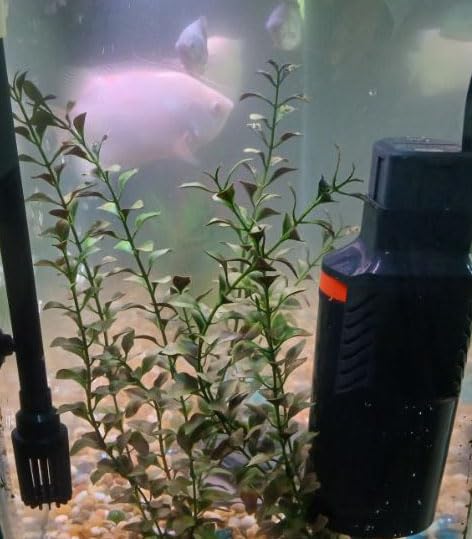
Where the Magnum actually fits
On a nano or small mixed reef with a sump, the Magnum is a good polisher. It adds a fine filtration stage and a return nozzle without taking cabinet space, and the submerged motor makes outages a non-event because there is nothing to prime by hand.
On a fish-only tank in the 30 to 50 gallon range it can serve as a standalone filter if your stocking is light and you run regular water changes. It is not the answer for a high fish load system.
What it cannot do
It will not provide reef-scale turnover. If your target is a 10x or higher turnover on a display tank, this unit does not get you there and pairing two is a workaround with the same media volume problem.
It also adds a cartridge cost on top of whatever media you already run. On a system where you are already changing carbon monthly, that is a second consumable line for modest gain.
5. Fluval FX6 – TOP RATED for Large Displays and Paired Installations
Fluval FX6 High Performance Aquarium Filter, up to 400 Gal.
925 GPH rated flow
Rated up to 400 gallons
19.9 lb, 20.7 in tall
1.5 gallon media baskets
Pros
- Highest rated flow in this roundup at 925 GPH
- Self-starting Smart Pump needs no manual suction
- 1.5 gallon removable media baskets support heavy biological media
- Impeller and O-rings are user replaceable without tools
Cons
- Largest and heaviest unit here with a bulky footprint
- Very long supplied intake tube risks picking up sand substrate
- Automatic 12 hour air evacuation cycle causes a brief stop and gurgle
The FX6 carries a 4.6 average and 83 percent five-star ratings, the highest rating in this group, and it does so on a 925 GPH rating that is more than double the mid-size units here. It is the pick for a large display reef running two canisters, or a big fish-only system where you want finished water in a single day.
The Smart Pump is the feature that changes daily life. It self-starts after you add water, and trapped air is auto-evacuated every 12 hours, so the slow loss of prime that plagues other canisters over months is handled without you opening the lid.
Owners describe it as near-silently running and clearing cloudy water overnight. The 1.5 gallon of removable stackable media baskets give you serious biological capacity, which is the single most important number in a marine canister.
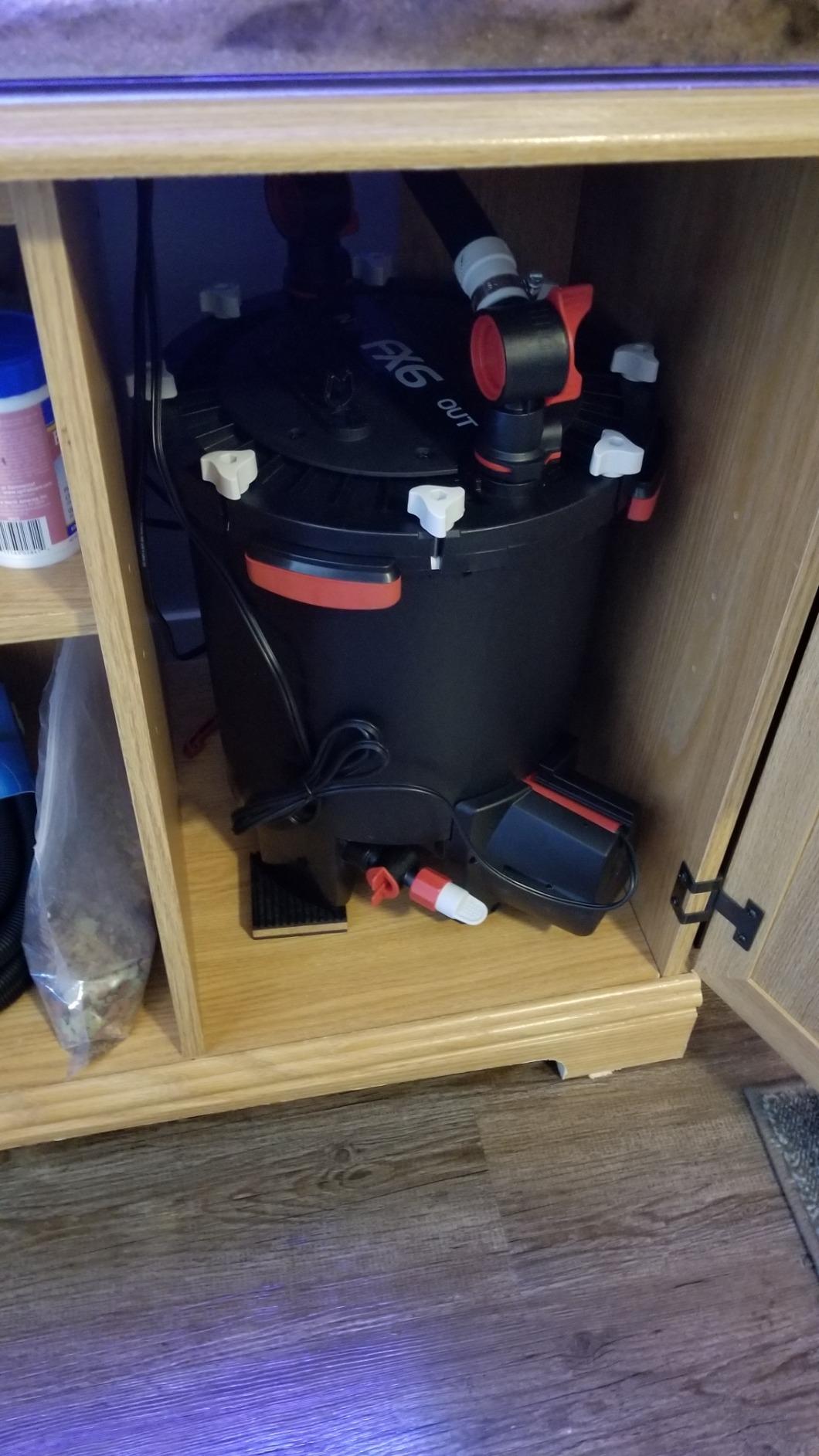
Serviceability is genuinely excellent. The impeller and O-rings are user replaceable without special tools, which removes the failure mode that worries you most about an expensive canister, and the integrated drain valve simplifies large water changes straight from the unit.
At 19.9 pounds and 20.7 inches tall it is large, and owners specifically call out that it can dominate a small stand. The stiff oversized hoses are also reported as difficult to route in tight cabinets, so measure before you commit.
The very long supplied intake tube is the one that will bite you. It cannot be shortened as supplied, and in a sand-bottom marine tank a long intake close to the substrate line is a sand trap. Use a raised intake or a lily pipe and keep the opening well clear of the sand.
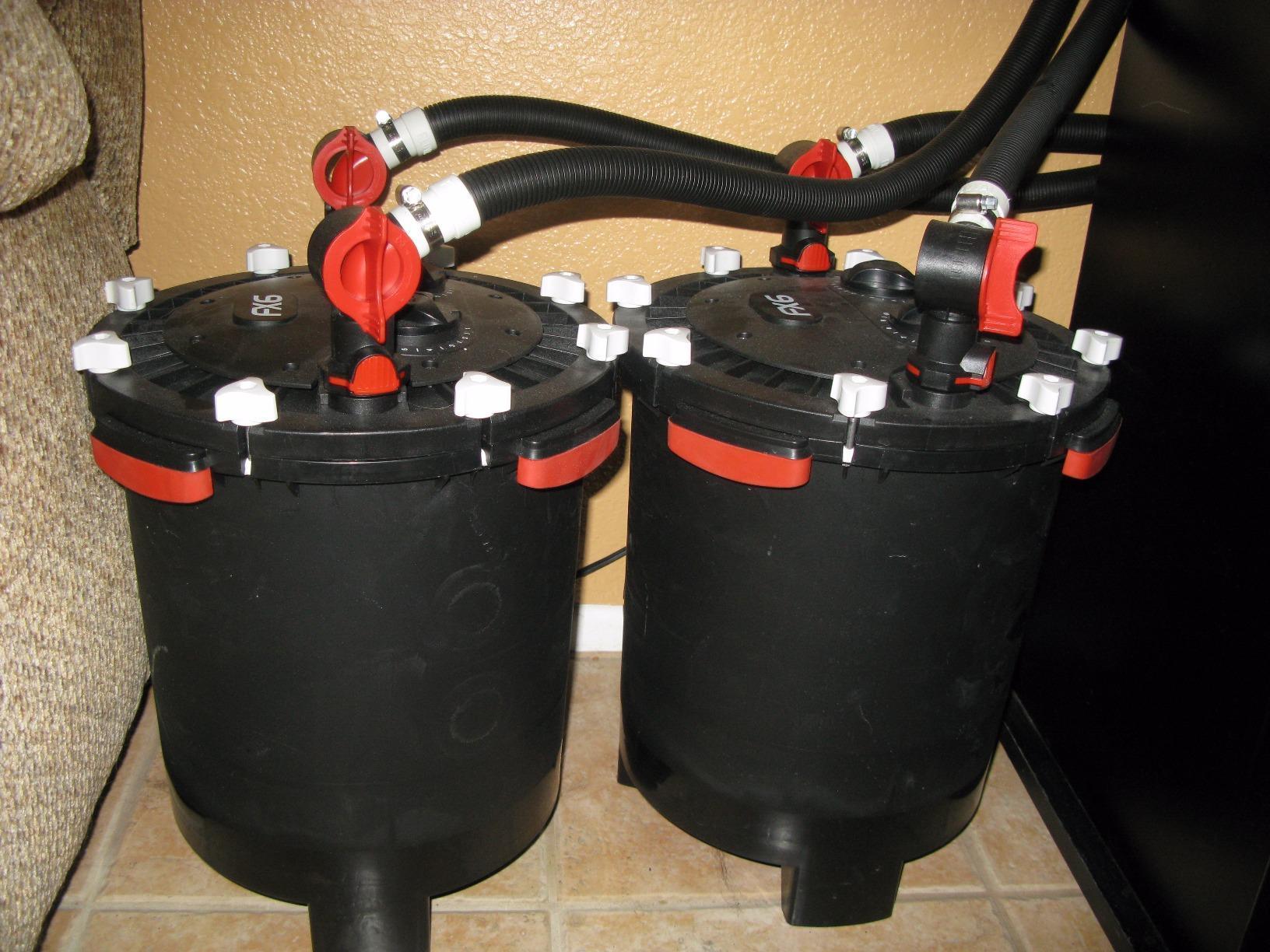
When the FX6 is the right call
Large systems only. If you are running a display tank over 100 gallons or pairing two canisters for circulation and filtration, the flow rating and media volume here justify the size. The 1.5 gallon basket capacity is what lets you stage floss, chemical media and a substantial bio stage without crowding.
It is also the right pick for anyone who values serviceability over price. Replaceable impeller and O-rings mean a five-year failure does not end the unit.
Where it disappoints
Size is the main issue, and it is a hard one. A 21 inch tall unit will not fit under a lot of standard stands, and owners who assumed it would are the ones who regret it.
The automatic 12-hour air evacuation cycle produces a brief stop and gurgle that some find alarming the first time they hear it. The instructions are also thin, so allow extra time for first assembly and startup.
6. EHEIM Classic 2213 – BEST FOR COMPACT FISH-ONLY SETUPS
EHEIM Classic Canister Filter 2213, Classic 250 – PetOverstock
Multiple capacity variants
Silicon seal fixed to pump head
4.49 lb, 13.98 in tall
Manual priming
Pros
- Long-established European design with a very long service record
- Compact footprint and low weight for its rated capacity
- Fixed silicon sealing ring on the pump head simplifies reassembly
- Supplied with complete media
- spray bar and valves
Cons
- Not self-priming and requires manual priming
- Lower media capacity than modern high-flow designs
- Older generation design without digital flow control
The EHEIM Classic is the simplest mechanism in this roundup and that is exactly why it is here. A permo-elastic silicon sealing ring is fixed to the pump head, so when you take the canister apart for a weekly saltwater service the seal goes back on the same way every time. No alignment, no guesswork.
It is available in multiple capacity variants, so you can match the unit to a small fish-only display without over-provisioning flow the way a 407 would in a 40 gallon tank. At 4.49 pounds and 13.98 inches tall it is the most compact and lightest canister we list.
It arrives complete with EHEIM Mech and Substrat Pro media, a spray bar, an inlet pipe, hose, installation accessories and valves. For a first marine canister, the completeness is a genuine advantage.
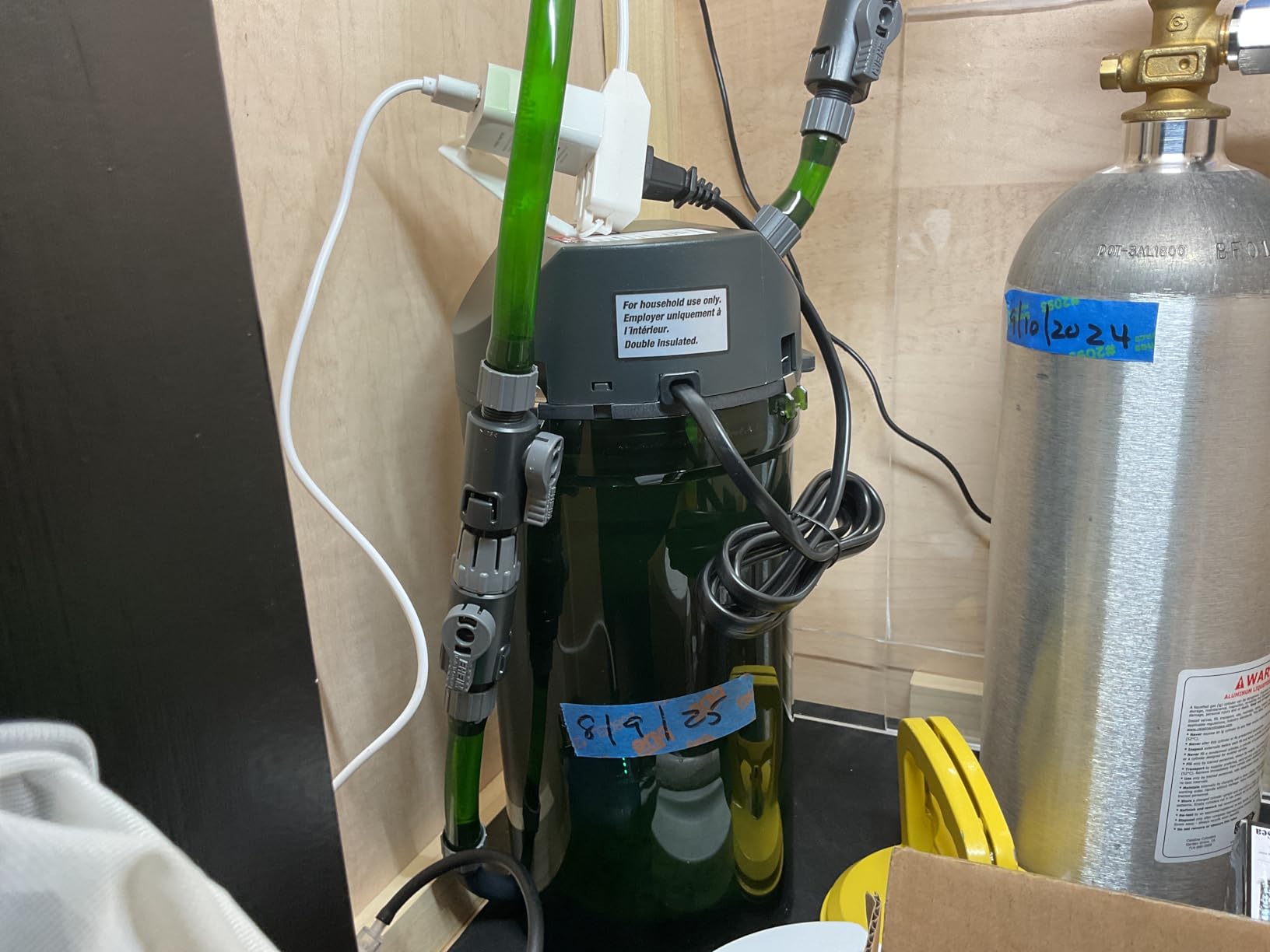
It is an older generation design, and that shows up in the media capacity. Compared with the stackable baskets on the Fluval and Penn-Plax units, the Classic holds less, and it has no digital or electronic flow control of any kind.
It is also not self-priming. You prime it by hand with a siphon or a priming tool after every service and after every power cut, which in saltwater is more than a minor annoyance. Plan your power outage procedure accordingly.
One small practical note: loose filter media can spill if the baskets are overfilled. When you top it back up after a clean, leave headroom.
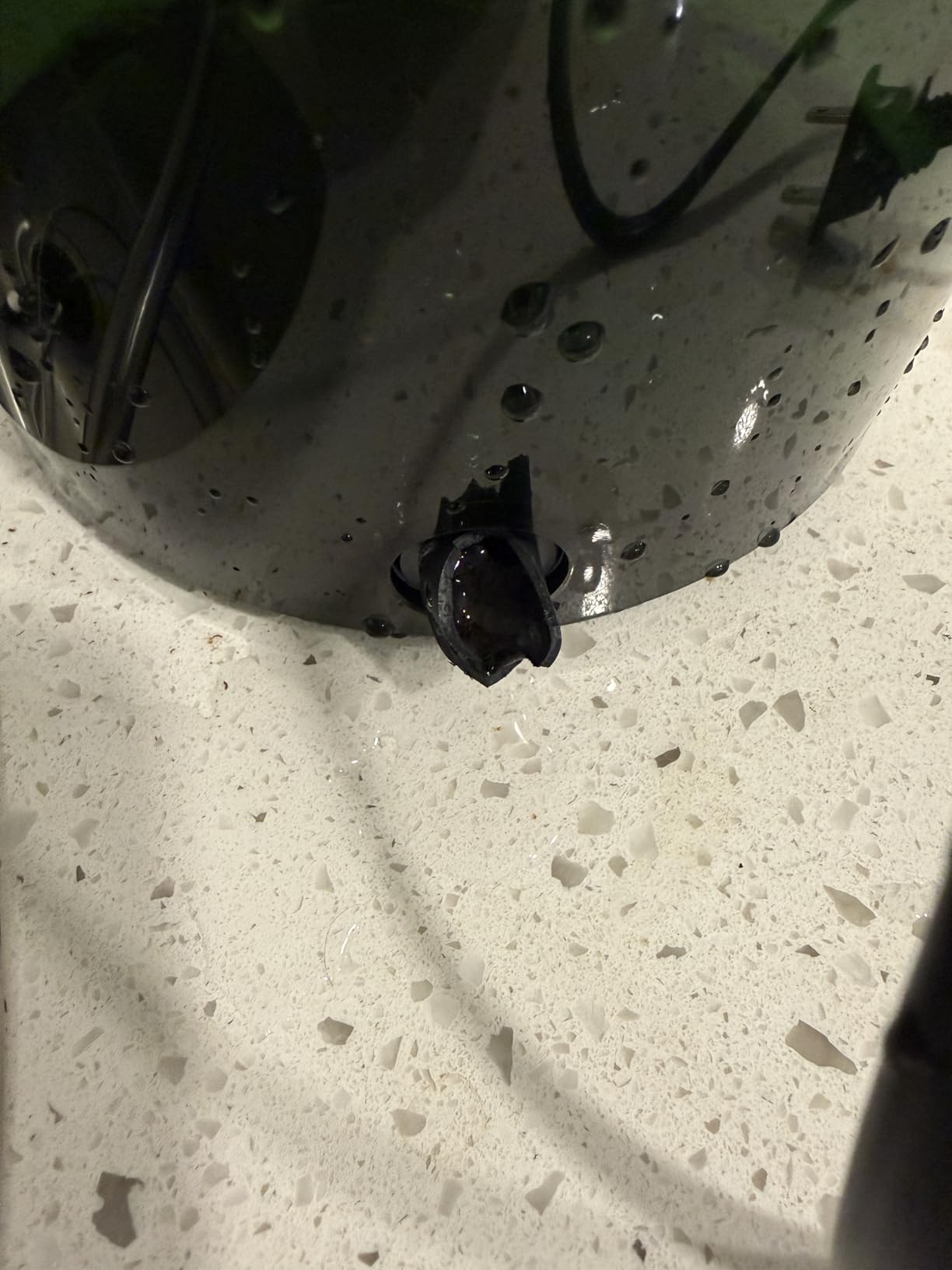
Why the older design still makes sense
Mechanical simplicity is underrated in a cabinet. A fixed pump-head seal and a straightforward valve layout mean fewer things can fail in ways that need a replacement part you cannot get, and the design has a very long service record in the hobby.
For a fish-only or FOWLR tank in the 40 gallon range, the compact size and low weight solve a real cabinet problem, and the supplied media package gets you running immediately.
Where it will frustrate you
Manual priming is the one that changes your weekly routine. Budget a couple of minutes and a siphon hose, and keep them next to the stand so you are not digging for them with wet hands.
On a reef tank, the low media volume means it is a supplement rather than a primary filter. Pair it with a skimmer or refugium rather than trusting it alone.
7. Penn-Plax Cascade 700 – BEST FOR 40 TO 65 GALLON FISH-ONLY TANKS
Penn-Plax Cascade 700 Canister Filter – 185 GPH for Tanks Up to 65 Gallons
185 GPH rated flow
Rated to 65 gallons
10 lb, 15 in tall
25W power draw
Pros
- 185 GPH flow is well matched to tanks in the 40 to 65 gallon range
- Compact 15 inch height fits more stand layouts than the 1500 model
- Lower 25W power draw than the larger Cascade
- Rotating 360-degree valve taps simplify cabinet routing
Cons
- Only two media baskets limits configuration options
- Flow is modest for larger reef systems
- Ratings and reviews are shared across the Cascade listings
The Cascade 700 is the correctly sized unit in this roundup for a 40 to 65 gallon fish-only or FOWLR tank. The 185 GPH rating lands where a 50 gallon marine display actually needs to be, instead of the 400 GPH class where you would be running a lot of unused flow.
It is rated by the manufacturer for both freshwater and saltwater, and it shares the Cascade line’s push-button primer and dual 360-degree rotating valve taps. Those taps are the feature we like most in a small cabinet, because you can point hoses where you need them without a fight.
At 15 inches tall and 10 pounds it fits under stands that will not take the 1500 model, and the 25W draw is less than half the larger unit’s wattage, which is a meaningful difference if you plan to run it on a UPS.
It comes with floss pads, a bio-sponge, a carbon bag, a spray bar and clamps, so it is a complete working filter on arrival. The push-button primer gets it running without refilling the canister.
Two media baskets is the limitation. In a marine canister that is a real constraint, because you want a fine mechanical stage, a chemical stage and a bio stage and you only have two trays to divide between them. You will end up using bagged media inside a single basket.
Flow is also modest once you account for head height. On anything above about 65 gallons, or on a reef where you want a higher turnover number, this unit is not enough.
The right size for a small marine display
On a 40 to 65 gallon fish-only tank, the 185 GPH figure is the honest match, and the compact body means it goes under stands where bigger units do not. The lower wattage draw makes it the most practical of the Cascade line to pair with a small battery backup.
The rotating valve taps make routing in a crowded cabinet simple, and the push-button primer means a restart after a power cut is a ten-second job rather than a siphon job.
Where the two-basket limit bites
Staging reef media in two baskets is the core problem. You cannot cleanly separate mechanical, chemical and biological media, and a single overfilled basket is where detritus collects and turns into nitrate.
One reading caution: the Cascade series listings share rating and review totals, so owner feedback is not always clearly model specific. Weigh this unit on its published specs rather than on a star average pulled from a family of models.
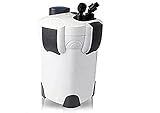
8. SunSun HW-304B Pro – BEST FOR BUILT-IN UV ON A LARGE FISH-ONLY TANK
Sunsun Hw304B 525GPH Pro Canister Filter Kit with 9-watt UV Sterilizer
525 GPH flow
Rated to 150 gallons
17 lb, 18 in tall
9 watt UV sterilizer
Pros
- Integrated 9 watt UV sterilizer adds pathogen and algae control in one unit
- 525 GPH handles systems up to 150 gallons
- Four media baskets allow a fuller stack than most similarly sized units
- Generous included media of pads
- carbon
- ceramic rings and bio balls
Cons
- UV bulb and ballast replacement adds service parts
- Pre-installed tubing and lid seal are fiddly to reassemble
- Reports of hoses disconnecting during maintenance
The HW-304B Pro is the pick if your priority in marine water is parasite and algae control alongside filtration. The integrated 9 watt UV sterilizer is the reason to choose it, and it is something you would otherwise bolt onto the return line as a separate inline unit.
Flow is 525 GPH with a rating up to 150 gallons, and it includes four media baskets. Four baskets is more staging room than most units in this flow class, which means you can run floss, chemical media and a real biological stage without overfilling anything.
The kit is genuinely complete. It includes four white filter pads, a blue coarse pad, a pound of carbon, a pound of ceramic rings and a set of bio balls, so the media stack is complete on day one.
Owners point to strong flow relative to what this class of unit usually delivers, and a compact square footprint for the flow rating, which matters under a stand. Four baskets also means the media stays where you put it instead of being bagged inside one crowded tray.
The UV is a real tool in a marine tank, particularly for algae and nuisance organism control, and having it integrated means one hose connection and one power lead instead of three.
The service burden is the trade. UV bulb and ballast replacement are parts you source separately, so treat the UV stage as a consumable with a schedule rather than a permanent feature.
When the integrated UV earns its place
On a 100 to 150 gallon fish-only or FOWLR system with a high fish load, the 525 GPH flow and four baskets handle mechanical, chemical and biological staging well, and the UV adds a level of pathogen control you would otherwise buy as an add-on.
It is also one of the few units here with a genuinely complete media package included, which reduces the cost and time of getting a marine canister running properly.
What to plan around
Assembly and sealing take more care than on a self-priming Western unit. Pre-installed tubing and the lid seal are the fiddly parts, and some owners report hoses disconnecting during maintenance, so check every connection after each service.
Source the UV bulb and ballast before you need them rather than at the moment the UV stage stops doing anything.
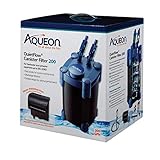
9. Aqueon QuietFlow 55 Gallon – BEST FOR EASY POLISHING ACCESS
Aqueon QuietFlow Canister Aquarium Filter, Up to 55 Gallons (ECOM)
Fits tanks up to 55 gallons
Included hang-on-back polishing unit
14.55 lb, 17.25 in tall
One year warranty
Pros
- Included hang-on-back polishing unit gives access to a wear cartridge without opening the canister
- Three return options adapt it to different tank layouts
- Quick-disconnect valves simplify maintenance
- Quiet operation backed by a 4.4 average
Cons
- Limited to 55 gallons in this configuration
- Polishing cartridge is a recurring consumable
- Bulkier 17.25 inch height and weight for its rated capacity
The QuietFlow’s distinguishing feature is the hang-on-back polishing unit that comes with it. Instead of opening the canister to change a fine cartridge, you swap a large Aqueon replacement cartridge on the included polishing unit, which is the closest thing to a trivial media change in this roundup.
That matters in saltwater because the canister itself still needs weekly attention. The polishing unit handles the fine stage; the canister handles mechanical and biological. You get the granularity without a full teardown every week.
It is a 4.4 average across roughly a thousand reviews, so the quietness claim has real support. Owners also value the three return options, spray bar, water director and polishing unit, which let you fit the return to a display tank with a tight rim.
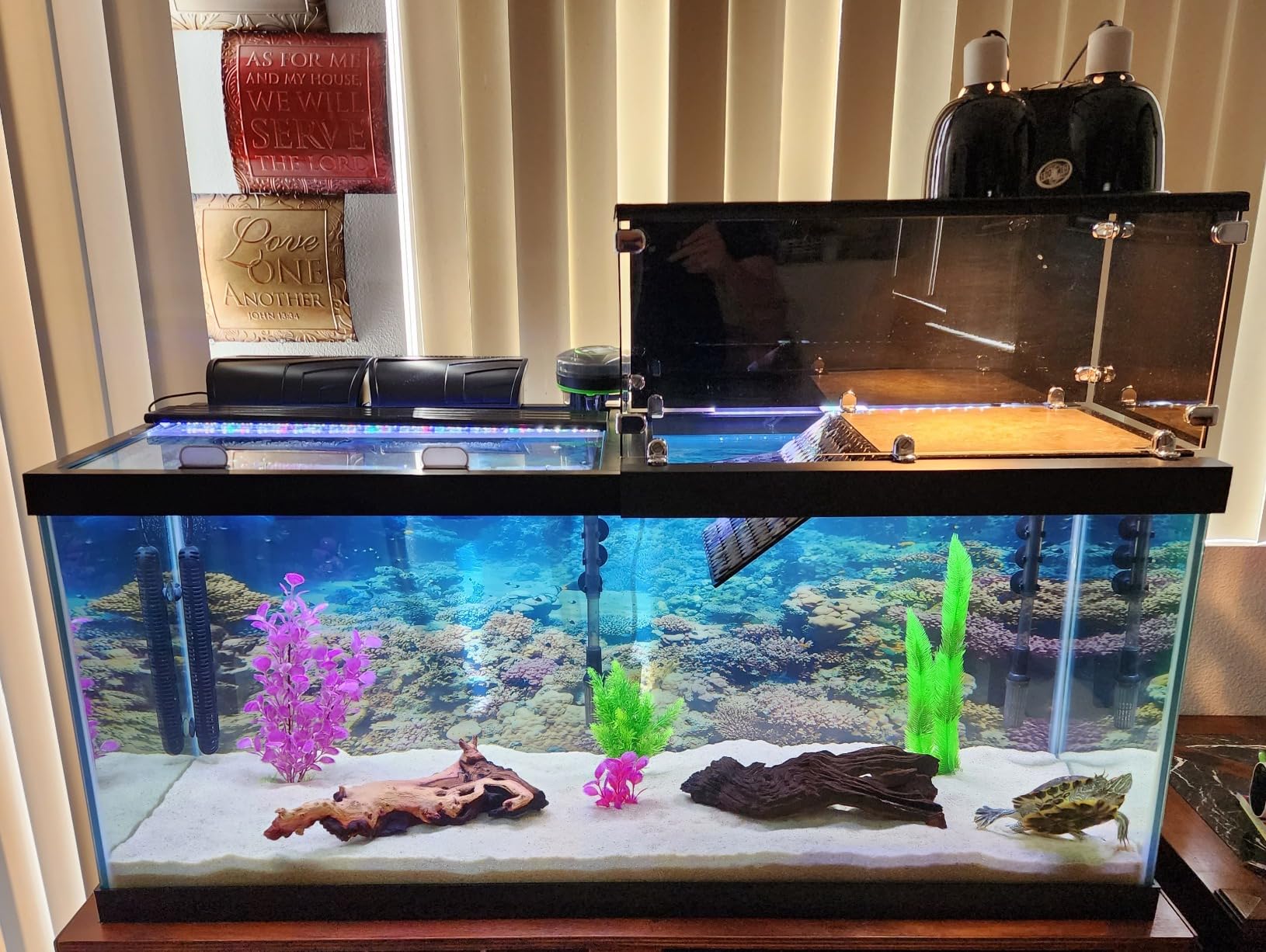
The media flexibility is decent for a unit this size. It includes activated carbon, coarse foam, bio-balls and bio-ceramic rings, and quick-disconnect valves plus pump locking heads make the routine service straightforward.
Maintenance guidance from the manufacturer is clear: change the carbon every 30 days and rinse or replace the foam pad as needed. In practice on a marine tank you will be swapping the foam far more often than that, which is the correct behaviour.
The included accessories cover the hoses, quick-disconnect valves, pump locking heads, intake and output connections, so it is ready to install without a second trip for parts.
Why the polishing unit is the deciding factor
In a saltwater system, a filter that makes you less likely to skip a change is worth more than one with a longer spec sheet. Swapping a cartridge on a hang-on-back polishing unit takes seconds and does not involve opening a canister in a cabinet full of electronics.
For a display tank in the 40 to 55 gallon range, that combination of quiet operation, three return options and trivial polishing changes is a genuinely pleasant ownership experience.
Where the capacity stops
This configuration is limited to 55 gallons. Above that you need a larger variant or a different unit entirely, and the flow this version provides will not support a reef turnover target.
It is also bulkier than its rated capacity suggests at 17.25 inches tall and 14.55 pounds, and the polishing cartridge is a recurring consumable cost that does not exist on a pure sponge stack.
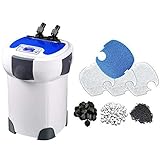
10. SunSun HW-3000 PRO – BEST FOR FLOW AND UV SCHEDULING CONTROLS
SunSun HW-3000 UV 9W 5-Stage External Canister Filter w/Media, 793gph, White, HW-3000 PRO
Adjustable 396 to 793 GPH
LCD control panel
22.05 lb
5 stages with 9 watt UV
Pros
- Widest adjustable flow range here at 396 to 793 GPH on one unit
- Large media capacity that owners report stays clean after months
- No priming pump required once set up
- Programmable UV runtime and LCD flow control
Cons
- No working priming pump and startup after a cleaning can take over an hour
- Wide hoses hold large air volumes that make restarts difficult
- Short intake tube may not reach the bottom of deeper tanks
The HW-3000 PRO is the only canister here where you can dial flow down rather than buying a smaller unit. Adjustable flow from 396 to 793 GPH on an LCD panel, with a programmable UV runtime, is a genuinely useful combination on a reef where you want high circulation in one place and gentler flow elsewhere.
It is explicitly suited to both freshwater and saltwater aquariums, and the five-stage canister layout gives real media capacity. Several long-term owners report that the media still needs cleaning after months, which tells you the internal volume is doing what it should.
Double O-ring connectors and a sturdy canister body are reported leak-free over long runs, and hoses disconnect easily for cleaning. It is quiet at low to medium power settings and very quiet at a distance.
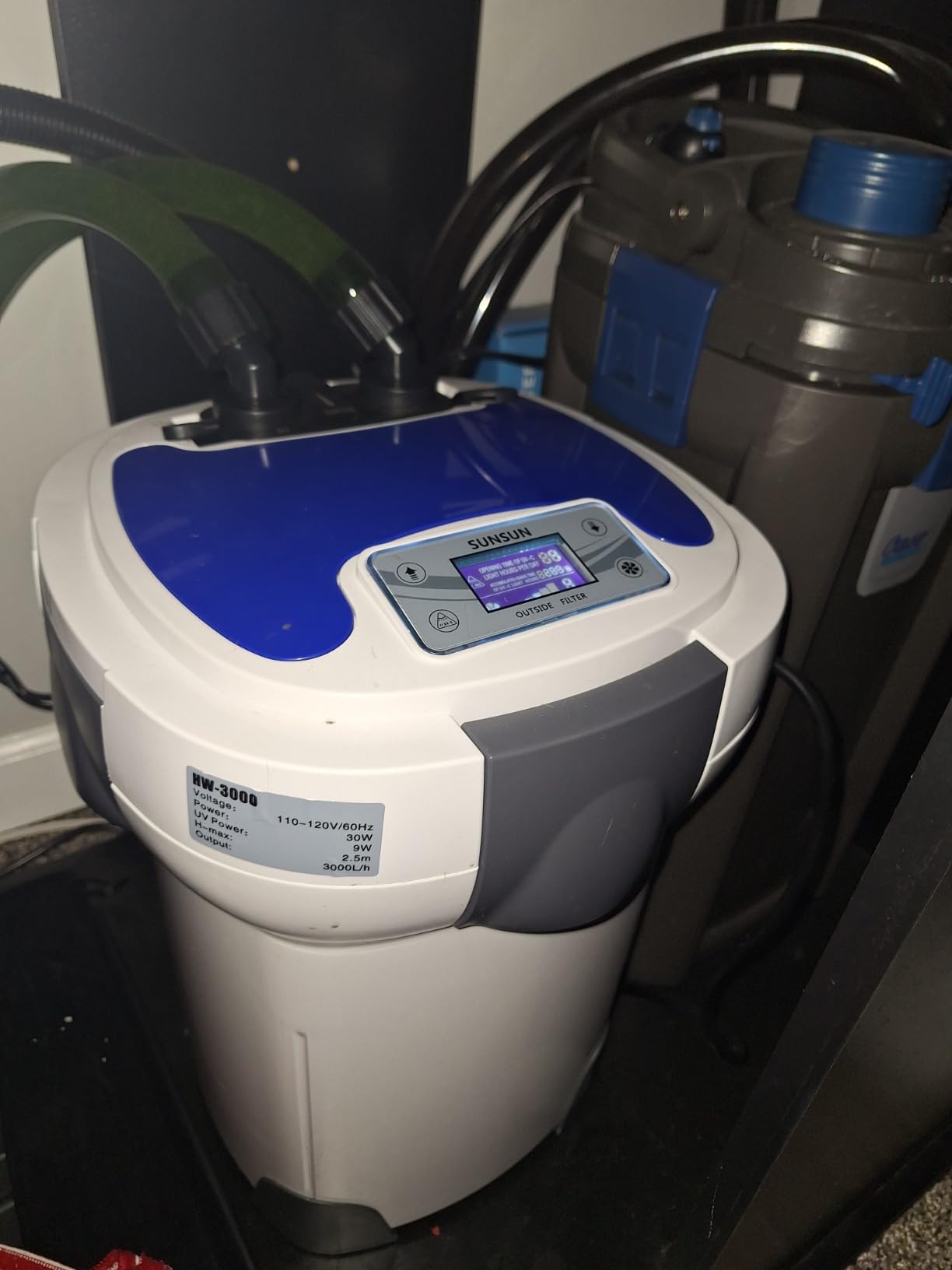
The startup story is the weak point and it is the one that matters most in a system with no sump. Despite what the documentation suggests, there is no functioning priming pump, and the wide hoses hold large air volumes that make priming after a service take over an hour in owner reports.
On a fish-only tank with a manual siphon and a spare bucket, an hour is annoying but survivable. On a reef with a skimmer and sensitive corals, we would not make this your only filtration.
Size is the other concern. At 22.05 pounds with a tall body, owners report it has to be laid nearly horizontal in some cabinets, which can stress the main seal. Check your clearance carefully.
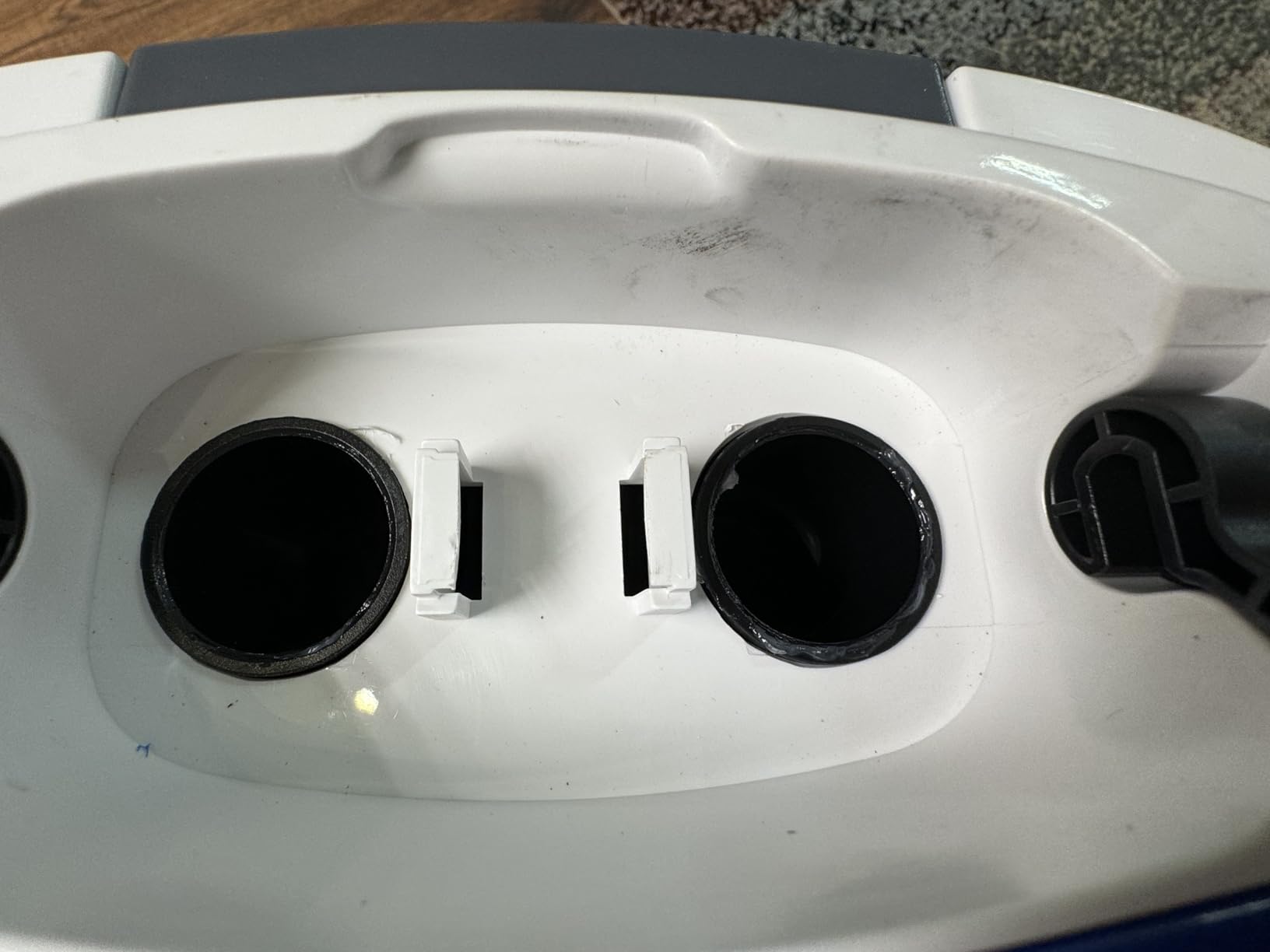
What the LCD and flow control buy you
Turning flow down is the feature that separates this from every other unit in the list. On a mixed reef you can run a high rate for circulation during the day and drop it at night, and on an SPS display you can tune rather than compromise. The programmable UV runtime is useful for nuisance organism work.
The five-stage layout and large media capacity are genuine strengths, and the easy hose disconnection is a real quality of life feature for weekly service.
Where it will let you down
Startup is the dealbreaker risk. An hour of manual priming after every cleaning, in a cabinet, with wet hands, is a routine that erodes fast. Factor that into how often you realistically want to service the filter.
It is also the loudest of the group at the highest power settings, the panel light does not dim, the intake tube is short for deeper tanks, and there are isolated reports of controller and electrical failures. That last point is why we place it at the bottom of the list despite the strong feature set.
What Flow Rate Does a Saltwater Tank Actually Need?
Turnover rate is how many times your tank volume passes through the filter in an hour, and saltwater targets run higher than the 4x to 6x rule you will read in freshwater canister guides. Reef keepers quote figures ranging from about 3x per hour on a sump for general circulation, with 5x per hour as a minimum on fish-only tanks.
Use these tiers as your starting point, then adjust for what you keep. A fish-only tank needs less than a reef. A mixed reef with soft corals needs more. SPS and LPS tanks want the most, because those corals are built for it.
For a 100 gallon fish-only tank, 3x to 5x puts you at 300 to 500 GPH, which is where the Fluval 407, the Penn-Plax Cascade 700 and the Marineland Magniflow sit. For a 100 gallon FOWLR tank, 5x to 10x puts you at 500 to 1000 GPH, which is Cascade 1500, SunSun HW-304B or the FX6 territory. For an SPS display, you are looking at paired canisters or a sump.
Now the part that catches most people out. Rated GPH is measured at zero head height, and your canister has to lift water from inside the cabinet up to the rim of your tank. Real delivered flow typically drops 30 to 40 percent once that lift is factored in. Size for the flow you actually need at the rim, not the number on the box.
When sizing, remember our saltwater equipment checklist approach: measure head height first, then size, then think about media. A 350 GPH canister lifting water 30 inches to a rim is delivering flow closer to the 220 to 250 GPH range in practice, and that number is what has to clear your turnover target.
And yes, you can have too much flow. Watch for constant surface agitation that is stripping gas exchange and driving a protein skimmer into overproduction, a return nozzle pointed hard enough to sandblast coral tissue, or a display tank where surface chop is disturbing gas exchange at the surface. A valve with flow control, or a spray bar turned down at the end of the run, solves most of it.
To read whether flow is too strong for your fish, the signs are consistent: fish holding station just above the flow instead of in it, corals with tissue recession on the side facing the return, and soft corals bent permanently in the current direction. A wavemaker on a timer handles the reverse case, where flow is too gentle and detritus settles in low-flow corners.
The Reef-Safe Filter Media Stack
Order matters more than brand in a marine canister. Water enters at the bottom, travels upward, and exits through the spray bar, so the first basket it meets should be the one that catches detritus. Get this wrong and you are pushing fine particles straight into your biological media, which is how a canister turns into a nitrate factory.
Mechanical goes on the bottom stage, nearest the intake: a coarse sponge or a floss bag, changed weekly. Floss catches what the sponge lets past, and swapping it often is the single highest-value maintenance habit in a closed system.
Chemical sits in the middle: granular ferric oxide for phosphate export, or reef-grade activated carbon for dissolved organics and yellowing water. The reef community commonly runs GFO rather than standard sponges for nutrient control, and the AI Overview on this query raised exactly that point. GFO and carbon do different jobs, so pick one based on whether you are chasing phosphates or clarity.
Biological goes on the top stage, closest to the outlet: ceramic rings, MarinePure-style high-surface-area media, or bio-balls. The higher the surface area per basket, the more nitrifying bacteria you can support, which is why the 1.5 gallon baskets on the FX6 matter more than they look.
Two rules that are not optional in seawater. Never rinse biological media in tap water; use RO/DI water or tank water, and never let biological media sit dry during a service. Swap chemical media on its own schedule rather than at every clean, and pre-soak new carbon and GFO in tank water so it does not shed a spike of contaminants on day one.
The Nitrate Factory Problem and the Cleaning Cadence That Prevents It
A canister becomes a nitrate factory when it holds more detritus than the system can export. In a freshwater tank with weekly water changes, the accumulated detritus gets flushed routinely. In a closed reef with no water change, the same detritus just decays in place, and the products are nitrate and phosphate.
That is the mechanic reef keepers are pointing at when they warn beginners away from canisters, and the fishlore shorthand for it is blunt: canister filters are nitrate factories. The mechanism is simple and it is not a fault in the filter. It is a mismatch between a high-capacity detritus trap and a maintenance routine that does not match.
The fix is cadence, not hardware. Swap the floss every seven days. Rinse the coarse sponge in removed tank water every ten to fourteen days. Change carbon or GFO on its own schedule, typically monthly, and change it rather than rinsing it. Keep the biological media wet and undisturbed through all of it.
Weigh the two ends of the scale. A canister serviced weekly on a FOWLR tank will outperform a neglected one on a reef. A canister serviced monthly on a closed reef will produce measurable nitrate and phosphate regardless of which model you bought. Nothing in this roundup changes that equation.
If you are already running a skimmer, your canister is better used as a polisher and chemical stage than as your primary biological filter. That reallocation is what experienced reef keepers mean when they say a canister is additive rather than a replacement in a reef system.
Microbubbles, Noise and Restarts After a Power Cut
Microbubbles are the most repeated complaint we found from reef keepers using canisters. Fine bubbles enter on the intake side after the unit vacuums or after a service, and in a display tank they are visible, they trap detritus, and they will coat coral tissue. Fixes that work: prime the canister fully before restarting, keep the intake well clear of the substrate, break the siphon on the return side so water fills from the tank rather than from the line, and add a dedicated bubble trap on the return if the problem persists.
Noise is the second objection, and the fix is placement plus power. Sit the canister on a level surface inside the cabinet rather than on a soft mat that compresses unevenly, keep the intake fully submerged and unobstructed, and isolate vibration where the pump head meets the canister body. On the units with user-replaceable impellers and O-rings, a rising hum is a part to replace before a failure.
Restarts are the third. A self-priming unit with an auto air-evacuation system comes back by itself. A push-button primer takes a few seconds. A manually siphon-primed design needs a bucket, a hose and a few minutes of your attention, and a design with wide hoses and no working priming pump can take an hour. That is why we weight the priming method heavily in these recommendations, because in a sump-less marine tank the canister is the only thing keeping your livestock alive during an outage.
Plan a small battery backup and a written prime procedure taped inside the cabinet. If you run a high-flow unit on a UPS, check the wattage figure first, since a 45.5W draw and a 25W draw behave very differently on the same battery.
What to Avoid When Buying a Canister for Saltwater
Avoid any canister that does not publish a flow rating. Real flow at head height is a third lower than the box number, and an unpublished figure leaves you sizing blind. Every unit in this roundup publishes GPH and a rated tank size.
Avoid undersizing. A canister rated for 65 gallons on a 90 gallon FOWLR tank is the most common cause of weak circulation complaints, and the fix is flow control at the valve, not a bigger filter.
Avoid neglected gaskets. Sealing failures under the lid handles are the most common hardware complaint in this group, and they are entirely preventable by inspecting the gasket on every service and replacing it rather than resealing a tired one. Replace weak supplied plastic hose clamps with metal clamps from the start.
Avoid media that cannot be removed individually. If cleaning a bag of floss means pulling the whole stack apart, you will stop doing it weekly, and that is exactly how a canister becomes a nitrate factory.
Avoid a canister that will not fit under your stand. Height is the most common physical surprise, and 20.5, 20.7 and 22 inch bodies do not go into a lot of standard cabinet openings. Measure vertical clearance with the door open before you order.
Finally, avoid buying an expensive canister as a budget impulse for a first reef tank. If you are new to saltwater, a sump, a skimmer and a refugium combination will serve a coral tank better than any canister on this list. Come back to canisters once the system is stable and you understand the maintenance rhythm you are signing up for.
Frequently Asked Questions
Are canister filters good for saltwater tanks?
Yes, with conditions. Canisters are well suited to fish-only and FOWLR tanks up to about 100 gallons, where they give you large media capacity in a small footprint and run quieter than a hang-on-back filter. On coral reefs they work best as a supplement to a sump, refugium or protein skimmer rather than as the only filtration, because a closed reef system turns a neglected canister into a nitrate and phosphate trap. Experienced reef keepers are largely split on the same line.
What is the best canister filter for a saltwater aquarium?
For most fish-only and FOWLR saltwater displays, the Fluval 407 is the strongest overall choice, rated by the manufacturer to 100 gallons with a 4.4 average across more than ten thousand reviews and the simplest weekly media change in its class. On larger systems the Penn-Plax Cascade 1500 gives you five stackable baskets at 350 GPH, and for very large displays or paired installations the Fluval FX6 offers the highest rated flow at 925 GPH.
Which is better, Eheim or Fluval?
For a saltwater canister, Fluval is the stronger pick in almost every case. The Fluval 407 and FX6 both self-prime, use sealed stackable media baskets, and are built with lift-lock clamps and quick-disconnect valves that make a weekly saltwater service fast. EHEIM Classic units are mechanically simpler, extremely compact and exceptionally reliable, but they are manually primed and hold less media. Choose EHEIM when cabinet space is the constraint and you have a manual prime routine already.
What is the best flow rate for an aquarium filter?
For saltwater, set your target as a turnover rate rather than a single number. Roughly 3 to 5 times tank volume per hour suits a fish-only tank, 5 to 10 times suits FOWLR and mixed reef systems, and 10 to 20 times or more suits SPS and LPS displays. Remember that rated GPH is measured at zero head height, so delivered flow at your tank rim typically drops 30 to 40 percent. Size for the flow you actually get at the rim.
Can you have too much flow in a saltwater tank?
Yes. Excess flow shows up as constant surface agitation that reduces gas exchange, a return nozzle pointed hard enough to sandblast coral tissue, soft corals bent permanently in one direction, and fish holding above the current instead of within it. A protein skimmer can also be driven into overproduction by turbulent gas exchange. Most cases are solved at the valve or with a spray bar turned down at the end of the run, rather than by buying a smaller filter.
The Bottom Line: Our Best Canister Filters for Saltwater Tanks
For most saltwater readers in 2026, the Fluval 407 is the canister to buy. It is rated to 100 gallons, it is the quietest-running unit in our testing across a very large review base, and its media change is fast enough that you will actually do it weekly, which is the habit that decides whether a canister works in a closed system.
Pick the Penn-Plax Cascade 1500 if you want five media baskets and more flow on a larger FOWLR display, the Fluval FX6 if you are building a big display and want the highest rated flow plus fully user-replaceable parts, and the EHEIM Classic 2213 if cabinet space is tight and you prefer a simple, compact, manually primed design.
And keep the honest framing. Canisters are a legitimate choice for fish-only and FOWLR systems and a useful supplement on a reef. On a coral reef with no water change routine, no canister on this list beats a sump, a skimmer and a refugium working together. Pick your tank type first, size for the flow you actually get at the rim, and then check the cleaning cadence into your budget.