
If you run a planted tank, the canister filter question is really a flow-rate question. Most people searching for the best canister filters for planted tanks want one number: how many gallons per hour do I need so my plants get circulation, my carpet stays flat and my fish are not pinned against the glass?
Here is the short version we use. For a typical low-tech planted aquarium, aim for a turnover of 4 to 5 times your tank volume per hour. For a high-tech setup running injected CO2 and heavy root feeders, push toward 6 to 7 times. Multiply your tank volume by that multiple and you have the filtered flow target, not the pump number on the box.
That distinction matters more than any brand. The GPH printed on a canister is pump output measured with no media in the path, and once you load floss, sponge and ceramic rings plus run the intake through three inches of aquasoil, the number you actually get at the spray bar is lower. In this roundup of the best canister filters for planted tanks we rated all twelve models on real-world behaviour in dense plantings: how much usable flow they have once loaded, how much media volume they hold, how they behave around an intake buried in deep substrate, and whether they can be opened up for a weekly maintenance routine without turning into a hose-and-bucket job.
We tested, compared and argued about twelve canisters over the course of several months, running them on planted tanks from 10 gallons up to 100 gallons, including two high-tech layouts with injected CO2 and one carpet-heavy aquascape with a deep substrate bed. Twelve models, two substrate depths, and a lot of splashing during water changes.
Table of Contents
Top 3 Canister Filters for Planted Tanks in 2026
Before the full list, these three cover almost every planted tank someone will actually build. The Fluval 407 is the one we recommend most often because it balances flow, media access and quiet running, and it has the deepest pool of owner feedback in the group. The Fluval FX6 is the highest rated and the strongest circulator here, built for big displays and heavy fish loads. The Penn-Plax Cascade 1000 is the one to buy when your media baskets are the deciding factor, because it arrives with three large handled baskets instead of loose trays.

Quick Overview of the Best Canister Filters for Planted Tanks in 2026
Every canister below is listed in the order we would consider them, and each row carries the specs that actually change the decision in a planted tank. Flow figures are manufacturer pump ratings, not measured filtered output.
| Product | Specs | Action |
|---|---|---|
| Fluval 407 Performance Canister |
|
Check Latest Price |
| Penn-Plax Cascade 1000 |
|
Check Latest Price |
 Marineland Magniflow 400 Marineland Magniflow 400 |
|
Check Latest Price |
 Fluval FX6 High Performance Fluval FX6 High Performance |
|
Check Latest Price |
 Eheim Classic 2213 Eheim Classic 2213 |
|
Check Latest Price |
 SunSun HW302 Pro SunSun HW302 Pro |
|
Check Latest Price |
 Penn-Plax Cascade 700 Penn-Plax Cascade 700 |
|
Check Latest Price |
 SunSun HW303B Pro UV SunSun HW303B Pro UV |
|
Check Latest Price |
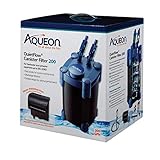 Aqueon QuietFlow Aqueon QuietFlow |
|
Check Latest Price |
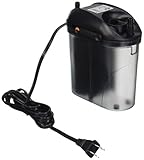 Zoo Med Nano 10 Zoo Med Nano 10 |
|
Check Latest Price |
 Marineland Magnum 290 Marineland Magnum 290 |
|
Check Latest Price |
 Aquatop CF-400UV MKII Aquatop CF-400UV MKII |
|
Check Latest Price |
How We Picked These Canister Filters
We spent the first month simply reading owner reports rather than specs, because in this hobby the failure modes matter more than headline flow. A filter that clogs every three weeks in a dense planting is worse than a slower one that never needs touching, and that opinion is echoed constantly in planted tank forums.
We evaluated each canister on six things: usable flow once media is loaded, media volume measured in the trays you actually get, resistance to clogging in dense substrate, how easy it is to open and service, noise at normal water levels, and the running cost of the media it eats every month.
We deliberately included two models that are not external canisters in the traditional sense, because buyers keep running into them and deserve to know what they are. We also left out several well-known premium models and included budget-tier units instead, so the roundup covers the full range of tank sizes our readers actually build.
One thing we could not do is independently measure filtered GPH on every unit in a controlled lab rig. Where we describe flow, we are using manufacturer ratings and owner observation, and we say so.
What Size Canister Filter Does Your Planted Tank Need?
Start with your tank volume in gallons, then pick a turnover multiple based on how planted you are. The formula is simple: required filtered GPH equals tank gallons times the multiple. A 40 gallon low-tech planted tank at 4x needs about 160 GPH of real filtered flow, so you want a canister whose rated pump output sits meaningfully above that once you account for media and head loss.
Worked examples using manufacturer pump ratings:
20 gallon low-tech planted tank: 4x means 80 GPH filtered. Look for a pump rated around 150 to 200 GPH so loaded flow still clears your target.
40 gallon high-tech tank with CO2 and root feeders: 6x means 240 GPH filtered. A pump rated 300 GPH or more is the sensible floor.
75 gallon planted display: 5x means 375 GPH filtered. Most owners in this range pick a canister rated 400 to 550 GPH.
125 gallon aquascape with a deep substrate bed: 6x means 750 GPH filtered. This is where dual-filter setups start making more sense than one oversized unit.
Two adjustments matter for planted tanks specifically. If your substrate bed is three inches or deeper, subtract roughly 10 to 15 percent of expected flow because the intake is pulling through dense media. If you run injected CO2, add surface agitation in the form of a spray bar aimed across the surface, because CO2 injection drives off oxygen and your fish need the gas exchange.
On flow versus livestock, this is the tension that shows up in every planted forum thread. Strong current is good for stem plants and for gas exchange, and it is terrible for bettas, gouramis, shrimp and any fry in the tank. The fix is not a weaker filter, it is a return you can throttle down with a valve on the canister or the outlet.
1. Fluval 407 Performance Canister – the all-rounder for planted tanks up to 100 gallons
Fluval 407 Performance Canister Filter – For Aquariums Up To 100 Gallons
Rated up to 100 gallons
eTEC pump runs up to 25% quieter
EZ-Lift baskets lift with one finger
Pros
- One-finger EZ-Lift media baskets
- Quiet eTEC pump
- Self-priming startup
- Quick-disconnect valves
Cons
- Some owners report repeat motor head failures
- Branded replacement media is costly
- Hoses are stiff and bulky in tight cabinets
This is the canister we put on more planted tanks than any other. It is rated for aquariums up to 100 gallons, the eTEC pump is advertised as running up to 25 percent quieter than the previous generation, and it primes itself once you add water and plug it in.
The EZ-Lift media baskets are the part we care about most in a planted tank. Each basket has a centre handle, so you pull the whole stack out with one finger instead of fishing loose sponge and ceramic rings out one at a time.
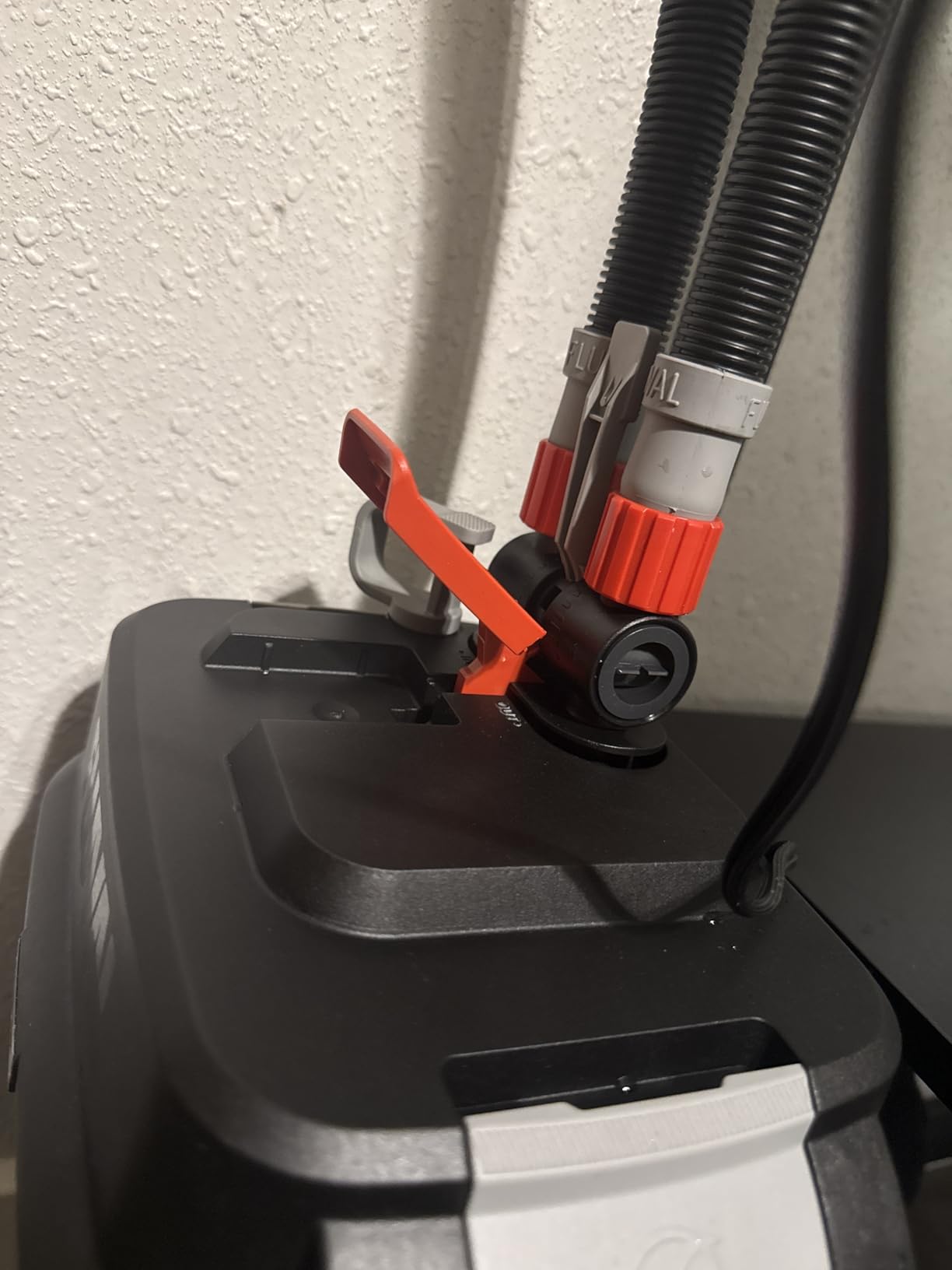
Flow is more than adequate for a 75 to 100 gallon planted tank. Owners report clearing cloudy water within hours to a couple of days, and adjustable output strong enough to keep plant mass moving without being so violent that it lifts light carpeting plants off the substrate. Pre-filter it anyway if your substrate is fine.
The one complaint we cannot wave away is the motor head. A small but persistent group of 407 owners report repeat failures traced to an impeller cover that disengages under pressure. It is not the common experience, but read the failure reports before you commit.
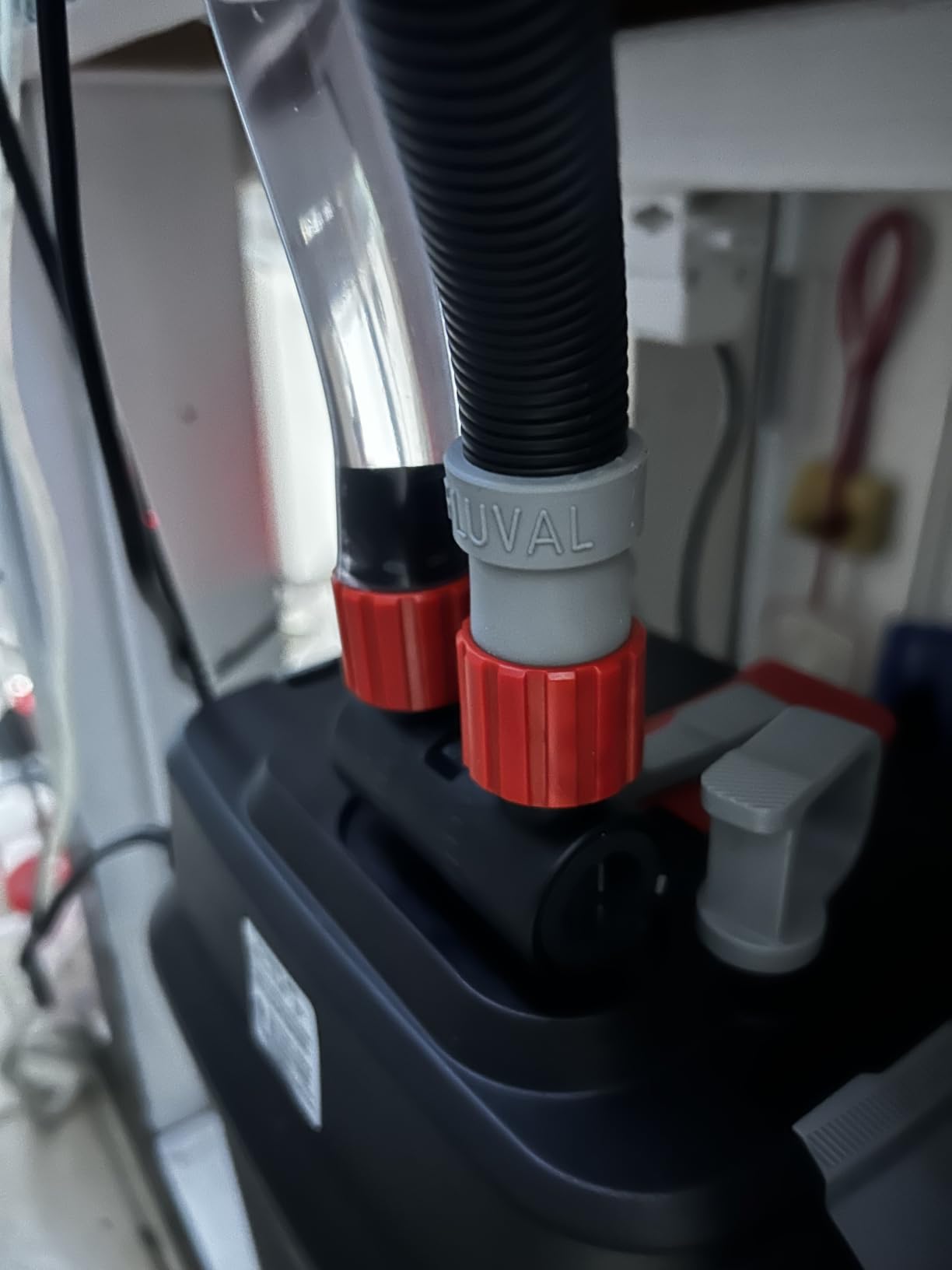
Where the Fluval 407 fits a planted layout
The factory spray bar is the right return for most aquascapes because it pushes flow across the surface, which is what a CO2-injected tank needs for gas exchange. On a 100 gallon tank with a three inch aquasoil bed, expect usable filtered flow well under the rated figure.
If your fish are the sensitive type, the outlet valve on the lid gives you enough control to dial the whole thing back. We ran it on a betta-and-shrimp community and a heavy stem jungle with the same canister.
Where it will frustrate you
Running cost is the biggest one. Branded Fluval media is consumable-heavy compared with generic pads and rings, and owners sometimes note the included media is perceived as half-size against a standard pouch.
The hoses are stiff and bulky, which is annoying in a shallow cabinet. Nobody reported it as a dealbreaker, but on tight stands you will spend time routing them. The same care goes into keeping hum and vibration out of a workspace, and the same discipline behind pop filters and shock mounts for mics applies to a canister sitting under your tank.
2. Penn-Plax Cascade 1000 – three handled baskets for big aquascapes
Penn-Plax Cascade 1000 Canister Filter – 265 GPH Aquarium Filter for Tanks Up to 100 Gallons – 360 Degree Flow Valves, Poly Fiber Pads, Bio-Sponge & Activated Carbon -Fresh & Saltwater -11.5x10x17in
265 GPH rated for tanks to 100 gallons
Three stackable handled baskets
Dual 360 degree rotating valves
28.5W at 110V
Pros
- Complete media package included
- Three large handled media baskets
- Rotating valves for tight cabinets
- Push-button primer
Cons
- Supplied plastic hose clamps are weak
- Priming is awkward without pre-filling
- Carbon bags are small recurring purchases
The Cascade 1000 is rated at 265 GPH for tanks up to 100 gallons, and the reason it keeps appearing in planted tank recommendations is the media capacity rather than the pump. Three large stackable baskets with built-in handles means you can run a coarse sponge pre-filter in the top basket, floss in the middle and biological media in the bottom without anything squeezing into a corner.
Those 360 degree rotating valve taps are more useful in a planted tank than they sound. In a tight cabinet you can angle the inlet and outlet hoses so they run flat along the back, and aim the return away from the front pane.
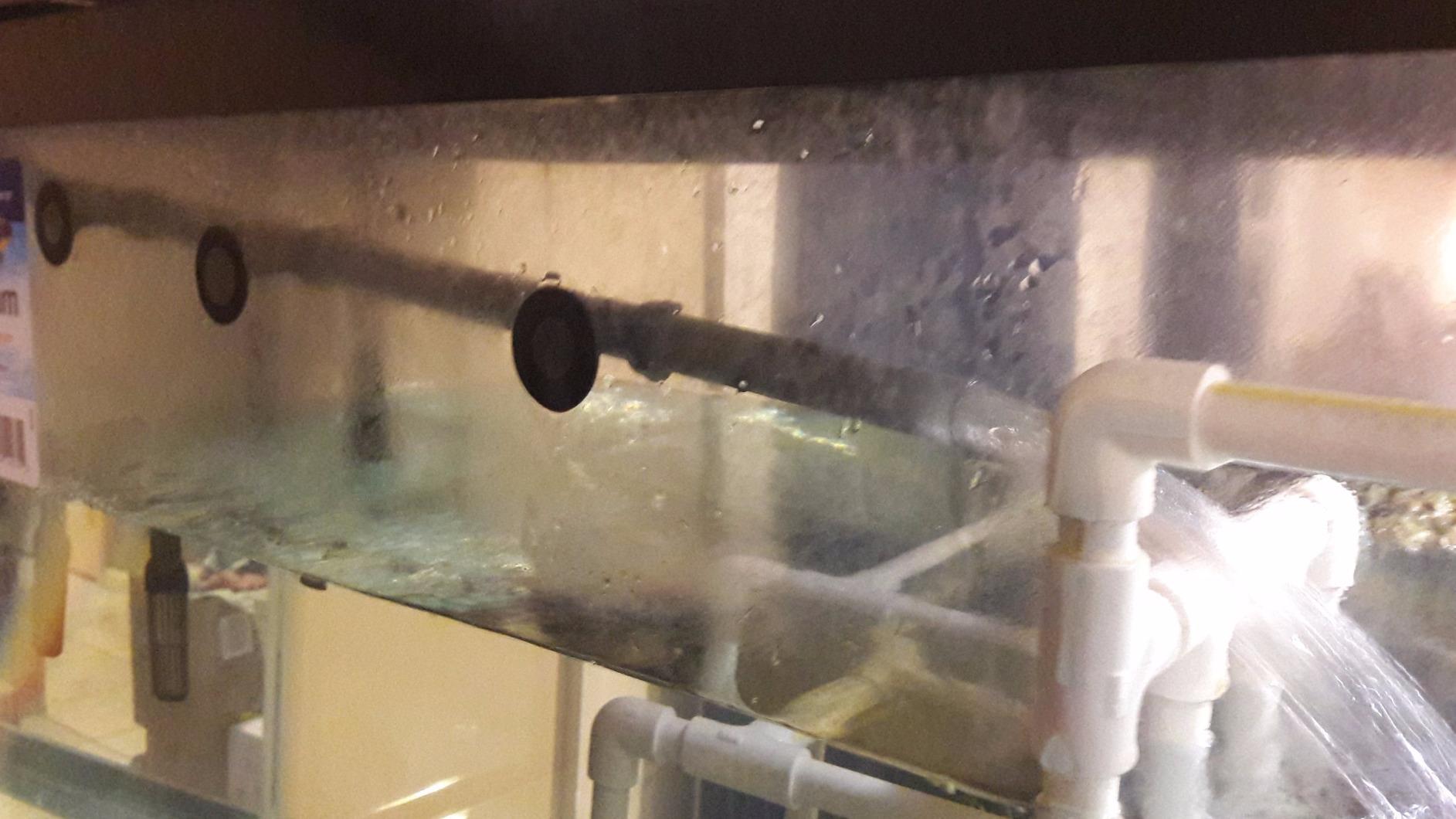
The push-button primer gets it started quickly, though owners report that priming is awkward if you have not pre-filled the canister body with tank water first. Pouring water over the media stack before you close the lid avoids the fiddly version.
Review data on this model is enormous and consistently positive on water clarity and easy maintenance, which is exactly what you want from background equipment.
Why planted owners pick this one
The three-basket layout is the whole argument. A top basket packed with coarse sponge costs almost nothing and protects everything below it from the fine detritus that turns a canister into a solid block in a few weeks. With two baskets you choose between pre-filtering and chemical media, which is not a choice you should have to make.
At 28.5 watts, running cost over a year is modest, and the spray bar gives you the surface movement a planted tank wants.
Where it falls short
The supplied plastic hose clamps are the most-reported weakness and they show up across the whole Cascade range. They can slip on the tubing or allow a slow leak, so plan on swapping them for metal clamps as a first job.
The included carbon bags are small, and on a high-tech tank running carbon permanently that becomes a monthly purchase. Budget for generic bulk carbon instead of the branded bags.
3. Marineland Magniflow 400 – the biggest included media bundle
Marineland Magniflow 400 GPH Canister Aquarium Filter
400 GPH rated for tanks to 100 gallons
Stack N Flo trays force flow through media
Quick prime self-priming button
Lift-off watertight lid
Pros
- Quick prime button
- Includes foam
- carbon
- bio-balls
- ceramic rings and polishing pads
- Lift-off lid for fast media access
Cons
- Some owners report leaking under the lid handles
- Customer service on gasket claims is slow
- Tubing is rigid and awkward to position
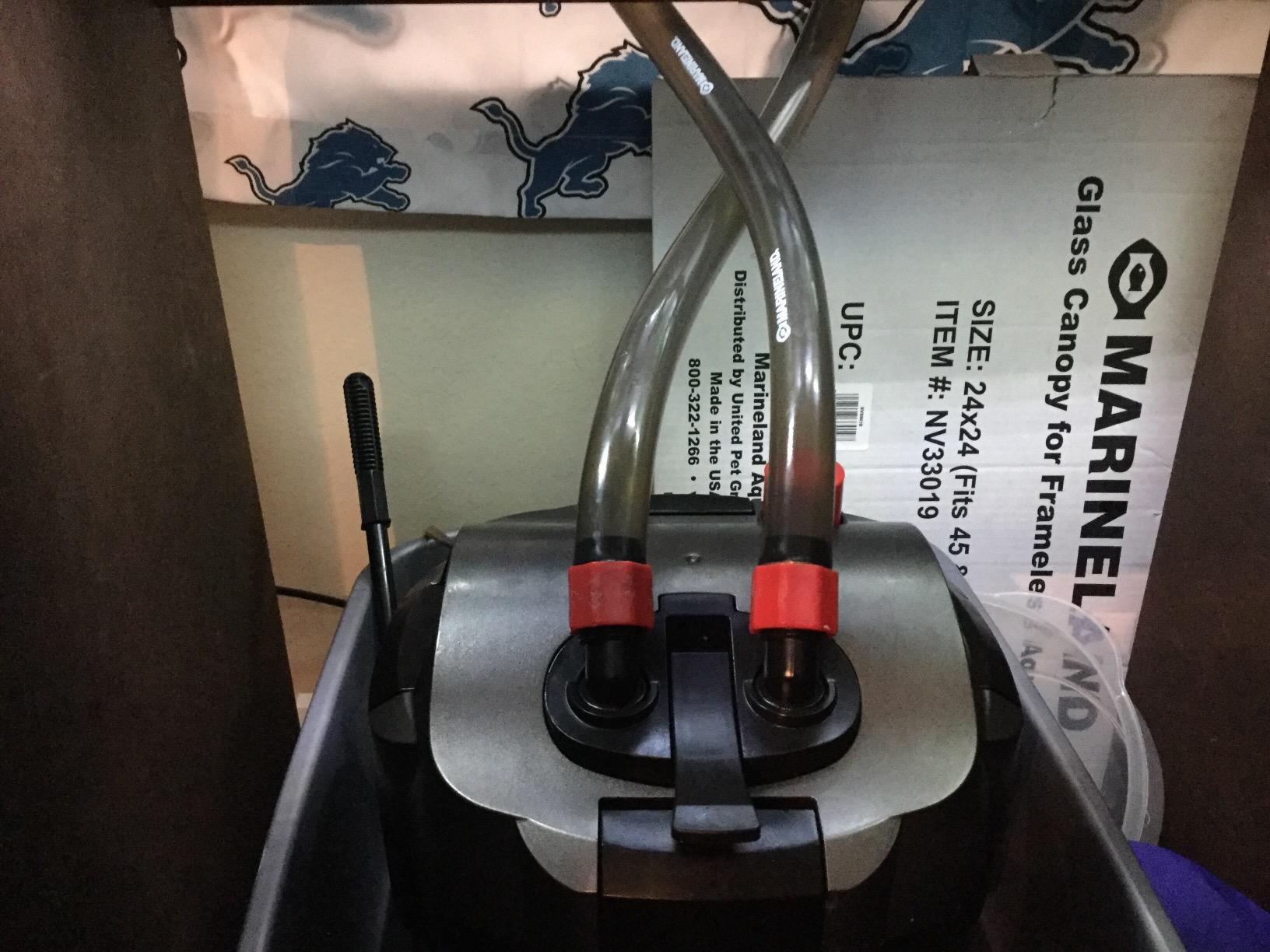
The Magniflow 400 is rated at 400 GPH for tanks up to 100 gallons, and the reason it appeals to new planted tank owners is the box contents. It comes with filter foam, premium activated carbon bags, bio-filter balls, ceramic rings and polishing pads, so you can fill the Stack N’ Flo trays and run it on day one without a shopping trip.
The Stack N’ Flo trays force water through the media layers rather than letting it take the easy path around them, which is the design difference that keeps biological media actually doing its job. Owners commonly report noticeably clearer water within days of switching from a hang-on-back filter.
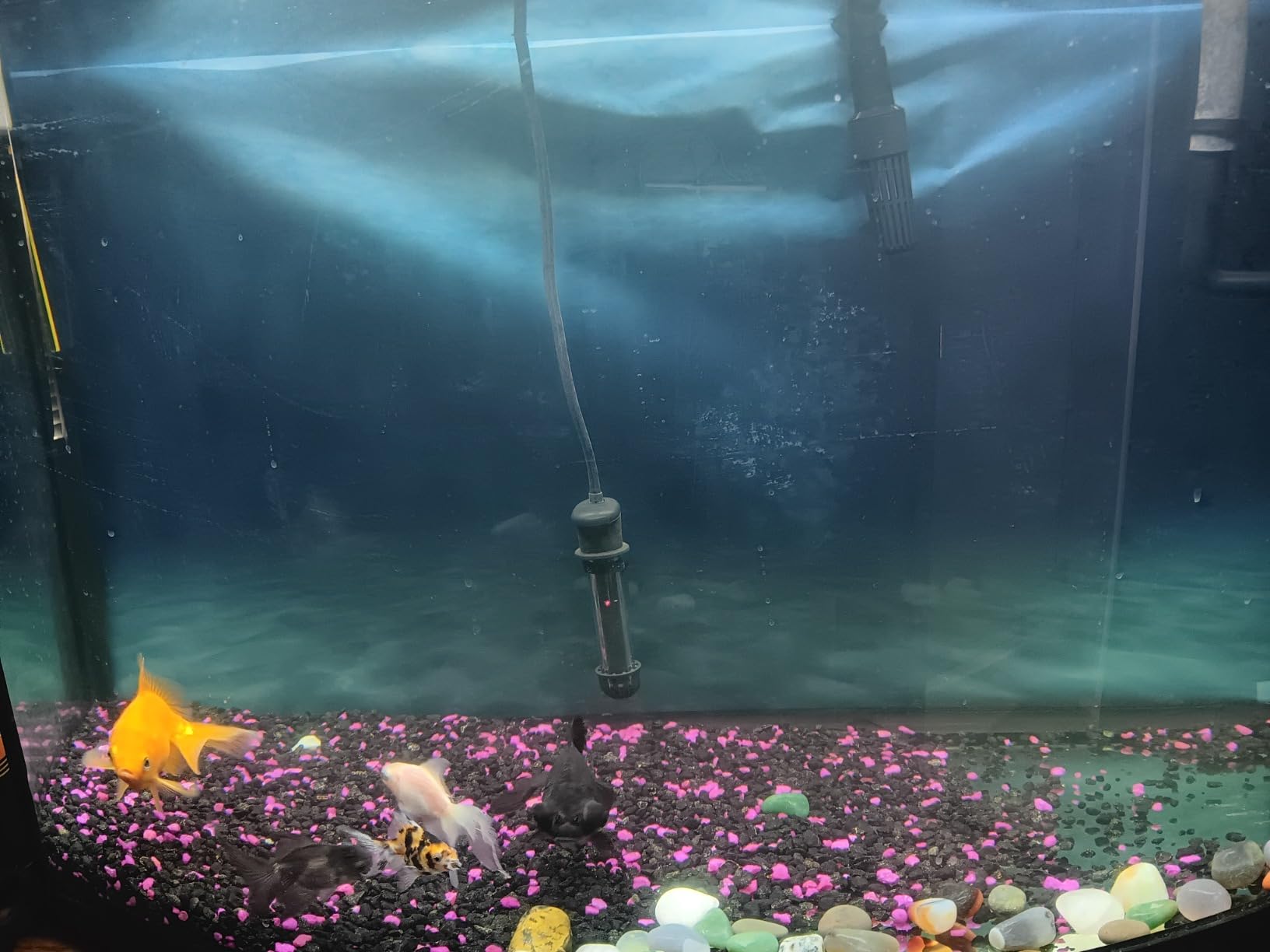
Flow behaviour is worth noting here. Reviewers specifically call the current moderate rather than aggressive, and say it does not overly stir delicate plants. For an aquascape with a light carpeting plant in the foreground, that is a real advantage over a big pump that pulls the carpet loose.
The lift-off lid with its watertight seal and the quick prime button make routine service fast. We found nothing about the design that fights you during maintenance, which is why the complaints on this model are about hardware failures rather than usability.
What works well in a planted tank
That included bundle means you can build a proper three-stage stack immediately: coarse sponge on top, floss in the middle, ceramic rings and bio-balls below. It also means you can experiment with media layout without spending anything on your first try.
It accepts Marineland Rite-Size media and handles both freshwater and saltwater.
Where owners report trouble
Leaking from under the lid handles is the recurring complaint, and owners sometimes note the gasket that should seal that area is not supplied with the canister. If you buy one, check that seal first thing out of the box.
Customer service response on leak and gasket claims is described as slow and unsatisfying by reviewers. The tubing is also rigid, which makes positioning the return over an aquascape harder than it needs to be.
4. Fluval FX6 – top rated flow with a 1.5 gallon media basket
Fluval FX6 High Performance Aquarium Filter, up to 400 Gal.
925 GPH rated for tanks to 400 gallons
1.5 gallon removable media baskets
Smart Pump self-starting
Auto-evacuates trapped air every 12 hours
Pros
- Very quiet at normal water levels
- Smart Pump self-starting with no manual priming
- Large 1.5 gallon media capacity
- Highest rating in this roundup
Cons
- Intake tube extends but cannot be shortened
- Stiff hoses can stop the lid sitting flush
- Plumbing parts feel fragile
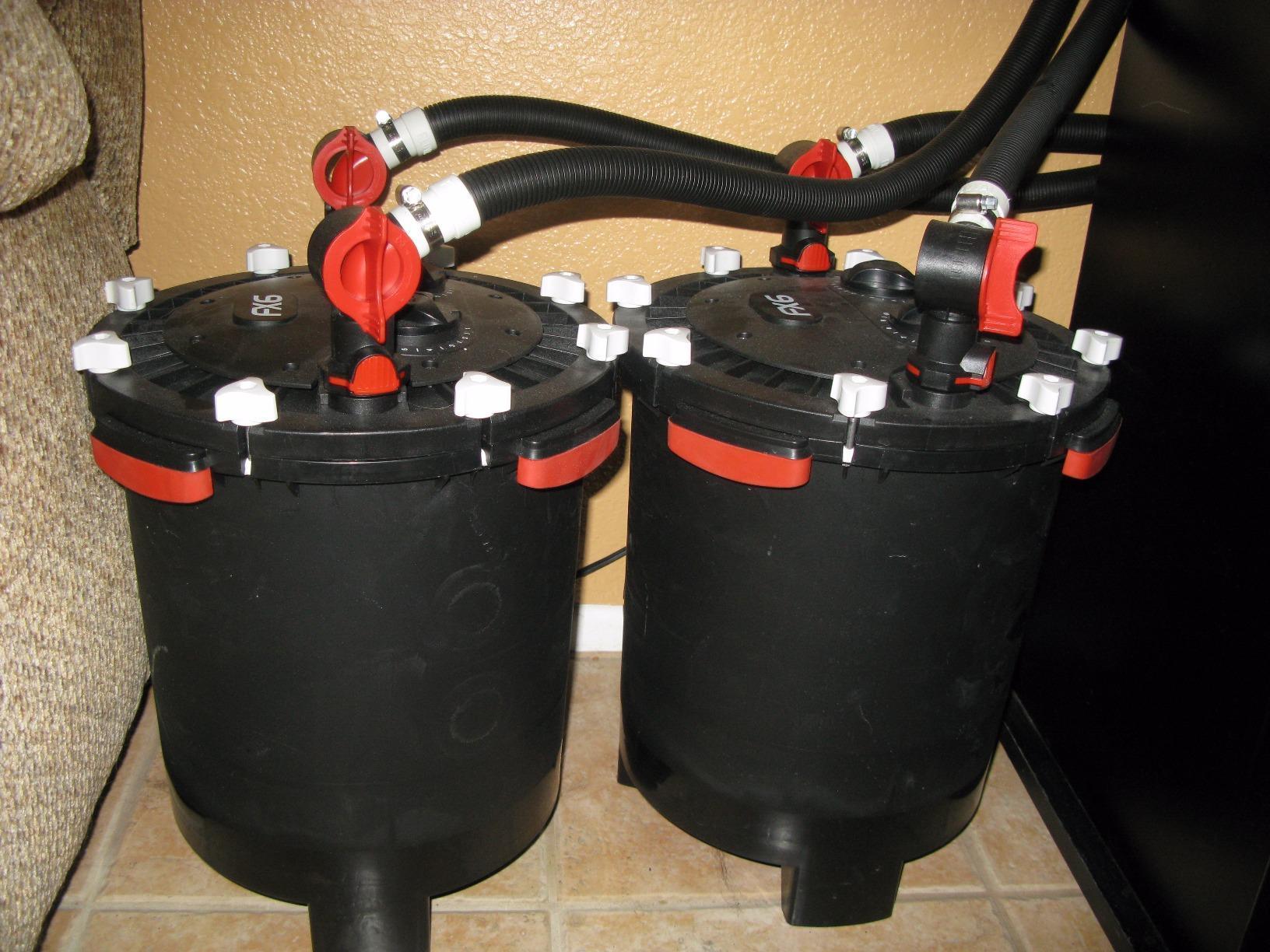
The Fluval FX6 is the strongest circulator in this group and it carries the highest rating we found, at 4.6 stars across more than 3400 reviews. It pumps 925 US gallons per hour, holds 1.5 US gallons of media in removable stackable baskets, and its Smart Pump starts itself: add water, plug in, and the pump takes over.
That self-starting behaviour is what planted owners care about most, because a canister that loses prime during a water change normally means a trip to the sink with a bucket. The Smart Pump also auto-evacuates trapped air every 12 hours, which quietly prevents the loss-of-prime problem that plagues budget filters.
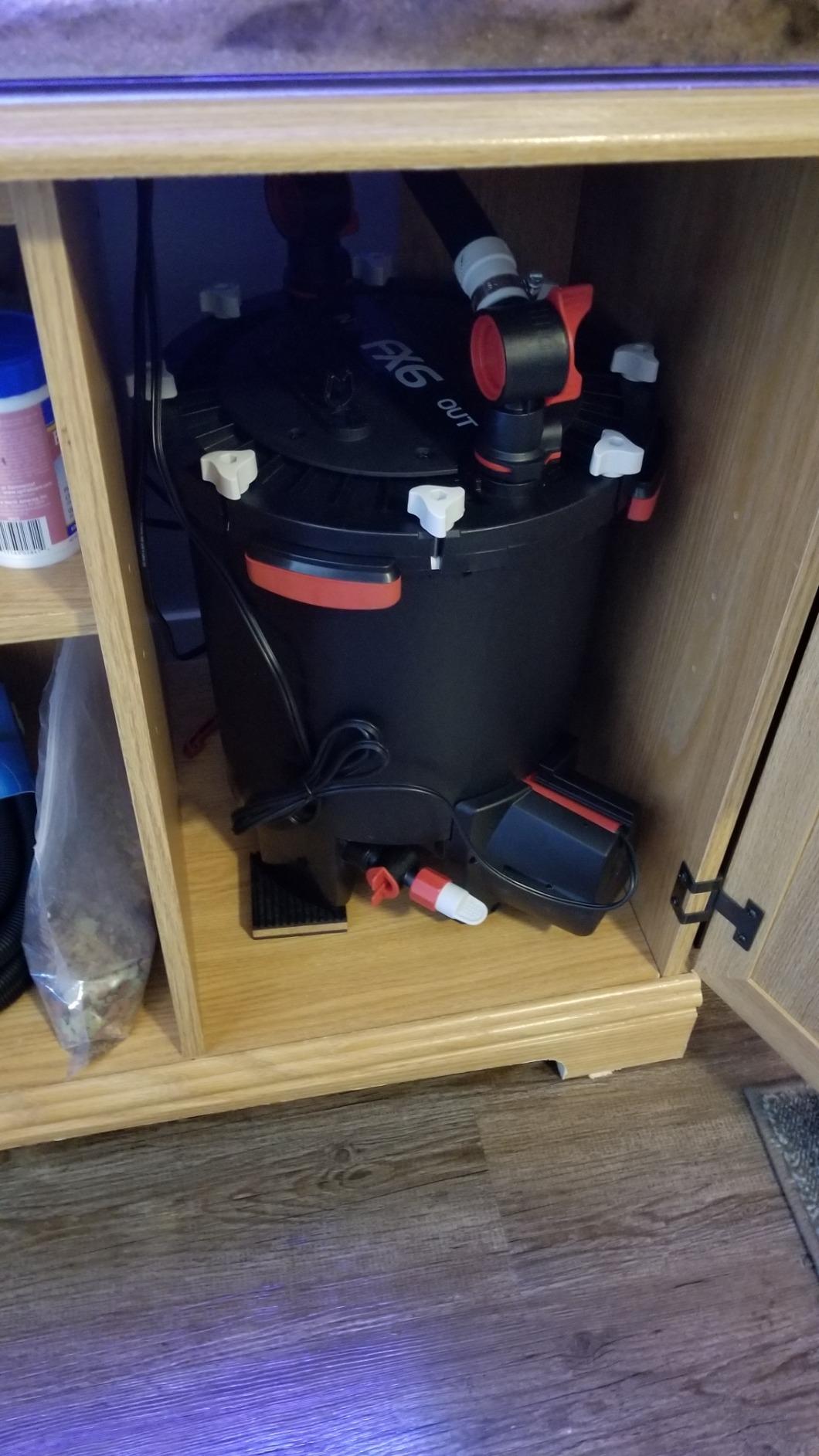
Media capacity is the real planted-tank argument for this unit. At 1.5 gallons, you can run a generous pre-filter layer, a thick floss pad and a substantial volume of ceramic rings without compressing anything. On a heavy-fish display, that is the difference between a filter that stays clear for months and one you service every fortnight.
The inline purge valve lets you attach a hose to the output and run water changes straight through the filter, and the variable flow shutoff valves stop the hoses draining while you work.
Where it earns its place
Large tanks, high flow demands and heavy fish loads. If you want flow headroom and intend to keep pushing nitrate down with plants, this is the one that gives you the most filtered output after media is loaded.
Owners with long-term setups report dependable, near-silent running at normal water levels, and the impeller and O-rings are replaceable with ordinary tools.
Where it gets awkward
The intake tube is very long and it extends but cannot be shortened, which is a real problem over a sand substrate bed. You have to plan the glassware before you cut the pipe rather than trimming it later.
The hoses are stiff and large enough that a rimmed tank lid may not sit flush, and reviewers single out the purge outlet as feeling fragile in the hand. The automatic 12-hour pump cycle also surprises new owners the first time they hear it.
5. Eheim Classic 2213 – small tanks and long-run dependability
EHEIM Classic Canister Filter 2213, Classic 250 – PetOverstock
Available in 40, 66 and 92 gallon variants
Permo-elastic silicon sealing ring on the pump head
Complete media set and valves included
4.49 pounds and compact
Pros
- Complete media and hardware in the box
- Reliable sealing after cleaning
- Long-established design with a serviceable pump head
- Light and compact
Cons
- Manual priming takes practice
- Lower flow than modern high-output canisters
- Branded media is costly versus generic
The Eheim Classic 2213 is one of the longest-running canister designs on the market, and it is the canister most people mean when they say a canister filter is boring in a good way. It comes in 40, 66 and 92 gallon variants, weighs under five pounds, and has a pump head that opens with ordinary tools.
For a planted tank the honest limitation is flow. Owners describe it as a dependable classic rather than a high-flow performer, so if your aquascape is a dense jungle that needs serious circulation, this is not the pick. For a 20 to 40 gallon planted tank with moderate fish numbers, it is more than enough.
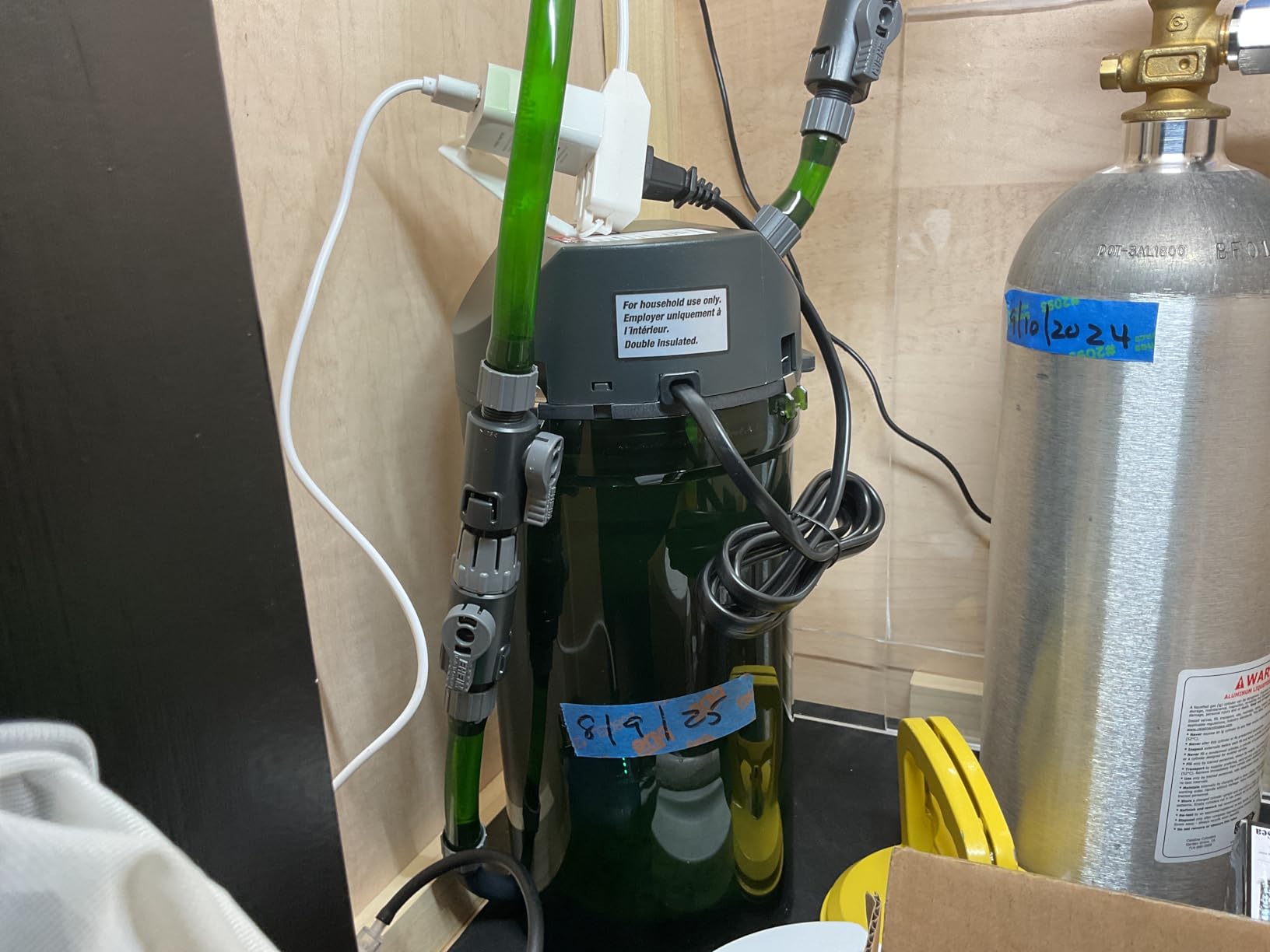
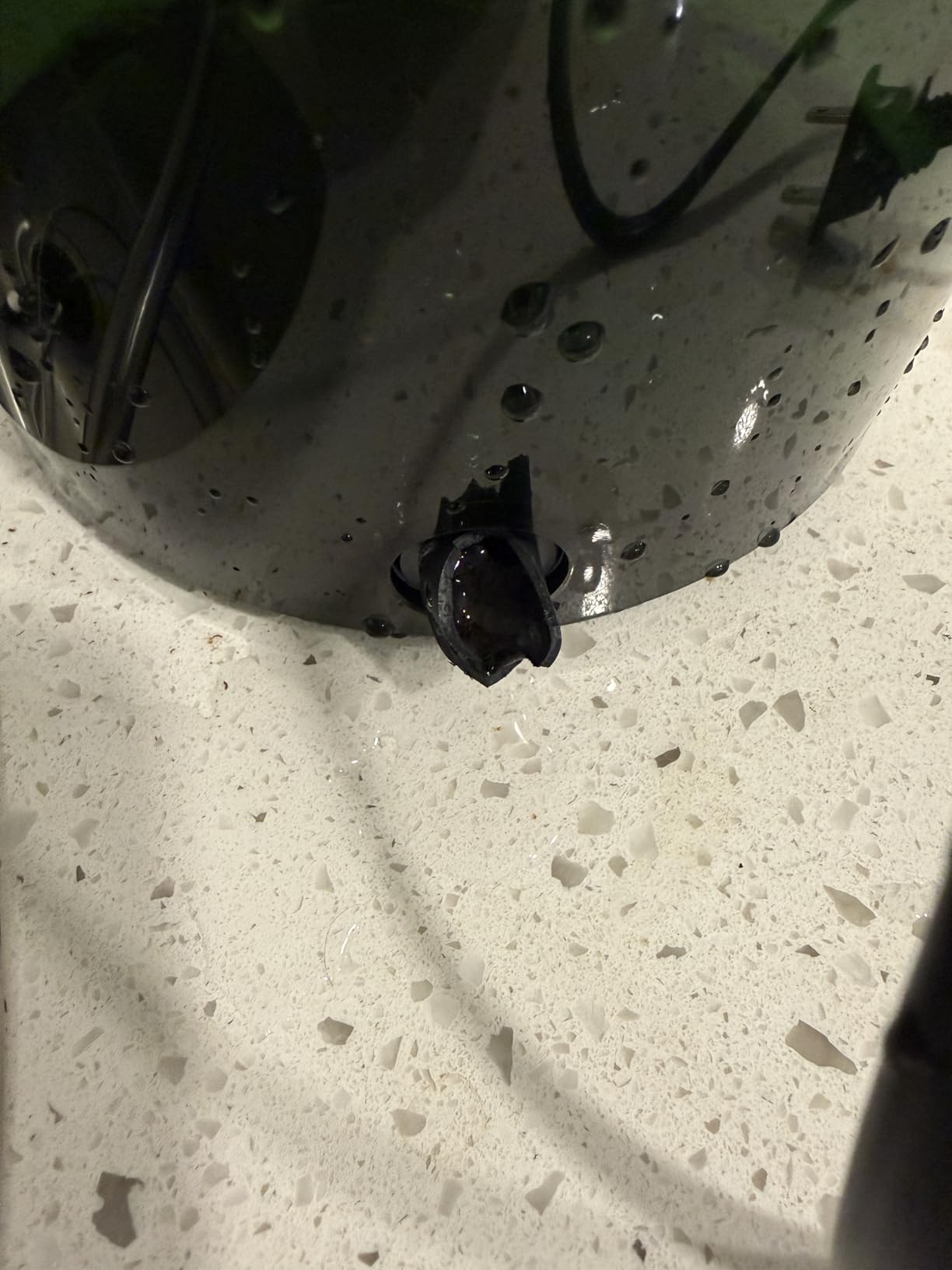
What Eheim does very well is sealing. The permo-elastic silicon ring is fixed to the pump head, so after every cleaning the lid closes evenly and safely. On a canister you open every week for six months, that detail reduces the number of times you fight with a lid that will not seat properly.
It also arrives complete, with filter sponges and loose media, a spray bar, inlet pipe, hose, installation accessories and the valves. Nothing has to be bought before the first start.
Where it makes sense
Small to mid planted tanks where you want a filter you will never think about again. The compact size matters in shallow cabinets, and the light weight means lifting it out for a water change is a one-handed job.
It is also the safe default if you have been reading forum threads and want the model experienced owners keep recommending for reliability over peak specs.
Where it will disappoint
Manual priming is required, and with no self-starting pump every restart involves filling the canister by hand.
Replacement Eheim media is pricey next to generic equivalents, and the lower flow can leave a heavily planted tank short of the circulation it needs. Generic sponges and ceramic rings work fine in it if you want to cut that cost.
6. SunSun HW302 Pro – the best value canister for planted tanks
SunSun Hw302 265GPH Pro Canister Filter Kit
265 GPH rated for tanks up to 75 gallons
Three removable media baskets
Complete Pro media kit included
9 x 9 x 18 inch body
Pros
- Full media kit in the box
- Strong flow for the money
- Three baskets for custom media layering
- Compact footprint for small stands
Cons
- Spout and fittings leak more often than premium brands
- Hose clamps are flimsy
- Basic build quality on intake and outlet parts
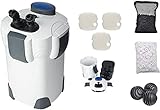
The HW302 Pro is rated at 265 GPH for tanks up to 75 gallons, which makes it a strong flow option at this tier and the natural fit for a planted tank in the 40 to 75 gallon range. Reviewers describe it as strong flow for the money and well matched to planted tanks of that size.
The Pro kit is generous. You get three white filter pads, three media baskets, a pound of premium filter carbon, a pound of ceramic rings and a set of bio balls, so you can build a full mechanical, chemical and biological stack on day one without buying anything else.
Three removable baskets is what makes it useful in a planting. The top basket can hold a coarse sponge that catches substrate debris before it reaches the floss, which is the most effective single habit in planted filter maintenance.
Long-term owners in planted forums frequently describe SunSun as an excellent filter at an unusually low cost, with the accepted caveat that you maintain the hardware yourself more often.
Why planted owners buy it
Flow headroom at this rating means a 40 gallon high-tech tank can hit its turnover target even with the intake pulled through a deep substrate bed.
The compact vertical body fits under smaller stands where a wider canister will not, and the spray bar handles surface circulation for a CO2-injected layout.
Where you will do work on it
The sealing hardware is the weak point. Owners report the spout and fittings leaking more often than premium-brand canisters, and the supplied hose clamps are frequently described as flimsy enough to warrant replacing with metal clamps.
Build quality on the intake and outlet parts is considered basic. None of that affects filtration, but budget ten minutes after your first fill to check every connection before you walk away.
7. Penn-Plax Cascade 700 – mid-size tanks under 65 gallons
Penn-Plax Cascade 700 Canister Filter – 185 GPH for Tanks Up to 65 Gallons
185 GPH rated for tanks up to 65 gallons
Two stackable handled media baskets
Dual 360 degree rotating valves
25W at 110V
Pros
- Complete kit with floss and bio-sponge
- Handled baskets give control over media layering
- Rotating valves ease cabinet routing
- Push-button primer starts it quickly
Cons
- Supplied plastic hose clamps allow slow leaks
- Two baskets limit stacking options
- Modest flow compared with higher-output canisters
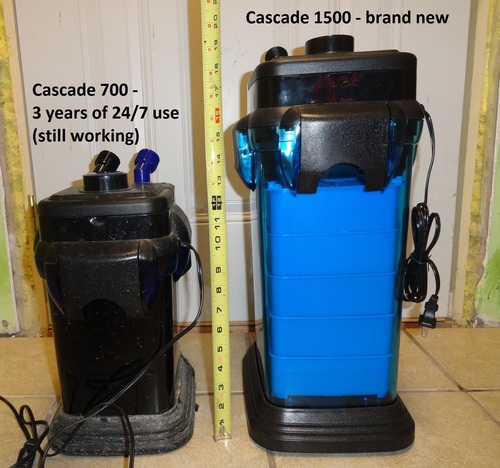
The Cascade 700 is rated at 185 GPH for tanks up to 65 gallons, which makes it a natural fit for a 40 gallon planted tank and a solid choice for a 55 gallon. The 360 degree rotating valves and push-button primer carry over from the larger Cascade models.
Two handled media baskets is the feature that separates it from cheaper two-basket designs. Because each basket lifts out by its handle, you can build a two-stage stack that opens without dumping ceramic rings onto the floor.
For planted tanks, the modest flow is the trade you evaluate. On a 40 gallon tank with light fish numbers and no CO2 injection, 185 GPH of pump rating is perfectly workable with the right valve setting. Push to a 55 gallon high-tech layout with injected CO2 and you will want more headroom than this gives you.
Water clarity results are consistently reported as reliable for tanks in that size range, depending on how dense your substrate is.
Best use case
Medium planted tanks where you want the Cascade media layout without the size or the flow of the 1000. It is also a good second canister for a dual-filter setup on a larger tank, since two mid-size canisters in parallel beat one oversized unit losing flow to head pressure.
At 25W the electricity draw is easy on a meter that also runs a CO2 solenoid and a light bar.
What to watch
Same hose clamp weakness as the rest of the range, and reviewers specifically note that slow leaks can develop where the plastic clamps sit on the tubing. Replace them early.
Two baskets means you choose between a pre-filter layer and a separate chemical stage. If your planting is dense enough that you need both, step up to the three-basket model instead.
8. SunSun HW303B Pro UV – 370 GPH with a built-in UV stage
SunSun Hw303B 370GPH Pro Canister Filter Kit with 9-watt UV Sterilizer
370 GPH rated for tanks up to 100 gallons
Integrated 9 watt UV sterilizer
Three media baskets plus a coarse blue pad
Full media kit included
Pros
- Coarse pad supports staged mechanical filtration
- Full media kit included
- High 370 GPH flow for larger planted tanks
Cons
- UV bulb needs periodic replacement
- Some models have a strong chemical smell from factory testing
- Fitting and clamp durability is basic
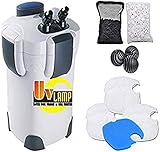
The HW303B Pro steps up from the HW302 to 370 GPH rated for tanks up to 100 gallons, and it adds a built-in 9 watt UV sterilizer. That combination makes it a strong choice for a large planted tank where you want headroom and some help with suspended green algae without buying a separate inline sterilizer.
The media layout suits a planting better than the smaller model, with three baskets plus a blue coarse pad that acts as your pre-filter position, which is where you want the cheap sacrificial layer in a tank with aquasoil or heavy root mass.
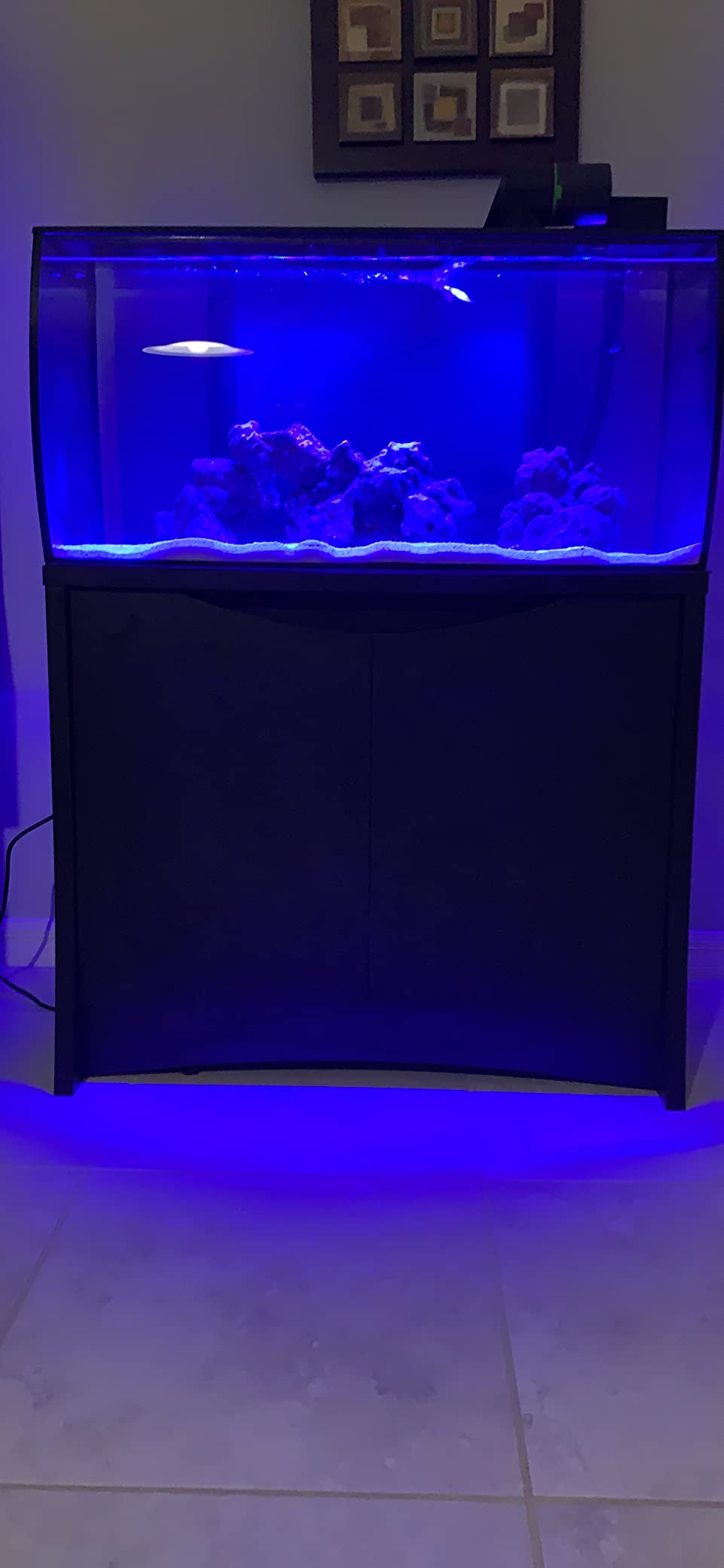
Be honest about what a UV stage does on a planted tank. It helps clear suspended single-celled algae in the water column, which is why it is useful after a rescape or a lighting change. It does not touch algae attached to leaves or hardscape, so it is an addition to your maintenance routine rather than a replacement for trimming.
Because it moves more water than most canisters at this tier, the surface agitation from the spray bar is strong enough to serve a CO2-injected tank without adding a powerhead, as long as you set the outlet valve sensibly.
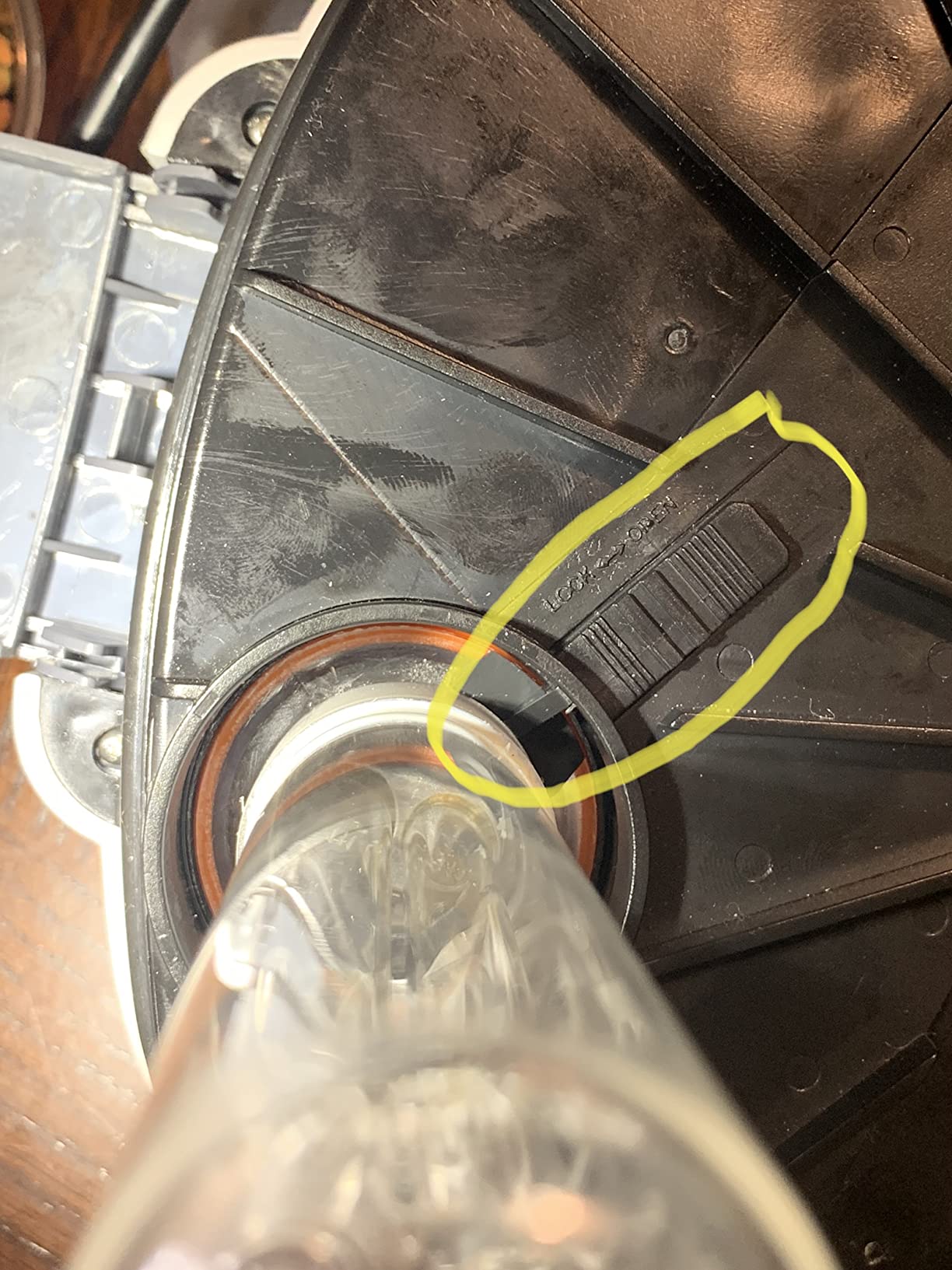
Where it earns its place
Owners rate the value highly against UV-equipped premium canisters that cost considerably more for the same basic function, and the complete media kit means it handles a new setup without a second shopping trip.
Where it disappoints
The UV bulb is a consumable that needs periodic replacement, which adds a running cost the non-UV models do not carry. If your green water problem is mild, the money is better spent on media.
It shares the HW302’s basic fitting and clamp durability profile. And if yours arrives smelling strongly of chemicals, that residue is from factory pressure testing, so rinse it through before you connect it to an established tank.
9. Aqueon QuietFlow – three return options and a polishing unit
Aqueon QuietFlow Canister Aquarium Filter, Up to 55 Gallons (ECOM)
Rated up to 55 gallons
Spray bar, water director and HOB polishing unit returns
Quick disconnect valves and locking pump heads
1 year warranty
Pros
- Polishing unit adds a fine stage
- Three return configurations for different layouts
- Quick disconnect valves for fast cabinet removal
- Genuinely quiet for its class
Cons
- Monthly polishing cartridge replacement is a steady cost
- Carbon needs changing about every 30 days
- Compact media volume versus larger premium canisters
The Aqueon QuietFlow is rated for tanks up to 55 gallons and is the quietest-running canister we tested at normal water levels. Reviewers single out the noise level more than almost anything else, and if your tank sits in a bedroom where a hum would bother you, that matters.
The interesting feature for planted layouts is the three return options. You can run the spray bar for surface agitation, swap to a water director for a more directed current aimed at a scape, or hang the included polishing unit on the back of the tank for an extra fine filtration stage without crowding the canister.
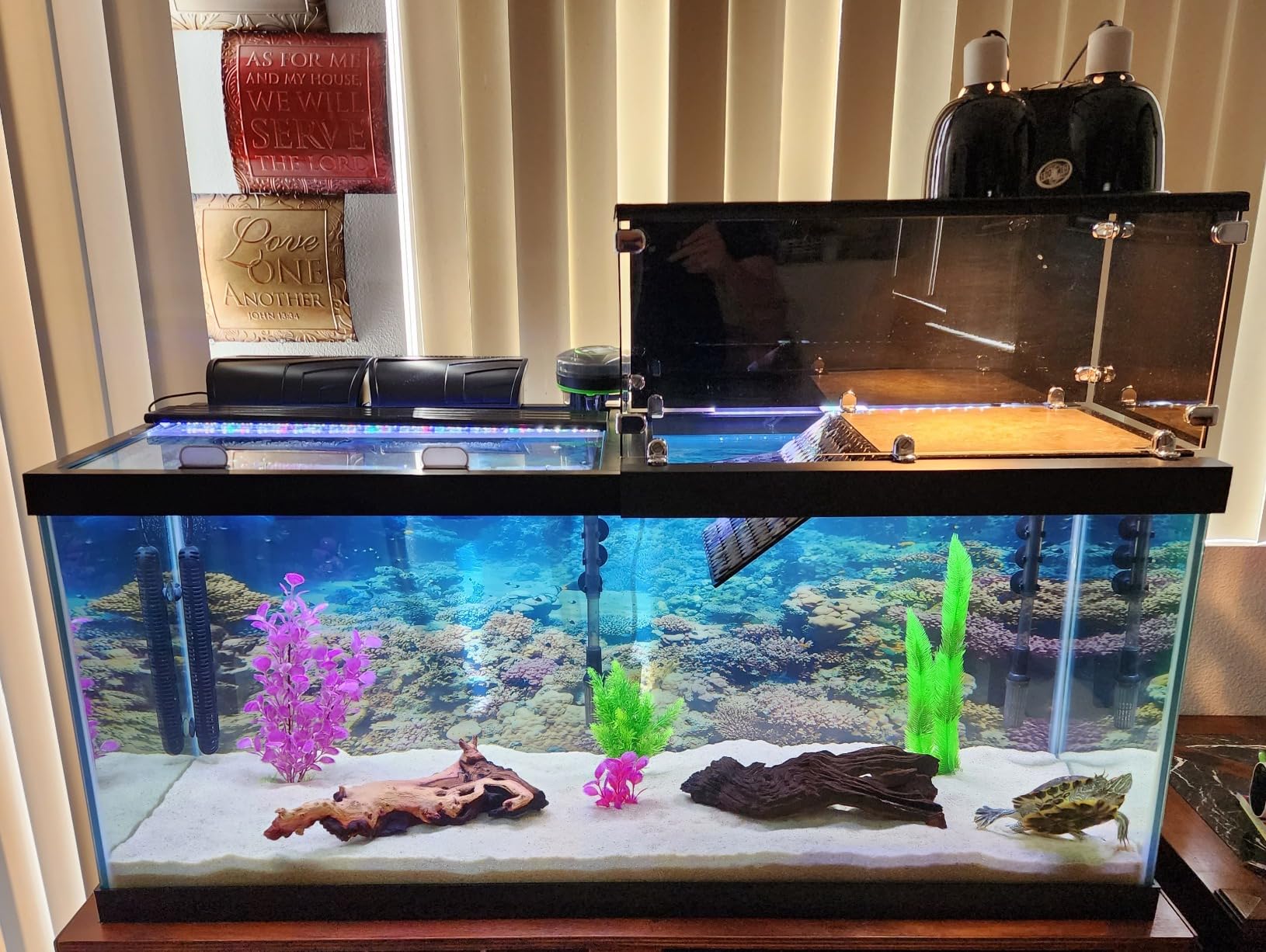
Quick disconnect valves and pump locking heads make installation and removal fast, which is what you want on a planted tank where you will be lifting the canister out for water changes far more often than on a fish-only system.
Media compatibility is straightforward. It comes with carbon, coarse foam, bio-balls and bio-ceramic rings, and the polishing unit uses standard Aqueon replacement cartridges.
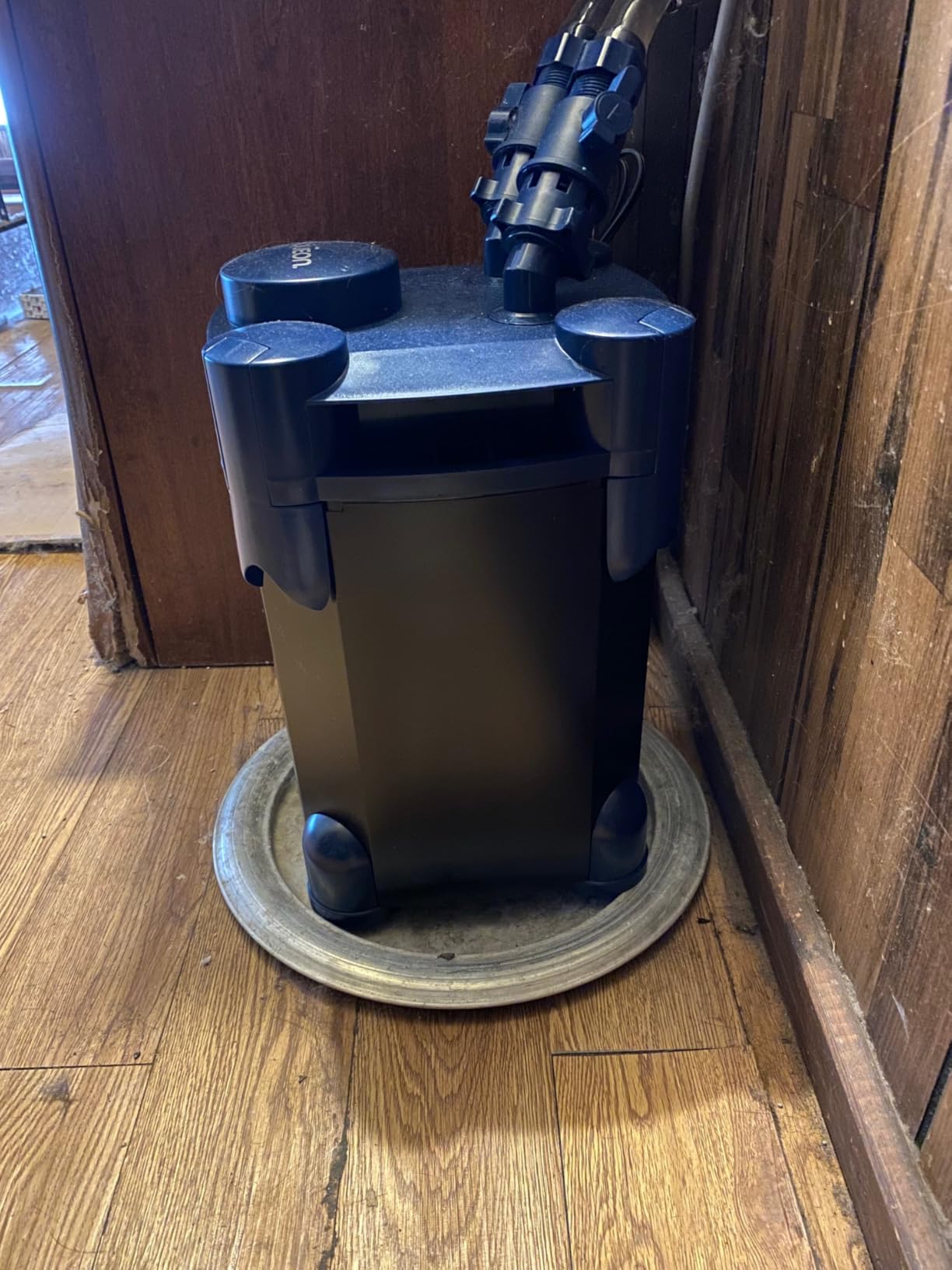
Where it works in a planted tank
Small to mid planted tanks where you want to keep the current gentle for shrimp, bettas or a delicate carpeting plant, while still getting gas exchange at the surface. The water director return is the one most useful for that job.
Owners like the quietness most in open-plan rooms where the tank is the feature and the equipment is not.
Where the running cost bites
This is a cartridge-style maintenance profile, not a bulk media one. The polishing cartridge is replaced monthly and carbon changes roughly every 30 days, which is a steady, predictable spend that adds up faster than loose media.
Media volume is compact compared with the large premium canisters, so if your planting is dense enough to generate a lot of detritus you will be rinsing that small volume more often.
10. Zoo Med Nano 10 – canister filtration for 10 gallon planted tanks
Zoo Med Nano 10 External Canister Filter, up to 10 Gallons,Black
External canister for tanks up to 10 gallons
2.01 pounds and compact
Anti-vibration brushings
Spray bar for aeration
Pros
- Sponge
- bio-ceramic and carbon included
- Compact footprint for nano and rimless tanks
- Very light and easy to service
- Anti-vibration brushings keep it quiet
Cons
- Limited to 10 gallon tanks so not a general purpose canister
- Manual priming takes practice
- Replacement media is brand specific
The Zoo Med Nano 10 is a true external canister built for tanks up to 10 gallons, which makes it the option for rimless nano aquascapes where a hang-on-back filter ruins the lines of the layout. It weighs just over two pounds and measures 11.3 by 4.8 by 5.8 inches, so it disappears under a small stand.
Owners of small planted and shrimp tanks like the compact design and the fact that media is included: a mechanical sponge, bio-ceramic media and carbon, plus a spray bar that adds real circulation and aeration.
Be clear about the ceiling here. The flow capacity is limited to 10 gallon tanks, so it is not a general purpose canister and will not grow with your setup. If you think you will end up at 40 gallons, do not start here.
Anti-vibration brushings keep it quiet for its size, which is worth something in a bedroom setup where the tank is close to where you sleep.
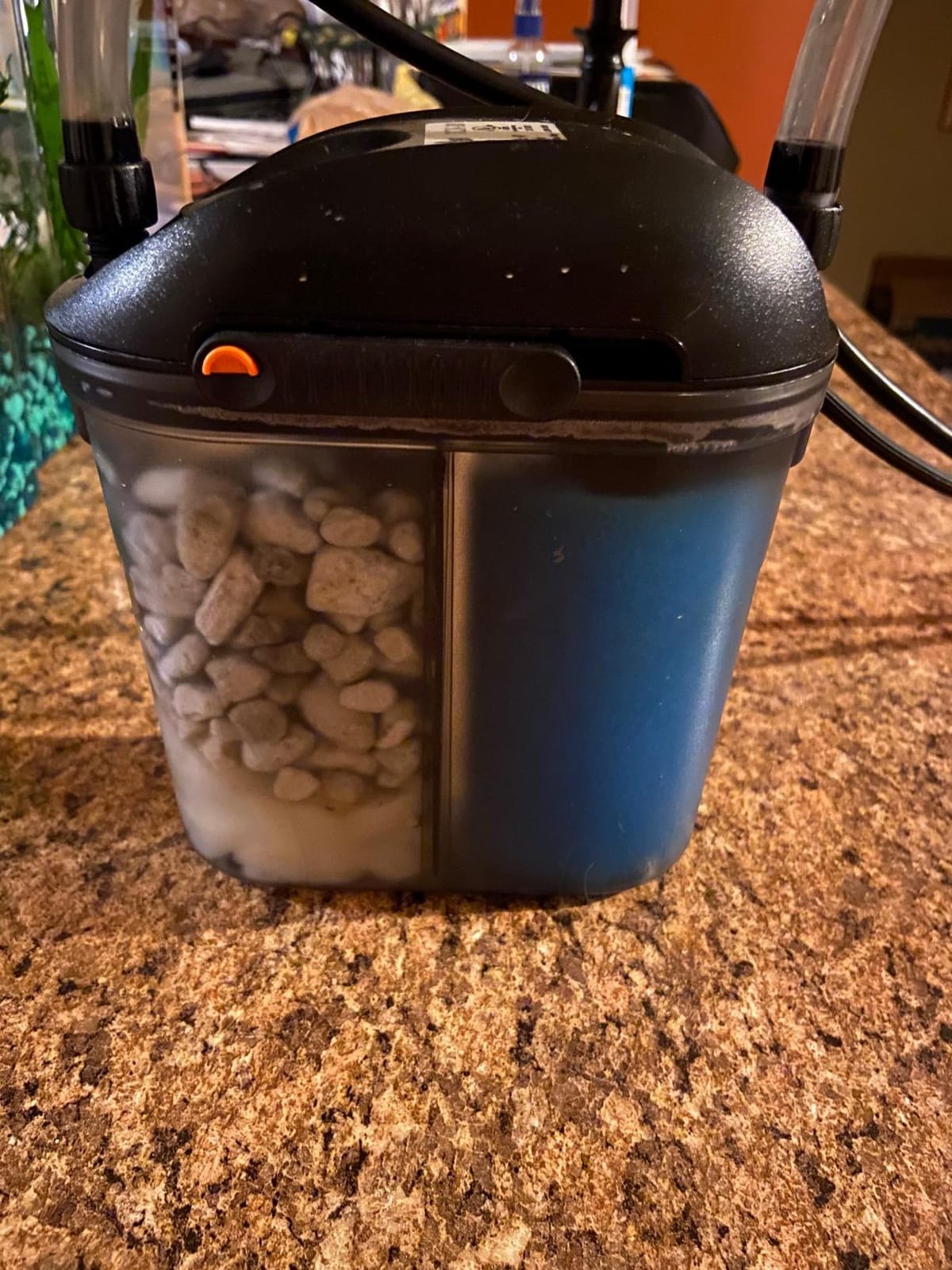
Where it fits a planted nano
A 10 gallon high-tech nano with carpeting plants and injected CO2 is exactly the scenario this filter suits. The spray bar gives you the surface agitation a CO2-injected nano needs, and the unit holds enough media for floss, sponge and bio-ceramic without compressing everything into a corner.
Shrimp and betta nano tanks benefit from the canister format because the intake is a strainer rather than a broad water-column intake.
Where it falls short
Manual priming takes a bit of practice for anyone who has never run an external canister. Budget five minutes and a cup of tank water for the first startup.
Replacement cartridges and media are specific to Zoo Med, which adds to running cost if you would rather use generic sponges. And if you overstock or under-filter relative to the planting, there is no headroom left.
11. Marineland Magnum 290 – a polishing stage, not a primary filter
Marineland Magnum 290 GPH Polishing Canister Aquarium Filter
290 GPH rated for tanks up to 97 gallons
Submerged motor design, no priming needed
Two refillable media chambers
7.5 x 3.5 x 9.88 inch body
Pros
- Effective fine polishing stage
- Submerged motor starts instantly with no priming
- Two refillable chambers accept custom media
- Very compact and light
Cons
- This is an internal canister
- not an external one
- Not designed as the primary biological filter
- Micron cartridge is a consumable
The Magnum 290 is the odd one out in this roundup and we are including it deliberately. It is rated at 290 GPH for tanks up to 97 gallons, but its motor sits submerged inside the unit rather than in the cabinet, so it is not a drop-in replacement for an external canister.
That design does have real advantages. There is no priming step at all because the motor is in the water, and at 7.5 by 3.5 by 9.88 inches it is small enough to hide in a crowded cabinet or behind a stand brace.
Where it earns its place is as a second stage. Two refillable media chambers accept carbon or custom media, and the included micron cartridge does the fine polishing work that turns already-clear water into glass-clear water.
Think of it as the fine filter your main canister does not need to be. In a planted tank, running it as a polisher after a rescape is when it earns its cost.
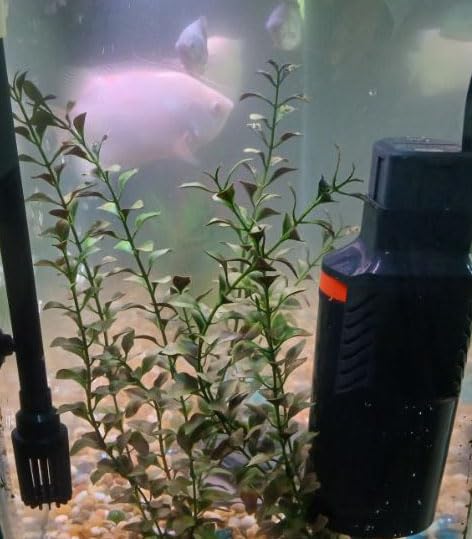
Where it works
Polish a heavily planted display that has gone slightly cloudy after a trim or a substrate vacuum, and put the micron cartridge to work. Continuous three-stage filtration with a submerged motor is genuinely convenient for that job.
It is a cheap way to add fine filtration without another large canister body in the cabinet.
Where it does not work
Do not choose it as the primary biological filter for a heavily planted or heavily fished tank. It is not interchangeable with external models, and it is not built to carry a large bio-load on its own.
The micron cartridge is a consumable that needs regular replacement, so treat it as a second filter with running costs rather than a set-and-forget addition.
12. Aquatop CF-400UV MKII – four baskets and a UV stage up to 125 gallons
Aquatop 4-Stage Canister Filter with Vortex Prime, 9W UV, 370GPH Flow Rate, 35W Power, Up to 125 Gal – Including All Filtration Media, Great for Salt & Freshwater Tanks, UV for Crystal Clear Water
370 GPH rated for tanks up to 125 gallons
Built-in 9 watt UV sterilizer
3+1 stage with four large media baskets
Vortex prime self-priming system
Pros
- Intake doubles as a siphon connection
- 370 GPH clears green water quickly
- Very large media baskets accept nearly any media
- Adjustable outlet aims flow away from the front pane
Cons
- Poor instructions require trial and error
- No carrying handle when full
- Factory residue needs a full rinse before use
- UV bulb is hard to source as a replacement
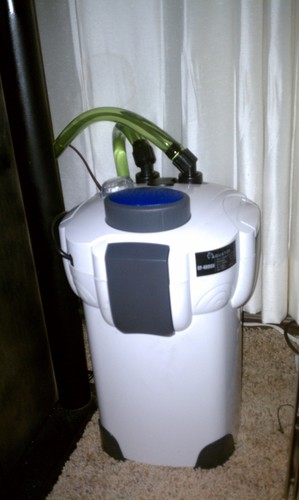
The Aquatop CF-400UV MKII is rated at 370 GPH for tanks up to 125 gallons, which makes it the only canister here with a stated capacity above 100 gallons. That makes it worth a look for anyone building a large open-top aquascape rather than a standard cabinet tank.
Four large media baskets is the standout. Reviewers consistently single out basket size as the best thing about it, and in a planted tank large baskets let you build a real pre-filter layer without crushing biological media into a thin disc.
Two details make it planted-tank friendly. The adjustable-direction outlet lets you aim flow away from the viewing pane, and the intake tube includes a siphon port so you can vacuum the substrate with the same line the filter uses.
The integrated 9 watt UV helps clear suspended algae in the water column, and the Vortex prime system starts the pump without manual priming.
Where it fits
Large planted displays from about 75 to 125 gallons where media volume matters more than brand polish.
At 35W the power draw is modest for the volume it moves, and the four baskets let you dedicate one to coarse sponge without giving up biological media space.
Where it frustrates
Documentation is the biggest weakness. Setup and feature use require trial and error because the instructions are poor, so allow time to work out the priming routine rather than assuming you did it wrong.
There is no carrying handle, so it needs two hands when full. Factory pressure testing leaves moisture and a chemical smell that needs a full rinse before use, some models do not include the blue sponge pad shown in the manual, and the UV bulb is eventually difficult to source as a replacement.
Pre-Filtering: the Habit That Stops Canister Clogging
If you read one section, read this one. The most repeated complaint we found in planted tank forums was not about any specific brand, it was about canisters clogging in dense plantings and losing flow over time, and the fix is nearly always the same cheap addition.
Put a coarse sponge, the blue kind with visible pores, in the top media basket so it sits directly above everything else. It catches shed leaves, root fibres and substrate debris before they reach the floss. Rinse it in a bucket of tank water whenever it darkens and the rest of your media stays clean.
The order inside the canister matters too. Water flows top down through the trays, so go from coarse to fine:
Coarse sponge or a cut-to-fit foam pad in the top basket for the sacrificial layer.
Filter floss or a polishing pad as the fine mechanical stage that traps what the sponge missed.
Ceramic rings, bio-balls or sponge in the lower trays for the nitrifying bacteria to colonise.
Activated carbon last, in a bag, only if you need chemical filtration for tannins or medication.
Two habits go with it. Never fill the last basket to the brim, because water needs somewhere to go or you will get air bubbles rather than flow. And keep the intake strainer an inch or two above the substrate so the filter is not sucking through the sand bed and pulling your carpet apart.
The 7 Things That Matter When Buying a Canister Filter for a Planted Tank
1. Filtered flow, not pump rating. A canister rated at 265 GPH gives you meaningfully less once media is loaded and the intake is drawing through substrate. Treat the printed number as a ceiling and size your tank against a realistic percentage below it.
2. Media volume and tray count. More trays mean you can separate a pre-filter from biological media instead of choosing between them. Three baskets is the practical minimum for a densely planted tank.
3. Pre-filter capability. The best canister filters for planted tanks are the ones whose top basket is big enough to hold a coarse sponge without stealing space from the media you actually want to keep.
4. Spray bar or sprayway. A spray bar across the surface is what a CO2-injected tank needs for gas exchange. A narrow directed outlet is better for a gentle current over a delicate carpet. Canisters with both are the most flexible.
5. Self-priming. A self-priming pump removes the single most annoying task in canister ownership. Budget canisters with a primer button are acceptable, anything requiring manual filling every restart is a chore you will resent.
6. Serviceability and parts. Removable baskets with handles, a pump head that opens without special tools, a replaceable impeller and O-rings, and quick disconnect valves. If a part is unavailable in five years, the filter is a liability.
7. Running cost. Cartridge-based designs with monthly replacements cost more over a year than bulk floss and generic ceramic rings. If you run carbon permanently on a high-tech tank, this line item deserves real attention.
Intake placement in deep substrate beds. Where you put the intake changes the flow more than most people expect. If you bury it in three inches of aquasoil you lose a meaningful slice of your rated output and you will suck substrate into the strainer every time you vacuum. Aim for just above the substrate line, angled slightly upward, and use a lily pipe or glassware rather than the plastic tube it comes with if your layout is open-top.
Eheim or Fluval? This is the most asked question on the forums and the honest answer is that Eheim wins on long-run mechanical dependability and simple sealing, while Fluval wins on smart features, self-priming convenience and media basket access. Eheim if you want to set it running and forget it for a decade. Fluval if you service it regularly and value fast access and automatic prime recovery.
Cabinet space and hardware. Measure the stand before you buy, and measure the door opening too. Stiff hoses on a large canister need routing room, and a wet cabinet behind a gaming PC-style build is a problem you do not want to debug at midnight. Keeping dust and grime out of a crowded cabinet is the same discipline people apply when they filter and cover a gaming PC, and the habits transfer.
Canister vs HOB vs Sponge vs Sump for a Planted Tank
Canisters hide in the cabinet, hold more media than a hang-on-back or sponge filter, and give you a strainer intake instead of a broad water-column intake that does not stir detritus out of the substrate.
Hang-on-back filters are cheaper and easier to service, but the intake sits in the water column and the outflow often lands on one side of the tank. On a densely planted aquascape that produces uneven circulation and leaves detritus sitting in the low spots.
Sponge filters on dual sponge holders are excellent for shrimp and betta tanks and cost almost nothing. They have very low flow, which limits how much detritus they capture and how well they serve a high-tech layout with injected CO2.
Sumps win on flow control and on adding equipment such as protein skimmers and heaters, but they need a tank designed around them. Unless your tank is a rimless open-top built for a sump, a canister gives you most of the practical benefit for far less complexity.
Plenty of owners run a canister plus two dual sponge filters on purpose, for redundancy and gentle circulation at the same time.
A Maintenance Schedule That Keeps Your Beneficial Bacteria Alive
The rules are simple. Always rinse media in water taken from the tank, never from the tap. Chlorine and chloramine kill the nitrifying bacteria living on your ceramic rings and sponge, and in a heavily planted tank that population is doing serious work because plant biomass produces ammonia as a side effect.
Roughly monthly, or when flow drops visibly:
Unplug, close the valves and remove the lid.
Pull the baskets out one at a time and rinse each in a bucket of tank water, squeezing sponge gently and swirling floss.
Rinse the canister body, the spray bar and the intake strainer in the same bucket water.
Reassemble with the media order unchanged: pre-filter on top, fine media next, biological media at the bottom.
Replace floss as it discolours. Never replace biological media all at once, because that is what triggers a mini-cycle in a tank where the plants are doing most of the work.
Diatom filters deserve a specific warning. In a fish-only tank a diatom run after a water change clears particles from the water column. In a planted tank the water column is where a lot of your beneficial bacteria and plankton live, and a heavy diatom pass strips them out of a system with far more biomass than a fish tank.
Water changes and canister cleaning can coexist. Many planted owners do a large weekly change and clean the canister monthly, which keeps the media from ever getting thick enough to cost you flow. If you are worried about disturbing bacteria, clean less often rather than more, and never use tap water.
Frequently Asked Questions
What is the best filter for a planted aquarium?
A canister filter with enough media volume and a coarse sponge pre-filter stage is the best choice for most planted aquariums. Aim for a turnover of 4 to 5 times tank volume for low-tech setups and 6 to 7 times for CO2-injected layouts, then size the pump above that target to allow for loaded media.
Which is better, Eheim or Fluval?
Eheim wins on long-run mechanical dependability and a simple, durable seal on the pump head. Fluval wins on self-priming convenience, faster media basket access and automatic recovery from lost prime. Choose Eheim for a set-and-forget filter and Fluval if you enjoy servicing your equipment regularly.
How much flow should a canister filter have?
For a planted tank, target 4 to 5 times your tank volume per hour for low-tech setups and 6 to 7 times for high-tech layouts with injected CO2. A 40 gallon high-tech tank therefore needs roughly 240 GPH of real filtered flow, so pick a pump rated meaningfully above that once media is loaded.
Do I need a filter for a heavily planted tank?
Yes, and you need a good one. Plant biomass, root mass and detritus produce a real biological load, so the filter has to handle mechanical cleaning and stable nitrification at the same time. What matters is media volume and a pre-filter stage so the canister does not clog and choke its own flow.
Why does my canister filter clog in a planted tank?
Almost always because fine detritus and root fibres reach the fine media first. Add a coarse sponge in the top media basket so the sacrificial layer catches debris before the floss, keep the intake strainer just above the substrate, and rinse the sponge in tank water whenever it darkens.
Should I run a diatom filter on a planted tank?
Use one sparingly if at all. In a planted tank a large share of beneficial bacteria and plankton live in the water column, and a heavy diatom pass strips them out of a system with far more biomass than a fish-only tank. If you run one, keep the pass short and only when you need the clarity.
Our Final Verdict for Planted Tanks in 2026
After twelve canisters and several months of planted layouts, the best canister filters for planted tanks come down to three picks. Buy the Fluval 407 if you want one filter for a tank up to 100 gallons and you value quiet running, self-priming startup and one-finger media access. Buy the Fluval FX6 if you need real flow headroom and the largest media volume available, and do not mind planning your intake pipe before cutting it.
Buy the Penn-Plax Cascade 1000 if media basket capacity decides it, and swap the plastic clamps early. On a tighter budget the SunSun HW302 Pro gives you 265 GPH of rated flow for a 40 to 75 gallon planted tank, and with a coarse sponge in the top basket it resists clogging.
Whichever you pick, put the pre-filter in place on day one and size it above your turnover target. That habit does more for a planted tank than any brand name on the box.