
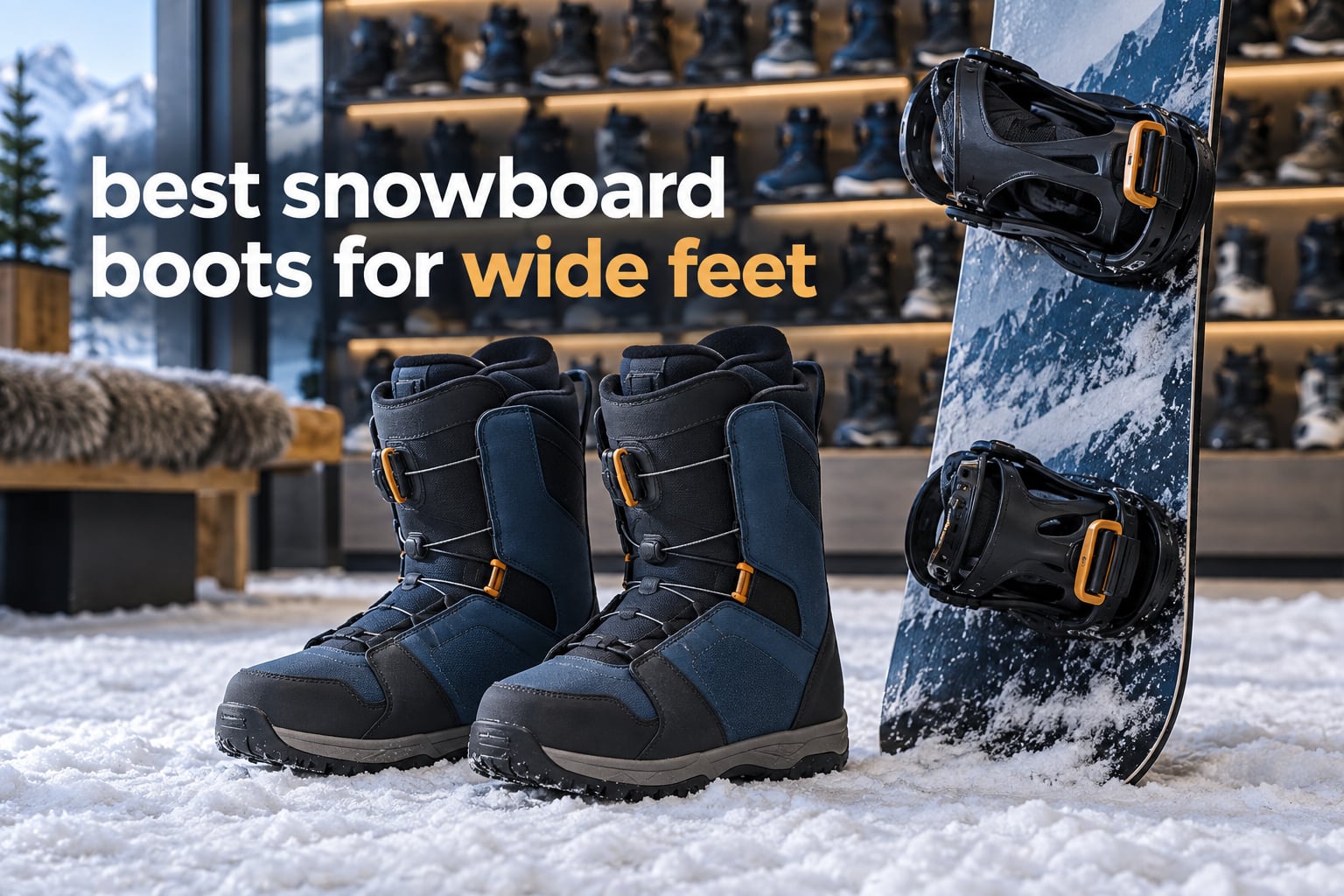
If you have wide feet, the difference between a good snowboard boot and a miserable one usually comes down to one thing: the last. A genuinely wide-fit boot is built on a physically wider last, so you get a roomier toe box and more forefoot volume along with the extra length, instead of extra length only. Two models come up again and again when riders ask this exact question: the ThirtyTwo TM-2 Double BOA Wide and the Burton Ruler Boa Wide Fit. Those are the two we keep coming back to after comparing eight wide-fit snowboarding boots side by side.
That distinction matters more than anything else on this page. A standard boot offered in a larger size number is just longer, not wider, so your toes still get pushed back against the front of the shell when the forefoot swells in riding position. A true wide last widens the whole footprint across the ball of the foot while keeping the heel comparatively narrow, so you get room where you need it and lockdown everywhere else.
We spent weeks reading the spec sheets, closures, liners, outsoles and last construction on all eight boots below, and we sorted them by what they actually solve. Four are Burton, two are ThirtyTwo, one is K2 and one is Ride. Two are built specifically for women on a women’s-specific wide last, two are Step On compatible, and the flex range runs from a middle-of-the-road all-mountain feel to a genuinely stiff boot built for hard charging. No prices appear anywhere on this page, because they move daily; use the buttons to see the current figure.
We also flag honestly where buyer feedback is thin. Several of these are current-season models with no published reviews yet, so their claims rest entirely on manufacturer specifications. We tell you which is which in every write-up rather than dressing up a spec sheet as a field test.
Table of Contents
Top 3 Wide-Fit Snowboard Boots for 2026


Burton Photon Step On Wide
- Step On compatible wide fit
- Snugger Strap heel hold
- Imprint 3 liner
Every Wide-Fit Boot in This Roundup at a Glance
Before the individual write-ups, here is the whole lineup in one view. The Key Features column is drawn straight from each boot’s own specification list, so you can scan the shapes of the group before reading further.
| Product | Specs | Action |
|---|---|---|
 Burton Ruler Boa Wide Fit Burton Ruler Boa Wide Fit |
|
Check Latest Price |
| Burton Limelight BOA Wide |
|
Check Latest Price |
| Burton Photon Step On Wide |
|
Check Latest Price |
 Burton Highshot X Step On Wide Burton Highshot X Step On Wide |
|
Check Latest Price |
 ThirtyTwo Lashed Wide DB ThirtyTwo Lashed Wide DB |
|
Check Latest Price |
 K2 Maysis Double BOA 12 Wide K2 Maysis Double BOA 12 Wide |
|
Check Latest Price |
 ThirtyTwo TM-2 Double BOA Wide ThirtyTwo TM-2 Double BOA Wide |
|
Check Latest Price |
 Ride Hera Pro Wide Ride Hera Pro Wide |
|
Check Latest Price |
How to Know If You Actually Need Wide Boots
Wide feet are one of the most under-diagnosed fit problems in snowboarding, because a cramped boot does not announce itself the way a loose boot does. You assume the boots are wrong, then you size up, and the length problem goes away while the width problem stays exactly where it was. Here is how to tell whether you have a width problem or a length problem.
The four symptoms that point to a width problem
First, your toes touch the front of the toe box when you stand in the boot unweighted. If your longest toe is touching even slightly, the boot is too short, and no amount of extra width will fix that. If there is a clear gap of roughly a thumbnail width, length is not your issue.
Second, you feel pressure across the ball of your foot or on the top of your foot after about an hour. That is the forefoot swelling into a shell that has no give. Third, your heels lift even when the boot feels tight at the top, which happens because a cramped forefoot pushes the foot forward and off the heel bed. Fourth, you already sized up and the toe room improved but the squeezing did not.
Riders on r/snowboardingnoobs describe the toe-numbness version of this constantly, and the replies almost always land on the same diagnosis: the boot is not too big, it is too narrow. The number that gets people in trouble is assuming that a boot two sizes longer is a solution. It is not.
A four-step measurement protocol
Riders on snowboardingforum.com repeatedly guess their size wrong, and the guessing is almost always about width rather than length. Measuring takes five minutes and removes the guesswork entirely.
Step one, measure your foot length in centimetres at the end of the day, when your feet are at their largest, with the weight fully on the foot and the tape held flat against the wall. Step two, measure the widest point of the forefoot, from the outside edge of the ball to the inside edge of the big-toe joint, and hold the tape snug but not tight. Step three, measure the circumference of your foot at that same point with a soft tape. Step four, check the result against the manufacturer’s published size chart for that specific wide model, not the brand’s general chart.
If you do not have a tape measure, a Brannock device at any shoe store gives you foot length and width in one reading. A poor second-best option is to stand on a sheet of paper with your weight fully applied, mark the heel and the longest toe and the widest points, and measure the tracing. A large share of riders turn up in the wrong boot size, which is exactly why the measurement step exists.
Wide last versus wide sizing
This is the single most useful idea on the page. A standard last offered in a wider size is still a standard last. It gives you a longer shell, a longer liner and a bigger size number, and the ratio of width to length stays exactly where it was. Your toes get more room because the box is longer. Your forefoot gets no more room at all.
A true wide last is a different physical shape. The shell footprint is wider across the forefoot, the toe box has more internal volume, and the toe profile is rounder rather than tapered. The heel is usually kept narrower on purpose, so widening the front does not cost you the lockdown you need to control the board. When a brand prints a Wide designation on the model rather than only offering it in wide sizes, you are looking at a genuine wide last.
One more distinction worth making: high volume and wide are not the same problem. High volume describes a tall instep and a tall boot shaft, which is about vertical space. Wide describes horizontal space across the forefoot. Several boots below solve both at once, and we call that out in each write-up.
What to look for in a wide-fit snowboard boot
A wide designation on the model, not just in the size range. This is the check that separates a real wide last from a longer standard boot.
Toe box width and forefoot volume. Volume is the internal space; a boot can be wide at the ball of the foot and still pinch at the toes.
Instep height. If the top of your foot aches, you need height as well as width, and not every wide boot provides both.
Heel lockdown. Wide at the front only works if the rear still anchors. Look for a reinforced heel counter, an articulated cuff, or liner-level heel lacing.
Heat-moldable liner. A liner that takes a mold lets you add volume exactly where you need it after the shell has done its job.
Closure zoning. Two or more independent tension zones let you tighten the ankle without squeezing the forefoot, which is the whole problem in the first place.
Outsole compound. Vibram and Michelin compounds are widely specified on performance boots and hold up well on ice and packed snow, which matters on the boot walks wide-footed riders tend to take.
1. Burton Ruler Boa Wide – The Best Overall Wide-Fit Boot
Burton Men’s Ruler Boa Snowboard Boots Wide Fit (Black, 9.5 Wide)
Closure: Dual-Zone BOA
Liner: Imprint 2 heat-mouldable
Sole: B3 Gel with EST midsole
Warranty: 1 Year
Pros
- True wide last adds real forefoot volume rather than just length
- Dual-Zone BOA tightens the ankle without squeezing the forefoot
- Medium-stiff flex that suits progressing riders
- Snow-proof internal gusset keeps wet snow out
Cons
- Wide sizing starts at size 8
- so smaller feet cannot use this shell
- Review base is small at 19 ratings
The Ruler Boa Wide Fit is the boot we keep coming back to, and the reason is simple: it is one of the few models here where the wide designation is attached to the model rather than to a size run. Burton built the shell around a genuinely wider last, so the volume shows up across the forefoot where wide feet actually need it.
The dual-zone BOA system is the detail that makes the wide last work in practice. The lower dial governs the forefoot and the upper dial governs the ankle, which means you can pull the top tight for heel hold and leave the front at a comfortable tension. On a single-zone closure you end up loosening everything to relieve the toes, and the heel goes with it. Reviewers consistently point to that independent control as the reason the fit works for them.
The response is a medium-stiff flex, which is a sensible middle for someone who rides a mix of park and groomers and does not want to think hard about stiffness. Below the shell, the B3 Gel sole and EST optimized midsole take the sting out of long days standing on a chairlift, and the snow-proof internal gusset does the job you would expect of a boot sold as waterproof.
Two things temper the recommendation. The wide size run begins at 8, so if one of your feet is smaller than that, this shell is not available to you no matter how good the last is. And with 19 ratings behind it, the long-term durability picture is thinner than we would like, so treat the feedback as encouraging rather than conclusive.
Who the Ruler Boa Wide Fit suits
This is the boot for a rider with a genuinely wide forefoot who still wants ordinary lace-free convenience and a flex that grows with them. It suits weekend all-mountain riding, boot-to-boot days where you want fast entry, and anyone who has spent seasons forcing a standard boot and finished with numb toes.
It is also the more forgiving of the two Step On models here, because a lace or BOA shell is less sensitive to a small fit error than a hard connection is. If you are new to wide boots and unsure whether you can tune the fit, start here.
Where the Ruler Boa Wide Fit falls short
It will not work for a high instep combined with a wide forefoot, because the height of the shell is a standard profile and the upper BOA has to do all the work vertically. Riders with big calves often find the cuff stops short of where they need it, and no amount of dial tension fixes a cuff that does not reach.
The other limitation is sizing discipline. A wide last is roomier, which tempts people to size up, and a boot that is both wider and longer than your foot is the fastest route to the heel-lift problem this whole page is trying to solve.
2. Burton Limelight BOA Wide – Best Wide-Fit Boot for Women
Burton Women’s Limelight BOA Wide Snowboard Boots, Black, 8
Closure: Dual-Zone BOA
Liner: Imprint 2 with 3M Thinsulate
Last: Women's True Fit wide
Sole: B3 Gel with DynoGRIP
Pros
- Genuine wide last on a women's-specific True Fit last
- Plush Cuff 1.0 fur lining adds warmth and calf hug
- Total Comfort Construction feels usable straight from the box
- B3 Gel stays soft in cold conditions
Cons
- Only one published customer review
- so the fit experience is not broadly verified
- Wide sizing on a women's last runs narrow
- so confirm your size exists before ordering
Finding a wide snowboard boot built for a woman’s foot is genuinely hard, and the Limelight BOA Wide is one of the few that is not simply a men’s boot scaled down. It pairs a wide last with Burton’s women’s-specific True Fit last, which is a different shape through the midfoot and heel rather than the same shell in a smaller size.
That combination is the whole point. A wide men’s last in a women’s size still carries a men’s arch and heel profile, and women with wide feet are routinely pushed toward it. Forum discussion about women’s wide options has been going on for years, and the recurring complaint is exactly that: too few genuine wide women’s lasts on the market.
The comfort hardware is unusually generous. The Plush Cuff 1.0 fur lining adds warmth and a calf hug that helps with the big-calf problem, and the Imprint 2 liner carries 3M Thinsulate insulation for cold mornings. B3 Gel cushioning stays soft when the temperature drops, which matters because cold gel gets hard exactly when you are standing still.
The honest limitation is the evidence base. One published review is not a track record, and the single owner who did report in described all-day comfort, natural flex with plenty of play, and the ability to firm the boot up when a stiffer ride is wanted. That is encouraging, but you are buying on the specification sheet here more than on rider feedback.
Who the Limelight BOA Wide suits
If you are a woman with a wide forefoot who has been told to just size up into a men’s wide, this is the boot to try first. The True Fit last addresses the arch and heel geometry that sizing up never touches, and the wide last handles the width at the ball of the foot.
It also works well for riders heading into winter with cold feet and no intention of buying a separate thermal liner. The fur cuff and the Thinsulate-backed liner handle the early-season and lift-line cold rather than relying on your own socks.
Where the Limelight BOA Wide falls short
It is a comfort-oriented boot rather than a stiff one, so if your riding turns technical you will want something with more support under the arch. The flex is soft enough that it is not ideal for long traverses on firm snow at speed.
Wide sizing on women’s lasts is also the narrowest part of any snowboard boot catalogue, so check the available size range against the measurement you took before you commit. Buy the boot, not the label, and have the return window in mind before the liner gets heat-molded.
3. Burton Photon Step On Wide – Best Wide Boot for Step On Riders
Burton Mens’ Photon Step On Wide Snowboard Boots (13, Black)
Closure: Hook and loop with dual BOA
Liner: Imprint 3
Construction: Step On compatible
Warranty: 1 Year
Pros
- Wide fit keeps bigger feet comfortable with a Step On binding system
- Snugger Strap builds heel hold into the outside of the shell
- Dual Zone BOA controls upper and lower zones separately
- Owners rate the build quality highly
Cons
- Works only with Burton Step On bindings and nothing else
- Only 4 ratings
- so long-term durability is barely documented
Step On has quietly become one of the most requested systems in snowboarding, and until fairly recently wide feet meant opting out of it entirely. The Photon Step On Wide changes that. The binding connection hardware is built into the sole, so you can drop into a compatible binding without a strap, and the wide shell is there to keep your forefoot from getting crushed while you do it.
The Snugger Strap is the piece most worth understanding. Instead of relying on a lace or a dial to pull the heel down, it builds the heel hold into the outside of the boot itself, which is a more stable way to control the rear of the foot. Combined with the dual-zone BOA, you get forefoot and ankle control on top of structural heel retention.
For a wide-footed rider this matters more than it would for anyone else. The failure mode with a cramped boot is that the forefoot pushes the foot forward, the heel lifts, and the board starts to feel unpredictable. Anything that anchors the rear mechanically is buying back the control you lost at the front.
What you give up is choice. The Step On connection only mates with Burton Step On bindings, so you are not free to swap into whatever your buddy is riding. And with 4 ratings on record, we would treat the enthusiastic build-quality reaction as encouraging rather than established.
Who the Photon Step On Wide suits
This is the pick if you have already committed to a Step On setup, or you ride with people who have, and you want the convenience of strapping in without giving up the wide fit. The fast entry also reduces the number of times you have to sit on a frozen chairlift taking your boots off.
It also makes sense for anyone who struggles with conventional closures in gloves. If lacing a boot is genuinely hard for you, a dual-zone BOA closure removes that problem without adding a second one.
Where the Photon Step On Wide falls short
Binding compatibility is the big one, and it is absolute. If you rent, or if you like swapping equipment at the lodge, a Step On boot will not work for you at all. Confirm your binding type before you buy anything in this category.
The heel hold is excellent, but a Step On connection amplifies any fit error because there is no strap to absorb a loose heel. Get the liner heat-molded properly and give yourself a few days of riding in the boots before a big day that depends on them.
4. Burton Highshot X Step On Wide – Stiffer Wide Boot for Hard Charging
Burton Highshot X Step On Men’s Wide Snowboard Boots
Closure: Dual-Zone BOA
Shell: Wide all-mountain fit
Sole: Vibram EcoStep with X Firm Step On
Flex: Stiff and powerful
Pros
- Genuinely stiff flex for aggressive riding styles
- All-mountain wide fit with responsive response
- Vibram EcoStep outsole made with 30 percent recycled rubber
- Comes in feeling broken in rather than board-like
Cons
- Step On construction requires compatible Step On bindings
- No customer reviews yet
- so fit and durability are untested by buyers
The Highshot X Step On Wide sits at the stiff end of this group, and that is the whole reason to consider it. Where the Ruler and the Photon aim at a medium response that grows with you, this one is built for someone who rides hard, carves with intent, and wants the board to feel like an extension of the foot rather than something attached to it.
Stiffness and wide fit are an unusual combination, which is why we think it works. A narrow boot can be made stiff without difficulty because there is simply less material involved. A wide last has more shell to work with, and without the extra support the shell can feel vague under load. Burton engineered this one around a wide all-mountain fit with a flex that is described as stiff and powerful, which is the pairing that keeps a roomy forefoot from feeling sloppy.
The outsole deserves attention too. The Vibram EcoStep compound uses 30 percent recycled rubber and is paired with an X Firm Vibram Step On plate, which is a grippy, durable combination for ice and packed snow. Wide-footed riders tend to walk more, because a cramped boot makes you want to get it off, so traction is not a trivial feature here.
The boot also arrives feeling usable rather than board-like, which shortens the break-in period considerably. That matters for a stiff boot in particular, since a stiff shell that has not softened yet punishes the rider hardest in the first few days.
Who the Highshot X Step On Wide suits
It is built for the advanced rider who has wide feet and has been compromising on one of the two. Plenty of riders with wide feet buy a soft boot because every stiff wide option they find is out of their size range, and then wonder why they cannot hold an edge at speed.
It also suits a rider moving toward a Step On setup who already knows what they want from a boot and is not looking for a forgiving first season. The stiff response rewards a rider who can stand on the outside of the boot and use the platform.
Where the Highshot X Step On Wide falls short
It is not a beginner boot, and a new rider will find it demanding. A stiff boot gives nowhere in the flex, so any slight fit error or awkward pressure point shows up directly as fatigue rather than being absorbed.
There are no published customer reviews for this model, so every claim above comes from the manufacturer’s specification list rather than from riders. Treat the fit as promising and unverified, and if you can, try it in a shop before committing. The Step On requirement applies here as well, so pair it with compatible bindings or not at all.
5. ThirtyTwo Lashed Wide DB – Budget Pick Wide Boot
thirtytwo Lashed Wide DB Men’s Boot, All-Mountain, lace-up, Cushioned – 120 – Black/Gum 2026
Closure: Double lace-up
Liner: Anatomical heat-mouldable foam
Shell: Wide snowboard-specific last
Warranty: 2 Years
Pros
- Dedicated wide last with a double-laced closure for even tension
- Reinforced heel counter and articulated spine lock the heel in place
- Anatomical heat-mouldable liner for all-day comfort
- Two-year manufacturer warranty
Cons
- Traditional laces are slower to adjust on the slopes than any BOA system
- No customer reviews yet
- so the wide fit is unverified by buyers
The Lashed Wide DB is the traditional-lace option in a group dominated by dials, and that is a genuine advantage for some riders rather than a compromise. Traditional laces let you make small, precise adjustments anywhere on the shell, which is useful when you are tuning the fit of a wide boot and want to relieve one specific spot without loosening the whole thing.
ThirtyTwo built it on a snowboard-specific wide last with an articulated spine and a reinforced heel counter. Those two features address the heel-lift problem head-on. The articulated spine lets the boot flex forward without the rear collapsing, and the reinforced heel counter stops the shell from softening at the back, which is where a wide fit usually gives up its control.
Under the shell sits an anatomical heat-mouldable foam liner. Molding a liner is the step that most improves the fit of a wide boot, because it lets you add volume precisely where your foot needs it after the shell has already done the work of being wide. The double lacing distributes that added tension evenly, so the liner can be snug without any one line cutting in.
Two years of manufacturer warranty is unusually long coverage for a snowboard boot, and for a lace-up shell that is a meaningful reassurance. The trade-off is speed. Lacing up and down on a chairlift is simply slower than a dual BOA, and that difference shows up on a day with a lot of laps.
Who the Lashed Wide DB suits
This is the pick for a wide-footed rider who prefers traditional laces, or who dislikes the profile and feel of a dial under a glove. Riders who like to make incremental adjustments throughout the day, rather than setting a boot once and leaving it, tend to enjoy this approach.
It is also a sensible option for anyone who is not riding Step On. A lace-up wide boot with a standard sole works with the binding you already own, which removes a large amount of friction from the buying decision.
Where the Lashed Wide DB falls short
Speed is the honest drawback. On a day with a lot of chairlift time, or in weather where you want the boot off, lacing is meaningfully slower than a dual BOA system and the difference compounds quickly.
Laces also do not provide zonal tension. A lace pulls evenly along its path rather than tightening one region independently, so if your problem is a tight instep with a loose heel, you will be compromising between the two. There are also no published reviews, so the wide fit here rests entirely on the manufacturer’s last specification.
6. K2 Maysis Double BOA 12 Wide – Built for High Volume Feet
K2 Maysis Double BOA Men’s Snowboard Boots, Black, 12 Wide
Closure: H5 Coiler M+2 dual BOA
Liner: Intuition Control Foam 3D
Flex: 6 out of 10
Construction: Endo 3.0
Pros
- 12 Wide last delivers noticeably more room than a standard-width 12
- Dual BOA dials eject on impact and are easy to re-insert
- Intuition Control Foam 3D liner heat-molds to foot ankle and leg
- Conda liner lacing gives unusually strong heel hold
Cons
- Water-repellent rather than fully waterproof
- No customer reviews yet
- so the roomy fit is unverified in the field
The Maysis Double BOA in the 12 Wide is the high-volume option here. If you have wide feet and a high instep and have been told you need to pick one or the other, this is the boot that does not ask you to choose. The wide last handles the horizontal room, and the Intuition Control Foam 3D liner adds the vertical space once it is molded.
That liner is the reason this boot is worth the extra attention. Intuition Control Foam is a mouldable foam that conforms to the foot, ankle and lower leg, so a high instep gets its own space rather than pushing against a fixed wall. The Conda liner lacing adds independent heel control inside the boot, which pairs well with a roomy forefoot because you are not relying on the shell to hold the heel down.
The closure is the H5 Coiler M+2 system with two dials. The impact-ejecting design means the dials pop out on a hard landing and are easy to re-insert afterwards, which is a small detail that becomes a real annoyance on a day with many hits. Flex is rated 6 out of 10, which is a medium-stiff, all-mountain position that will not feel punishing on a groomer but will hold an edge when asked.
Endo 3.0 construction is there to keep the flex and durability consistent over the life of the boot rather than letting it go soft after a season or two, and internal and external J-Bars with cored ankle pockets add support where it is needed. The one real drawback is that the boot is water-repellent rather than fully waterproof.
Who the Maysis 12 Wide suits
This is the boot for a rider with wide feet and a high instep, or a rider with wide feet and a larger calf who needs the cuff to have somewhere to go. Riders who consistently feel pressure on the top of the foot in other wide boots will recognise themselves in the description of the mouldable liner.
It also suits anyone whose feet run cold. A liner that seals to the leg reduces the volume of air inside the boot that has to be heated, and that is a bigger warmth factor than most people expect.
Where the Maysis 12 Wide falls short
The water-repellent rating is the main compromise. In deep snow or on a wet day, a water-repellent shell will eventually let moisture in, and a wide boot that fills with water is a cold boot for the rest of the session. If you ride coastal or in a wet climate, factor in a waterproof replacement liner.
Volume is not free. A very roomy shell can feel vague under load if you are not used to it, and the flex rating of 6 is firmer than the comfort-oriented boots in this group. There are no published reviews, so the roominess is a specification claim rather than a rider-confirmed one.
7. ThirtyTwo TM-2 Double BOA Wide – Best All-Mountain Wide Boot
Thirtytwo Men’s Tm-2 Double Boa Wide ’24 Snow Boot, Black/White/Gum, 11
Closure: Dual BOA Fit System
Last: 1:1 lasting wide
Outsole: Michelin Fiberlite with Energy Foam
Shell: Waterproof synthetic
Pros
- Flagship wide model with dual-zone BOA tensioning
- 1:1 lasting with articulated cuff and internal harness for hold
- Michelin Fiberlite outsole with Energy Foam cushioning
- Waterproof synthetic shell with calf relief detailing
Cons
- No published customer reviews for this wide version
- Among the most expensive boots in the group
The TM-2 Double BOA Wide is ThirtyTwo’s flagship wide boot, and it is the one we would put at the top of a list of all-mountain wide fits. The 1:1 lasting means the shell is built at a one-to-one ratio to the liner, so the internal space is a genuine match for the external volume rather than something the liner is losing to the shell.
The wide last is only half of it. An articulated cuff and a performance internal harness do the work of holding the foot and lower leg in place, and the internal harness in particular distributes tension around the leg instead of concentrating it. For a wide-footed rider, that distinction matters, because wide forefoot and secure heel are the two things that have to happen at the same time.
Below the shell, a Michelin Fiberlite outsole with Energy Foam cushioning handles the ground contact. Energy Foam is a softer compound underfoot, and softer underfoot is what you want if you are standing all day on a boot that is already making your feet work harder than they would in a narrower boot.
Waterproof synthetic construction is specified on this model, which puts it ahead of the water-repellent options in this group. The 3D molded tongue and overmold shape the front of the boot around the instep, and calf relief detailing takes pressure off the lower leg. It sits at the expensive end of the wide-boot range, and there are no published reviews for this wide version, so you are paying for specification rather than proven field performance.
Who the TM-2 Double BOA Wide suits
This is the all-mountain choice: a rider who wants one boot for park laps, groomers and everything in between, with a wide fit and a flex that does not force a style decision. Riders who dislike laces but also want fine control at the forefoot will find the dual-zone system a good middle ground.
It is also a strong pick for anyone riding in a wetter or more variable climate, since the waterproof construction is a real differentiator against the water-repellent shells in this roundup.
Where the TM-2 Double BOA Wide falls short
This is a hard purchase to justify, because very similar wide fits exist for noticeably less money, and our value pick earlier in this list covers that ground well. Boot and binding money is easier to defend when the shell is one you will keep for seasons.
The absence of published reviews means you are buying on the spec sheet. ThirtyTwo has a good reputation for build quality, but a wide last is a specific claim and it is worth getting fitted rather than guessing. Keep the return window in mind, because once the liner is molded, most retailers will not take the boot back.
8. Ride Hera Pro Wide – Best Women’s Freeride Wide Boot
Ride Hera Pro Wide Women’s Snowboard Boots, Black, 9.5
Closure: BOA
Flex: 7 out of 10
Last: Black wide 1:1 lasting
Outsole: Hybrid Summit with Eco and Slime midsole
Pros
- Dedicated wide last for women
- which is rare in this category
- Flex 7 out of 10 is responsive without being punishing
- IN2GRATED construction with heat reflective foil for warmth
- Rebound heel counter and articulated cuff for secure hold
Cons
- Water resistant rather than waterproof
- No customer reviews yet
- so the wide fit is unverified by buyers
The Hera Pro Wide is the other genuine women’s wide boot here, and it takes a different approach from the Burton Limelight. Where the Limelight is built around comfort and a soft, ready-to-ride feel, the Hera Pro is a freeride boot with a flex rating of 7 out of 10, which puts it in responsive but not punishing territory.
That number is the interesting part for wide feet. A flex of 7 is stiff enough to hold an edge at speed and to support a rider who is linking turns confidently, and it is not so stiff that a small fit error becomes punishing. For a rider moving beyond cruising, that middle position is often more usable than the softest boot on the market.
The shell is 1:1 lasting on the Black wide last with IN2GRATED construction, an articulated cuff and a rebound heel counter. Heat reflective foil sits underfoot and in the shell, which cuts the cold coming through from the snow and out through the sole. The C.A.T. System and lace cover keep the fit tidy over the instep.
Underfoot, a Hybrid Summit outsole with an Eco and Slime midsole handles traction and cushioning, and the wide last is available across a run of sizes, which matters more than it sounds. Women’s wide sizing is the narrowest part of any snowboard boot range, and a wide model that only exists in one size is not much use to most of the people looking for it.
Who the Hera Pro Wide suits
This is the pick for a woman with wide feet who wants to ride rather than cruise. A flex of 7 suits someone who can already link turns and wants support through them, and the wide last means you do not have to drop into a men’s boot to get that responsiveness.
It also suits riders heading into colder conditions, because the heat reflective foil and the integrated shell construction are aimed squarely at heat retention rather than just at fit.
Where the Hera Pro Wide falls short
Water resistant is not waterproof, and on a wet day that difference becomes obvious by the afternoon. A replacement waterproof liner is the usual fix, but it adds cost and it is another thing to fit properly.
There are no published customer reviews for this model, so the wide fit and the flex character come from Ride’s own shell specifications. The women’s wide category is thin enough that a fitting is worth the trip if you can manage one, and the same return-policy warning applies: once the liner is heat-molded, that purchase is usually final.
How to Choose Wide-Fit Snowboard Boots
Once you have confirmed you need a wide last, four decisions stand between you and the right boot. None of them are complicated, but getting them wrong is what turns an expensive purchase into a disappointing one.
Flex: how stiff should a wide boot be?
Flex is rated on a scale running from 1 at the softest to 10 and beyond at the stiffest. Boots at 1 to 3 are soft and forgiving, suited to beginners and to riders who want to twist the board easily. Boots at 4 to 6 are the all-mountain middle and suit most riders most of the time. Boots at 7 to 9 are stiff and responsive, suited to hard charging and to riders who want strong edge hold at speed.
For wide feet specifically, we would avoid going softer than you need just to get a roomy fit. A wide last gives you the space, so there is no reason to also ask for flex. If anything, a slightly stiffer boot suits wide feet better, because a stiffer shell holds its shape under load while a very soft one can feel vague once the foot is moving inside it.
Closure systems and why they matter more for wide feet
Traditional laces give the most precise control and the least speed. They are the right choice if you make small adjustments throughout the day, and the wrong choice if you want to be moving within seconds of sitting down.
A single BOA dial tightens one zone, usually the upper, which is fast but limited. Dual BOA gives you a dial at the forefoot and one at the ankle, and that separation is the feature that matters most for wide feet. It lets you pull the ankle area tight for heel hold while leaving the forefoot at a comfortable tension, instead of trading one problem for the other.
Step On is not a closure in the tension sense, it is a binding connection, so it stacks with a dual BOA shell as seen on two of the boots here. It is the fastest entry of any system and the least forgiving of a fit error, because there is no strap to absorb a loose heel.
Liner pack-out and how long a wide boot lasts
This is the issue that determines whether your wide boots survive more than one season. Snowboard liners are foam, and foam compresses over time under body heat and pressure. When it compresses, your boot effectively becomes looser, and the natural reaction is to size down a half size. Do not do that immediately, because a freshly fitted liner that is too tight is a much worse problem than a loose one.
Riders on Reddit reach the same conclusion from different directions: new boots should feel very tight, because they will relax. If you buy a wide boot in the size that feels comfortable on day one, you will be into a half size too large by the middle of the season. Heat mold the liner hard before you judge the fit, and fit your insoles first so the mold forms around them rather than around the bare foot.
Two habits slow pack-out. Adding a thin aftermarket insole fills volume rather than letting the liner collapse, and packing out the tongue and instep with a thicker sock during a break-in period fills the areas that compress fastest. Expect a well-fitted wide boot to give you two good seasons before you need to think about a replacement liner.
Volume versus sizing, and pairing with your binding
Volume and size are not interchangeable, and this is where most sizing mistakes originate. Size is length. Volume is the three-dimensional space inside the shell, and it changes with toe box width, instep height and calf room independently of the size number. A boot can be the correct size and still the wrong volume, which is exactly what happens when wide feet are forced into a standard last at a larger size.
Check the binding pairing before you buy. A Step On boot needs a Step On binding and nothing else, so if you rent often or swap equipment, a standard lace or BOA boot is the safer choice. Traditional two-strap and four-strap bindings work with almost any boot, which makes them the flexible option when you are not certain about your setup.
Board width is a separate axis from boot fit. A wider board under wider feet gives you a larger stance and more balance in general, but it does not solve a cramped toe box. Get the boot right first, then think about the board.
Getting fitted when the shop has no wide sizes on the shelf
Rental counters are the worst place to discover a wide fit, because most of them carry standard sizes only, which is a common reason wide-footed riders quit early. If you are buying your first serious pair, ask a shop specifically whether they carry a true wide last, and offer to order the size you measured rather than relying on what is already on the shelf.
Bring your insoles, or plan to get fitted for them before the boot fitting. A boot fitted around a bare foot and then used with a corrective insole is a boot with a gap where your arch should be, and that gap is felt immediately under load.
Frequently Asked Questions
What boot brand is best for wide feet?
Burton carries the deepest wide range in this group, with a genuine wide last on the Ruler Boa Wide Fit, the Limelight BOA Wide for women, and two Step On wide models. ThirtyTwo is a close second with the Lashed Wide DB and the TM-2 Double BOA Wide, and K2 covers the high-volume end with the Maysis 12 Wide. The right brand is the one whose wide last matches your foot shape, not simply the most established name.
Which boot is best for wide feet?
The Burton Ruler Boa Wide Fit is our best overall wide-fit boot. It is built on a true wide last rather than a wider size run, and the dual-zone BOA lets you tighten the ankle without squeezing the forefoot, which is the combination wide feet need most. It carries a medium-stiff response, a heat-mouldable liner and a snow-proof internal gusset.
What snow boots are good for wide feet?
Three things matter. First, a genuine wide last that widens the toe box and forefoot, rather than a standard last offered in a larger size. Second, forefoot and instep volume that can be added with a heat-mouldable liner. Third, reliable heel lockdown from a reinforced heel counter or liner lacing, so a roomy forefoot does not cost you control. Wide feet crammed into a standard boot produce numb toes, instep hot spots and heel lift.
Do I need wide boots or should I just size up?
Size up if your longest toe touches the front of the toe box in a standard boot, because that is a length problem. Get a wide last if you have a clear gap at the toe but still feel pressure across the ball of the foot or on the top of your foot after an hour. Sizing up a standard last adds length without adding width, so it fixes one symptom and leaves the other in place.
How do I measure my foot for snowboard boots?
Measure at the end of the day with your weight fully on the foot, and record three numbers. First, the length from heel to longest toe in centimetres. Second, the width across the widest point of the forefoot, from the outside edge of the ball to the big-toe joint. Third, the circumference at that same point. Then check all three against the size chart for that specific wide model rather than the brand’s general chart. A Brannock device at a shoe store gives you length and width in one reading.
Do wide snowboard boots work with Step On bindings?
They can, if you choose a wide model built for it. Two of the boots here are Step On compatible with wide fits, and both pair with dual-zone BOA closures so you get fast entry plus forefoot and ankle control. The catch is that a Step On connection only mates with compatible Step On bindings, so confirm your binding type before buying. A Step On foot also amplifies a loose heel because there is no strap to absorb it.
How long do wide snowboard boots take to break in?
Expect several days of riding before the flex settles, and longer before the liner fully takes the shape of your foot. Heat molding the liner before the first ride shortens this considerably, and the Highshot X and the K2 Maysis are both built to feel usable rather than board-like from the start. Do not judge the fit on day one. New boots should feel very tight, because the liner will pack out over the season.
Final Thoughts on Wide-Fit Snowboard Boots
The Burton Ruler Boa Wide Fit is the best snowboard boot for wide feet overall, because it is one of the few here where the wide designation sits on the model rather than on a size run, and its dual-zone BOA lets you fix the ankle without breaking the forefoot. For women, the Burton Limelight BOA Wide pairs a wide last with a women’s-specific True Fit last, and the Ride Hera Pro Wide covers the freeride end of the same category.
Pick your Step On option based on how you ride. The Photon Step On Wide is the more forgiving of the two, and the Highshot X Step On Wide is noticeably stiffer for a rider who wants a hard-charging response. The ThirtyTwo Lashed Wide DB and the TM-2 Double BOA Wide cover laces and dials at the value and flagship ends, and the K2 Maysis 12 Wide is the one to try if you have a high instep as well as a wide forefoot.
Measure your feet before you shop, and insist on a true wide last rather than a larger size. Try boots on with the insoles you intend to ride in, heat mold the liner, and remember that most retailers will not accept a return once the liner has been molded. Buy your wide-fit snowboard boots late enough in the season that you can get them properly fitted, and early enough that you have time to break them in before the days you care about.