
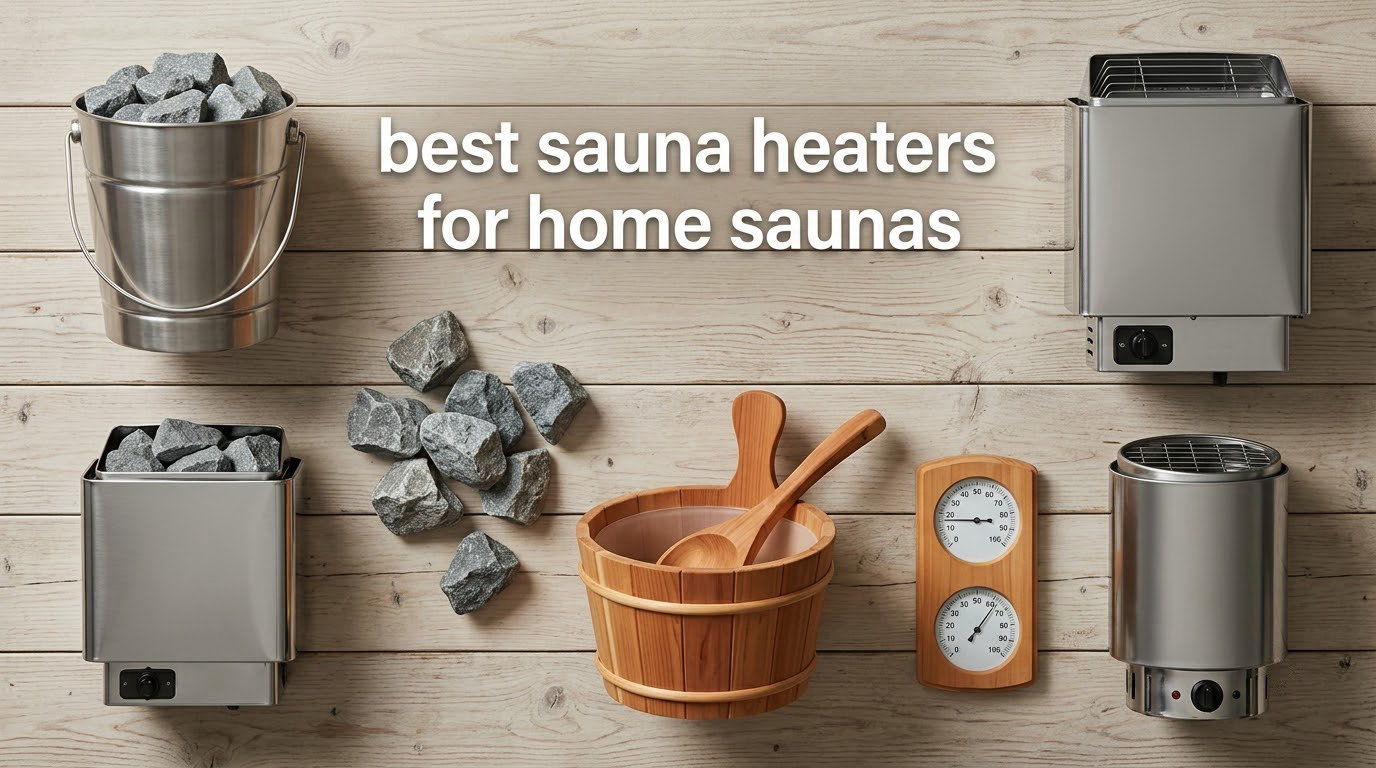
The best heater for a home sauna is the one whose kilowatt output matches your room’s cubic volume, whose voltage matches the electrical capacity you already have, and whose stone load is big enough to give you soft, even heat. For most homes, that means a 6kW to 8kW 240V unit on a dedicated circuit. Below is what we found after working through twelve heaters spanning 110V plug-ins to 13kW wood stoves.
I’ve spent the last few months reading spec sheets, wiring requirements, and owner feedback on sauna heaters, and the pattern is unmistakable. Nearly every regret in this category comes down to one of two mistakes: buying a heater that is too small for the room, or buying a 240V unit when the room only has a 110V outlet. Get those two decisions right and the rest is aesthetics.
That matters here because a sauna heater is not a casual purchase. It is hardwired into your electrical panel in most cases, it is one of the larger energy draws in a home wellness setup, and it decides whether your sauna reaches 180F in twenty minutes or never quite gets there in winter. The lineup below spans roughly the entire home market, from a plug-in 2kW unit for a small cabin to a 13kW wood-burning stove for a 459 cubic foot room, so there is a real option at every budget and every room size.
If you are still working out the basics of a home build, our guides to home arcade cabinets and home theater projectors cover the same kind of room-planning decisions, and our home safe buying guide is worth a look if the sauna will live in a converted shed or basement.
Table of Contents
Top 3 Sauna Heater Picks in 2026

Finlandia FLB-80 8kW
- 250-425 cu. ft. coverage
- Large rock capacity
- UL and ETL listed
- Built-in controls

Drizzlen 2kW 110V
- Plugs into a 20A outlet
- 70-100 cu. ft. coverage
- Heats up in 30 min
- Lifetime warranty
All 12 Sauna Heaters for Home Saunas at a Glance
| Product | Specs | Action |
|---|---|---|
| Finlandia FLB-80 8kW |
|
Check Latest Price |
| VEVOR 6kW 220V |
|
Check Latest Price |
 Mxmoonant 6kW 220V Mxmoonant 6kW 220V |
|
Check Latest Price |
 Harvia KIP 4.5kW Harvia KIP 4.5kW |
|
Check Latest Price |
 Harvia Cilindro H 9kW Harvia Cilindro H 9kW |
|
Check Latest Price |
| Drizzlen 2kW 110V |
|
Check Latest Price |
 GoldenWave Far-Infrared 2000W GoldenWave Far-Infrared 2000W |
|
Check Latest Price |
 Harvia The Wall 8kW Harvia The Wall 8kW |
|
Check Latest Price |
 HUUM Drop 6kW with UKU Control HUUM Drop 6kW with UKU Control |
|
Check Latest Price |
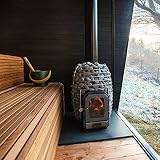 HUUM Hive Wood 13kW HUUM Hive Wood 13kW |
|
Check Latest Price |
 Amerec Designer B 4.5kW Amerec Designer B 4.5kW |
|
Check Latest Price |
| Mxmoonant 4.5kW 220V |
|
Check Latest Price |
1. Finlandia/Harvia FLB-80 8kW – Best Overall for Large Cabins
Finlandia/Harvia FLB-80/KIP-80B Sauna Heater, 8kw 240v/1ph, Maximum 425 cubic feet
8kW
240V single phase
Covers 250-425 cu. ft.
24 x 16 x 11 inch
49.2 lb
Pros
- Exceptionally large rock capacity with direct rock-to-element contact
- Serviceable industrial-grade stainless steel elements
- Built-in controls with a programmable 1-8 hour timer
- Covers cabins from 250 to 425 cu. ft.
Cons
- Requires 240V hardwired installation by an electrician
- Bulky wall-mounted unit consumes cabin wall space
Out of everything we went through, the FLB-80 is the one we kept coming back to. It carries 86 reviews at a 4.6 average, which ties for the most owner feedback in this group, and the reviews are unusually consistent about what matters: the rock tray is big, the elements are serviceable, and it holds heat in a large room.
The 8kW output puts it in the top tier for home installs, covering sauna rooms from 250 to 425 cubic feet. That range covers everything from a generous four-person cabin to a large barrel or gym-class room. It runs on 240V single phase, so it needs a dedicated circuit and a licensed electrician, which is normal at this output level.
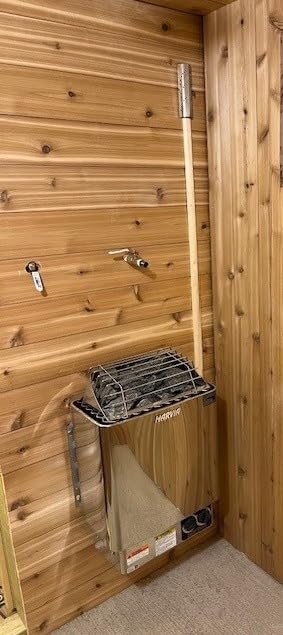
What separates it from cheaper 6kW units is the direct rock-to-heating-element contact and the sheer volume of stone the tray accepts. Owners on r/Sauna repeatedly point to stone mass as the number one quality differentiator, and this is the electric heater in our lineup where that heuristic pays off most clearly. More stone means the rocks act as a buffer, so the heat you feel stays even instead of spiking when you open the door.
Controls are built into the unit rather than mounted remotely, which keeps the wiring simple. You get a silent 60-minute timer, a thermostat, and a programmable clock that lets you pre-set heating up to eight hours ahead. That pre-program function matters more than it sounds, because it means you can start the sauna from outside the room and walk in to a finished session.
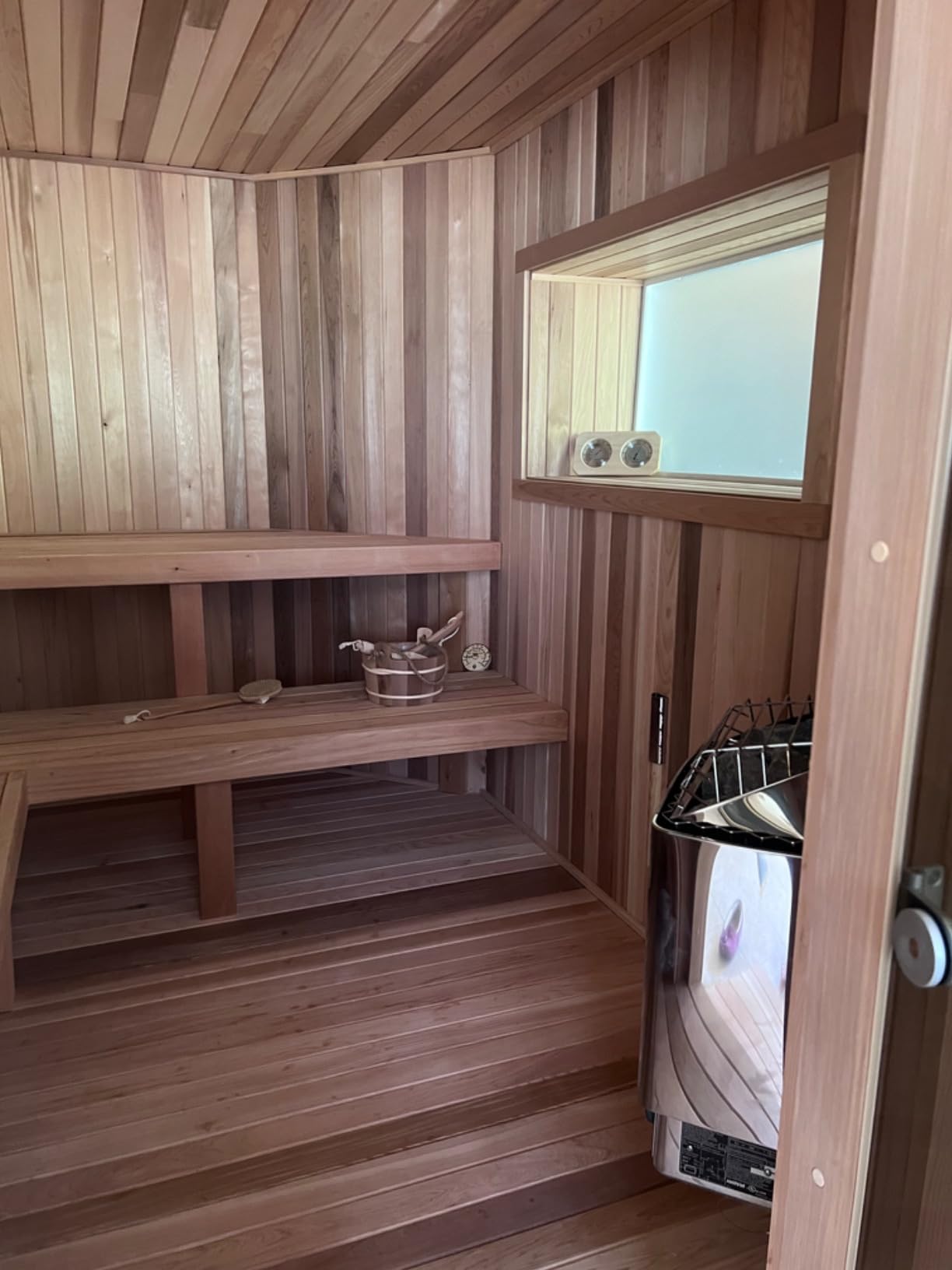
Is the FLB-80 the right call for a mid-size cabin?
If your room is under 250 cubic feet, this heater is simply too much output for the space, and an undersized-room mismatch is a real problem rather than a technicality. Overpowered heaters cycle on and off more aggressively, which shortens element life and makes the thermostat hunt. In that situation, step down to a 4.5kW or 6kW unit instead.
For a 250 cubic foot room and up, the calculus changes. The 1 kW per 45-50 cubic foot sizing rule lands a 250 cubic foot room at roughly 5 to 6kW, so the FLB-80 gives you genuine headroom rather than just hitting the mark. That headroom is what lets it push toward 200F in cold weather or in a cabin with a lot of glass.
What are the drawbacks worth knowing before you buy?
The installation is the real commitment. A 240V single-phase hardwired heater needs a proper circuit run from your panel, and that cost routinely exceeds what first-time buyers budget for. It is the single most cited regret in the sauna forums, and it is the reason we put a full electrical section later in this guide.
The second drawback is physical. At 24 inches tall and 16 inches wide, this is a substantial wall-mounted box, and it needs clear floor space and proper clearance in front of the rock tray. If your sauna is narrow, measure the wall before you commit, because this is not a unit you can tuck into a corner.
2. VEVOR 6kW 220V – Budget Pick Hardwired Heater
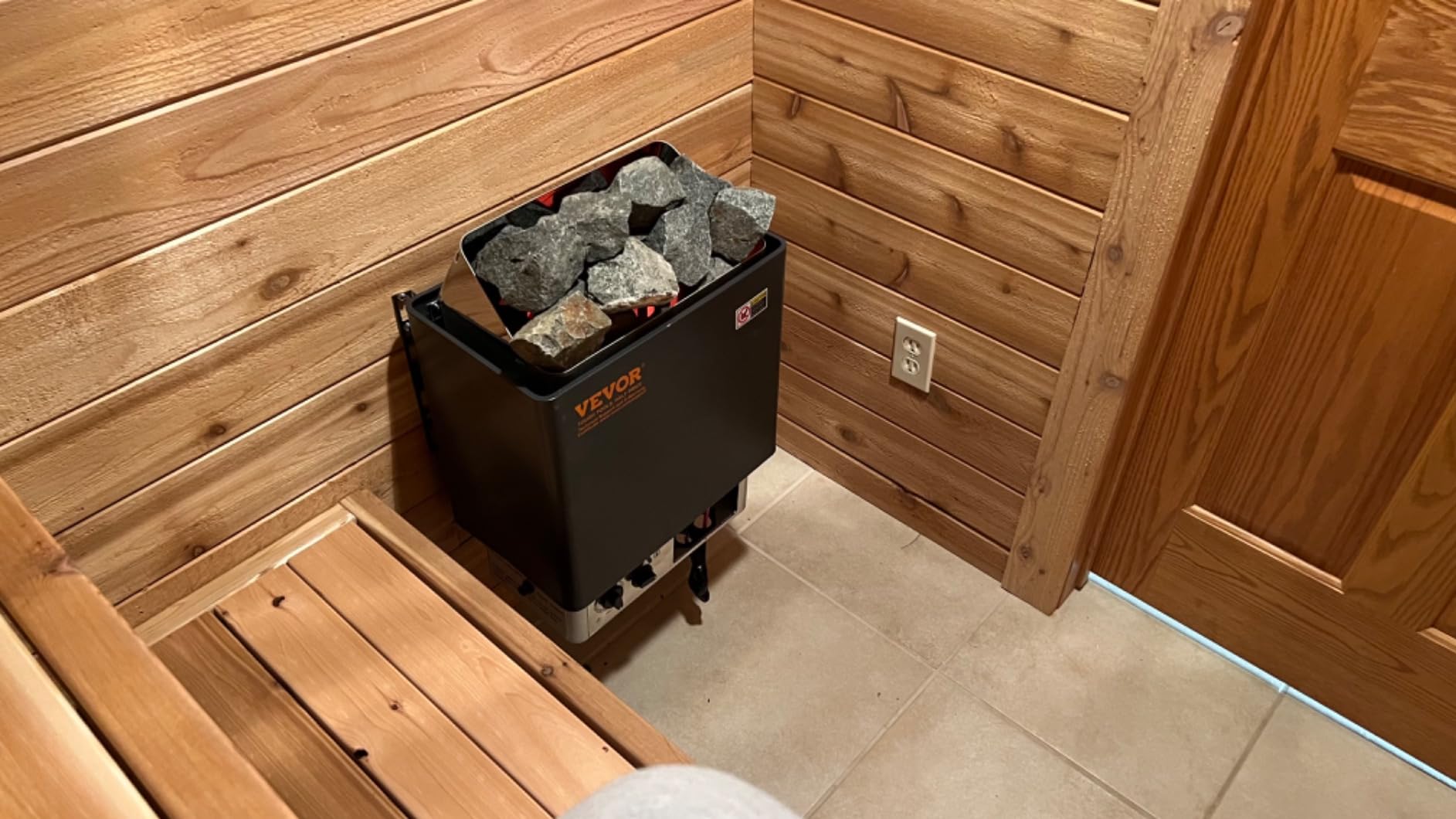
VEVOR Sauna Heater,220V Electric Sauna Stove, Steam Bath Sauna Heate 3h Timer and Adjustable Temp for Max. 176-318 Cubic Feet, Home Hotel Spa Shower Use (6KW) FCC Certification
6kW
220-240V AC
Covers 176-318 cu. ft.
16.1 x 10.6 x 22 inch
22 lb
Pros
- Reaches 170-200F in about 25-30 minutes
- Entry point into a hardwired 6kW class heater
- Clear terminal labeling makes wiring straightforward
- Coverage of 176-318 cu. ft.
Cons
- Small rock compartment limits steam output
- Sauna stones not included
- Some units reported arriving non-functional
The VEVOR 6kW is the reason this roundup covers budget units at all. Owners regularly describe it as delivering results comparable to heaters costing several times more, and the heat-up numbers back that up: 170-200F in roughly 25 to 30 minutes is a fast result for a 6kW unit in a room this size.
It covers 176 to 318 cubic feet, a wider band than most 6kW heaters advertise, which gives you room to grow into a slightly larger cabin later. The build is an aluminized zinc shell wrapped around a 304 stainless steel heating element, which is a sensible material pairing for a unit that will cycle through repeated high-heat cycles.
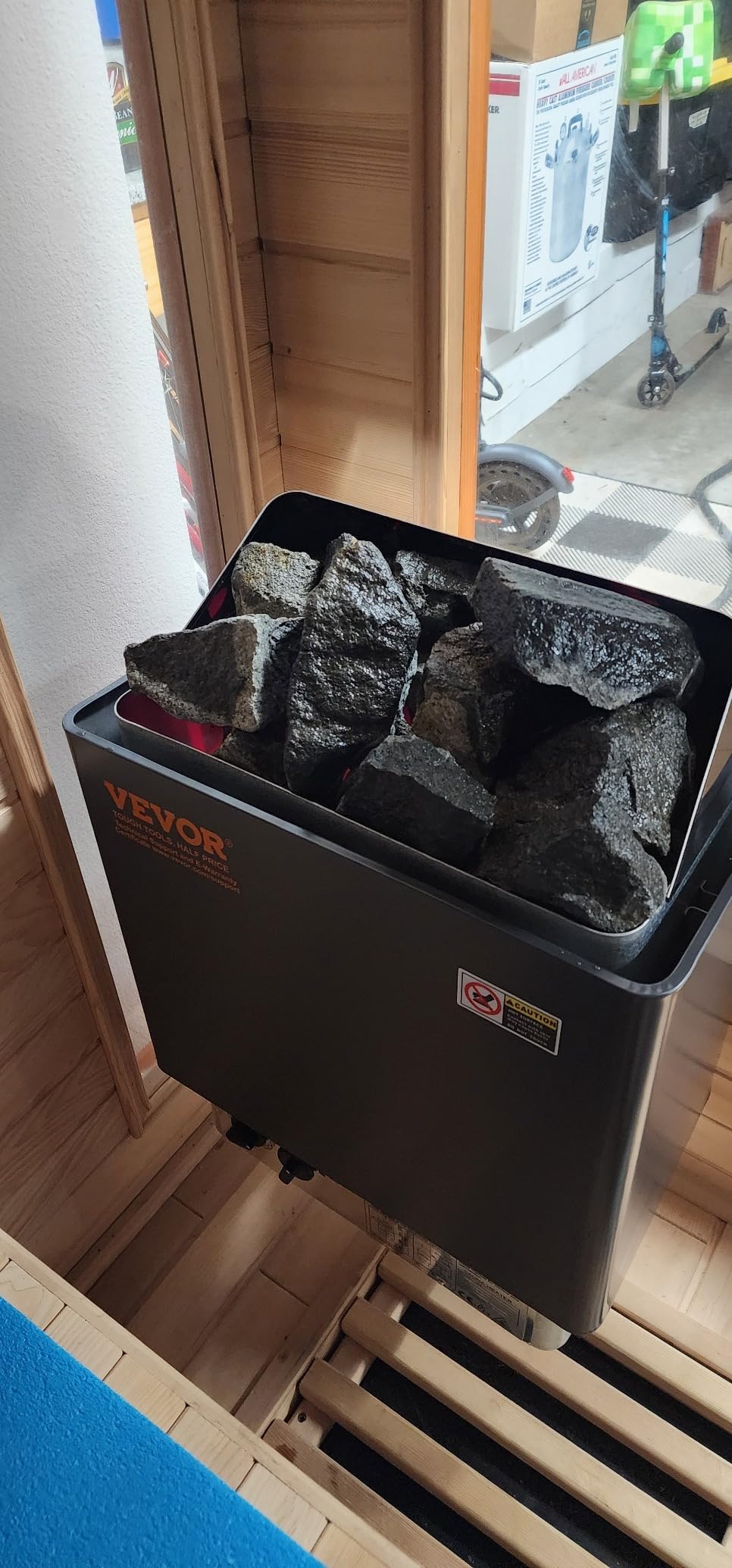
Controls are mechanical knobs rather than a digital panel, with a maximum temperature of 230F and a timer that runs up to three hours. That is a simpler interface than the digital panels on premium models, and for most home saunas it is entirely adequate. You lose the app-based preheating that some newer control systems offer, but you gain a thermostat that will not lose its settings.
The wall-mount bracket comes pre-drilled with reserved turnbuckles, and the recommended installation height is 3.5 inches from the floor. At 22 pounds it is the lightest full-size unit we looked at, so handling it during install is straightforward.
Does the VEVOR 6kW reach real sauna temperatures?
Yes, and this is where it separates from the cheapest marketplace heaters. Owner feedback consistently reports 170-200F within about half an hour, which is a proper Finnish sauna temperature rather than a warm-room approximation. Several owners note that with the door closed and the room fully insulated, it keeps climbing past that.
The 176 cubic foot floor is the figure to watch. Below that, the 6kW output is more than the room needs and you will get short cycling rather than faster heating. If your sauna is under about 150 cubic feet, look at the 4.5kW options further down this list instead.
What should you know before installing it?
Two things. First, it needs 33 pounds of sauna stones, which are not included, so budget for a stone order separately. Second, the 220-240V requirement means a dedicated circuit and professional wiring. This is not a plug-in unit despite the low price, and treating it like one is the most common source of confusion in this category.
There is also a small minority of owner reports about units arriving non-functional or a coil failing early. At 86 reviews the overall picture is still solidly positive, but we would test the heater as soon as it arrives rather than assuming it works, because the failure mode is cheap to catch and expensive to discover mid-session.
3. Mxmoonant 6kW 220V – Best for Even Heating in Mid-Size Cabins
Mxmoonant Sauna Heater, 6KW 220V Electric Sauna Heaters Dry Sauna Bath
6kW
220V
Covers 170-300 cu. ft.
18.8 x 13.77 x 21.45 inch
29.9 lb
Pros
- Even heat distribution across 170-300 cu. ft.
- 840 stainless steel heating elements
- Wall mount frees up cabin floor space
- Adjustable temperature and timer built in
Cons
- Sauna stones sold separately at 30-40 lbs
- No plug so hardwired installation is required
- 4.1 average with 13% one-star feedback
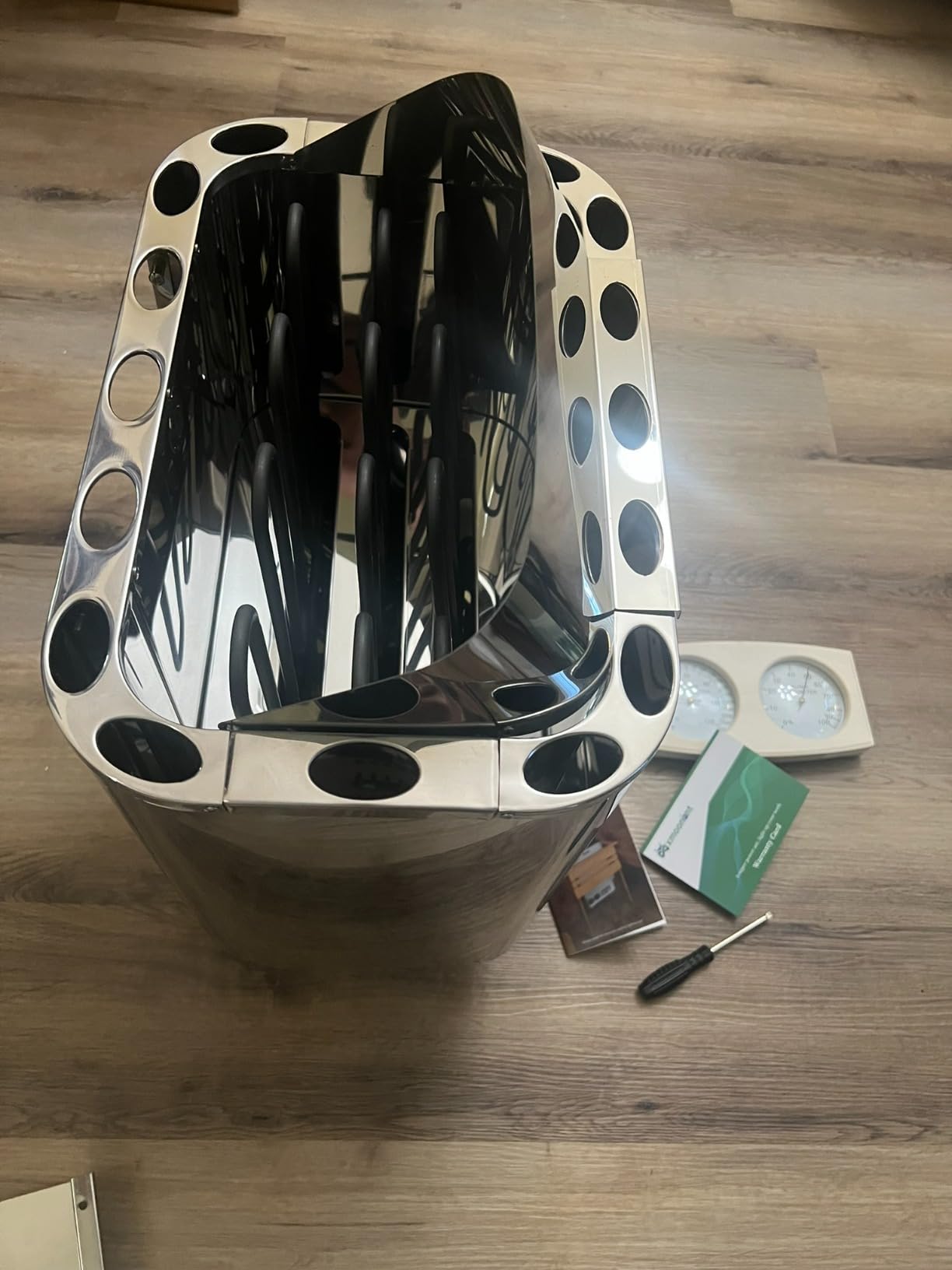
This is the mid-tier answer for a four-to-six person cabin. It covers 170 to 300 cubic feet with even heat distribution, and the wall-mounted design keeps the floor clear, which matters more in a compact room than most buyers expect.
The heating elements are 840 stainless steel, a grade chosen for heat resistance and structural strength through repeated cycling. Built-in adjustable temperature and time controls mean you do not need a separate external controller, which simplifies the wiring diagram compared with panel-mounted systems.
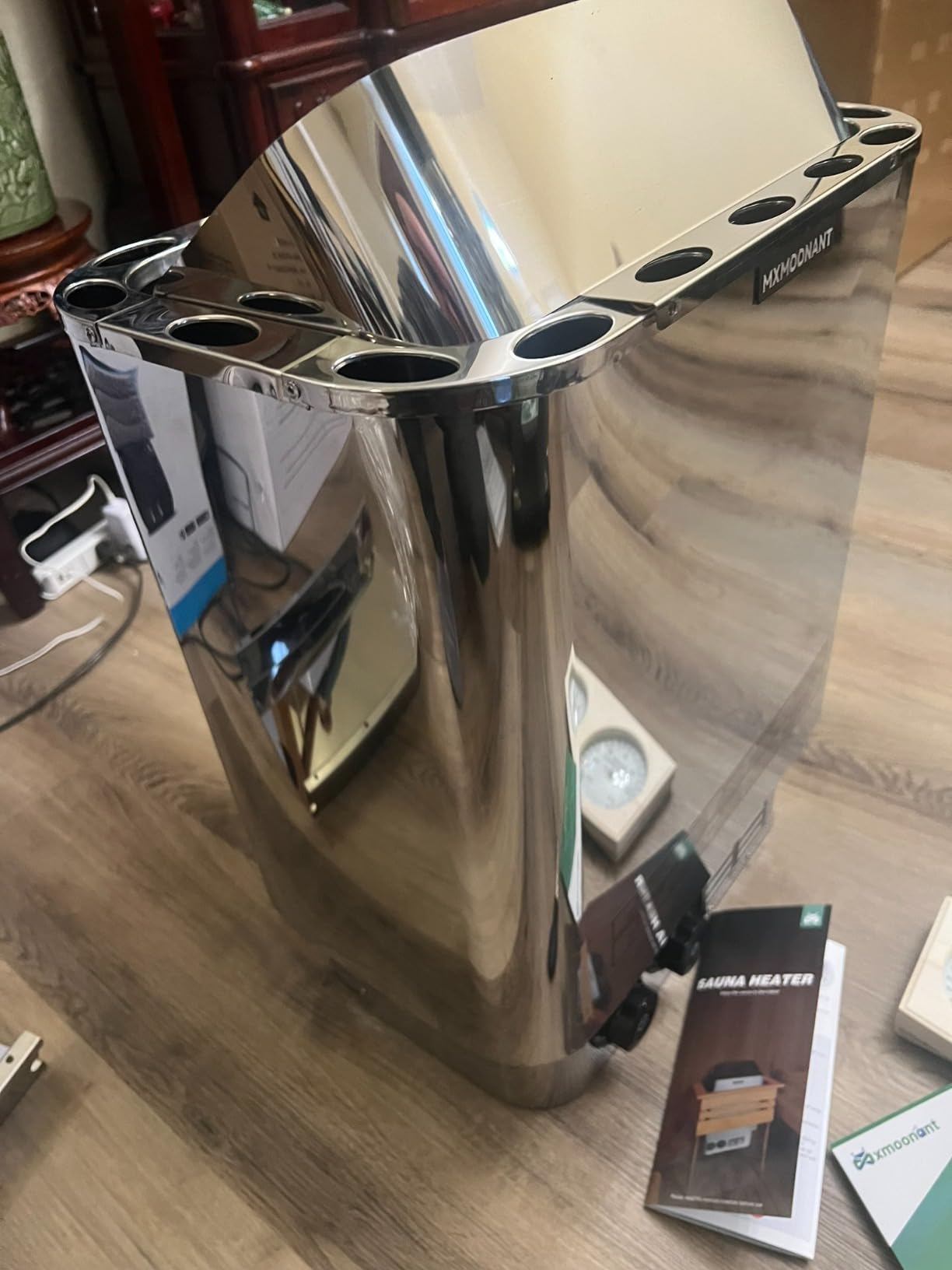
At 29.9 pounds and roughly 19 inches wide, it is a mid-sized wall unit with a 170 cubic foot minimum. That floor is a little higher than the VEVOR’s, so if you are building something on the smaller side, double-check the room volume before ordering.
Owner feedback lands at 4.1 stars across 30 reviews, with 68% five-star. The rating is lower than the leaders in this list, and the gap comes almost entirely from packaging and install friction rather than from heating performance, which owners describe as solid and evenly distributed.
Is a 6kW heater right for a 200 cubic foot sauna?
Yes, comfortably. The 1 kW per 45-50 cubic foot rule puts a 200 cubic foot room at 4 to 4.5kW as a baseline, so a 6kW unit gives you a full kilowatt of headroom. In practice that headroom is what lets the room reach and hold a high temperature in winter or when the insulation is imperfect.
Forum builders frequently recommend checking the manufacturer’s own sizing tool with your actual glass area rather than applying the cubic foot rule blindly, because glass and door area steal heat. If you have a large glass door or a window, run that tool before finalizing, and treat the number it gives you as the floor rather than the ceiling.
What are the real drawbacks?
You have to buy stones separately, and it needs 30 to 40 pounds of them. There is no plug, so a licensed electrician installation is required, and you should factor that into the total project cost rather than treating the heater price as the number that matters.
The other drawback is the 4.1 average with 13% one-star feedback. That is not a failure rate, but it is a thinner cushion than the 4.6 and 4.7 units in this lineup, and it is worth considering if you are nervous about long-term support for a lesser-known brand name.
4. Harvia KIP 4.5kW – Best for Small 2-Person Cabins
Harvia KIP 4.5KW, 240V-1PH Electric Sauna Heater With Built In Controls (Includes Sauna Stones)
4.5kW
240V single phase
18.8 A
Covers 106-212 cu. ft.
16 x 11 x 24 inch
27 lb
Pros
- Sauna stones included in the box
- Compact stainless steel footprint for small cabins
- Built-in controls keep wiring simple
- 18.8 A draw suits standard residential 240V service
Cons
- Curbside delivery only with extra fee for in-property placement
- 16% of reviews are one-star
- Hardwired 240V installation required
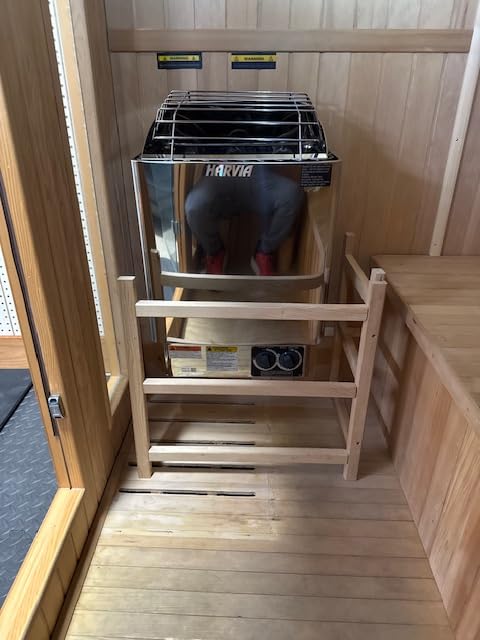
The Harvia KIP is the reference point for a small home sauna. It covers 106 to 212 cubic feet, which is a two-to-four person cabin, and it ships with sauna stones included, which removes one of the most commonly forgotten line items from a first build.
The 18.8 amp draw is the number that makes this unit attractive. That figure fits standard residential 240V single-phase service without pushing your panel, which is a real advantage over the 33 to 37 amp heaters further down this list. Fewer electrical demands means a cheaper install and fewer surprises.
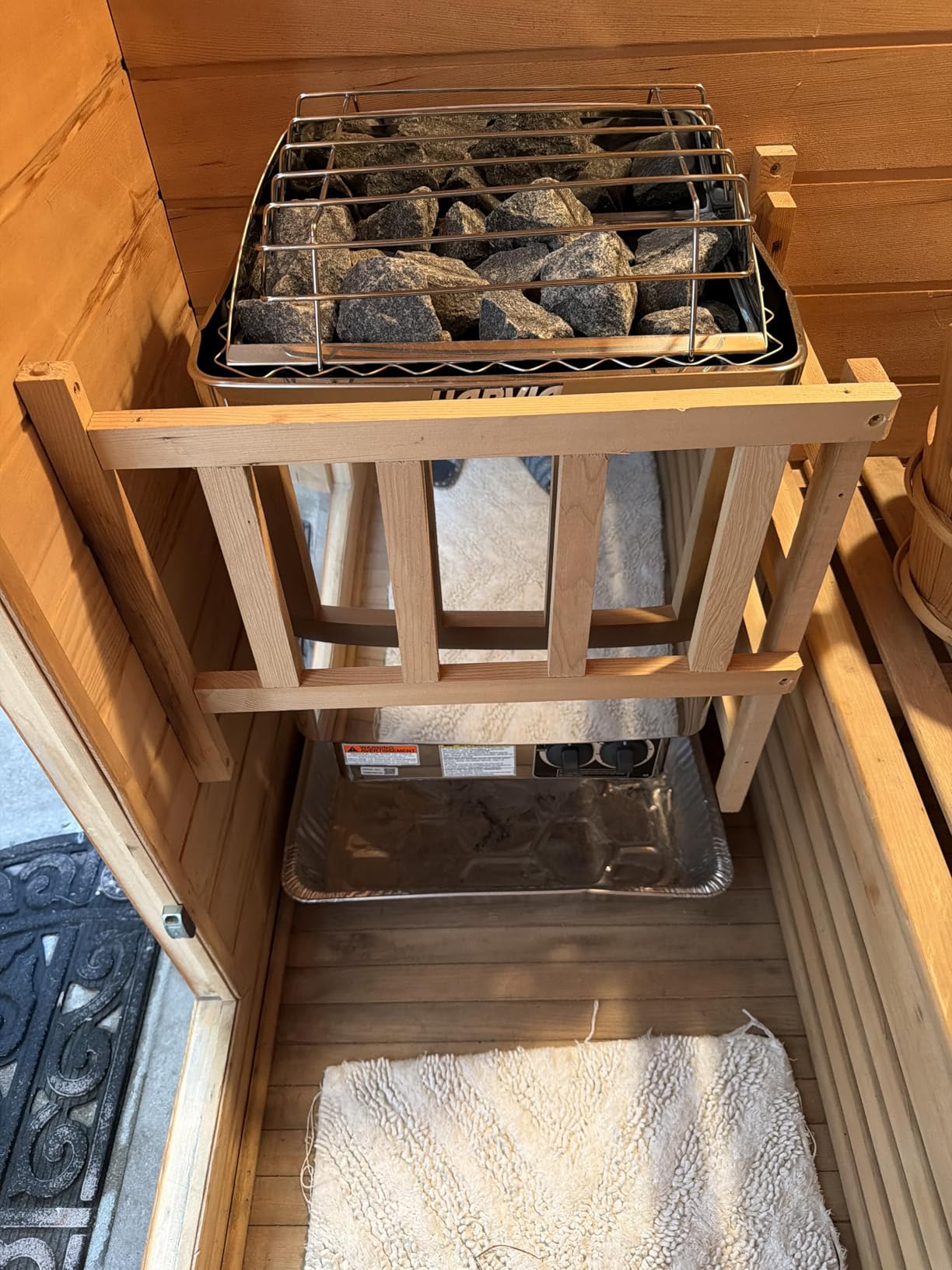
At 27 pounds and 16 by 11 by 24 inches, this is a compact wall unit with built-in controls. The controls are the main appeal for first-time buyers: no separate panel to mount outside the room, no extra sensor wiring, and a much simpler installation than a remote-controlled system requires.
Harvia designs and engineers these in Finland, and the KIP line has been one of the most commonly specified home sauna heaters for years. That longevity is not a spec number, but it is relevant when you are choosing a brand whose replacement elements and controllers you may need in a decade.
Will a 4.5kW heater heat a 100 cubic foot sauna properly?
It will, and 106 cubic feet is the stated floor for a reason. The sizing rule of roughly 1 kW per 45-50 cubic feet means a 100 cubic foot room sits right at the boundary, and 4.5kW covers it with a little margin. Below about 90 cubic feet, you are asking too much of it and should look at the plug-in 2kW units instead.
The 212 cubic foot ceiling is the more useful number to remember. Push past that and the heater will struggle to reach and hold temperature, particularly in cold weather, and the failure shows up as a sauna that never gets properly hot no matter how long you run it.
What about delivery and support?
Delivery is curbside only, and in-property placement requires separate arrangements with a third party at additional cost. That is the most common complaint in the reviews for this unit, and it is a logistics detail rather than a product defect, but it can surprise you if you are planning an install day around the delivery window.
The 4.1 average with 16% one-star feedback is the lowest among the Harvia models here, and the delivery friction accounts for a meaningful share of it. If the heater itself is what you are judging, the included stones and the 18.8 amp draw make this a strong pick for a small cabin.
5. Harvia Cilindro H 9kW – Best for Very Large Cabins
Harvia Cilindro H 9.0KW, 240V Sauna Heater Package w/Control & Sauna Stones
9.0kW
240V single phase
37.5 A
Covers 280-490 cu. ft.
16 x 16 x 40 inch
40 lb
Pros
- Highest output of any electric heater here at 9.0kW
- Handles 280-490 cu. ft. cabins
- Slim 16 by 16 inch column footprint
- Includes Xenio digital control and five boxes of stones
Cons
- 37.5 A draw needs heavy-gauge wiring and a dedicated circuit
- Tallest unit here at 40 inches and needs ceiling clearance
- Only 4 reviews on record
When a room is genuinely large, this is the heater that fits it. At 9.0kW the Cilindro H covers 280 to 490 cubic feet, which is the largest coverage range of any electric unit in this roundup and enough capacity for a seven-plus person cabin, a large barrel sauna, or a small commercial room.
The column design is the interesting part. At 16 by 16 inches it is a slim vertical form factor, which means it takes up far less wall area than a horizontal unit of equivalent output. That matters in a large room where bench layout and floor space are already under pressure.
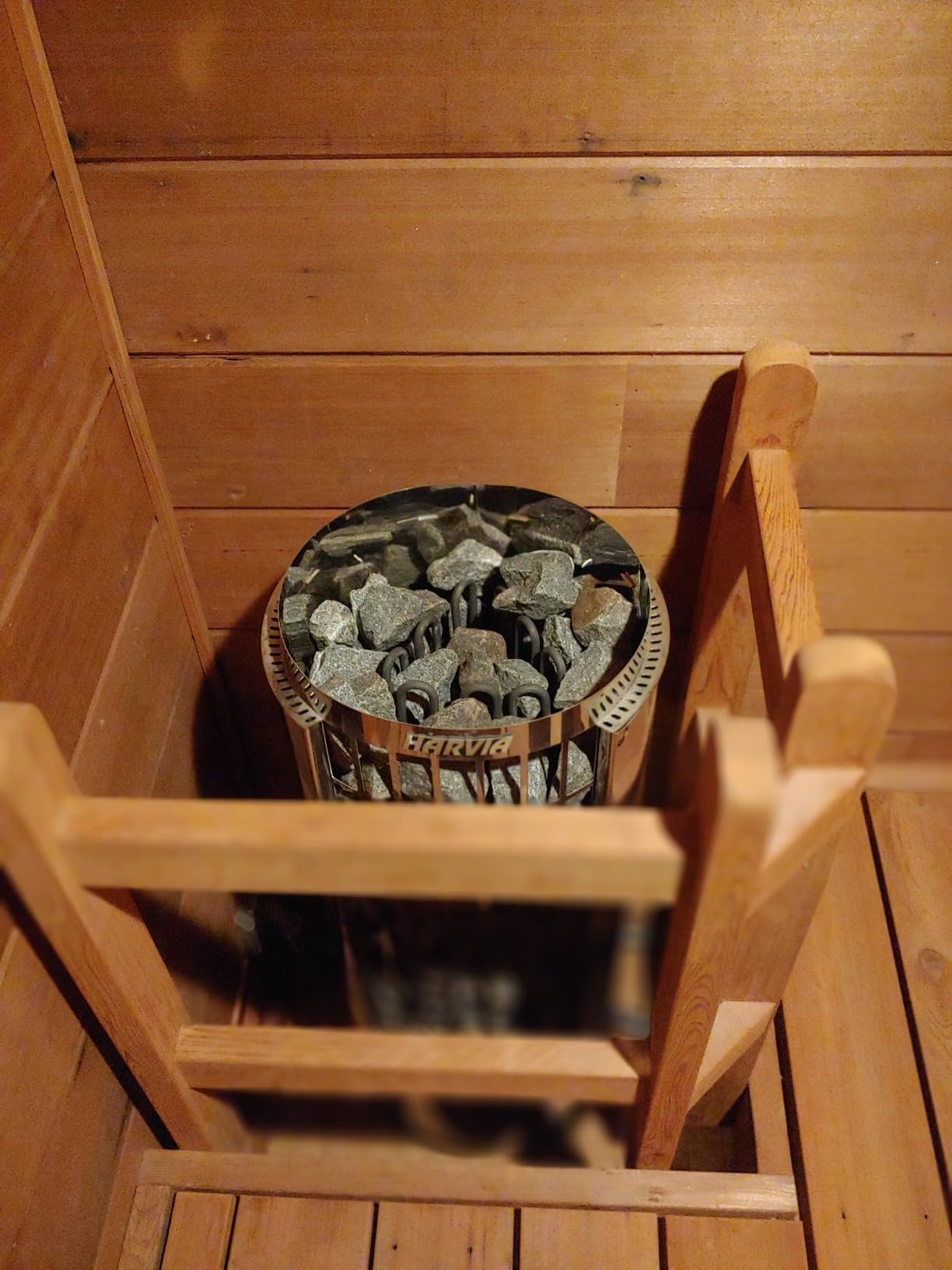
It ships with the Xenio control and power unit, plus five boxes of sauna stones. Five boxes is a substantial stone load by the standards of this list, and if you are reading the r/Sauna consensus that larger stone mass produces softer and more even heat, the bundled quantity is a genuine part of the value here rather than a throwaway.
The Xenio control is a digital panel system rather than built-in knobs, so the temperature and timer live outside the sauna on a wall-mounted display. That is the right call for a room this size, because you will want to start the heat from outside and walk in later.
Is 9kW overkill for a home sauna?
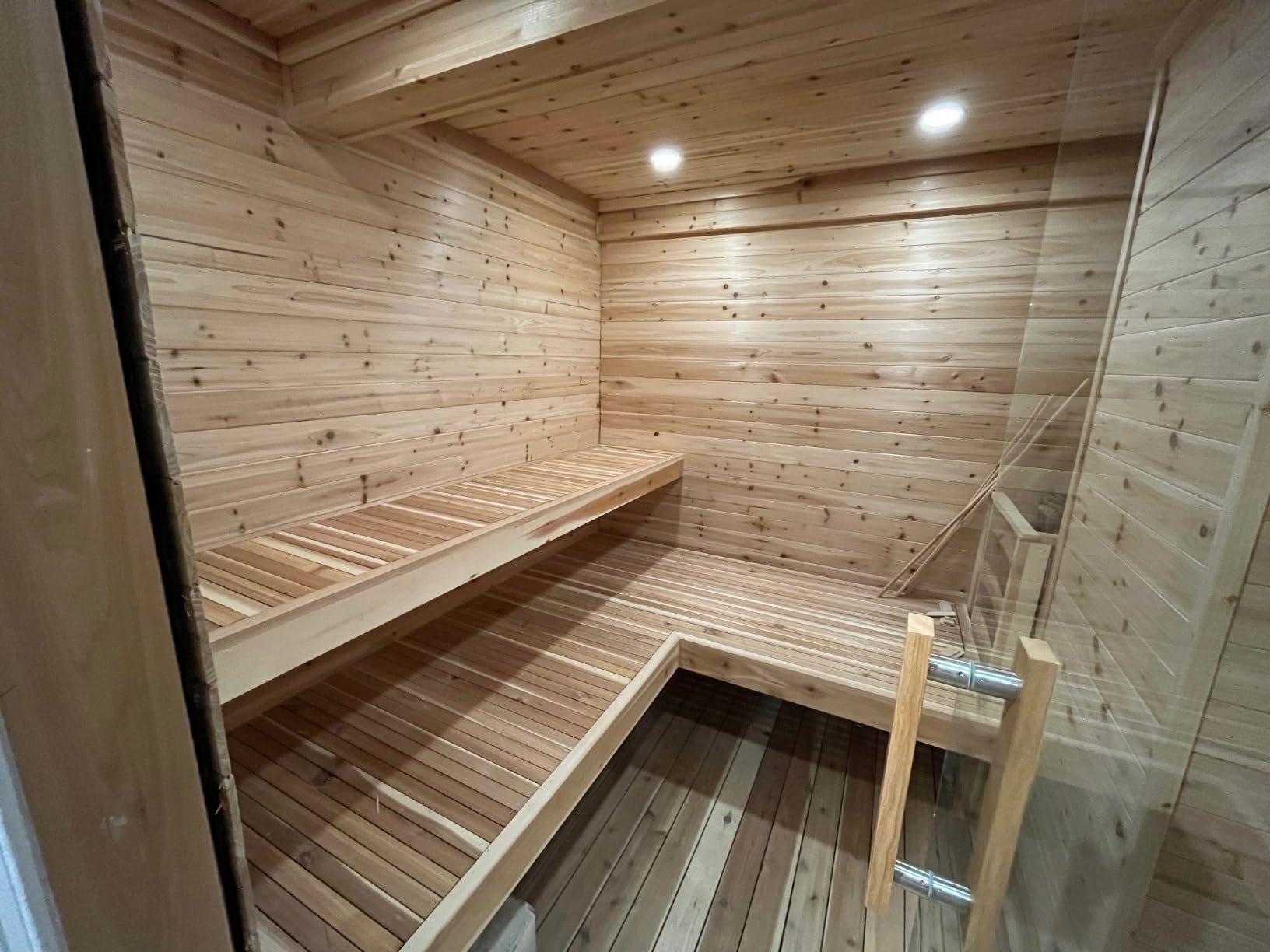
For most home rooms, yes. Nine kilowatts is sized for a 280 cubic foot floor, and a typical residential sauna runs 150 to 250 cubic feet. If your room is in that range, the FLB-80 or a 6kW unit is a better match, and buying 9kW for a 200 cubic foot room means short cycling and wasted electrical capacity.
Where 9kW earns its place is a large cabin, a barrel sauna with a lot of glass, or a room with weak insulation. Community sizing advice for a 7 by 7 by 5 foot room points to at least 7.5kW, and 9kW if the insulation is poor or you want temperature headroom, which is exactly the gap this unit fills.
What are the practical limits?
At 37.5 amps, this is a serious electrical load. It needs a dedicated 240V circuit with heavy-gauge wiring, and that install is the expensive part of the project by a wide margin. Plan the circuit before you order the heater, not after.
Height is the other constraint. At 40 inches this is the tallest unit in the lineup, so you need to check ceiling clearance and bench height carefully, and confirm the heater will not interfere with upper bench seating. The four reviews on record are all positive, but that is a small sample and there is limited long-term durability feedback to draw on.
6. Drizzlen 2kW 110V – Best Plug-In Heater With No Install
Drizzlen 2kW 110V Sauna Heater with Plug – Electric Sauna Heater, Plug and Play, Heats 100 cu. ft. in 30 Minutes
2kW
110V with plug
Covers 70-100 cu. ft.
16.1 x 10.8 x 22.4 inch
22.5 lb
Pros
- No electrician needed and no dedicated circuit
- Plugs into a standard 20A household outlet
- Heats 70-100 cu. ft. to 80F above ambient in 30 minutes
- Angled top shields heat from overhead surfaces
Cons
- No instructions included so setup is self-taught
- Sauna rocks not included
- Some sheet metal warping reported
The Drizzlen solves the problem that trips up most first-time sauna builders: there is no electrical project. It plugs into a standard 20 amp 110V circuit, so you can have a working sauna heater in an afternoon with no electrician, no panel work, and no dedicated circuit.
It covers 70 to 100 cubic feet and heats that space to 80F above ambient in about 30 minutes. That is a genuinely usable result for a small cabin, and owners report reaching 170-200F in roughly half an hour even in an uninsulated basement, which is a more demanding test than most product pages claim.
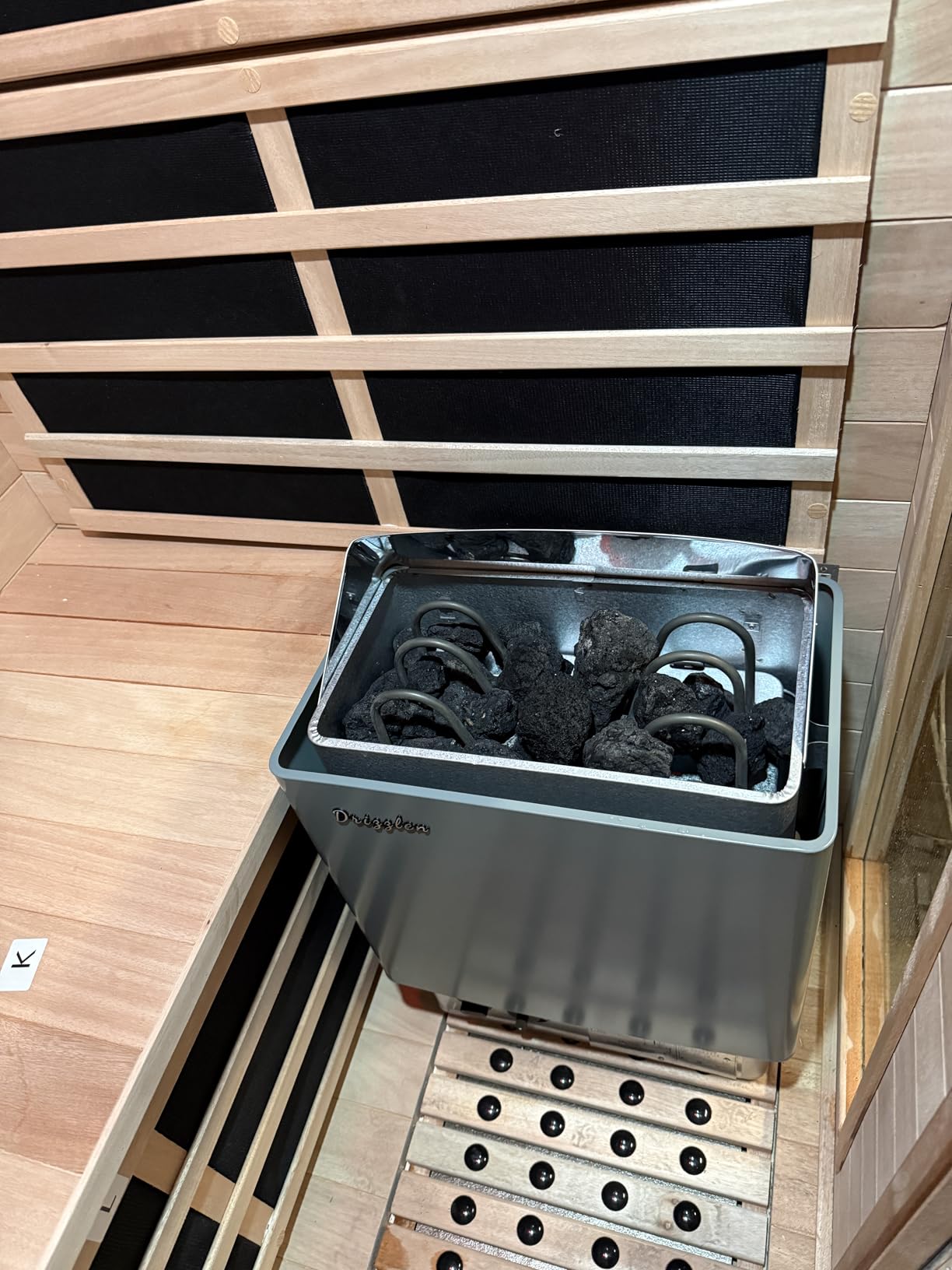
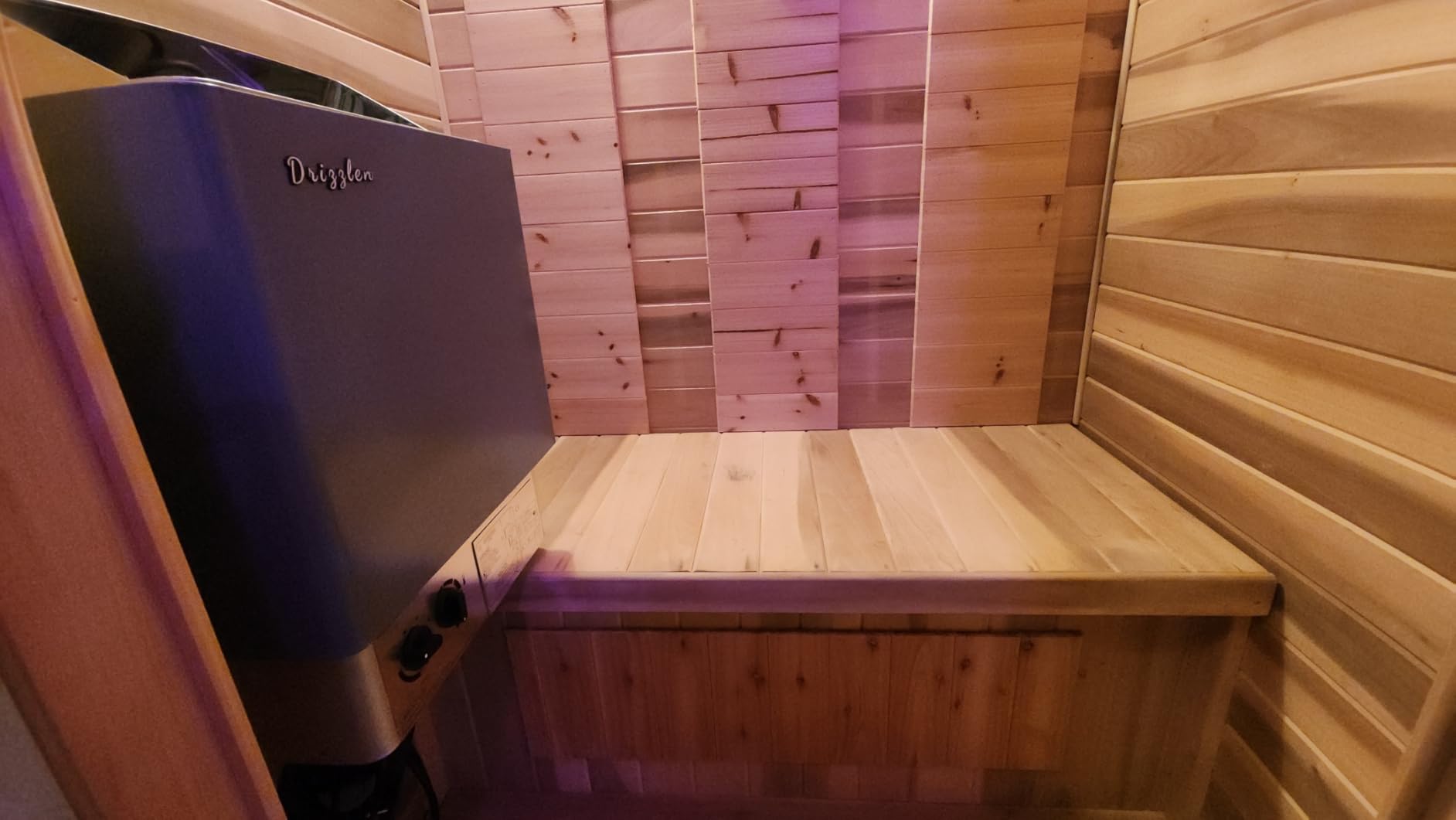
The angled top is a practical detail rather than a styling choice. It shields the heat from overhead surfaces, and owners note that the shielding shell stays comfortable to touch, which matters a great deal in a small room where you are frequently reaching past the heater.
Several owners used it as a drop-in conversion for infrared sauna cabins that were already installed, adding traditional wet-heat capability to an existing structure. The 7-inch floor clearance requirement is the main install constraint, and you need to keep it away from walls as well.
How hot can a 2kW 110V heater actually get?
Hot enough for a proper session in the right room size. The stated figure is 80F above ambient in 30 minutes, and with ambient around 90F that lands you in the 170F range, which is squarely in Finnish sauna territory. Push it longer and you go higher, with the usual caveat that the room needs to be well insulated and the door kept closed.
The 100 cubic foot ceiling is firm. Beyond that, 2kW simply cannot keep up with the heat loss, and you will get a sauna that feels underpowered no matter how long you run it. If your cabin is larger than 100 cubic feet, this is the wrong unit and the 4.5kW 220V options are the correct next step.
What should you watch out for?
No instructions are included, so setup is self-taught. That is a genuine annoyance on a unit you have to mount at the right clearance height, and it is worth spending an hour reading installation guidance before your first heat-up rather than guessing.
Sauna rocks are not included, and the unit needs ordinary stones or granite never substituted with random garden rock. There is also a strong initial odor that needs a burn-off session before anyone uses the sauna, and a few owners have reported sheet metal warping. All six reviews are five-star, so the experience is strong overall, but the sample is small and we would treat it as an early-stage product.
7. GoldenWave Far-Infrared 2000W – Best Stone-Free Upgrade
GoldenWave Far-Infrared Sauna Heater 110V/ 2000W with Plug for Home Sauna
2000W
110-120V household outlet
35-140 cu. ft.
17.7 x 9.25 inch footprint
17.65 lb
Pros
- No stones
- no water and no dedicated circuit needed
- Graphene far-infrared elements heat the cabin quickly
- Cool-touch Hemlock shell with tip-over and overheat shut-offs
- Touch panel plus app for remote pre-heating
Cons
- Only suited to small saunas of 35-140 cu. ft.
- Infrared-style heat rather than traditional hot-stone dry sauna
- Only 4 reviews on record
This is the option for anyone who does not want a traditional hot-stone sauna at all. The GoldenWave uses graphene far-infrared elements with no stones, no water, and no dedicated circuit, so it removes almost every step between unpacking a heater and taking a session.
It plugs into any standard 110-120V outlet and covers 35 to 140 cubic feet for one to two people. At 17.65 pounds with a 17.7 by 9.25 inch footprint, it is easy enough to move between a sauna and a spare room on your own.
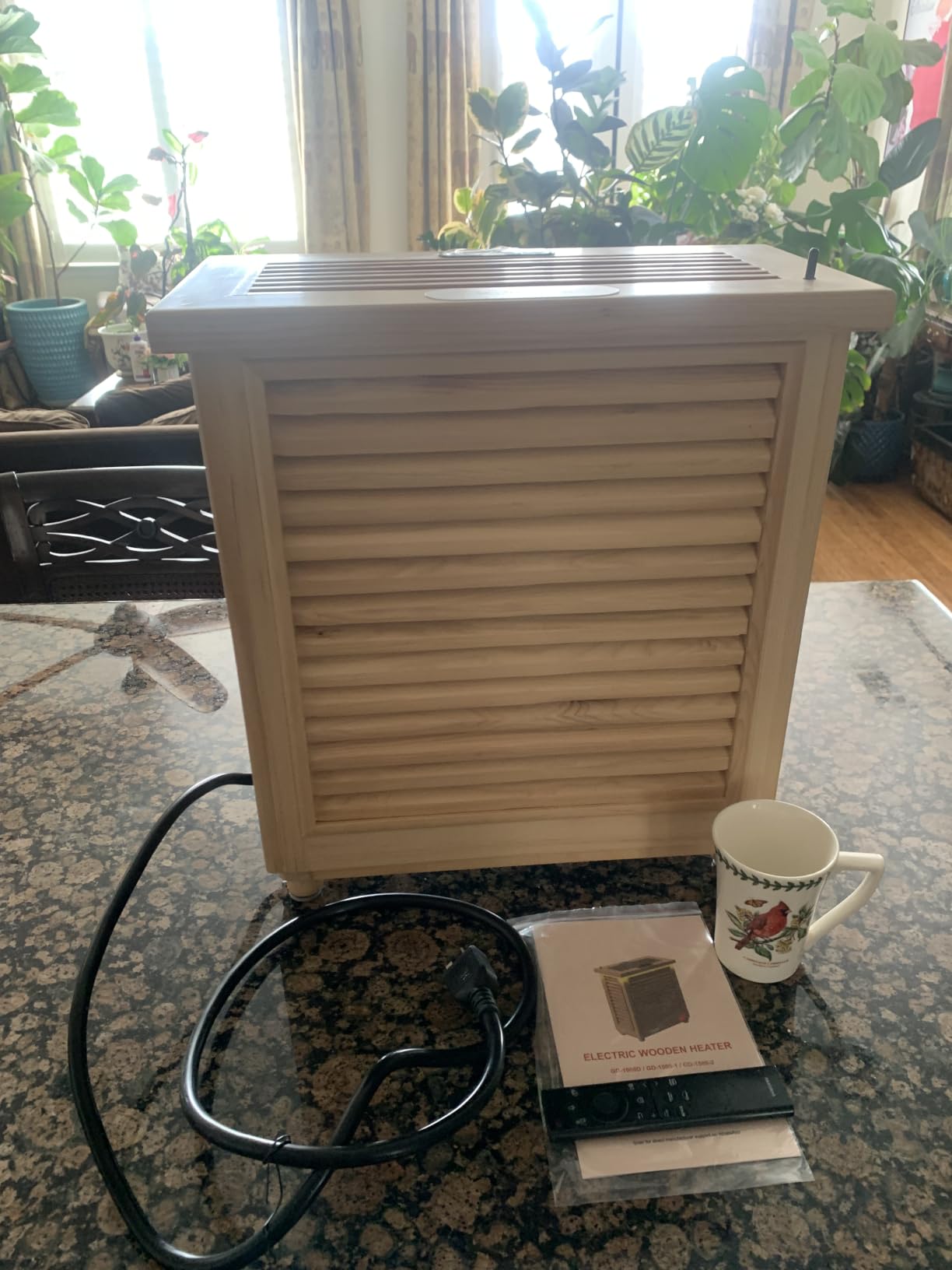
Safety is where this unit is unusually well specified. The Canadian Hemlock wood outer shell stays cool to the touch, and there is a built-in tip-over auto shut-off plus 150C overheat protection. For a heater that will sit in a small enclosed cabin with people in it, those three features together are worth paying attention to.
Controls run through a touch panel on the unit or a smartphone app, so you can preheat remotely and set timers and temperature from outside the room. It also doubles as a space heater and a clothes dryer, which is unusual but genuinely useful for a small utility building.
Which infrared sauna is best for home use?
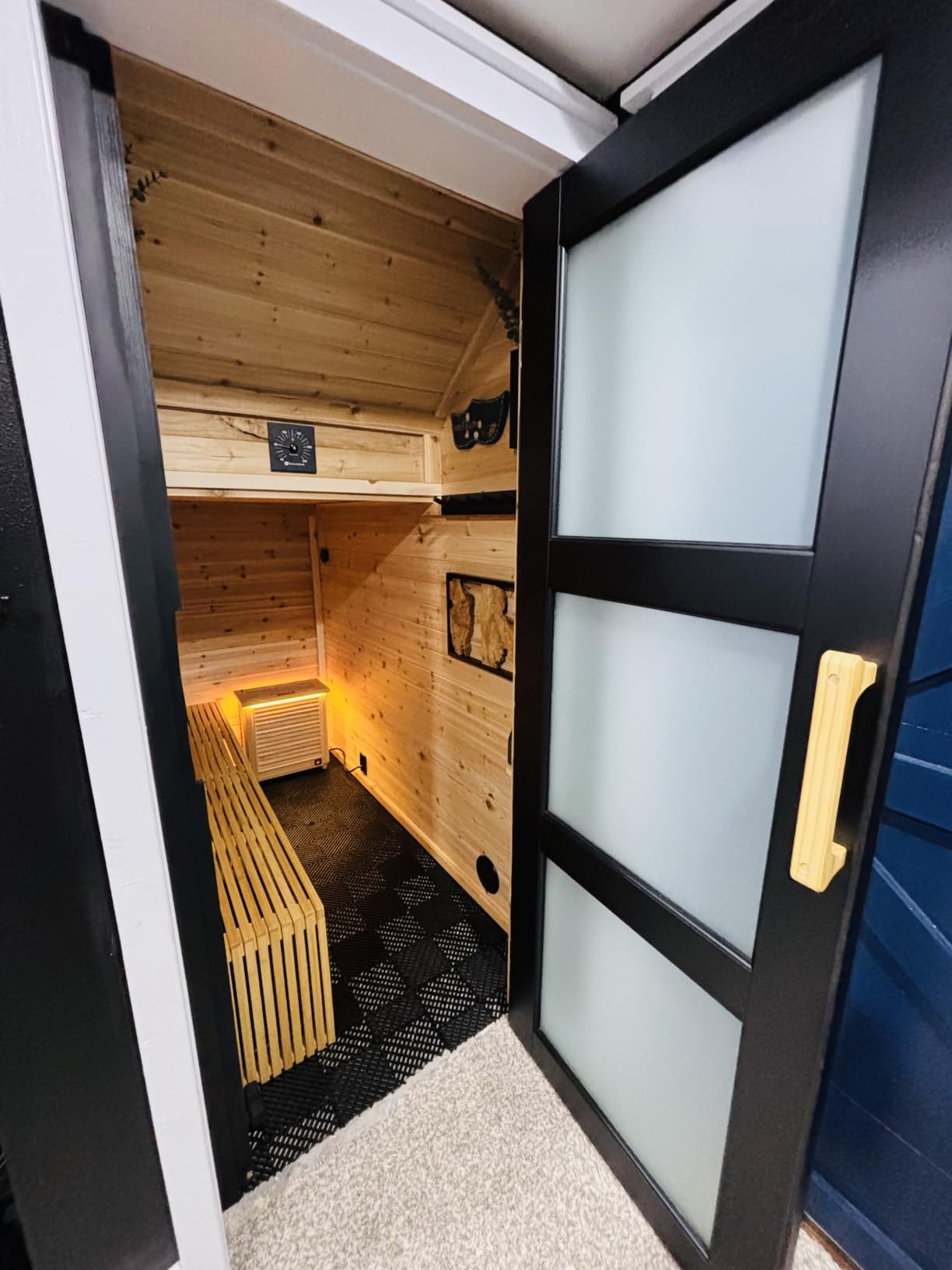
For a small, low-effort home setup, an infrared unit like this one is the answer, and the reason is the absence of maintenance. There are no stones to inspect, replace, or rearrange, no water to throw, and no löyly to manage. A sauna with 2000W covering up to 140 cubic feet can be plugged in and used within minutes of unboxing.
The tradeoff is that you are not getting a Finnish sauna. There is no hot-stone heat, no löyly, and no steam throw, and the session character is completely different. If your goal is the traditional experience, an electric stone heater is the only category worth considering, and none of the infrared arguments apply.
What are the limits to plan around?
The 140 cubic foot ceiling is the hard limit, and the spec sheet is explicit that higher wattage is needed for larger rooms. This is a one-to-two person heater and should not be stretched. Buying it for a 200 cubic foot cabin is the mistake we would most expect first-time buyers to make.
The warranty is one year of after-sales service, the shortest term in this lineup, and only four reviews are on record. That is not enough data to project long-term reliability, so this pick rests on the published specifications and safety features rather than on a long owner track record.
8. Harvia The Wall 8kW – Best for Tight Footprints
Harvia The Wall Electric Sauna Heater, Black, 240V, 8kW
8kW
240V single phase
33.3 A
Up to 423 cu. ft.
16.9 x 10.15 x 27.59 inch
75 lb
Pros
- Rated 4.7 stars across every review on record
- Bench-integratable design clears the cabin floor and walls
- Illuminated controls with built-in overheat protection
- Handles rooms up to 423 cu. ft.
Cons
- Heaviest unit here at 75 pounds so two-person handling is likely
- 33.3 A draw requires a dedicated 240V circuit
- Only 5 reviews limiting long-term data
The Wall takes a different approach to the same output the FLB-80 delivers. At 8kW it covers rooms up to 423 cubic feet on 240V single phase, but instead of projecting from the wall, it can be integrated into the sauna bench so the cabin floor and walls stay completely clear.
That bench integration is the reason to choose it. In a compact sauna where bench layout determines how many people fit, a heater that disappears into the bench frees up wall length you would otherwise lose to a bulky box. The black stainless steel housing and direct rock-to-element contact keep the heat path efficient.
You can choose right-handed or left-handed installation, which decides which side the controls and rock tray face. That is a small decision with a real payoff in a narrow room, because it lets you put the heater where the bench access is least disruptive.
At 8kW and 33.3 amps, this pulls more current than the 6kW units in this roundup, so the circuit has to be right. Stones and an installation and operation manual are included in the box, which saves a separate order on the two items most first-time buyers forget.
Design, engineered, and made in Finland, and rated at 4.7 stars across the five reviews on record, with none below four stars. That is a strong signal on a design-focused model, though five reviews is a small base and we would not read it as long-term reliability proof.
Is The Wall better than a standard wall-mounted heater?
Only in tight rooms. If you have wall space to spare, a conventional wall unit gives you easier access to the stones for inspection and rearrangement, and it is usually lighter to handle. The Wall trades that serviceability for floor space, which is a good trade in a 6 by 8 room and a poor one in a large cabin.
The 33.3 amp draw needs a dedicated 240V circuit with appropriate wire gauge. Plan and commission that circuit before the heater shows up, and confirm your panel has the spare capacity, because a surprise panel upgrade is the most expensive way a sauna project goes wrong.
The illuminated control carries built-in overheat protection along with on, off, time, and temperature control in the same housing. The built-in stone protector is a small detail that saves you from loading rocks where they do not belong.
What should you plan for?
Handling, mostly. At 75 pounds this is the heaviest unit here by a wide margin, so the bench framing should be finished before it arrives and two people should be booked for install day. Maneuvering it into a bench cutout alone is a bad afternoon.
9. HUUM Drop 6kW with UKU Control – Best Complete Bundle
HUUM Drop Series Sauna Heater with UKU Control Bundles (Sauna Stones Inlcuded) (6kW – Local – Black)
6.0kW
240V
25 A
30 A breaker with 10 AWG
Covers 177-353 cu. ft.
15.4 x 13.2 x 23.3 inch
Pros
- Drop design puts stones in direct contact with the elements for milder longer heat
- Complete UKU control bundle with temperature and door sensors
- Sauna stones included in the box
- Limited 5-year warranty on the body
Cons
- Top of the 6kW price band in this roundup
- Requires 240V single-phase hardwiring with a 30A breaker
- Only 2 reviews on record
The HUUM Drop is the most design-led heater in this roundup, and the water drop shape is doing real thermal work. Stones sit in direct contact with the heating elements and more of them are exposed, which produces a longer, milder heat and a session that feels different from a box-shaped heater at the same wattage.
At 6.0kW it covers 177 to 353 cubic feet. The electrical spec is unusually well documented for a consumer product: 240V, 25 amps, a 30 amp breaker, and 10 AWG wire. Having the exact wire and breaker figures published removes the guesswork from the install, which is a genuine advantage in this category.
The UKU Local control system is a wall-mounted panel for on-the-spot heating without a network connection. You do not need an app or a hub, which some buyers prefer and others consider a downgrade compared with Wi-Fi control systems.
What is actually in the bundle?
More than most. The box includes the heater, sauna stones, a wall-mount bracket, the control display panel, the main control module, a temperature sensor, a door sensor, and all the cabling. The door sensor in particular is a nice inclusion, since it lets the system know the sauna is unoccupied and can cut heat accordingly.
The warranty is a limited five years excluding elements, which is a real term but worth reading carefully, since elements are the part most likely to need replacement over the life of the unit. Two reviews are on record, both five-star, and they praise the packaging and the straightforward startup with the UKU interface.
What are the drawbacks?
Cost, primarily. This sits at the top of the 6kW band in this roundup, and the gap versus the other 6kW options is wide enough that it is the first question to ask yourself. You are paying for the design language, the control system, and the drop geometry, not for extra heat.
You also still need 240V single-phase hardwiring with a 30 amp breaker, so the no-install advantage does not apply. And with only two reviews, there is very little long-term ownership data to draw on, which is a fair concern for a purchase at this level.
10. HUUM Hive Wood 13kW – Best Wood-Burning Option
HUUM Hive Wood 13 kW Sauna Stove, 198 pounds of Rounded Olivine Stones Included (for saunas Between 210-460 cu ft.)
13kW
Wood fired
Covers 212-459 cu. ft.
199 lb of olivine stones included
Crafted in Estonia
Pros
- Stone capacity of about 199 lb
- Direct contact between stones and the heat source
- Stainless steel body and furnace door
- Treated only with natural oils
Cons
- Requires firewood handling and flue installation
- One reviewer reported firebox metal glowing and possibly distorting
- 3-year residential warranty with 1-year commercial
Wood is the traditional answer and it remains the one no electric heater replicates. The HUUM Hive at 13kW covers 212 to 459 cubic feet, which puts it in the same room range as the largest electric units in this list while delivering a completely different experience: fire, real combustion heat, and a session that does not depend on a thermostat at all.
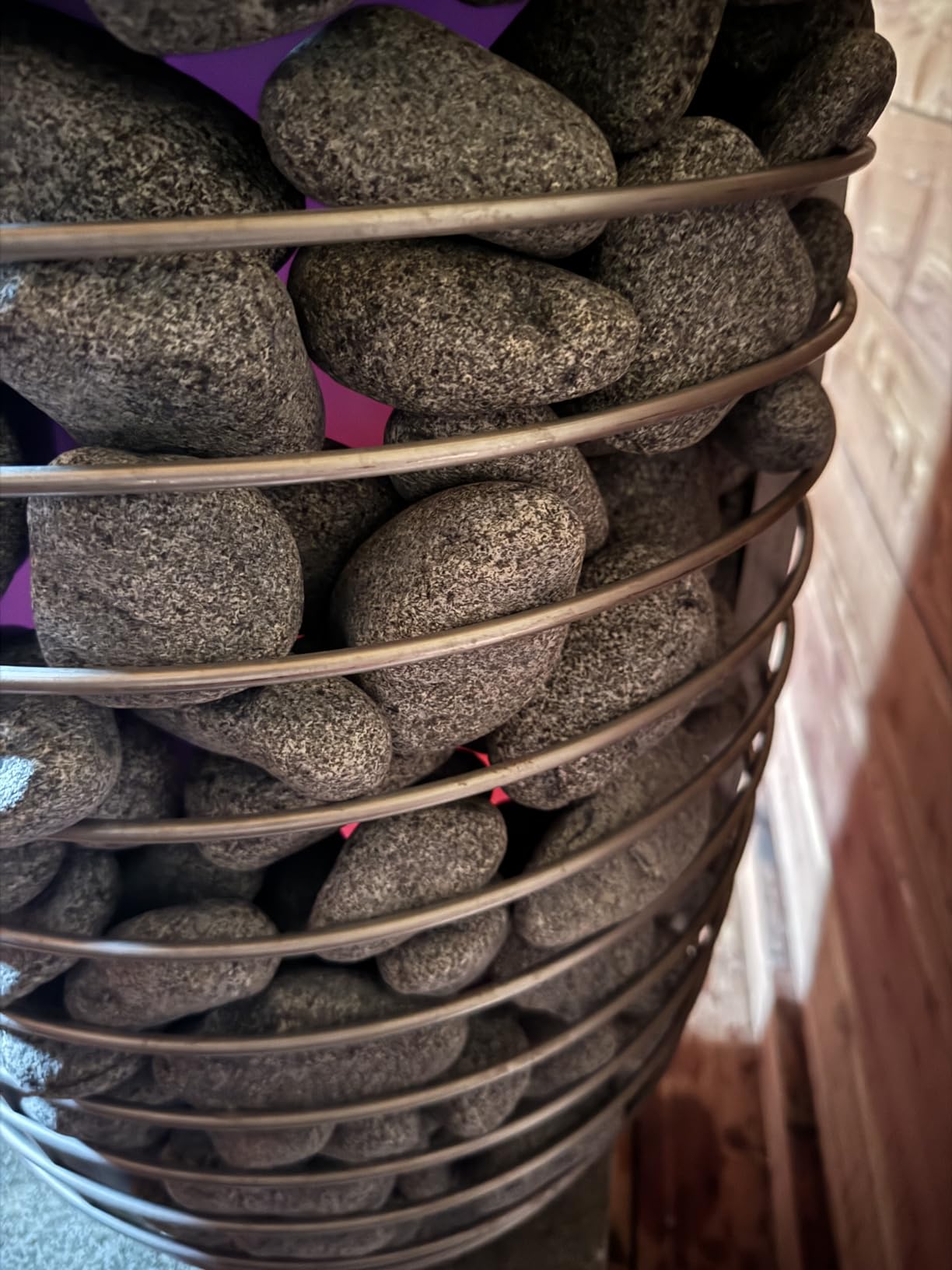
The stone load is the headline number. Nearly 199 pounds of rounded olivine stones come included, which is the largest documented rock mass in this roundup, and owners report heat lasting for up to an hour after the fire burns down. That is the stone-mass heuristic from the forums taken to its extreme, and for a wood stove it is not a gimmick.
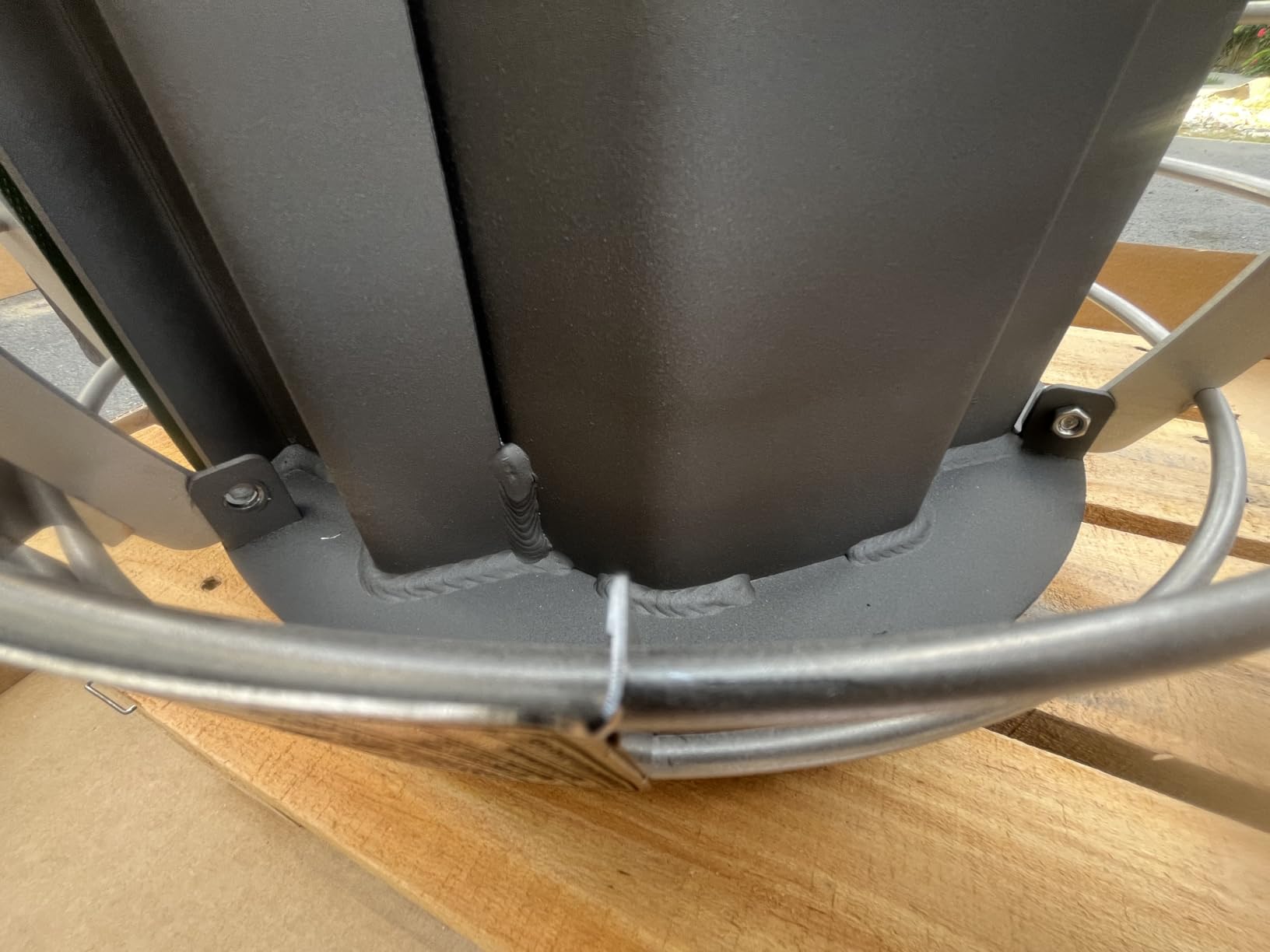
The firebox structure is designed for clean, efficient burning, which reduces both wood consumption and emissions. The body and furnace door are corrosion-resistant stainless steel, treated only with natural oils, and the stones sit in direct contact with the heat source for even distribution.
There is no electrical requirement at all, which makes this the right pick for an off-grid cabin, a property where running a circuit is impractical, or a mobile or barrel sauna setup where electric service is not an option.
What are the 200 rule for saunas and does it apply here?
The 200 rule is a traditional guideline that the floor and bench surface temperatures in a sauna should not exceed about 200F. The idea is that bather comfort comes from air temperature and löyly, not from a surface hot enough to burn, and that a bench you can sit on comfortably is a sign the sauna is built and loaded correctly.
It applies to any sauna, wood-fired or electric. With a wood stove you control it by managing the fire and the stone load, and with a large stone mass like this one you have far more thermal inertia to work with, which makes holding a comfortable bench temperature much easier.
What are the real drawbacks?
It is a stove, so you are managing firewood, a fire, and a flue installation rather than flipping a switch. That is the appeal for some buyers and a deal-breaker for anyone who wants a set-it-and-forget-it electric session. The install work is a different skill set entirely.
The reviews are mixed in one specific place. One owner reported seeing the firebox metal glowing and possibly distorting with a minimal flame, and another noted small screws missing on delivery. Most owners are enthusiastic about heat retention, build quality, and looks, and the warranty is three years residential and one year commercial.
11. Amerec Designer B 4.5kW – Best Built-In Control Pedestal
Amerec Designer B Sauna Heater with Built in Controls and Vulcanite Rocks DSNR-45B 4.5 KW 240 Volt Single Phase
4.5kW
240V single phase
18.75 A
Pedestal form factor
Indoor use
Includes Vulcanite rocks
Pros
- Built-in controls eliminate the need for a separate external controller
- Vulcanite rocks included for heat retention and steam
- 18.75 A draw suits standard residential service
- Modern pedestal styling
Cons
- Only one review on record so reliability data is absent
- 4.5kW output suits small to mid-size cabins only
- Hardwired 240V installation required
The Amerec Designer B is a pedestal rather than a wall unit, and that is a genuine layout difference in a small sauna. A floor-standing form factor can sit in a corner and reads as a deliberate design element rather than a box bolted to the wall, which is a real consideration if the sauna is in a finished room rather than a shed.
At 4.5kW on 240V single phase drawing 18.75 amps, the electrical profile is the same friendly one as the Harvia KIP. It fits standard residential single-phase service without straining the panel, which keeps the installation cost down.
Vulcanite rocks are included, and the integrated control panel handles temperature and session management without a separate external controller. That is the simplest possible wiring arrangement, which matters for first-time builders.
Does the built-in control panel make a real difference?
Yes, and mostly in cost and complexity. A built-in panel means one connection point at the heater instead of a run of control cable to a panel mounted outside the room, plus temperature sensor wiring. Fewer connections means fewer things to terminate incorrectly and a shorter install.
The tradeoff is reach. With controls on the heater, you set temperature from inside the sauna, so you cannot start a session from outside the room. If preheating from elsewhere matters to you, a remote control system like the one in the HUUM Drop bundle is the better fit.
How much should you trust a single review?
Not much, and we want to be straight about that. There is one review on record, at five stars, and that is simply not enough data to project long-term reliability or to compare heat performance against the units with dozens of reviews. This pick rests on the published specifications and the known Amerec platform rather than on owner feedback.
The 4.5kW output also means this is a small-to-mid-size cabin heater and nothing more. It is listed for indoor use, so it is not the choice for an exposed outdoor cabin, and the hardwired 240V requirement is the same constraint every 240V unit in this list carries.
12. Mxmoonant 4.5kW 220V – Best Compact 220V Unit
Mxmoonant Sauna Heater, 4.5KW 220V Electric Sauna Heaters Dry Sauna Bath
4.5kW
220V
Covers 100-210 cu. ft.
18.8 x 13.77 x 21.45 inch
30.8 lb
Pros
- Heats 100-210 cu. ft. cabins to over 200F in about 30 minutes
- Even heat distribution and sturdy stainless steel build
- Entry-level wattage for a real 4.5kW class heater
- Wall mount keeps the cabin floor clear
Cons
- No plug so an electrician is needed for installation
- Sauna stones must be purchased separately
- 18% of reviews are one-star
This is the pick for a 100 to 210 cubic foot cabin on a tighter budget. Owner feedback reports reaching over 200F in about half an hour with even heat distribution, and the general consensus is that it delivers results comparable to heaters costing several times more.
The elements are 840 stainless steel again, mounted on a wall bracket that frees up floor space. Built-in adjustable temperature and time controls keep the wiring simple, and the unit weighs 30.8 pounds, which is manageable for a two-person install.
Compared with the 6kW Mxmoonant earlier in this list, this is the same platform scaled down. The 100 cubic foot floor is the reason to choose it: if your room is 150 to 200 cubic feet, this is properly matched, whereas the 6kW version would be running more output than the space needs.
Does 4.5kW really reach 200F?
Owners report it, and the maths supports it for a room in the 100 to 210 cubic foot range. The sizing rule of 1 kW per 45-50 cubic feet puts a 100 cubic foot room at about 2.2kW minimum and a 210 cubic foot room at around 4.5kW, so this unit is matched to the top of its band rather than the bottom.
Reaching 200F quickly does require a well-insulated room with the door closed and a normal stone load. Under those conditions the community consensus is that a 4.5 to 6kW heater gets an average home sauna into the 160-170F range in about an hour, and higher if you leave it running.
What are the drawbacks?
There is no plug, so you need an electrician, and stones are purchased separately at 30 to 40 pounds. Those two line items are the real cost of this heater and they are easy to forget when comparing unit prices.
One Canadian reviewer reported that the unit is not electrically certified in Canada and would not be installed there, which is a concrete reminder to check local certification for your region before ordering. The 4.2 average with 18% one-star feedback leaves less cushion than the 4.6 and 4.7 units in this lineup, so this is the pick for buyers who have done their research on the spec sheet and the install.
How to Size a Sauna Heater for Your Room
Size is the decision that determines whether your sauna works, and it is a two-minute calculation once you know the rule. Every manufacturer and every experienced builder in the forums uses the same starting point: 1 kW per 45 to 50 cubic feet of sauna space.
Here is the procedure we recommend, in order.
Measure the room’s interior length, width, and height in feet, then multiply to get the total cubic volume.
Divide the volume by 45 to 50 to get a baseline kilowatt figure.
Add 1 to 2 kW if the cabin is outdoors, poorly insulated, has a lot of glass, or sits in a cold climate.
Check the manufacturer’s own sizing tool using your real glass and door area, and treat its number as the floor.
Confirm the heater’s stated coverage range includes your volume before you order.
Worked example: a sauna measuring 6 feet by 8 feet by 7 feet equals 336 cubic feet. Dividing by 48 gives roughly 7kW, so a 7.5kW or 8kW heater is the right match, and the FLB-80 or The Wall both fit. Add 1.5kW if that same room is an outdoor cabin with a glass door and the number moves to 9kW.
For a smaller 6 by 6 by 7 room, which is 252 cubic feet, dividing by 48 gives about 5.25kW, so a 6kW unit is the sensible pick. At 150 cubic feet you land near 3.1kW, which is where the 4.5kW units or a well-sited 2kW plug-in become relevant.
Never size down on the assumption that a bigger heater will just cycle off. Short cycling shortens element life, makes the thermostat hunt for temperature, and gives you a less even room. A heater matched to the space is always the better outcome, even when the smaller model is the more expensive purchase.
Electrical Requirements: 110V vs 240V, Breakers and Wiring
This is the section that saves people money, and it is the part most roundups skip. A sauna heater is a hardwired appliance in almost every case, and the voltage determines the entire electrical scope of your project.
A 110V plug-in heater needs nothing but a standard 20 amp household circuit. It is limited to roughly 2kW, which caps it at a 70 to 100 cubic foot room. Everything above that output is 220-240V, hardwired, on a dedicated circuit, installed by a licensed electrician.
The amperage figures follow directly from the kilowatt rating, and manufacturers publish them, so you can size the breaker before the heater arrives.
4.5kW to 6kW heaters draw roughly 19 to 25 amps and belong on a 30 amp breaker.
7.5kW to 8kW heaters draw roughly 31 to 34 amps and belong on a 40 amp breaker.
9kW to 10.5kW heaters draw roughly 38 to 44 amps and belong on a 60 amp breaker.
For a 9kW heater specifically, the answer is 37.5 amps on a 60 amp circuit, which is exactly what the Harvia Cilindro H specification states. That is the concrete number most people searching for an answer to a 9kW amps question are looking for.
Wire gauge goes up with the load. The HUUM Drop 6kW is specified for a 30 amp breaker with 10 AWG wire, and that pairing is the template: heavier gauge for the higher tiers, high-temperature rated wire in the sauna room itself, and a disconnect switch mounted outside the sauna as required by code.
Residential service is 240V single phase. Commercial settings are often 208V three phase, which changes the heater model and the wiring plan entirely, so if you are building anything shared or public, talk to a supplier about 208V-compatible units before you specify anything else.
Budget the install separately from the heater, and get the circuit done before the heater is delivered. Buyers who order a 240V unit and only then discover their panel cannot support it end up paying for a panel upgrade on top of the wiring, and that is the most expensive and most common regret in this entire category.
Stone Load, Löyly and the 200 Rule
Stone capacity is the least discussed and most important quality signal in sauna heaters. The consensus among experienced builders on r/Sauna is consistent: a larger stone mass produces softer, more even heat and allows for longer sessions, because the rocks act as a thermal buffer between the elements and the room.
Compare the loads in this roundup. The HUUM Hive ships with nearly 199 pounds of olivine stones. The Harvia Cilindro H includes five boxes. The budget units in this list ask you to add 30 to 40 pounds, and the VEVOR needs 33 pounds. That spread is the difference between löyly that feels soft and löyly that bites, and it is invisible in the kW number.
To throw löyly properly, you ladle water onto the stones. Water on hot stones flashes to steam instantly and creates the burst of heat and moisture that defines the sauna experience. It does not make the sauna hotter in any lasting sense, and pouring water directly onto electric heating elements is dangerous and prohibited. Public and commercial saunas frequently ban throwing water on the rocks, which creates a real etiquette conflict for visitors used to doing it at home, so know the rules of the facility before you assume you can.
The 200 rule is the traditional guideline that floor and bench surface temperatures should not exceed about 200F. It exists because a comfortable bench is evidence the sauna is properly built, properly loaded, and properly vented, and because bather comfort comes from air temperature and löyly rather than from a surface hot enough to burn on contact.
A related term you will see in forums is negative insulation, which describes a cabin with poor or inverted insulation where moisture can condense into the wall structure. Add 1 to 2 kW for negative-insulation rooms and cold climates, because the heat is escaping through the building rather than the door.
Electric vs Wood-Burning vs Infrared for a Home Sauna
Electric dominates home use for good reasons. It needs no chimney, no fuel, no fire, and no manual tending, and it delivers repeatable temperature control on a thermostat. If you have a 240V circuit available or can get one installed, an electric sauna heater is the sensible default for almost every home sauna.
Wood-burning is the traditional experience and the right answer in three specific situations: an off-grid cabin where running power is impractical, a property where a flue and chimney are easier than an electrical upgrade, or a barrel or mobile sauna where electric service is not an option. The trade is real fire, wood handling, and a flue installation.
Gas heaters are a commercial category. They are not appropriate for residential installation in most jurisdictions and are not represented in this roundup.
Infrared is a different product wearing the same name. A far-infrared sauna uses heating elements and no stones, produces no löyly, and runs at lower temperatures. The session is comfortable and the maintenance burden is near zero, but it is not a Finnish sauna and no stone heater in this list can be substituted for one. If your goal is löyly, you need stones and a stone heater.
Safety, Maintenance and First Heat-Up
Check for UL and ETL listing before you buy anything. All Finlandia and Harvia heaters in this roundup are UL and ETL listed, and that certification is the safety attribute to verify first. Several lower-cost units state only FCC certification, which is a radio-frequency standard and tells you nothing about electrical safety in a wet, high-temperature room.
Check IP rating and overheat protection too. The Harvia The Wall has built-in overheat protection, and the GoldenWave adds tip-over auto shut-off plus 150C overheat protection, which is the most complete safety package on this list.
Follow clearance rules exactly. The Drizzlen requires 7 inches of clearance from the floor and away from walls, and the VEVOR specifies a 3.5 inch install height. Manufacturers publish these numbers because the clearance is what prevents fire, and bypassing it to save an inch of space is not a trade worth making.
Never pour water directly onto electric heating elements, and never substitute ordinary stones or granite for proper sauna rocks. Rock type matters because they must handle repeated thermal cycling without releasing minerals or fracturing into the elements.
Inspect your rocks regularly, perhaps monthly. Rocks deteriorate, and cracked or crumbling rocks should be replaced rather than rearranged. For element maintenance, descaling is only relevant if you are in a hard-water area; otherwise an annual inspection and a look at the elements is sufficient, and a stone refresh every year or two keeps heat output honest.
New heaters need a burn-off before first use. A couple of full heat cycles with the door open will clear factory oils and protective coatings, and it also lets you confirm the unit is working before you run a session with people in the room. If your sauna is not reaching temperature, check the rock load first, then the door seal, then the thermostat setting, and only then suspect the heater.
Frequently Asked Questions
What is the best heater for a home sauna?
The best heater for a home sauna matches three things: your room’s cubic volume, your electrical capacity, and your tolerance for maintenance. For most homes that is a 6kW to 8kW 240V electric heater on a dedicated circuit, with built-in controls and a large stone tray. A plug-in 110V unit is the right call only for a cabin under 100 cubic feet.
How do I choose the right size sauna heater for my sauna?
Measure the room’s length, width, and height, multiply to get cubic feet, then apply 1 kW per 45 to 50 cubic feet. Add 1 to 2 kW for outdoor cabins, poor insulation, heavy glass, or cold climates. Then check the heater’s stated coverage range and run the manufacturer’s sizing tool with your real glass area before ordering.
What size circuit breaker do I need for a sauna heater?
Match the breaker to the kilowatt rating. A 4.5kW to 6kW heater draws about 19 to 25 amps and needs a 30 amp breaker. A 7.5kW to 8kW heater needs a 40 amp breaker. A 9kW to 10.5kW heater needs a 60 amp breaker. Wire gauge goes up with the load, and the circuit should be commissioned before the heater is delivered.
How many amps do I need for a 9 kW sauna heater?
A 9kW 240V single-phase sauna heater draws about 37.5 amps, which is why it requires a 60 amp breaker on a dedicated circuit with heavy-gauge wiring. The Harvia Cilindro H 9kW is specified at exactly 37.5 amps. Confirm your electrical panel has spare capacity before ordering, since a panel upgrade is the most expensive way a sauna project goes wrong.
Does pouring water on sauna rocks make it hotter?
No. Water on hot stones flashes to steam instantly, which creates the burst of heat and moisture called löyly, but it does not raise the steady-state temperature of the sauna. On an electric heater you ladle water onto the stones only, never directly onto the heating elements, which is dangerous and prohibited. Note that many public and commercial saunas ban the practice entirely.
Why is my sauna not reaching temperature?
Check the stone load first, since a tray that is under-filled will not hold or release heat properly. Next check the door seal and confirm the door is closing fully, then verify the thermostat setting and that the heater is not short-cycling because it is oversized for the room. Insulation and glass area are the remaining variables, and poor insulation in a cold climate often needs 1 to 2 kW more output.
Which Sauna Heater Should You Buy in 2026?
After working through twelve heaters, the Finlandia/Harvia FLB-80 is the pick for most people building a home sauna in 2026. It has the joint-deepest owner feedback in this lineup at 86 reviews, an exceptionally large rock capacity, serviceable elements, and coverage from 250 to 425 cubic feet that fits the majority of home rooms with headroom to spare.
If the budget is tighter or you want fast heat in a mid-size room, the VEVOR 6kW delivers 170-200F in about half an hour across 176 to 318 cubic feet, and the Mxmoonant 4.5kW covers smaller cabins at a lower entry point. If you cannot run a 240V circuit at all, the Drizzlen 2kW 110V gives you a real wet sauna with no electrician.
Before you order anything, measure your room, apply the 1 kW per 45-50 cubic foot rule, and confirm the electrical capacity matches the heater you chose. That three-step check is the difference between a sauna you use every week and one that sits cold. Start with the measurements, then pick from the twelve heaters above.
Once your room is sorted, our guides to space heaters for a cold gaming room and home intercom systems cover the other upgrades that turn a spare room into a space you actually want to spend time in.