
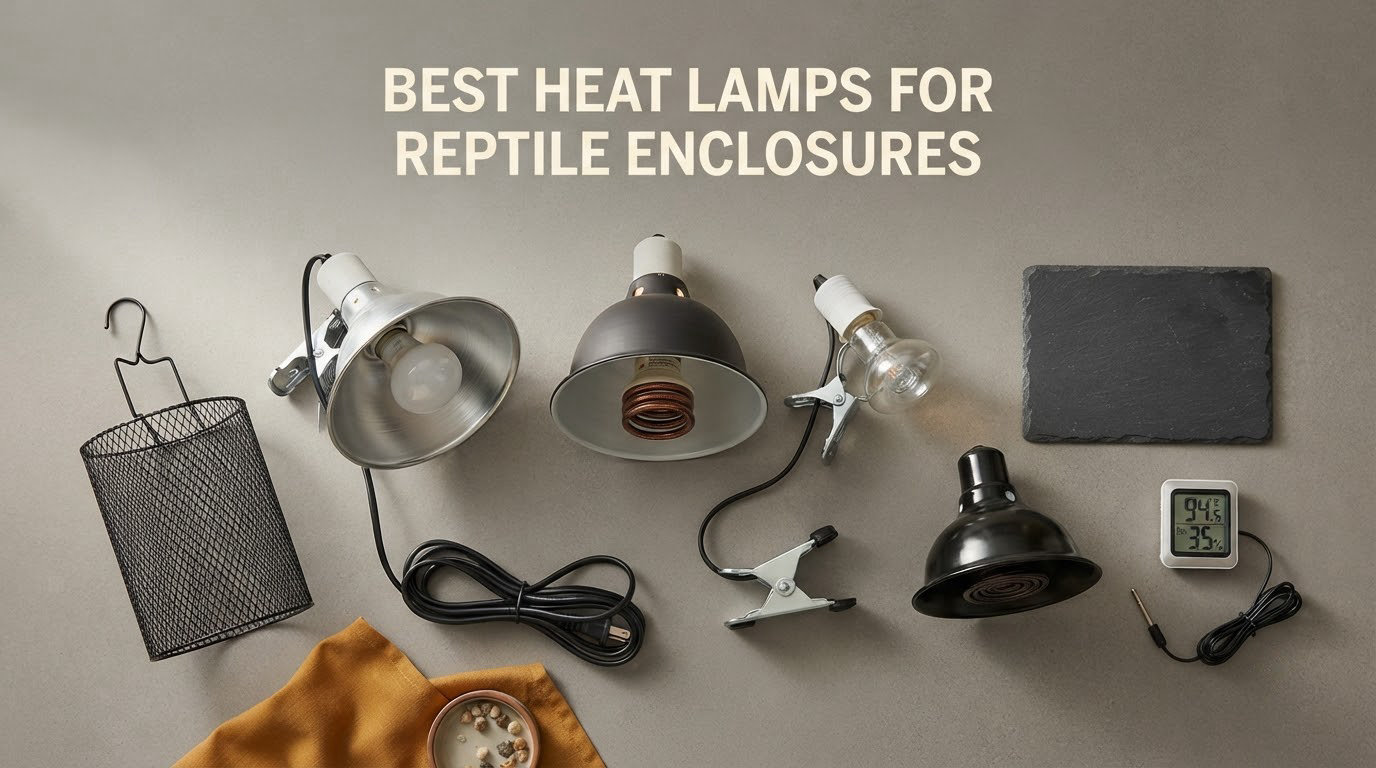
The best heat lamps for reptile enclosures are not all the same product, because your animal decides which one works. A diurnal bearded dragon needs bright visible basking light and UVB, while a nocturnal snake or gecko needs heat with no visible glow at all. Pick the wrong category and you either wash out an animal’s day/night cycle or leave a basking zone too cool to digest a meal.
We spent weeks reading customer review data across twelve bulbs, checking rated lifespans, beam type, wattage, light output and socket type for each one, then sorting them by what they actually do inside an enclosure. Nothing here depends on the wattage printed on the box alone, because a 100W bulb in a large canopy cage and the same bulb in a 20-gallon aquarium deliver very different basking temperatures.
One rule before any product list: every heat source in this roundup needs a thermostat and a working thermometer probe. Experienced keepers on r/ballpython and r/hognosesnakes say the same thing over and over – the bulb is the cheap part, temperature control is what keeps an animal safe. We also earn a commission from some of the links below, at no extra cost to you, and we flag burn and clearance risks wherever they apply.
Table of Contents
Top 3 Picks for the Best Heat Lamps for Reptile Enclosures (October 2026)

Fluker’s 100W Basking Spotl…
- Focused visible basking light
- Longest review history in the group
- Best seller in reptile habitat lighting

LUCKY HERP 100W UVA Basking
- 1650 lumens of visible light
- UVA for appetite and digestion
- 50W 75W and 100W options

LUCKY HERP 100W Ceramic…
- No light emitted at all
- Up to 10000 hour rated life
- Heats up in about 4 minutes
Together, those three cover the two setups most keepers are actually building: a daytime basking bulb paired with a no-light ceramic emitter for overnight warmth. The Fluker’s bulb is the most reviewed heat lamp we could find, the LUCKY HERP basking bulb is the stronger of the two daytime options, and the ceramic emitter is the highest-rated product in the group.
All 12 Heat Lamps Compared in 2026
Read that table as a map rather than a ranking. Anything that emits visible light is a daytime source. Anything described as no-light is a continuous or overnight source. The wattage tells you how big an enclosure it can realistically heat, and the rated life tells you how much of a budget to set aside for replacements.
1. Fluker’s 100W Incandescent Basking Spotlight – The Most Proven Daytime Basking Bulb
Fluker’s Incandescent Basking Spotlight Bulbs for Reptiles Tanks, Reptile Heat Lamp Bulbs for Infrared Light, 100-Watt
100 watt incandescent
Visible basking light
Reflector spotlight
2.5 x 2.5 x 5.5 inches
Pros
- Directs heat and light at one specific basking area
- Top-ranked product in reptile habitat lighting
- Very low cost per bulb
Cons
- Emits visible light so it cannot run overnight
- Bulbs need regular replacement
- Older incandescent design
This is the bulb we keep coming back to for daytime basking. In a 40-gallon breeder it produces a tight, obvious hot spot at one end of the enclosure, which is exactly what a ball python or leopard gecko needs to thermo-regulate. It has been on the market for two decades, which is why the review history on this one is deeper than anything else in the roundup.
The 100W version is the one most keepers land on for medium enclosures. Reviewers describe it as dependable rather than spectacular – it does the basic job of throwing heat and light in a direction without a lot of drama. Buy the 75W for smaller tanks and step up to 150W only for large, cold-room setups.
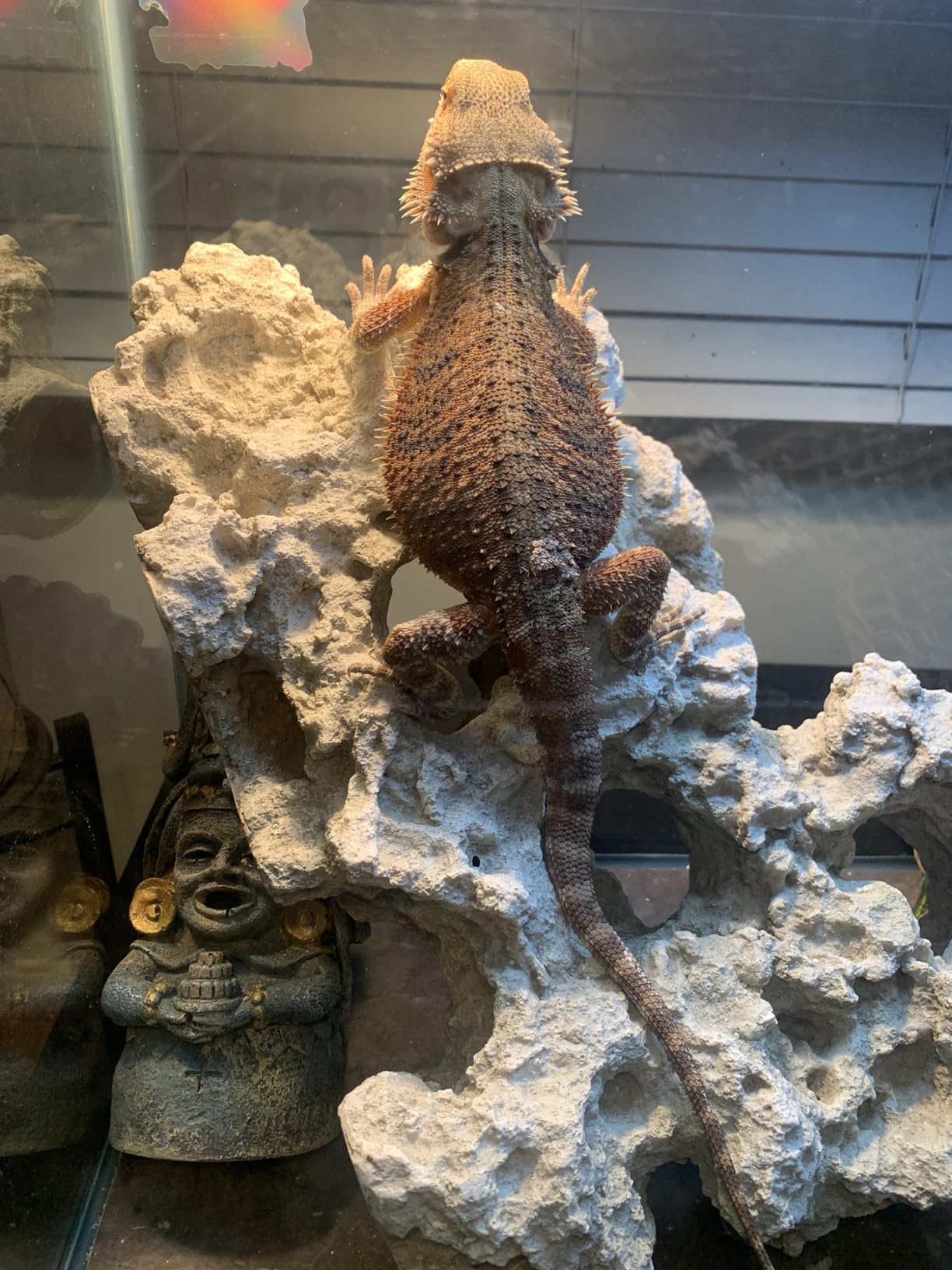
Technically it is a plain incandescent reflector in a standard E26 base, measuring 2.5 by 2.5 by 5.5 inches and weighing just 0.2 ounces. That simplicity is the point. It slots into any dome fixture that takes a normal household bulb base, and because the filament is the only fragile part, failure is a total loss of light rather than a partial fade.
The catch is that it is a light source first and a heat source second. A visible bulb left on overnight adds light pollution that nocturnal species do not tolerate well, and a reflector concentrates the beam so the surface near the basking stone can scorch substrate. Keep the fixture clear of the animal’s reach and confirm the measured surface temperature with an infrared thermometer before you trust the wattage number.
When this bulb is the right call
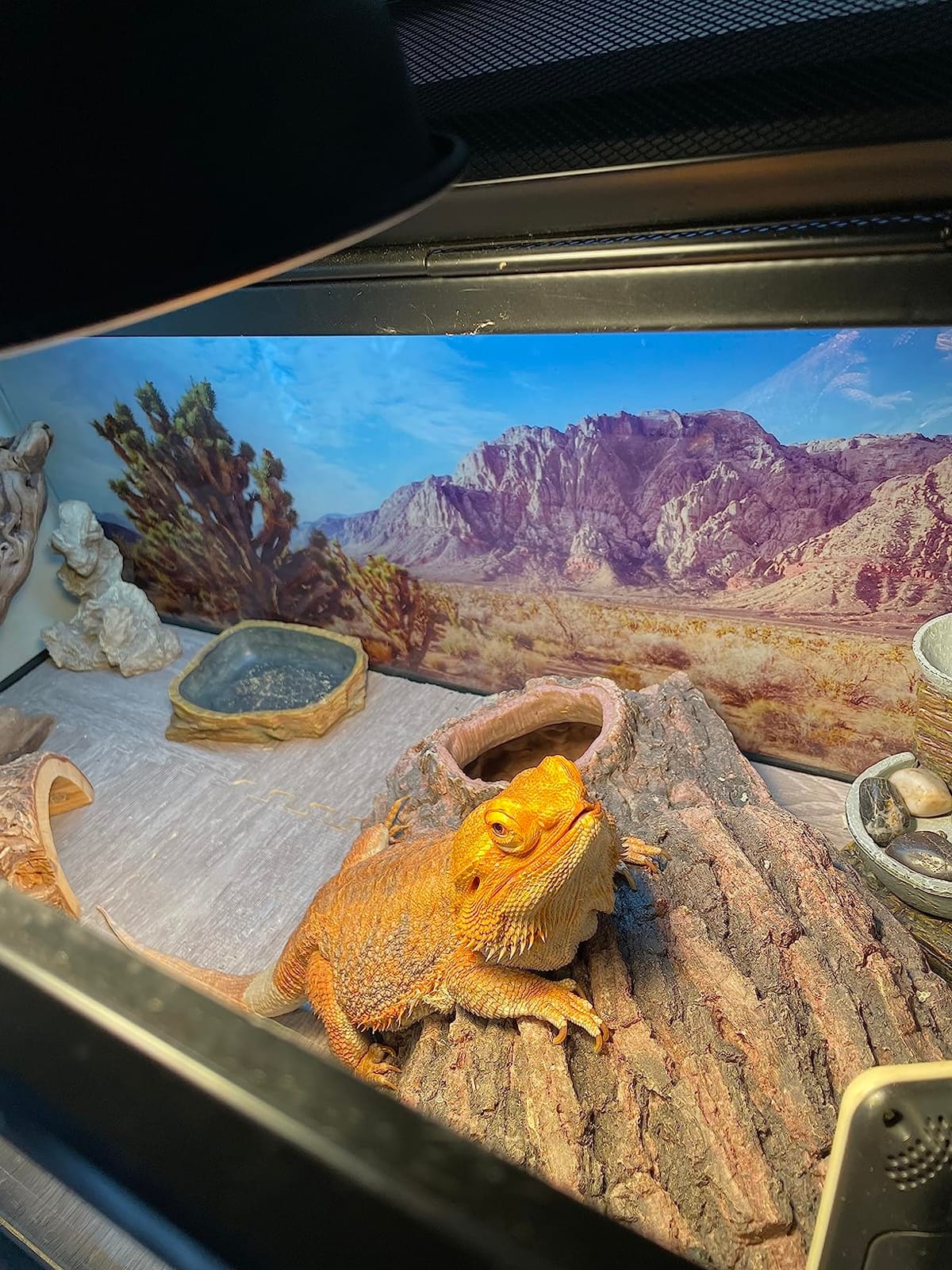
Choose the Fluker’s for any diurnal species that actively sits under a light source, including bearded dragons, turtles, tortoises and many lizards. It is also a good daytime bulb for a nocturnal snake when paired with a separate no-light source for after dark, since the animal only needs a defined basking spot during the day.
For a new keeper building a first enclosure, this is a low-commitment way to get a working gradient going. One bulb, one dome, one thermostat. Add a second no-light source later once you have measured the actual gradient.
When to pick something else
Skip it if your animal needs true darkness at night and you do not want to run a second heat source. A nocturnal reptile kept with only this lamp on a 24-hour cycle will have its photoperiod disrupted, which keepers on r/reptiles describe as one of the most common husbandry mistakes in terrariums.
It is also the wrong tool for a large adult tortoise or a big canopy cage. A single 100W reflector spread over a four-foot enclosure simply cannot push a surface hot enough to bask under, and you will end up replacing bulbs repeatedly while chasing the temperature.
2. MCLANZOO 75W UVA Basking Light 2-Pack – Best for Bearded Dragons

MCLANZOO Reptile Heat Lamp 75W 2 Pack,UVA Basking Light Bulbs,Natural Daylight Terrarium Heat Lamps for Bearded Dragon Accessories,Turtle,Tortoise,Lizard,Snake,Gecko,Chicken with Temperature Strips
75 watt UVA basking
E26 base, 120V
450 lumens white light
2 pack plus thermometer strip
Pros
- UVA output supports appetite and digestion
- Heats an enclosure quickly
- Thickened glass rated for 2000 hours
- Includes a stick-on thermometer
Cons
- Filaments can fail sooner than rated
- Emits visible light so switch it off at night
- Stick-on strips lose accuracy when repositioned
This is the daytime bulb we would put over an adult bearded dragon. The UVA content matters more than the raw wattage for a species that spends its day actively basking, because it drives appetite, digestion and breeding condition, and this one puts out a full 450 lumens of white light from a 75W filament.
Reviewers consistently mention heat. Owners of turtles, tortoises and beardies report the enclosure warms quickly and a clear basking zone forms within a few minutes of switching on, which matters when you are trying to hit surface temperatures in a cool room. The two-pack means you always have a spare on hand, and filament bulbs always fail eventually.
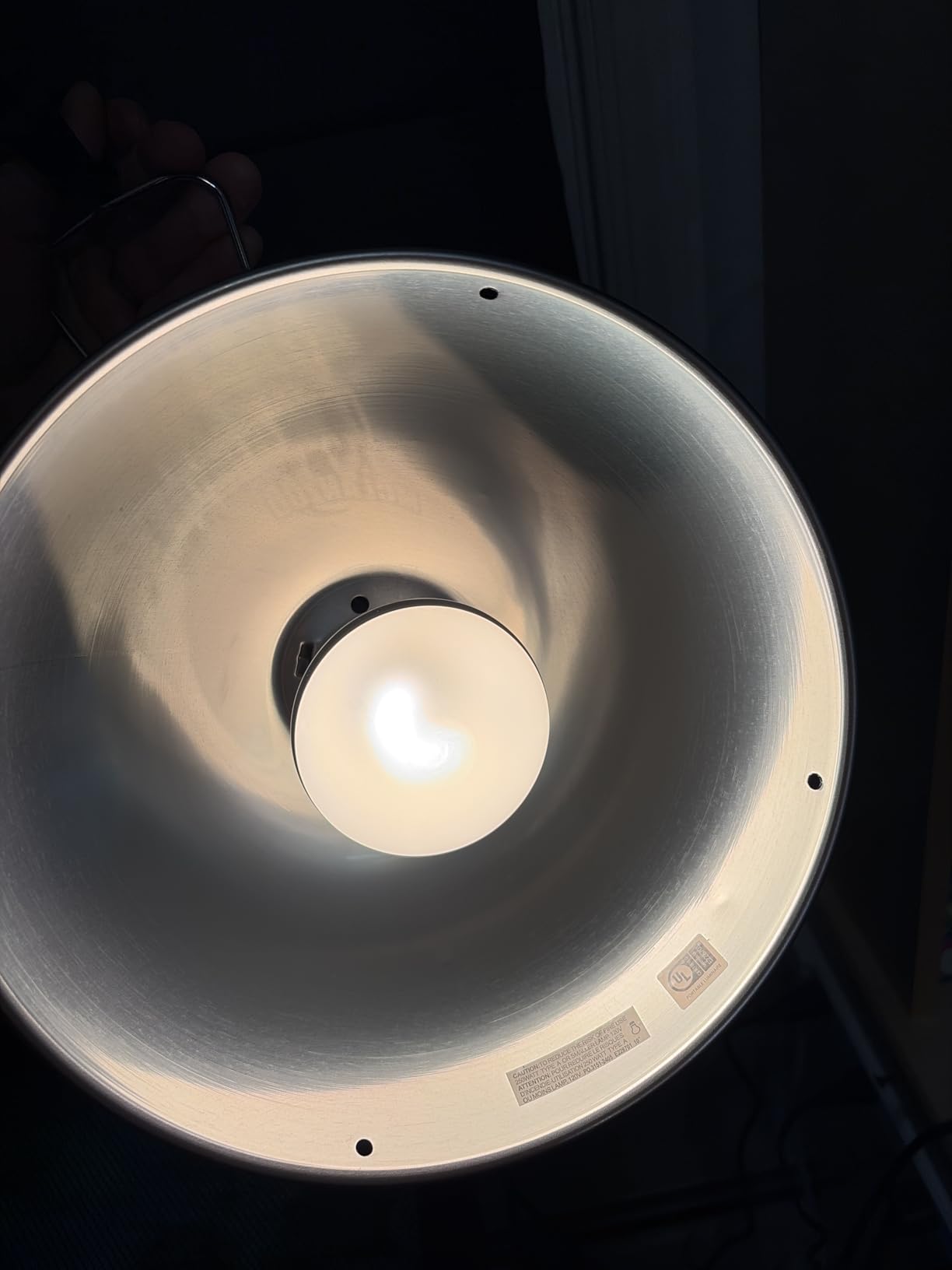
The spec sheet lists a standard E26 base at 120 volts, a reflector shape, a 3.1 inch bulb diameter and a 2000-hour rated life for the filament. Bulb dimensions are 3.1 inches wide by 4.3 inches tall, so it fits a standard reptile dome without crowding the reflector. The pack also includes a stick-on thermometer strip, which is a useful starting reference even though it is not accurate enough to be your only gauge.
The recurring complaint is longevity. A meaningful number of owners report filaments dying within weeks rather than at the 2000-hour mark, and the manufacturer’s own 2000-hour figure assumes continuous operation, while most people run a 10 to 12 hour photoperiod. Budget for a replacement every few months and keep the spare pair where you can reach it without dismantling the fixture.
How to size and place it
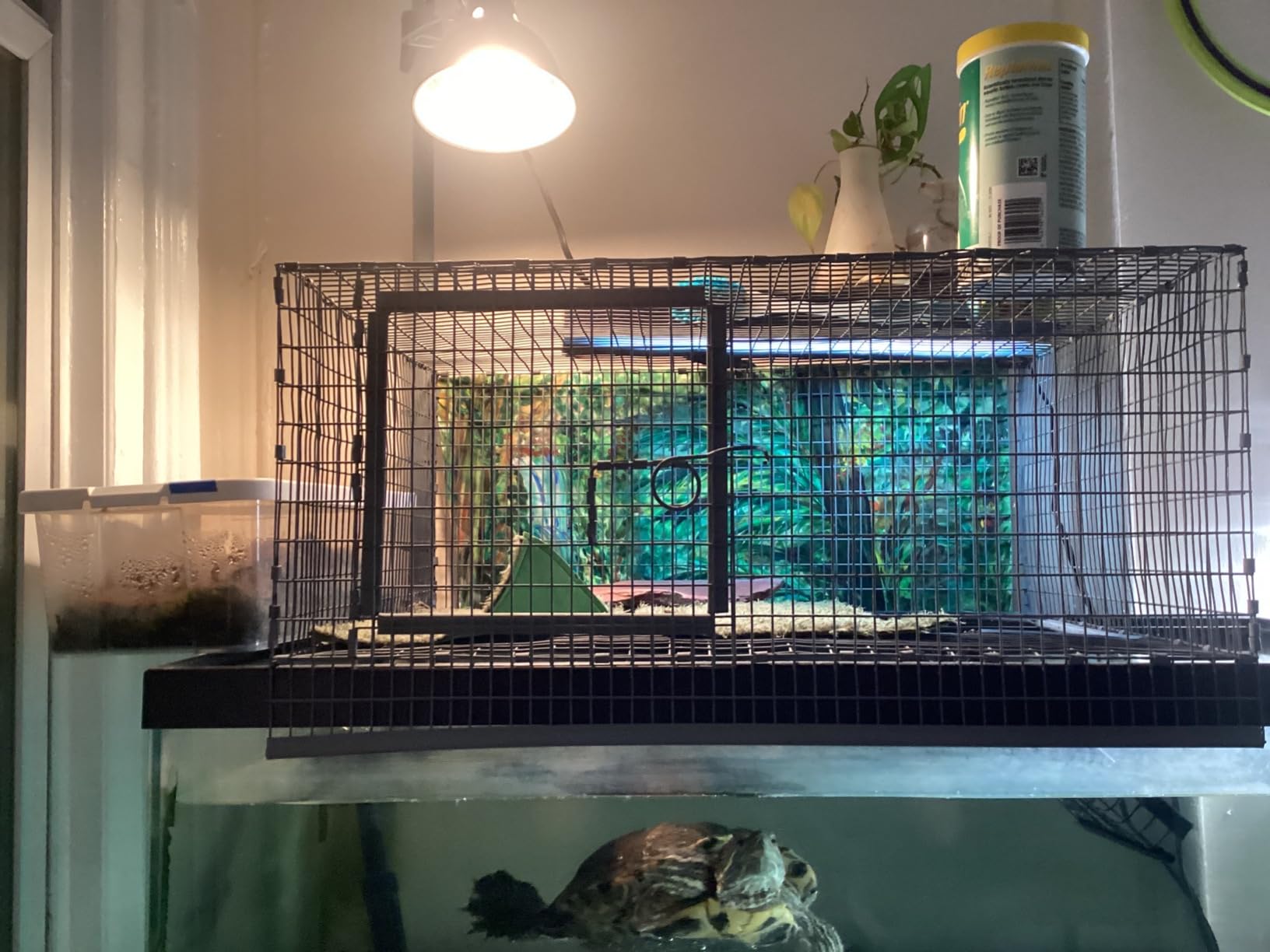
At 75W this suits roughly a 30 to 40 gallon enclosure in a normally heated room. Mount it high enough that the basking surface reaches your target but the animal cannot touch the glass, and set the thermostat probe on the warm side of the enclosure, not directly under the beam.
If your room drops below about 65F in winter, do not compensate by pushing this bulb to its limit. Add a second heat source instead, because a bulb rated at a fixed wattage cannot be pushed past its design output.
What to watch for
Measure the actual basking surface with an infrared thermometer rather than trusting air temperature. Air readings at bulb height are several degrees higher than what the animal feels on a rock, and that gap is where most enclosure problems start.
Keep this on a timer matched to your animal’s photoperiod. Turning it off at night and pairing it with a no-light emitter is the standard setup experienced keepers recommend, and it lets the animal sleep in real darkness.
3. LUCKY HERP 100W UVA Daylight Basking 2-Pack – Best Value Daytime Bulb
LUCKY HERP Reptile Heat Lamp Bulbs 100W, UVA Daylight Basking Bulbs 2 Pack
100 watt UVA basking
1650 lumens
E26 base, 120V
2 pack, 2000 hour life
Pros
- Brightest basking spot in the group for the wattage
- UVA supports foraging and courtship
- Premium glass and filament
- Available in three wattages
Cons
- Visible light rules out overnight use
- Still needs periodic replacement at long run times
This is the daytime bulb we recommend most often. At 100W and 1650 lumens it delivers roughly three and a half times the visible output of the 75W options in this roundup, which is a real difference when you are lighting a 4-foot enclosure rather than a small terrarium. The UVA output supports natural foraging and courtship behaviour on top of the obvious heat benefit.
Reviewers call out consistency. Unlike the budget filament bulbs that frustrate people with early burnout, owners of this one report steadier output over months of daily use, and several mention running it in a ceramic socket with no buzzing or flicker. The same range comes in 50W, 75W and 100W, so you can match the wattage to your enclosure later without changing brands.
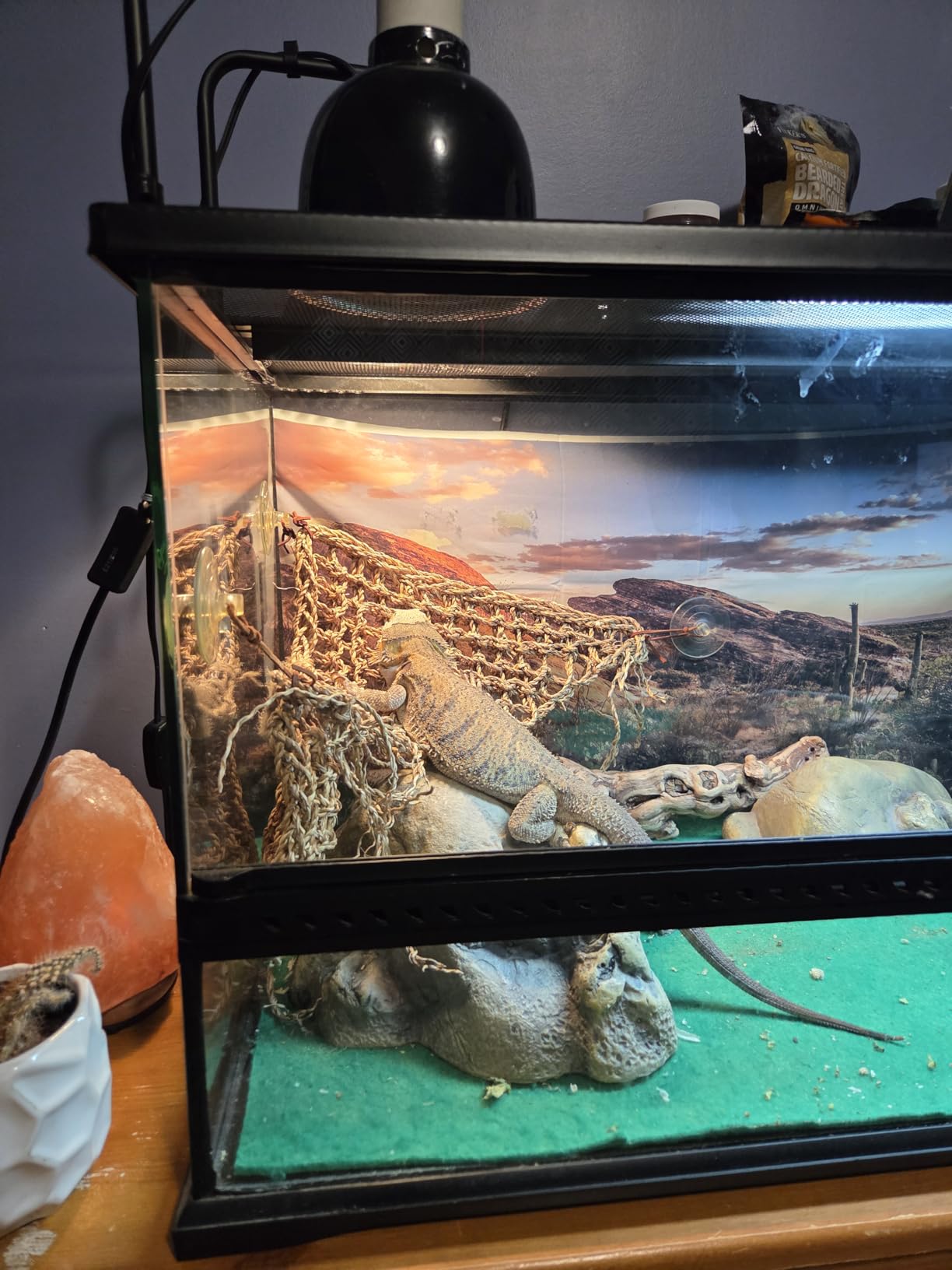
Specs are straightforward: E26 base, 120 volts, 3.1 inch diameter, 3.1 by 4.3 inch bulb dimensions, about 5 ounces, and a 2000-hour rated operating life. The reflector shape throws a focused beam rather than a wide flood, which is what you want when the goal is a defined basking stone at one end of the enclosure and a clear cool side.
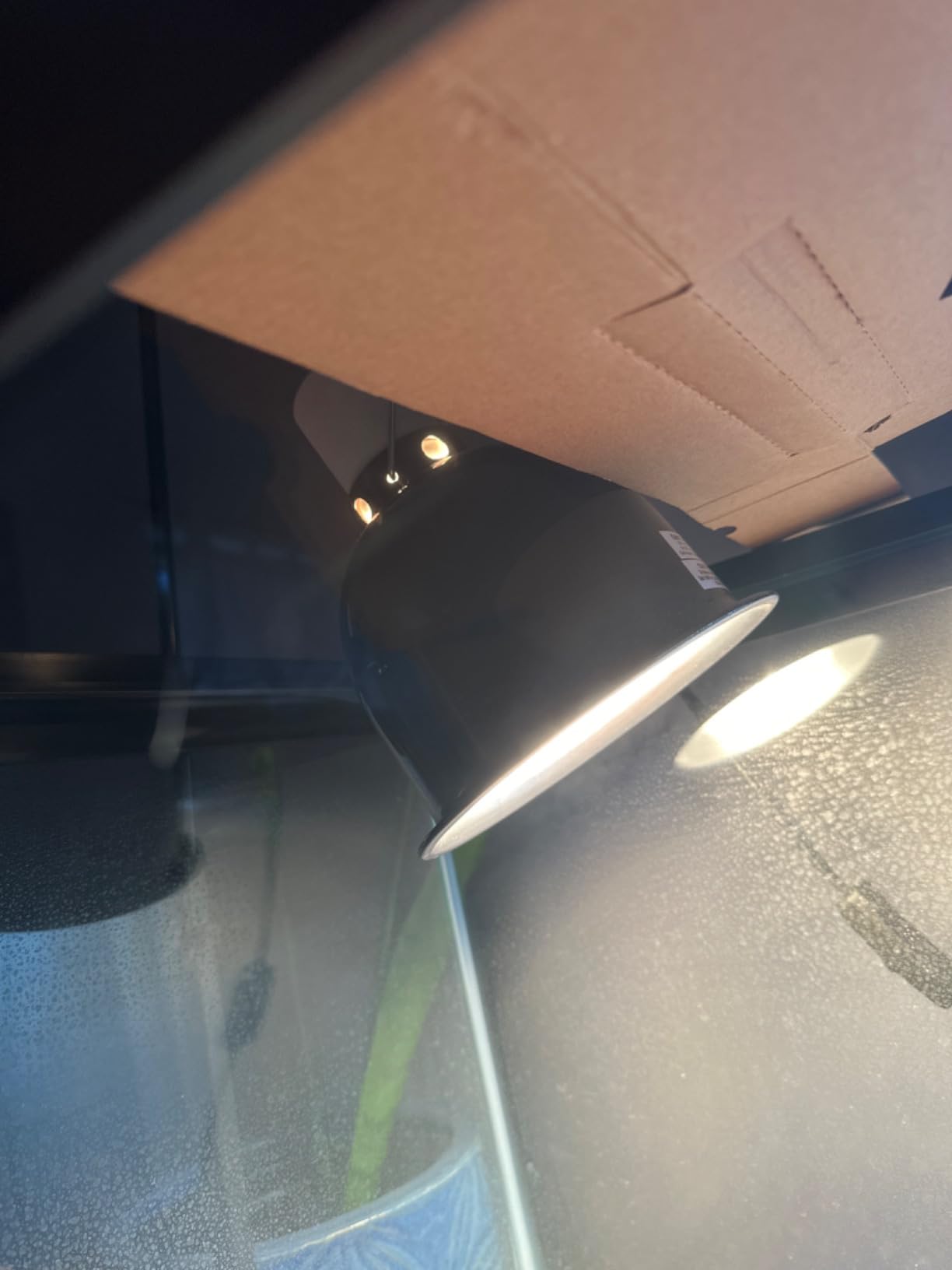
It is also listed as dimmable, which means it can be used with a dimming thermostat if you want finer control over a small basking zone than an on/off cycling thermostat provides. That flexibility is unusual in a bulb at this level and makes it easier to fine-tune in a small enclosure without overshooting.
Why this one earns best value
Three things put it ahead of the other daytime bulbs here: brightness per watt, a 4.5 average across more than 1700 reviews, and a documented complaint list that is shorter than its competitors’. It also holds the second-highest review count in the group, which means a lot of people have run it long enough to have useful things to say.
For most people buying a first basking bulb, this is the one to start with. Add a no-light emitter for the night half of the cycle and you have the standard two-part setup experienced keepers describe in r/BeardedDragons and r/ballpython threads.
Where the limits are
At 100W it is still a daytime-only source. Anything nocturnal that needs true darkness should have the bulb switched off on a timer, and a second source needs to take over the overnight heat load.
Also note the 2000-hour rating. At a 12-hour photoperiod that works out to a few months of real use, so plan a replacement rhythm and keep your spare bulb stored rather than sitting in a hot fixture.
4. REPTI HOME 100W Basking Spot 2-Pack – Most Versatile for Working Gradients

REPTI HOME Reptile Heat Lamp Bulbs, Simulate Natural Sunlight Heat Light Bulb, 2 Pack 100W Amphibian Terrarium Basking Spot Lamp for Reptile, Bearded Dragon, Lizard, Turtle, Snake
100 watt basking spot
E26 base
2 pack, 2000 to 3000 hours
Keep 30 cm from reptiles
Pros
- Concentrated reflector heats the basking area fast
- Two-bulb pack includes a spare
- Bright enough to light a large enclosure
- Steady reported output
Cons
- A minority report early failure or shattered bulbs
- Must not be used with dimmers or thermostats
- Visible light only
This is the cheapest credible way to get a hot spot in a large enclosure, and it holds a top position in terrarium heat lamps. Owners report consistent heat output and steady enclosure temperatures once it warms up, which is exactly the behaviour you want from a daytime basking source in a bearded dragon, tortoise or turtle setup.
The reflector concentrates light and heat into a beam, so the basking zone forms faster than it would with a general flood bulb. The manufacturer recommends 4 to 6 hours of use per day and replacing the bulb every 3 months, with a 30 cm minimum distance from the animal – sensible guidance that reflects how hot a concentrated 100W source gets.
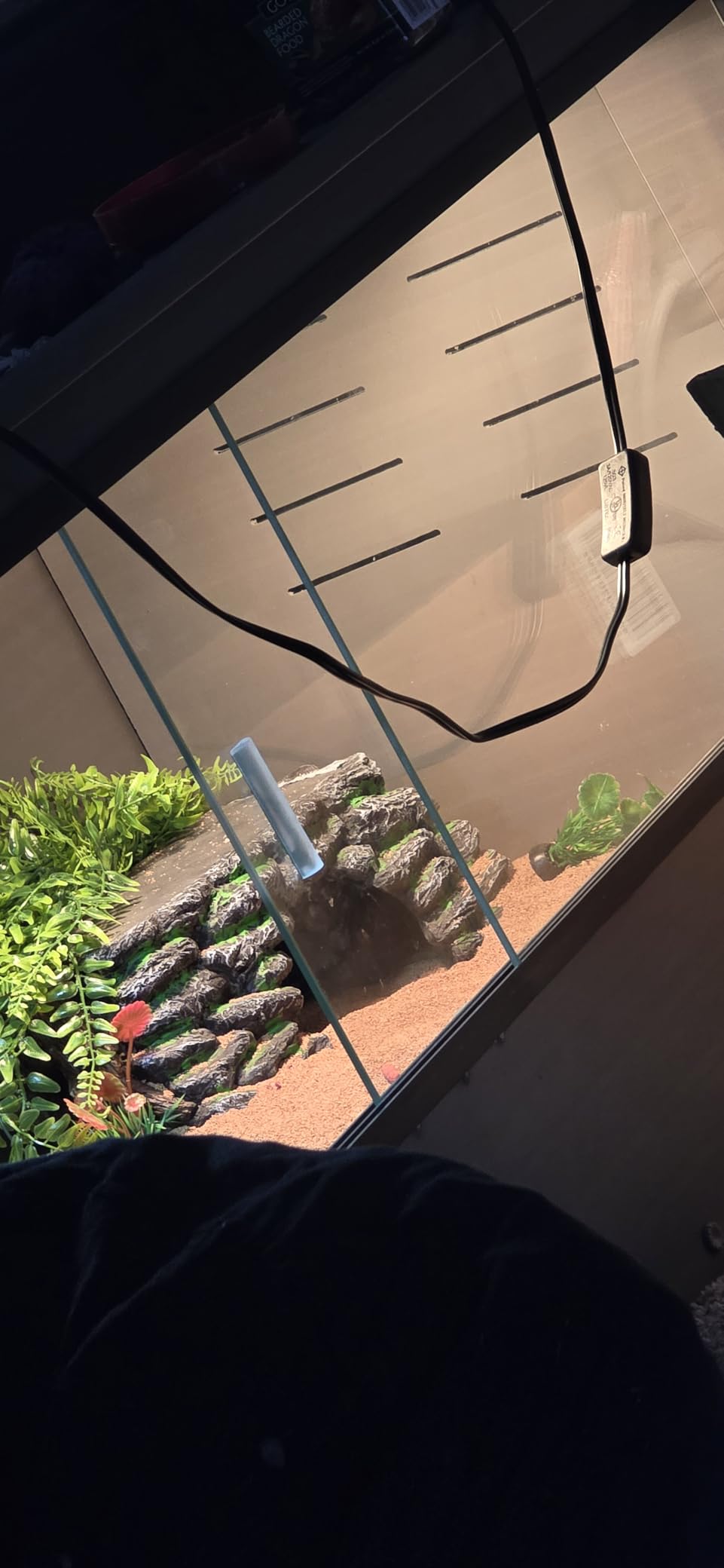
Specs list a 3.1 by 3.1 by 4.3 inch bulb at about 5.6 ounces on an E26 base, with a rated service life of 2000 to 3000 hours. Two bulbs are included, so even if one fails on day three you have a working replacement immediately instead of a dark enclosure overnight.
Two cautions from reviews. A minority of owners report early failure and even a bulb shattering shortly after installation, so inspect each bulb before you screw it in and after any move. The listing also explicitly says it must not be used with dimmers, thermostats or rheostats, which means an on/off cycling thermostat is required for safety.
Best used for
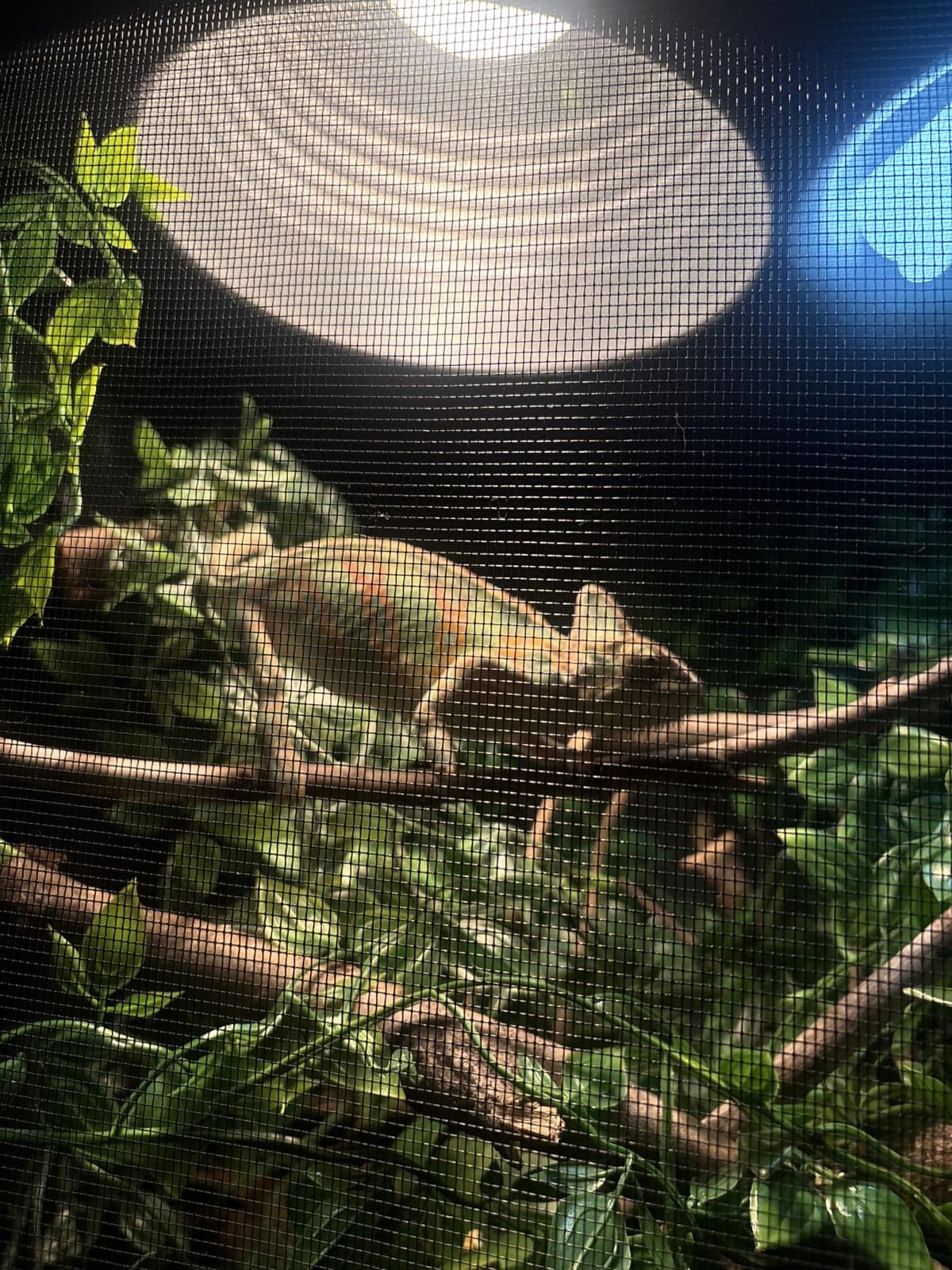
Pick this if you are outfitting a larger enclosure on a budget and you already understand that a visible bulb cannot be your only heat source. It suits bearded dragons, tortoises, turtles, lizards, snakes, iguanas, geckos, chameleons and amphibians, which is a broad enough list to cover most setups.
The concentrated beam is a genuine advantage in wide enclosures where a wide flood would produce an even, unhelpfully lukewarm temperature across the whole top. A tight spot gives the animal a real choice between hot and cool.
Who should avoid it
Skip it if you want a dimming thermostat in the chain, since the manufacturer rules that out. It is also not a good match for very delicate or small juveniles, since a 100W spot mounted at 30 cm is a lot of concentrated energy for a small animal to crawl into by accident.
If bulb breakage history worries you, a filament bulb rated in the thousands of hours is the wrong category. Look at a halogen option or a ceramic emitter instead, where there is no glass envelope to shatter.
5. LUCKY HERP 100W Ceramic Heat Emitter 2-Pack – Top Rated No-Light Heat Source
LUCKY HERP 100W Ceramic Heat Emitter, Reptile Heat Bulbs, Ceramic Heat Lamp for Reptiles, Amphibian, Chicken, Dog, Cat (2-Pack)
100 watt ceramic emitter
No light output
E26 base, 120V
Reaches temp in 4 minutes
Pros
- Highest rated product in the group
- Zero light keeps normal sleep cycles
- Heats to rated temperature in 4 minutes
- Thick ceramic shell lasts 1 to 2 years
Cons
- Requires a quality ceramic socket
- Keep more than 30 cm clearance
- Surface runs intensely hot
This is the ceramic heat emitter we recommend as the second half of any setup. It emits no light whatsoever, which is the whole point: your animal gets steady radiant heat overnight without any of the photoperiod disruption a visible bulb causes. It carries the highest average rating of any product we reviewed, and ball python and hognose keepers on r/ballpython and r/hognosesnakes single out LUCKY HERP emitters as a reliable choice.
Performance is the other strength. The manufacturer rates it to reach full temperature in about 4 minutes, and reviewers describe steady, even heat rather than a hot spot. Because there is no light, it can run on a dimming thermostat, which is how experienced DHP and CHE users keep nocturnal species comfortable without overshooting.
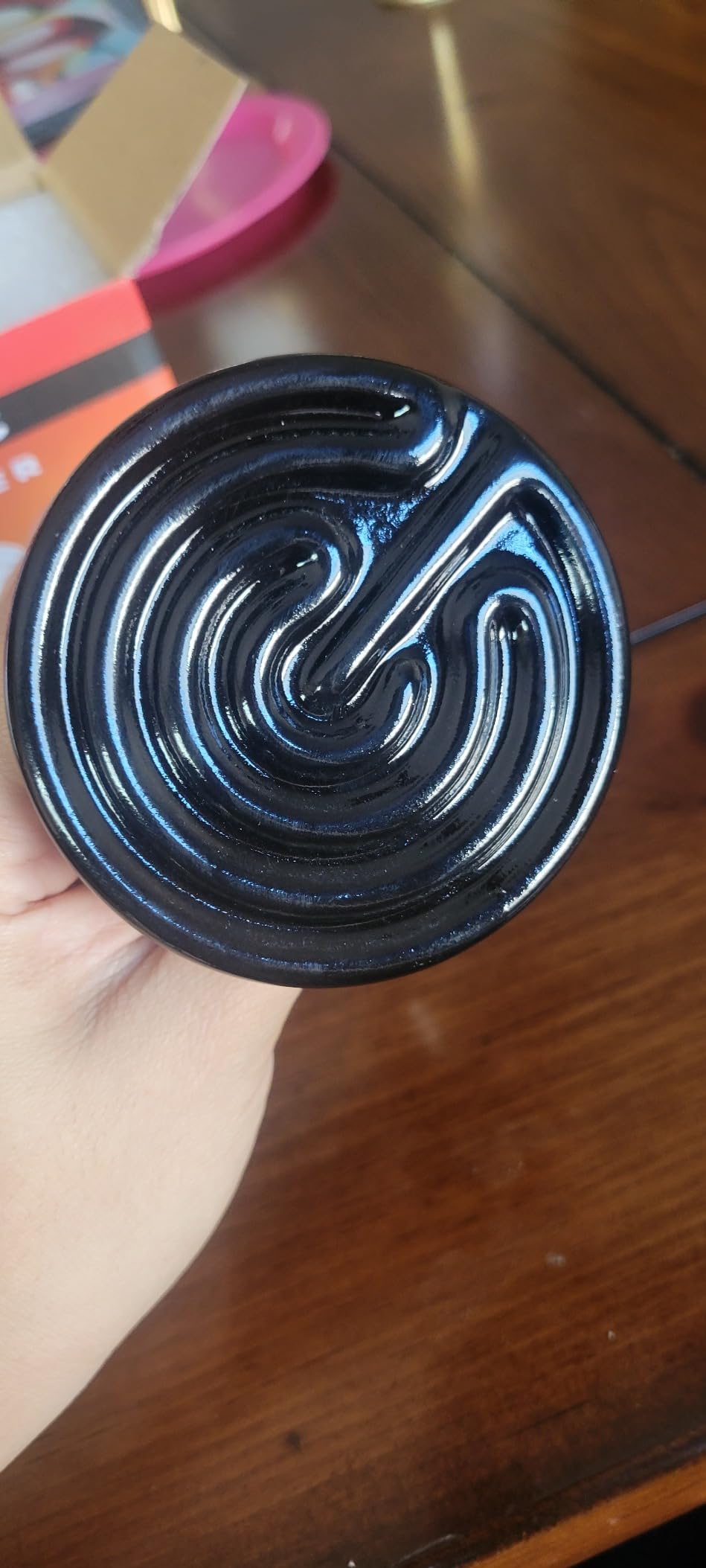
It is a 100W E26 ceramic unit on 120 volts, measuring 3.93 by 3 by 3 inches and weighing about 11.6 ounces, with a rated life of up to 10000 hours. The same emitter is available in 50W, 75W, 100W and 150W, so matching wattage to enclosure size is straightforward. That 10000-hour rating is roughly five times a filament basking bulb and is the main reason we rank it first among no-light options.
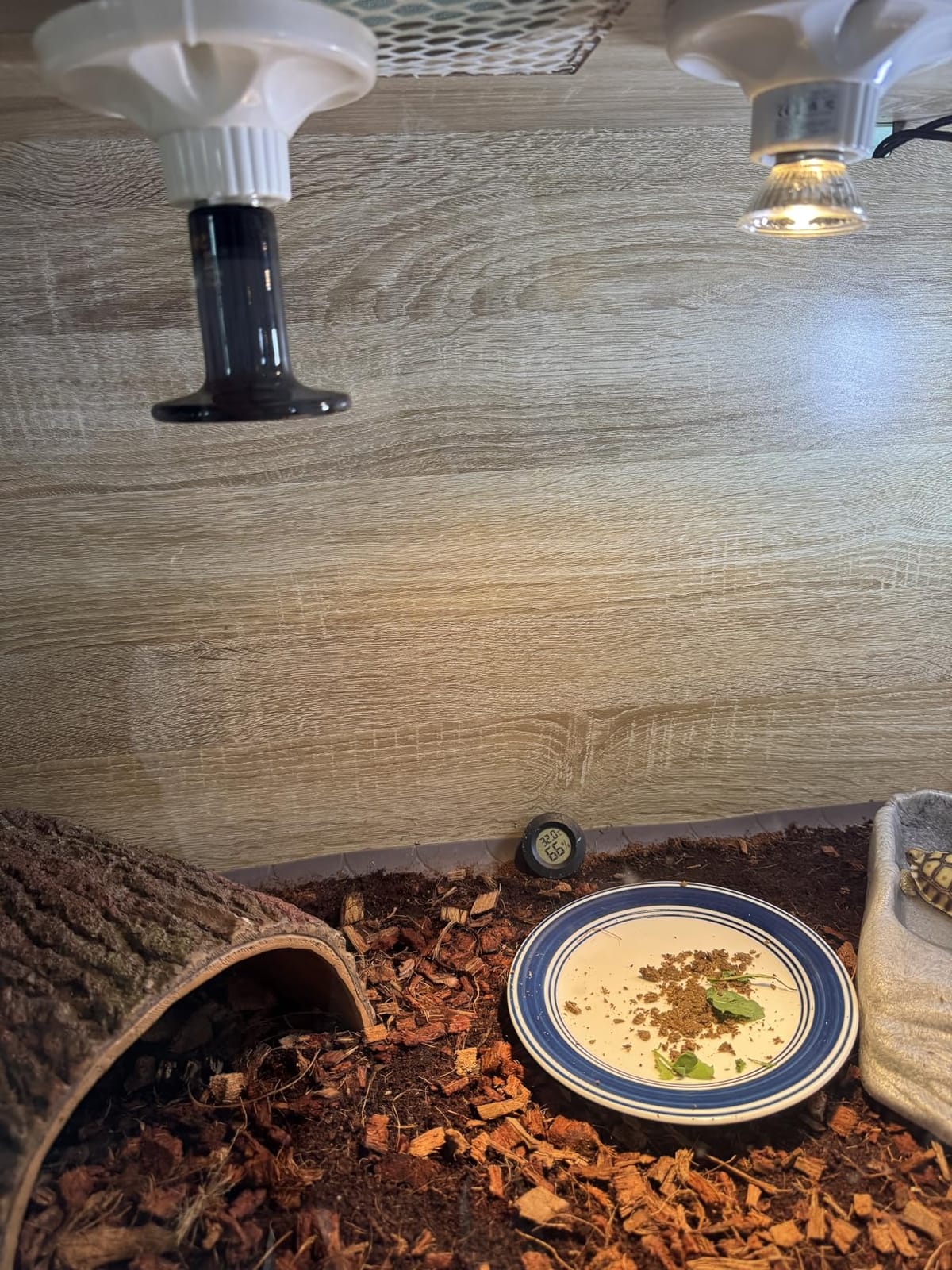
The hard requirements are non-negotiable. Use a quality ceramic lamp holder, never a plastic socket, and keep more than 30 cm of clearance between the emitter and the animal. The surface temperature is high enough to cause a burn on contact, and the bulb gives no visual indication that it is switched on, which is another reason to use a thermostat that logs cycles.
Where it earns its place
This is the correct overnight source for ball pythons, hognose snakes, leopard geckos, crested geckos and any other nocturnal or crepuscular animal. Pair it with a daytime basking bulb on a timer, run the basking bulb for 10 to 12 hours and leave the emitter on the thermostat overnight, and you get a natural-looking cycle.
It is also the right answer for small and juvenile enclosures where 100W would be too much, because the 50W and 75W versions cover exactly that. Reviewers also report a minority of units losing full temperature after several months, so check output with a thermometer rather than assuming it still works.
Who should skip it
Adult tortoise keepers should skip it. Concentrated radiant heat with no moving air can dry or burn a shell, which is a repeated warning on tortoiseforum.org, and most experienced tortoise keepers now use broad overhead heating instead.
Also skip it if you only have a plastic or multi-socket fixture. A ceramic emitter in a plastic socket is the single most common fire complaint we see in keeper forums, and no bulb rating makes that safe.
6. MCLANZOO 75W Infrared Red Night Lamp 2-Pack – Best for Nighttime Heat With a Glow

MCLANZOO Infrared Heat Lamp Bulbs 75W 2 Pack,Red Basking Spot Light Bulb Reptile Heating lamp for Bearded Dragon,Turtle,Snake,Leopard Gecko,Chicked with Digital Temperature Thermometer
75 watt red infrared
E26 base, 120V
Up to 3000 hour life
2 pack
Pros
- Soft red glow owners report beyond 3000 hours
- Evaporated aluminum coating concentrates heat
- Pairs with a daylight bulb for 24 hour heating
- Low surface dazzle
Cons
- Some reviewers question red bulbs for reptiles
- Occasional broken bulbs on arrival
- Uneven coating appearance
Red infrared lamps are the compromise choice, and this is the version we would use if you want overnight heat but still want to see your animal. The glow is soft rather than glaring, and owners of leopard geckos and turtles report that it does not appear to disturb normal activity patterns the way a white bulb does.
Longevity is the surprise here. The manufacturer rates the evaporated aluminum coating process at up to 3000 hours, and reviewers report service beyond that figure, with some running a single bulb for 10 months of continuous use. If you are considering this category at all, that consistency is the main argument for it over cheaper red bulbs.
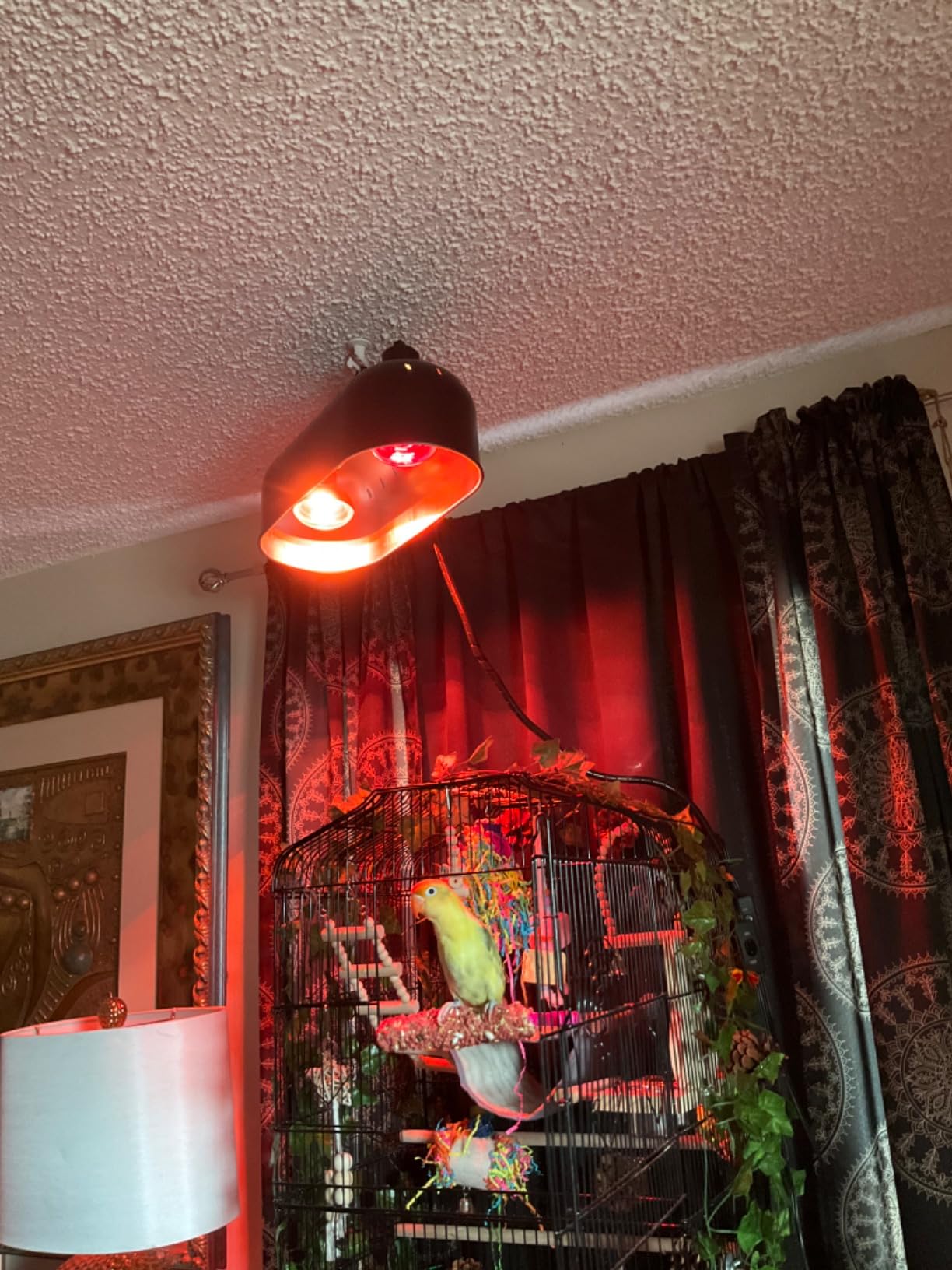
The bulb is a 75W E26 red unit rated at 110 to 120 volts, measuring 3.35 by 3.35 by 4.53 inches at roughly 6.5 ounces. It is sold as a 2-pack in 50W, 75W and 100W, and the listing mentions a four-step quality inspection and a 30-day return window, which matters given the occasional reports of bulbs arriving broken.
There is real debate about red light in reptile keeping, and we would not pretend otherwise. Some reviewers in this product’s own feedback question red bulbs for enclosures, and keepers on r/reptiles describe red night lights as not good for any reptiles. The scientific concern is that reptiles can perceive wavelengths beyond what humans see, so a red bulb is not the same as darkness.
When a red lamp makes sense
Use it when you need overnight heat and you want to observe behaviour at night without a bright white source in the enclosure. It also works well in a two-fixture setup where a daytime basking bulb handles the photoperiod and the red lamp maintains ambient warmth after dark.
For species that are strictly nocturnal, though, a no-light ceramic emitter is the better tool. It produces the same heat with genuinely zero photons reaching the animal.
Before you buy
Confirm your thermostat can handle a purely on/off cycle, since infrared bulbs are not typically listed as dimmable. Cycle frequency matters with red lamps because the visible pulse at each switch is more noticeable than with a no-light source.
Also inspect the coating. The evaporated aluminum layer that gives this bulb its life rating can look uneven, and some buyers read that as a defect when it is a normal artifact of the process.
7. REPTI ZOO 100W Intense Basking Spot 2-Pack – Best for a Tight Focused Beam
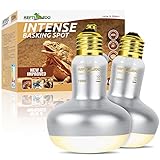
REPTI ZOO 2 Pack Heat Lamp 100W, Intense Basking Spot Simulated Natural Sunlight Heating Lamp Bulb, Heat Emitter UVA Heat Lamp Bulb for Reptile Chickens Pet Brooder
100 watt intense basking
Flat bottom reflector
110 volts, E26
3000 hour life, 1 year warranty
Pros
- Flat bottom focuses 35 percent more heat into the beam
- Vacuum aluminizing improves efficiency
- Quiet with no buzzing or flickering
- Four-stage inspection with a 1 year warranty
Cons
- Notable share of 1-star reviews citing failure
- Visible light only
- E25 shape listing is inconsistent with the E26 base
The design detail that sets this one apart is the flat-bottom reflector, which the manufacturer says focuses about 35 percent more light and heat into the beam than a standard reflector. In practice that means a tighter, hotter basking point, which is what you want when a wide flood leaves you with a uniformly lukewarm top and no real gradient.
REPTI ZOO is an established reptile brand and this bulb carries a one-year warranty with three months of free replacement coverage, better protection than most competitors in this roundup offer. Owners like the concentration of heat and the quiet operation, with no buzzing or flicker reported.
Specs list a 100W E26 base, 110 volts, 3.2 by 4.8 inch dimensions at about 5.3 ounces, and a 3000-hour operating life. The listing notes a 35 percent efficiency increase from an updated vacuum aluminizing process, and the output is described as white light at 100 lumens, which is far dimmer than a standard basking bulb because the design trades visible brightness for beam concentration.
Two things to be aware of. First, there is a notable share of one-star reviews reporting premature failure, so test the bulb before relying on it. Second, the listing mixes an E25 bulb shape with an E26 base, which is an inconsistency in the spec sheet – physically most dome fixtures take the larger E26 base, but check your fixture before ordering.
Best for desert species
A tight, hot beam is exactly what a desert lizard wants. Beardies, uromastycs and similar species will flatten under a concentrated spot and move away when it gets too warm, which is thermoregulation behaviour you want to encourage rather than a temperature they simply have to tolerate.
Position the beam over a flat stone or basking platform so the surface reaches your target. Because the beam is tighter than usual, the drop-off to the cool side is also sharper, which makes the gradient easier to read with a probe.
When to choose differently
Do not choose it for a large enclosure that needs broad ambient warmth, since the efficiency gain comes from focus rather than coverage. And because it produces visible light, it stays a daytime-only source in any setup.
If you are very sensitive to early failures, the warranty terms are the deciding factor. REPTI ZOO’s one-year coverage is the strongest on this list; most others stop at 90 days or 3 months.
8. ReptiKing 100W Intense Basking Spot 2-Pack – Best for Building a Clear Gradient

ReptiKing Basking Light for Reptiles, 2-Pack 100W Upgraded Intense Basking Spot, Reptile Heat Bulb Light, UVA Heat Lamp Bulbs for Bearded Dragon Turtle Chicken
100 watt intense basking
Narrow dense UVA beam
1600 lumens
2000 hour life
Pros
- Narrow high-density beam simulates direct sun
- Helps create a clear hot and cold gradient
- 1600 lumens from a 100W reflector
- Pairs with an emitter for a 24 hour cycle
Cons
- 2000 hour life means regular replacement
- Visible light makes it daytime only
- 90-day warranty is the shortest here
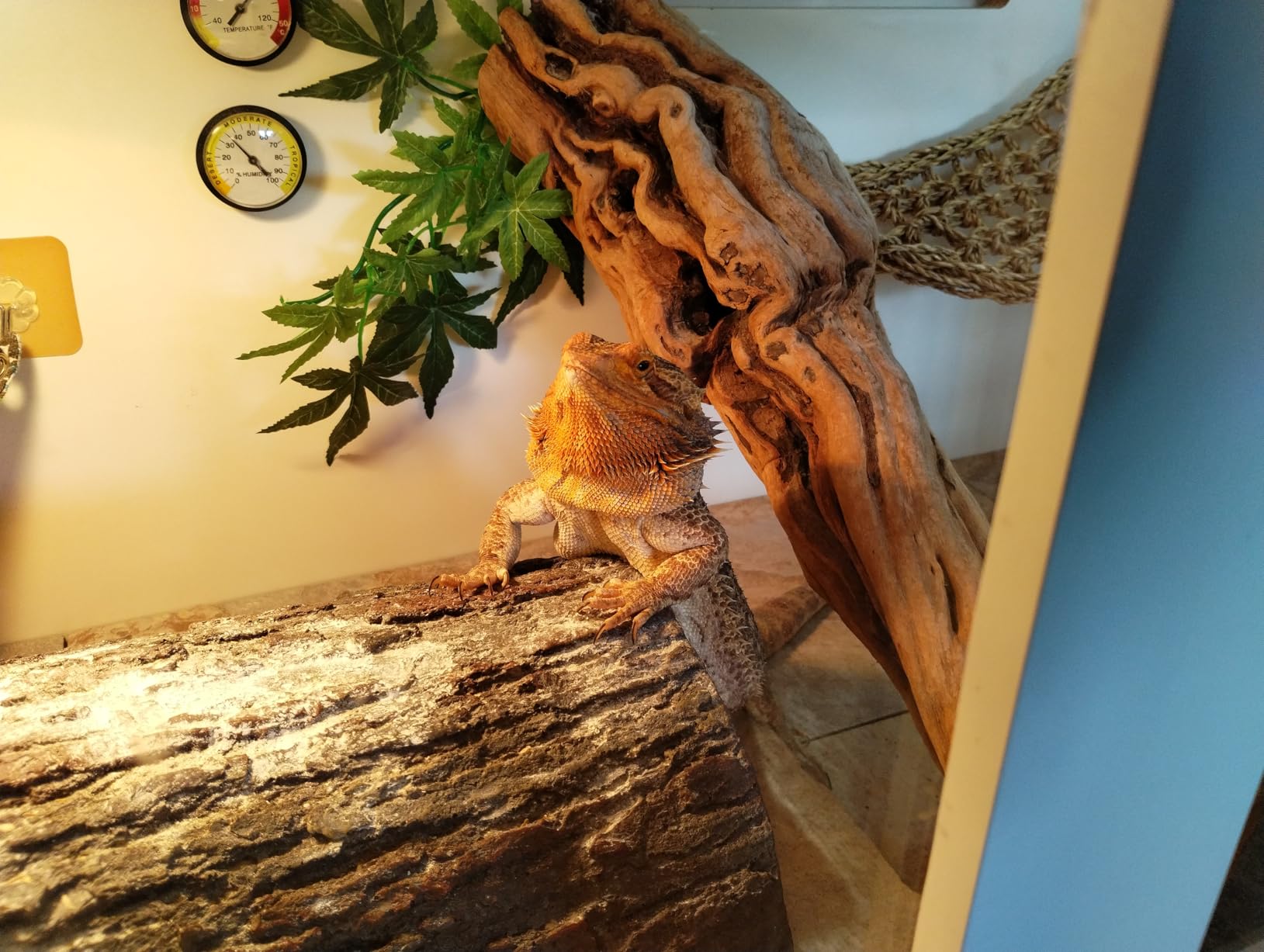
This is the bulb to buy if your problem is gradient, not heat. The narrow, dense beam with UVA output is described by owners as closely imitating direct sunlight, and reviewers specifically mention that it helps build a clear hot and cold gradient inside a standard terrarium rather than warming the whole space evenly.
At 1600 lumens from 100W it is one of the brighter options here, which also means it doubles as a light source for a planted or bioactive setup. Owners pair it with a ceramic heat emitter or an infrared spot to run a complete 24-hour cycle from a single dome.
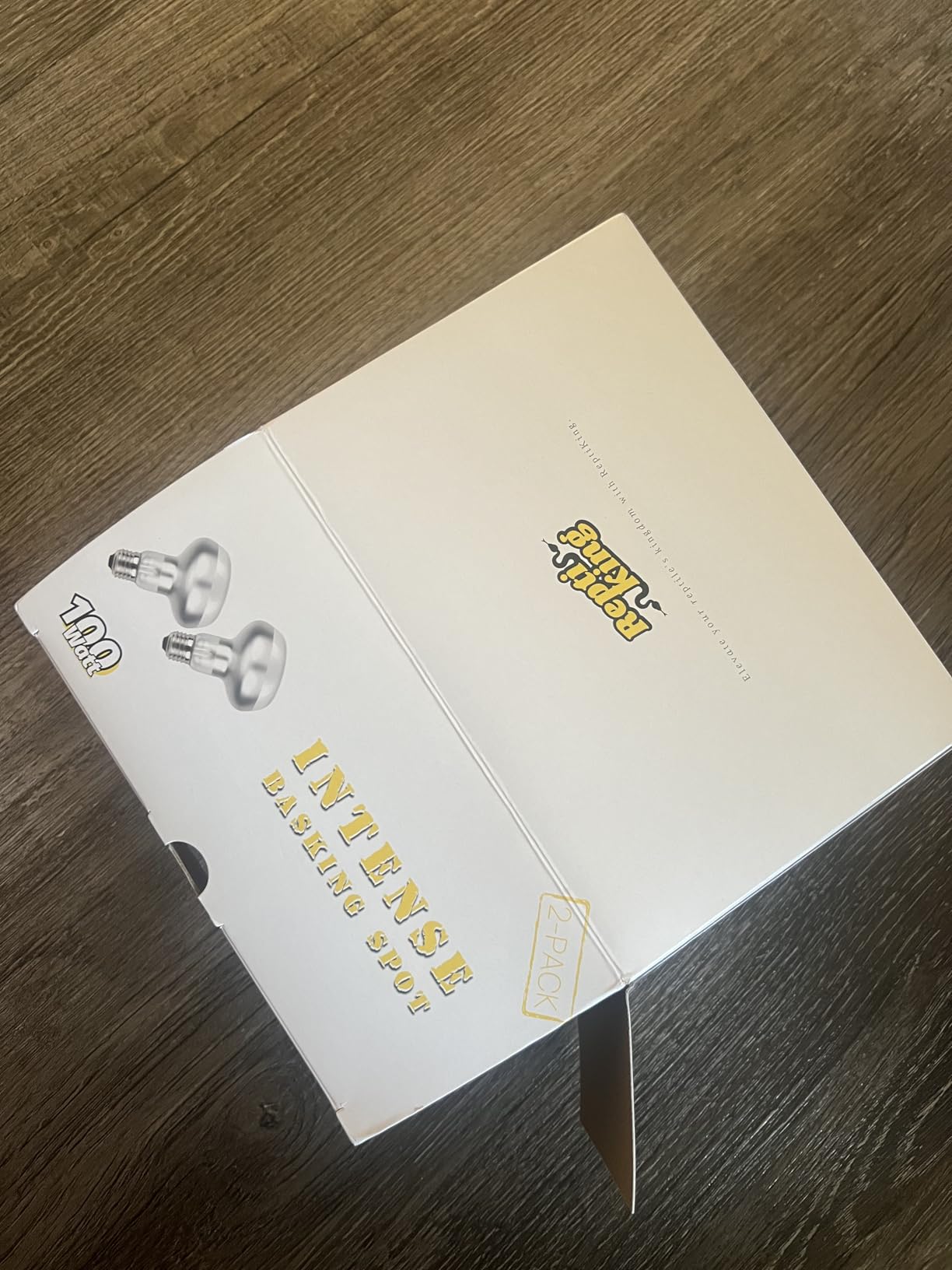
Technical details: E26 base, 120 volts at 60Hz, 3.2 by 4.8 inches, about 5.9 ounces, reflector shape in glass, 2000 hours rated service life. The listing describes it as suitable for bearded dragons, crested geckos, desert lizards, turtles, tortoises, iguanas and chickens, which covers both arboreal and ground-dwelling setups.
Keep the 2000-hour rating in mind. At a realistic 12-hour photoperiod you are looking at replacement every few months, and unlike a halogen or ceramic option, filament failure is sudden and total. The 90-day manufacturer warranty is the shortest in this group, so treat the spare bulb as part of the purchase rather than an afterthought.
Why gradient is the deciding factor
A reptile does not need a warm enclosure, it needs two different temperatures and the ability to move between them. A narrow beam creates that drop-off quickly, so a 4-foot enclosure can have a proper hot end and a genuinely cool end within a single fixture.
If you are struggling with an enclosure that feels uniformly lukewarm, this is the bulb type that fixes it. If your problem is simply that the whole room is cold and the enclosure will not hold any heat at all, you need a different approach entirely.
Where it falls short
It is a visible-light source, so it cannot run at night. That means pairing it with a second no-light emitter for nocturnal species, or accepting a disrupted photoperiod, which is not a trade-off we recommend.
It is also one of two bulbs in the pack with the shortest stated warranty period. If you run a bulb continuously, buy a spare at the same time rather than waiting for a failure to order one.
9. REPTI ZOO 75W Day and Night Combo Pack – Best for First-Time Keepers
REPTI ZOO 75W Reptile Heat Lamp Bulb, 2PCS Day & Night Basking Spot Light Combo Pack Includes Infrared Heat Lamp and UVA Daylight Heating Lamp Basking Light
75 watt combo pack
One UVA plus one infrared bulb
2.5 inch diameter
3000 hour life
Pros
- Day and night bulbs in one pack
- Soft red glow for observing nocturnal activity
- Compact 2.5 inch diameter fits small domes
- Good heat output for medium habitats
Cons
- Red bulb is the weaker of the two
- Both bulbs run very hot
- 90-day replacement coverage only
This pack exists because most beginners do not yet know whether they need daytime light, night heat, or both. It gives you one UVA daylight basking lamp and one infrared emitter in a single order, so you can build a complete two-mode setup from one fixture and one thermostat without guessing.
Owners like the soft red glow, which lets you observe nocturnal activity without fully lighting the enclosure. The compact 2.5 inch diameter is the other thing people mention, because it fits smaller terrariums and low-profile domes that larger reflectors physically will not fit inside.
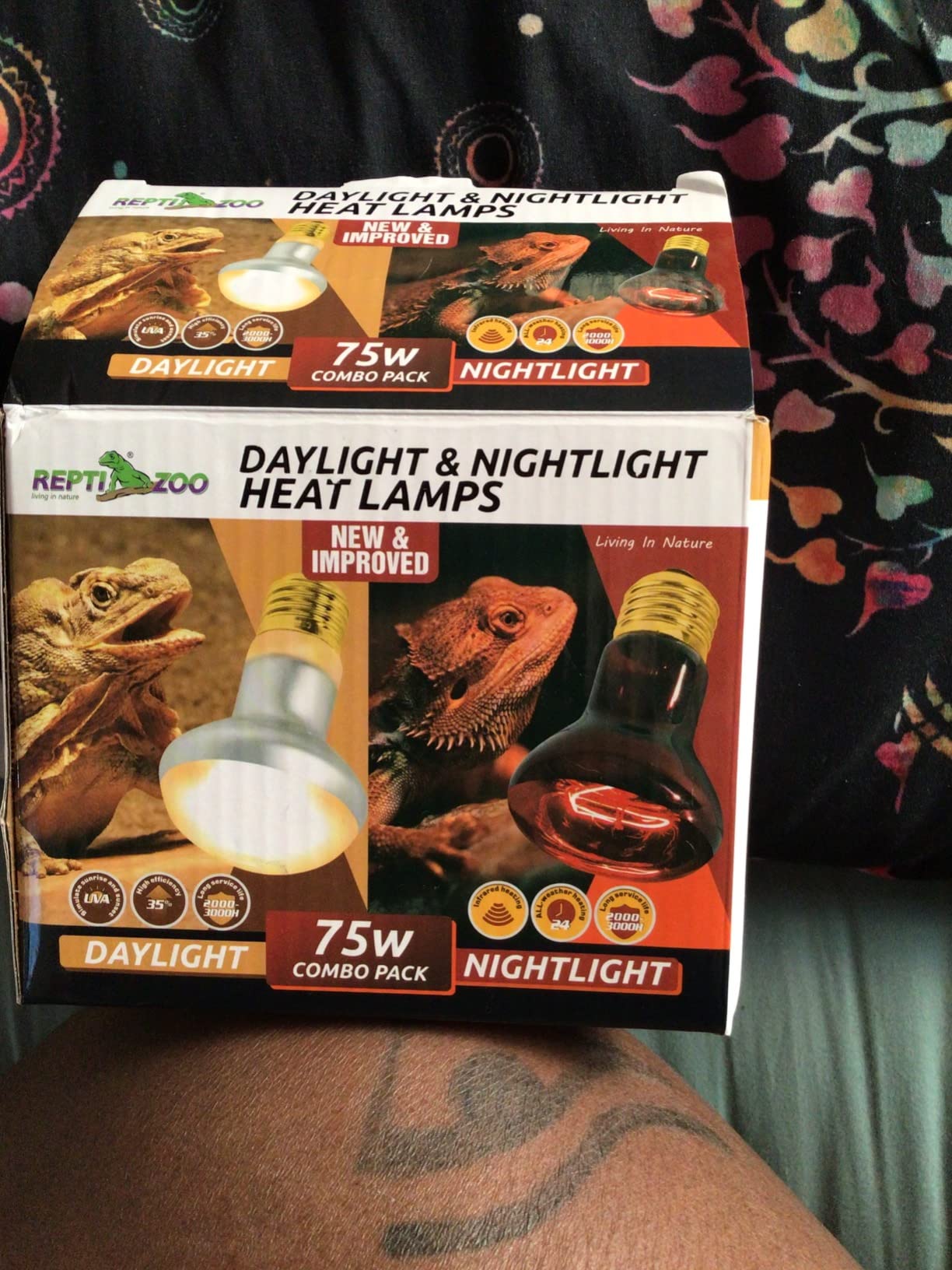
Both bulbs are 75W on an E26 base at 120 volts, 2.5 inches wide by 4 inches tall, in a reflector shape with a 3000-hour rated life. The pack includes one infrared emitter and one UVA daylight lamp, which is the whole setup in two components, and the listed warranty coverage is three months.
Heat output is reported as good for medium and larger habitats, though both bulbs run hot enough that an infrared thermometer becomes genuinely useful rather than optional. The recurring complaint is the red bulb specifically, with several owners reporting it failing around three to four months while the UVA bulb keeps going.
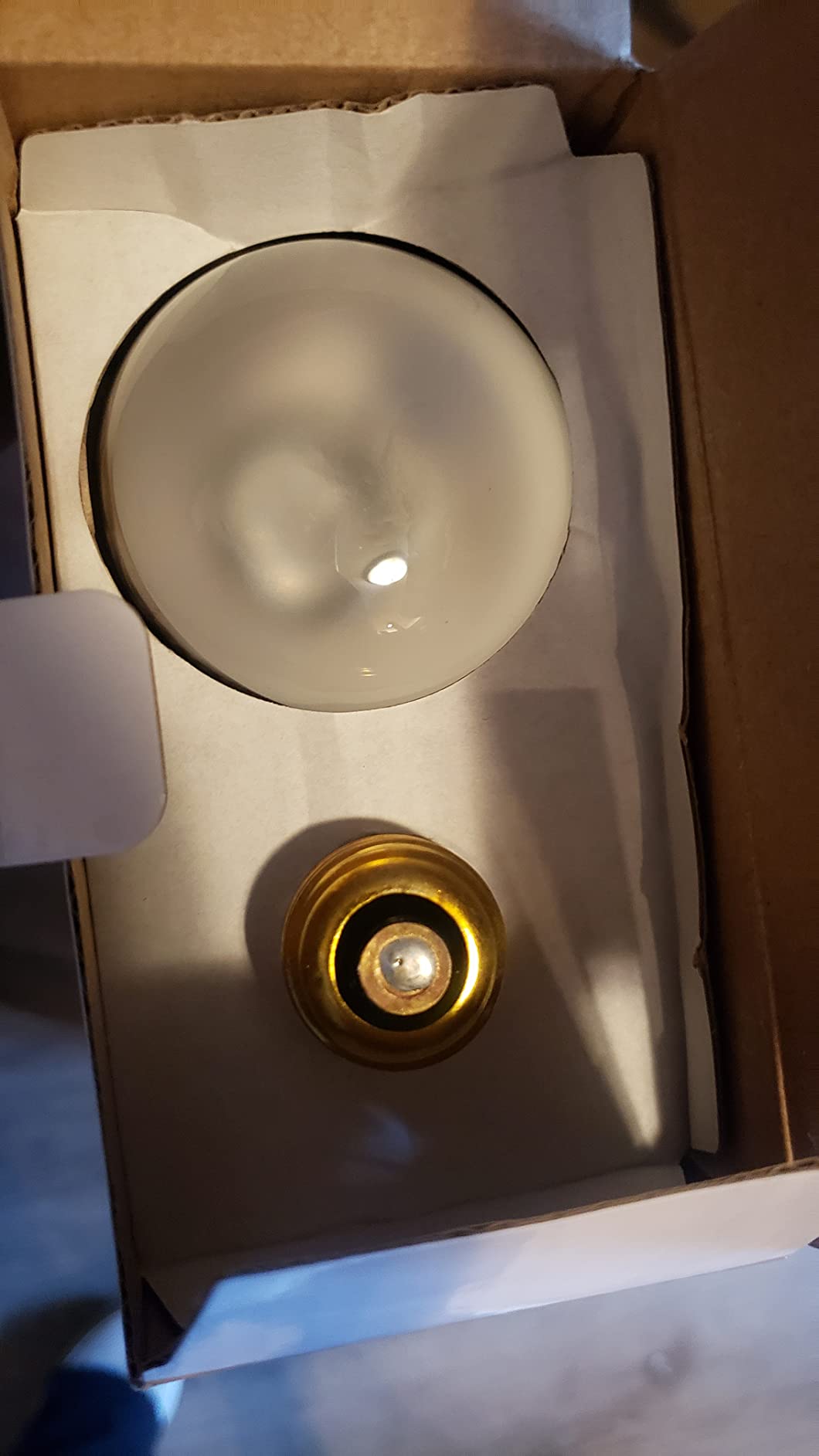
A sensible first configuration
Use the UVA bulb on a timer for your animal’s daylight hours, and the infrared bulb on the thermostat for the rest of the day. That arrangement gives a visible basking period, a warm night period and a real gradient, and it is the setup most keepers arrive at eventually anyway.
For a small enclosure this pair is genuinely convenient because one dome can hold either bulb, so you do not need a second fixture and a second power lead.
Where you will outgrow it
Once you know your species, replace the red bulb with a no-light ceramic emitter. The heat is the same and the photoperiod stays intact, which matters more for nocturnal animals than the glow does.
The 3000-hour rating and three-month replacement window also mean this is a starting kit rather than a long-term answer. Plan on upgrading the night side within a year.
10. ReptiKing 100W Daylight Basking Spot 2-Pack – Best for Small and Juvenile Enclosures

ReptiKing Reptile Heat Bulb Lamp, 2-Pack 100W Daylight Basking Spot, Bearded Dragon/Turtle/Lzard/Gecko Light Bulb, UVA Heat Lamp, Basking Light for Reptiles
100 watt daylight basking
E26 base, 120V
2000 hour service life
2 pack
Pros
- Daylight spectrum supports a realistic light cycle
- Creates a defined basking zone
- Low cost per bulb in a 2 pack
- Easily paired with a night source
Cons
- Daytime light only
- 2000 hour life needs replacement
- Bulbs run very hot to handle
This is the daytime bulb we would put in a 20 to 30 gallon enclosure, and at 4.6 stars across 930 reviews it is one of the better-rated products here despite a much smaller review base. The daylight spectrum is what sets it apart, since it supports a realistic light cycle and breeding condition rather than just producing warmth.
Owners report a clearly defined basking zone, which means hot and cold areas are easy to establish in a compact tank. The 2-pack keeps the per-bulb cost low, which is exactly the calculation most people are making when they are outfitting a smaller enclosure for a juvenile.
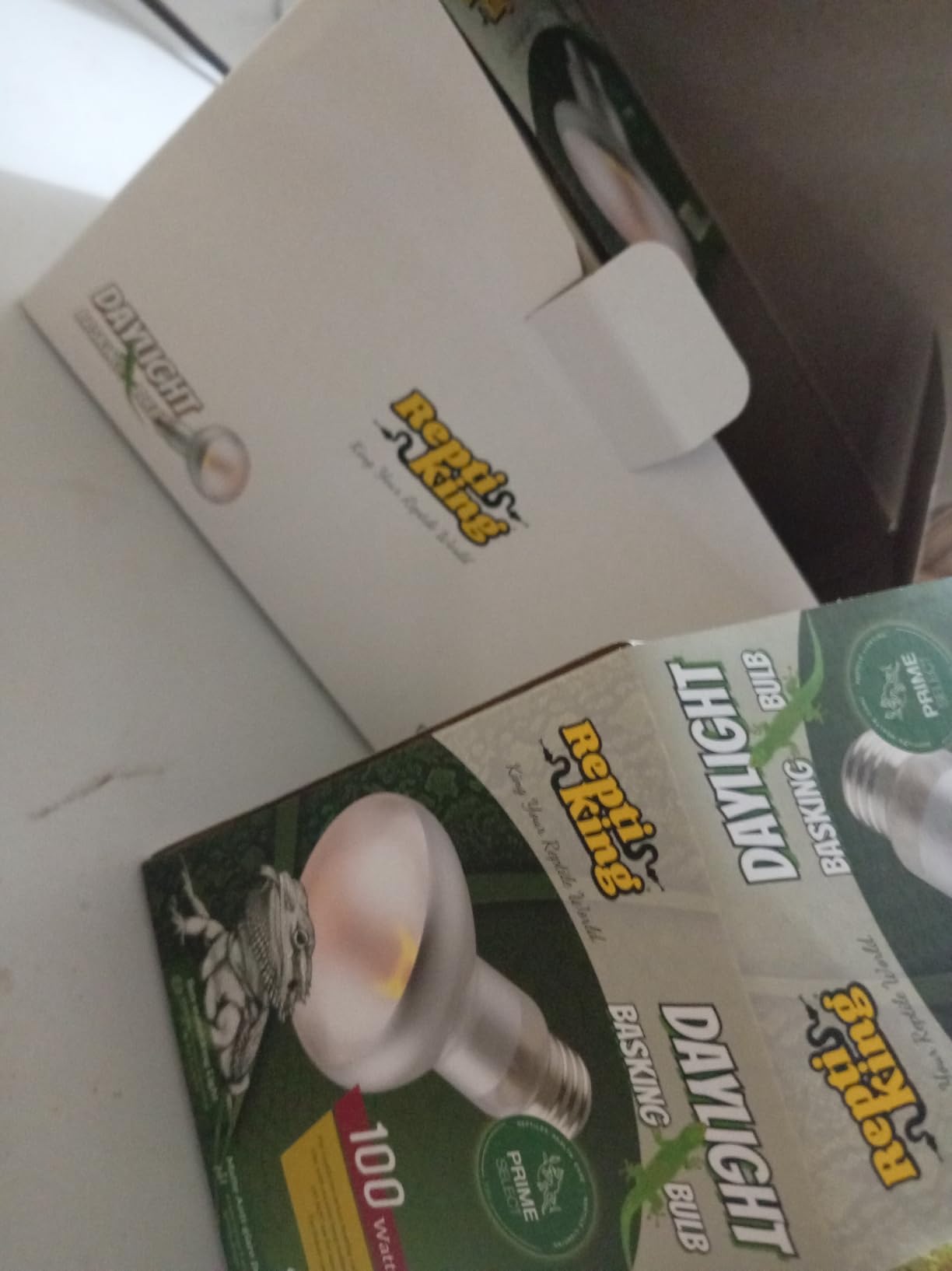
This is the third-generation daylight basking spot from ReptiKing, available in 75W, 100W and 150W. The 100W version is a 120V, 60Hz E26 bulb rated for 2000 hours of service, weighing about 5.9 ounces. The listed species coverage includes bearded dragons, crested geckos, turtles, tortoises, hermit crabs, iguanas and chickens.
The manufacturer notes it can be combined with a night heat lamp or a ceramic emitter for 24-hour heating, which is how we would run it. Bulbs in this category run hot enough that you need a cool-hand method to swap one, and an infrared thermometer is worth having so you are not guessing at the surface temperature.
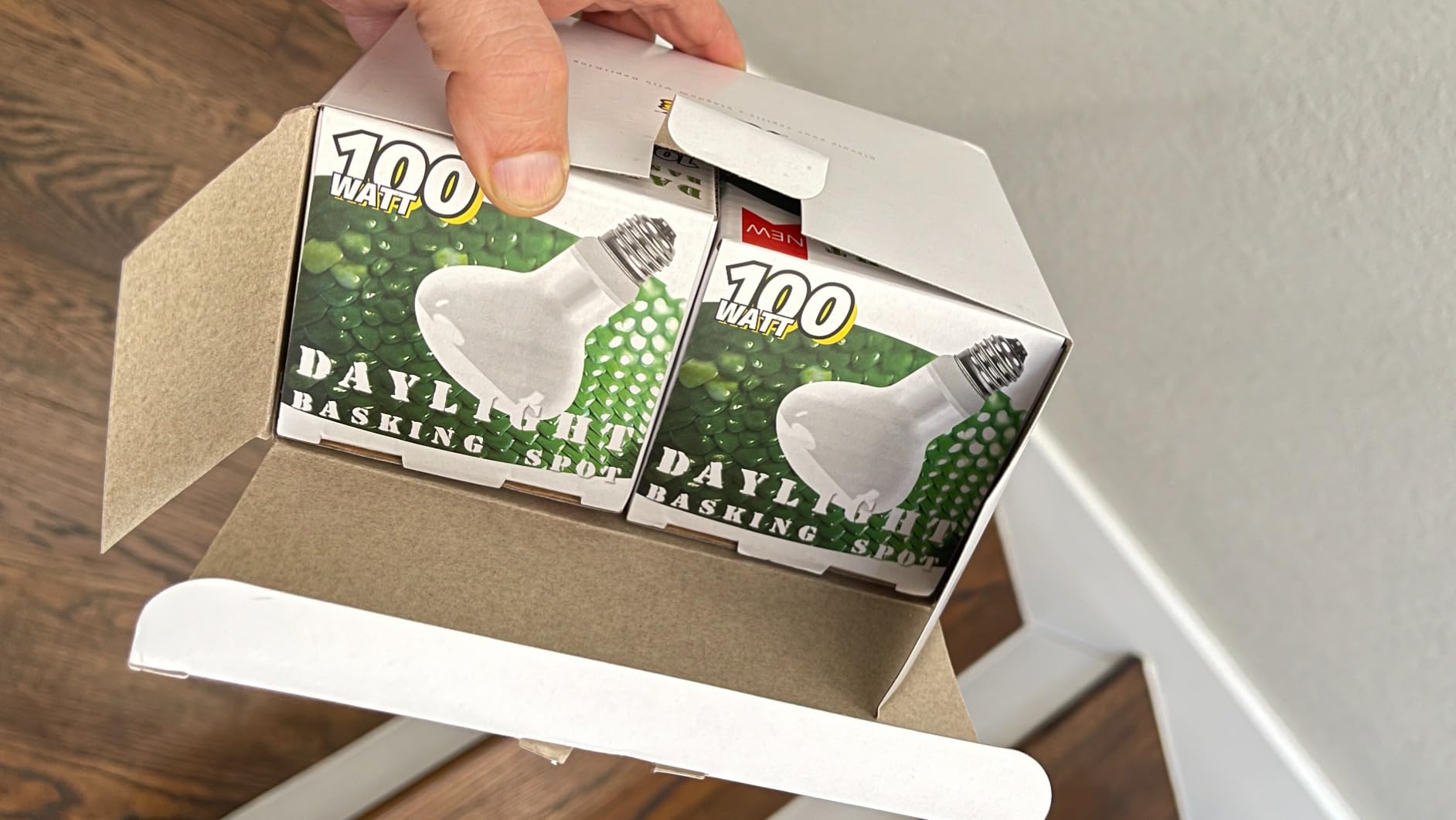
Right sizing for juveniles
Small enclosures heat up fast, and oversizing the bulb is the more common beginner mistake here. A 100W daylight spot in a 20-gallon tank with a screen top will overshoot quickly, which is exactly why it must be on a cycling thermostat rather than a switch.
Because the same range includes 75W, you can start lower for a hatchling and step up as the animal grows. That flexibility is the reason we rate it for juveniles rather than large adults.
What to pair it with
Add a no-light ceramic emitter for overnight warmth and you have the standard two-source configuration. A single daytime bulb is fine for a temporarily warm room, but relying on it alone means your animal never gets true darkness.
Keep the 2000-hour rating in mind and order your spare bulbs in advance. For a small enclosure running on a set daytime schedule, replacements come round faster than people expect.
11. Lachesan 50W Halogen UVA 4-Pack – Best per Bulb for Gentle Heat
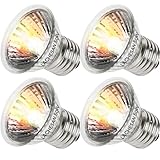
Lachesan 50W Uva Light Bulbs 4-Pack, Turtle Heat Lamp for Reptile
50 watt halogen UVA
2700 Kelvin warm
500 lumens
4 pack, 3000 hours
Pros
- Clean UVA output for metabolism and breeding
- Lowest cost per bulb in the roundup
- ROHS and CE certified
- Fits standard sockets easily
Cons
- 50W is too gentle for large enclosures
- Lifespan drops to about four months on 12 hour use
- Surface too hot to touch while on
Halogen is the more efficient cousin of a standard basking bulb, and this 4-pack is the cheapest way to get genuine UVA into a small enclosure. Owners of turtles, tortoises, geckos and small lizards buy these in repeat, largely because the per-bulb cost is the lowest of anything we reviewed and there is always a spare in the box.
The output is a 2700 Kelvin warm tone at 500 lumens, which is gentler and more focused than a broad incandescent wash. Reviewers note clean UVA output for metabolism, mood and breeding, and the certification markings give some reassurance that this is not the cheapest possible sourcing.
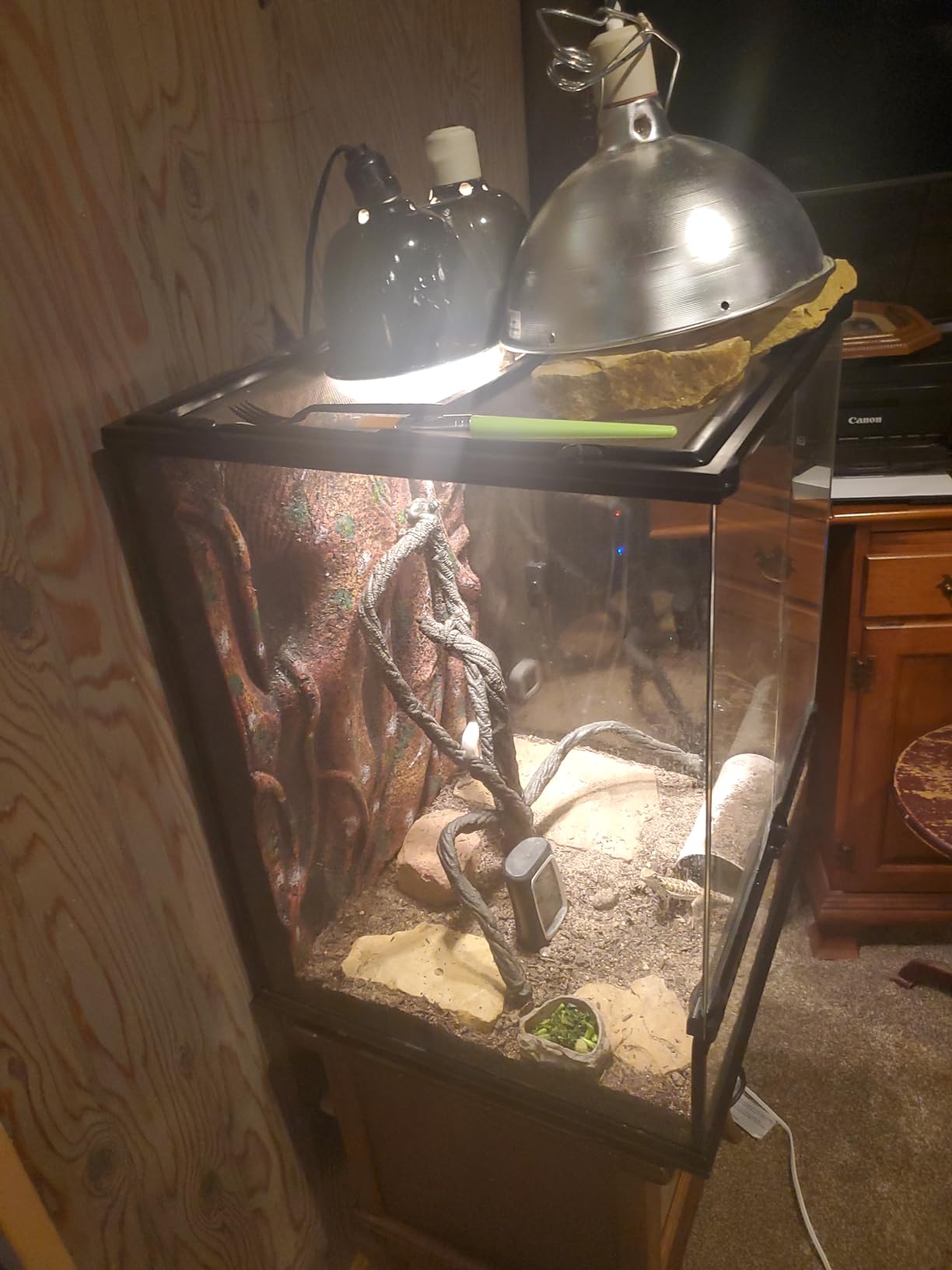
Specs: 50W, 120 volts, E26 base, multifaceted reflector shape in glass, halogen light source, 3000 hours rated life, four bulbs per pack. The listing also notes it is usable for project, garage and plant-growing applications, which tells you the heat output is moderate rather than extreme.
The limiting factor is wattage. At 50W this is gentle heat suited to smaller enclosures, not large adult habitats, and owners report the lifespan falling to roughly four months under a daily 12-hour schedule. The surface runs hot enough that the manufacturer warns against touching the bulb while it is operating.
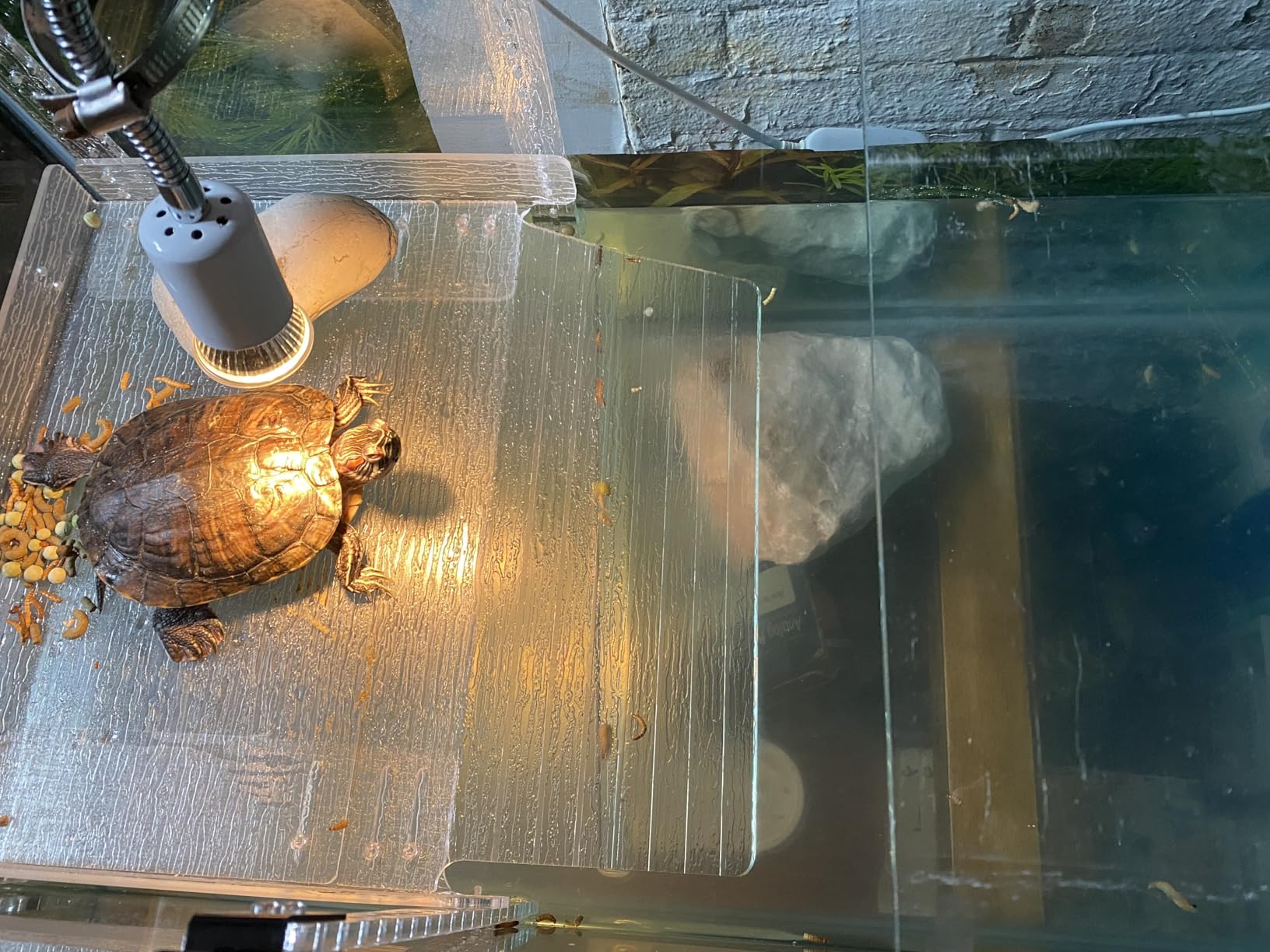
Best for small and mid-size tanks
This bulb earns its place in enclosures where 100W would be excessive. A 10 to 20 gallon tank, a small tortoise table, or a juvenile setup benefits more from a modest, controllable heat source with real UVA than from a large concentrated beam the animal cannot escape.
Because halogen output is efficient for its wattage, a 50W halogen can outperform a 50W incandescent on useful radiant heat, which is the whole reason to choose this category in the first place.
When to choose differently
If you have an adult bearded dragon or a large tortoise enclosure, 50W will not carry the basking surface temperature you need. Look at a 100W or 150W option, or step up to a halogen range with a higher wattage.
Also plan for replacement. The 3000-hour figure sounds generous, but reviewers confirm it drops sharply with daily 12-hour use, so a 4-pack quietly becomes a routine purchase rather than a one-off.
12. DOMICA 150W Ceramic Heat Emitter 2-Pack – Best for Large and Cold-Room Enclosures

DOMICA 150W 2 Pack Reptile Heat Bulb, Beared Dragon Ceramic Heat Emitter, E26 No Light Night Use Heater Bulbs for Turtle, Lizard, Snake, Amphibians, Pet Brooder Coop Chicken (150W-Large Tank)
150 watt ceramic emitter
No light output
E26 base, 110 volts
Withstands 500F
Pros
- No light keeps the photoperiod intact
- Heats faster than traditional bulbs in cool rooms
- High-density ceramic rated to 500F
- Months of reliable heat reported
Cons
- Extremely hot surface and no on indicator
- Requires a fixture rated 150W or higher
- Some buyers report failure within a month
This is the emitter to consider when a 100W unit is not enough, either because the enclosure is large or because the room is genuinely cold. Owners report it heats up faster than traditional bulbs in cool rooms, and the high-density ceramic is rated to withstand temperatures up to 500F without warping, which is the number that tells you this is a serious heat source rather than a light bulb with extra steps.
It emits no light, so overnight use keeps the photoperiod intact, and reviewers report months of reliable heat alongside some non-reptile uses like brooders and crawlspace pipe warmers. The two-pack means you can run one and keep one in reserve, which matters for an element that runs this hot.
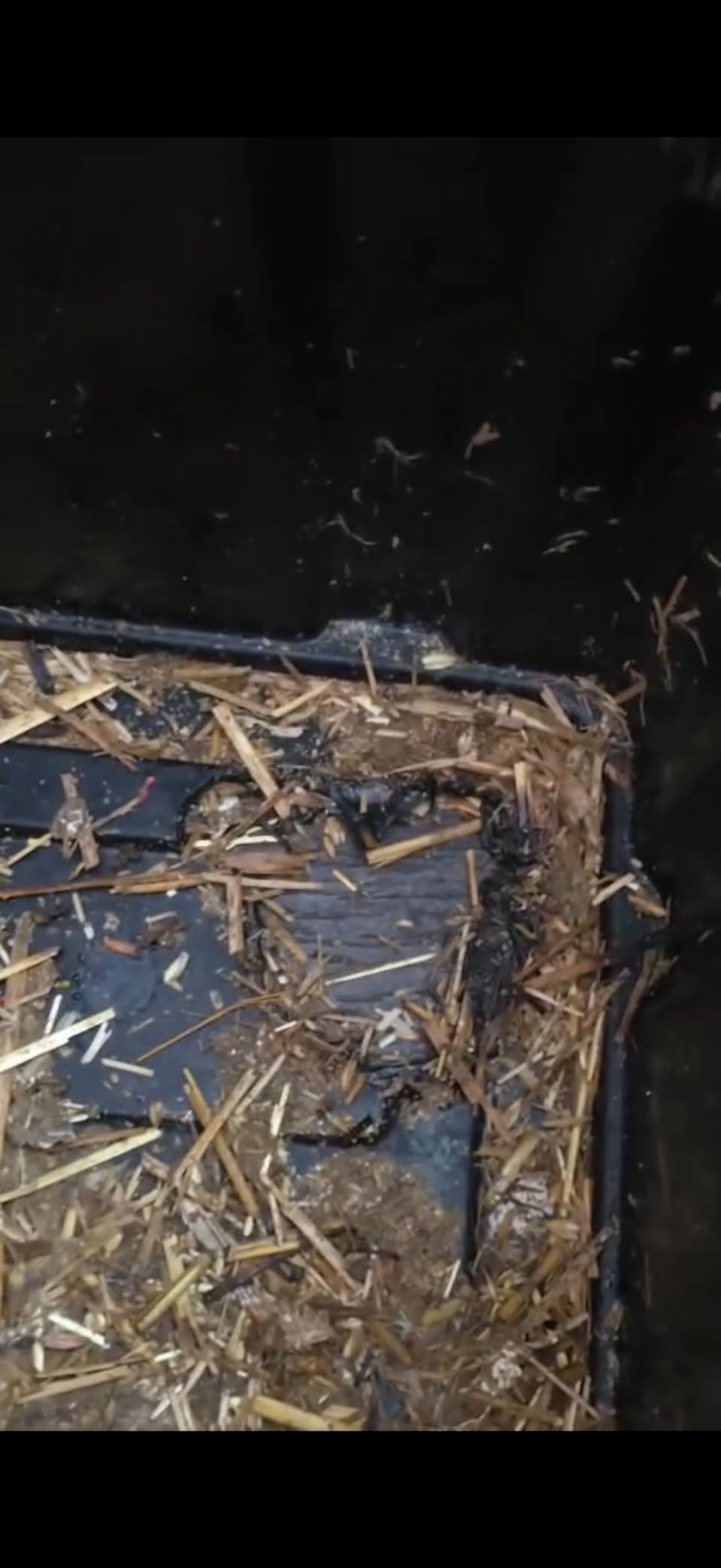
Specs list 150W, 110 to 120 volts, an E26 base, ceramic material, and dimensions of 3 by 3 by 4.3 inches. The unit is also offered in 50W, 75W and 100W, so the range covers small enclosures up to large ones, and the listing is explicit that the fixture must be rated 150W or higher.
Two honest warnings. The surface is extremely hot, so handling it while lit is a burn risk, and there is no visual indicator that the bulb is on – you cannot tell by looking at it. A minority of buyers also report bulbs failing within a month, so test output with a probe as soon as it is installed rather than assuming.
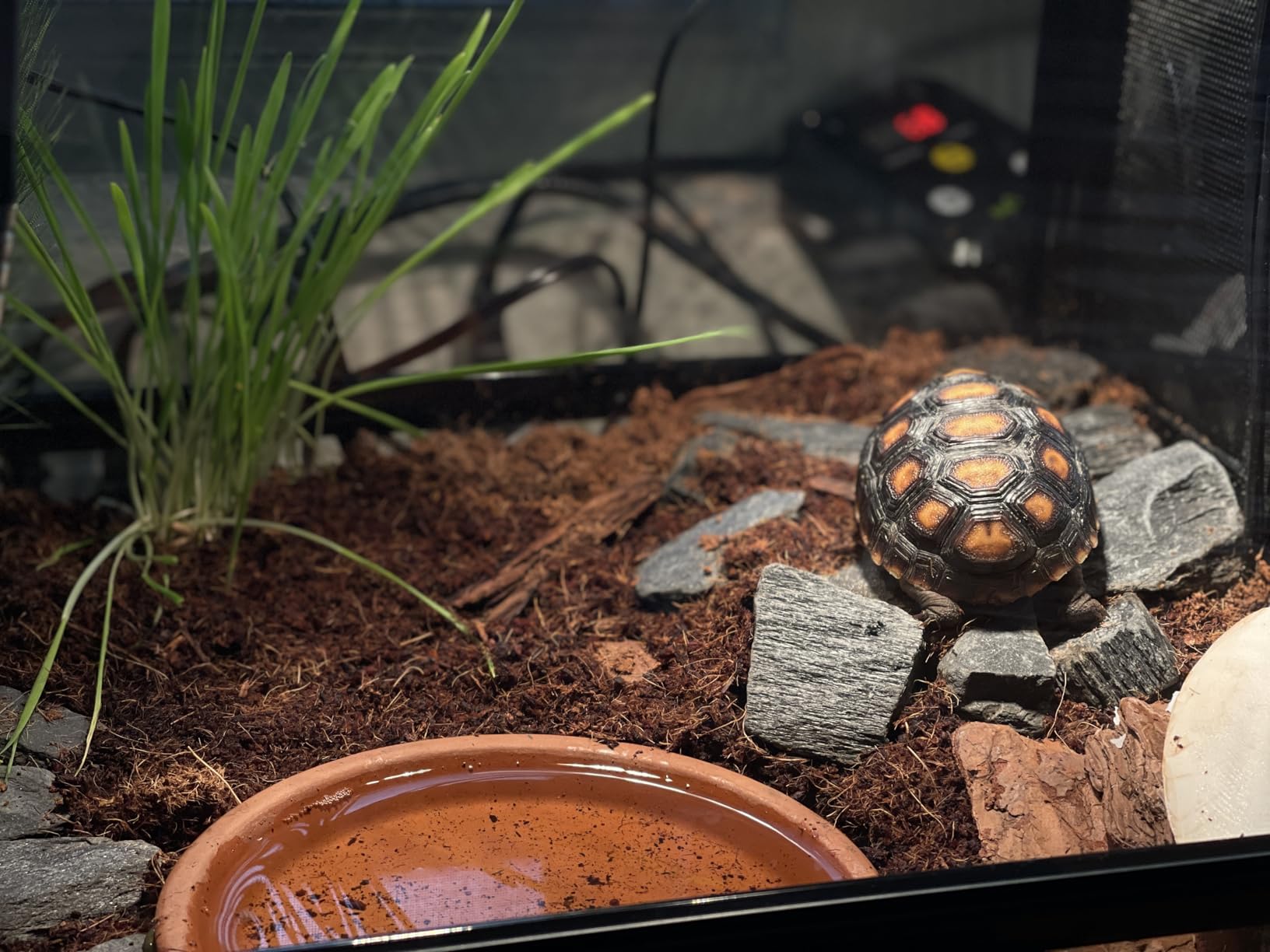
When a high-wattage emitter is justified
Large adult enclosures, screen-topped cages and setups in basements or unheated rooms are where a 150W emitter earns its rating. If a 100W emitter leaves your basking surface short of target in a cold room, stepping up the wattage is the direct fix.
It also works as an ambient source in a large enclosure rather than as a basking spot, since ceramic emitters radiate in all directions. A broad radiant source is often a better fit for a big habitat than a narrow beam the animal could accidentally sit in.
Where caution is required
Skip it in a small enclosure. A 150W no-light emitter in a 20-gallon tank will cook a gradient in minutes and there is no beam to aim away from the animal. Match the wattage to the volume, not to a wishlist.
Adult tortoise keepers should avoid ceramic emitters of this size entirely, because concentrated heat with no airflow is a known shell and carapace risk. For tortoises, broad overhead heating with moving air is the recommended approach.
Heat Lamp Types Explained Before You Buy Anything
Most confusion in this category comes from treating five different products as one category. These are the types you will see in the roundup above, and the honest one-line difference between them.
Incandescent basking bulb. Cheap, ubiquitous, and the reason most keepers already own one. Visible white light, some UVA, a concentrated reflector beam, and a rated life measured in the low thousands of hours. It is a daytime source by definition.
Halogen basking bulb. A more efficient incandescent, meaning more useful radiant heat and cleaner UVA per watt. Brighter, whiter and more focused, with a somewhat longer rated life. Still a daytime source.
Infrared red night bulb. Emits heat with a visible red glow. The compromise option: it gives you overnight heat and lets you watch your animal, but the animal can see wavelengths you cannot, so it is not true darkness.
Ceramic heat emitter (CHE). A solid ceramic element that radiates heat with zero light. Longer rated life than any filament bulb, runs cool to the touch in the sense that it does not emit light, and is the standard no-light source. It is not a deep heat projector – a DHP concentrates heat more directionally, typically with a built-in reflector – but the practical difference in most home enclosures is smaller than the forum debate suggests.
Fixture. A dome or clamp lamp with a ceramic socket, rated for the wattage you intend to use. It is not a heat source itself, but it is the part most likely to fail, and a plastic socket with a ceramic emitter is a genuine fire risk.
What none of these lamps provide is UVB. UVB requires a separate linear or compact fluorescent fixture. Confusion between UVB and heat is one of the most common misconceptions we saw while reading keeper threads, and pairing a basking bulb with a proper UVB tube is the standard complete system experienced keepers describe.
Enclosure Size to Wattage Sizing Guide
Wattage is a starting point, not an answer. The same bulb in a 4-foot canopy cage and a 20-gallon aquarium produces completely different basking temperatures, and room temperature shifts everything. Use this guide to pick a ballpark, then verify with a probe and adjust.
Juvenile snakes, 10 to 20 gallon tanks. Start with a 40 to 75W basking bulb for daytime and a 25 to 50W ceramic emitter if you need overnight heat. Small enclosures heat up faster and overshoot more easily, so a cycling thermostat matters more here than anywhere else.
Adult ball pythons and similar, 40 gallon breeders. A 75 to 100W basking bulb for the visible basking spot plus a 50 to 100W no-light emitter for overnight heat. This is the most common full-size setup in this roundup and the one our top three picks between them cover.
Bearded dragons, 75 to 120 gallon enclosures. A 100 to 150W basking bulb is the usual starting point, and in a cool room or a large enclosure a second source is often needed to hold ambient heat. Keep a close eye on surface temperature at the basking site, since dragons will flatten under a hot spot and stay there.
Leopard geckos and crested geckos, 20 to 40 gallon. A 50 to 75W basking bulb handles daytime, and a 25 to 50W no-light emitter covers the night. Nocturnal species benefit most from a dimming thermostat on the emitter.
Medium and large tortoises. Broad overhead heating is preferred over a concentrated source, and experienced tortoise keepers on tortoiseforum.org warn specifically against ceramic heat emitters for adults because of shell burn and drying risk. This is one area where the popular forum answer genuinely differs from the general advice for other reptiles.
If a bulb will not hold your target temperature, do not immediately jump to a higher wattage. First check the room temperature, then check the distance from bulb to basking surface, and only then increase power. Moving the dome up or down changes the result faster and costs nothing.
The same measurement-first logic applies to the hardware around the enclosure. If you are also planning how you will store, back up or share files from the same setup, our guides to JBOD enclosures for data hoarders, USB4 and Thunderbolt SSD enclosures and DAS enclosures for home editing follow the same approach: compare the real rated specs, then verify the fit in your own workspace before you commit.
Running Cost and Bulb Lifespan
Running cost is easy to estimate per lamp because the wattage is the wattage. At 10 to 12 hours of use per day, a 100W lamp burns roughly 1 kilowatt-hour a day, so monthly consumption lands somewhere around 30 kilowatt-hours per lamp. Multiply by your local electricity rate and then by the number of fixtures you run.
That makes the operating-cost ranking simple: a 50W halogen or a 25 to 50W emitter costs roughly half what a 150W emitter costs to run each month, and a 100W basking bulb sits in the middle. On a four-foot enclosure running two sources on a twelve-hour photoperiod, halving the second source’s wattage is the single easiest saving available to you.
Lifespan matters as much as electricity, because replacements are a recurring cost too. Halogen bulbs in this group are rated around 3000 hours, standard basking bulbs around 2000 to 3000 hours, and ceramic heat emitters up to 10000 hours. At a 12-hour photoperiod, a 2000-hour filament bulb realistically needs replacing every few months, and reviewers across several of these products confirm early failures make that shorter rather than longer.
The practical takeaway is that a slightly higher-priced emitter is usually cheaper over a year than repeatedly replacing filament bulbs, even before electricity. The red bulbs in this roundup were the exception, with owners reporting service beyond their 3000-hour rating, though the reviewers most disappointed with them were those who found early failures in the first few months.
Store spare bulbs somewhere cool and dry and never in the fixture, and never handle a halogen bulb with bare fingers while it is running. Oil from your skin creates a hot spot on the glass that shortens life.
Safety First: Thermostats, Ceramic Sockets and Burn Risk
Before any product list, the single most important rule: no heat source in a reptile enclosure runs without a thermostat. This is the most consistent point across every keeper forum we read, and it is the one thing we would refuse to compromise on. A dimming thermostat gives finer control than an on/off cycling model, and is what most experienced DHP and CHE users recommend.
Match the fixture to the emitter. Ceramic heat emitters and high-wattage basking bulbs require a ceramic socket and a fixture rated for at least the bulb’s wattage. Plastic sockets and multi-socket fixtures are the most common source of melted housings in keeper forums, and no amount of careful monitoring makes them safe with a 150W ceramic element.
Respect clearance distances. The manufacturers in this roundup specify a minimum of 30 cm from the animal for both the 100W ceramic emitter and the 100W basking spot. That number exists because concentrated radiant heat causes contact burns on skin and shell, and reptiles are drawn to warm surfaces precisely because they are warm.
Use a guard or a dome where an animal can reach the fixture. A bulb that an animal can chew or climb into is a burn waiting to happen, and tortoises in particular will settle against a warm surface for hours.
Monitor with two tools. A probe thermometer on the warm side tells you what the thermostat is actually holding, and an infrared thermometer lets you check surface temperature under the basking site, which is the number your animal actually experiences. Air temperature at bulb height reads several degrees higher than the surface.
Finally, remember that these lamps are radiant heat sources, not UVB. Pair a basking bulb with a separate UVB fixture for diurnal species, and if you are unsure about a species’ requirements, check a care sheet or ask a reptile vet before committing to a setup.
How to Verify Your Temperature Gradient
Trusting a wattage number without measuring is the most common reason keepers end up with a lamp they think is broken. A simple four-step check takes ten minutes and tells you immediately whether your setup works.
Place a probe thermometer on the warm side at the animal’s basking height, not at the top of the enclosure. Run the setup for a full day, including the overnight period, because a lamp that hits the right temperature at midday can fall well below target at 3am with no night source at all.
Then check the cool side. A usable gradient for most species means a hot basking zone and a cool hide that is several degrees lower, with enough space for the animal to choose. If the cool side is only two degrees down, your heat source is too spread out or too weak for the enclosure size.
Finally, measure the basking surface with an infrared thermometer. This is the reading that predicts whether your animal will actually bask and digest food properly, and it is routinely different from both the air temperature and the probe reading.
If the numbers do not match your targets, adjust distance before wattage. Raising or lowering the dome changes the surface reading more per centimetre than upgrading a bulb, and it costs nothing.
Frequently Asked Questions
What is the best heat lamp for a reptile terrarium?
The best heat lamp depends on whether your animal basks in visible light. Diurnal species such as bearded dragons and turtles do best with a bright basking bulb paired with a separate UVB fixture, and nocturnal species such as ball pythons and leopard geckos do best with a ceramic heat emitter that emits no light at all. In both cases the lamp must run on a thermostat.
What is the safest heat lamp for reptiles?
The safest setups share three traits: a thermostat on every heat source, a fixture with a ceramic socket rated for the bulb wattage, and a guard or dome the animal cannot reach. Ceramic heat emitters also need the manufacturer recommended clearance of at least 30 cm. A no-light ceramic emitter on a dimming thermostat is generally the gentlest option for nocturnal species.
What is the difference between a basking lamp and a heat lamp?
A basking lamp is a visible light source: it produces white light, some UVA and a concentrated heat beam, and it is meant to run during the day only. A heat lamp in the narrower sense is a no-light source such as a ceramic heat emitter, which radiates heat without emitting visible light and can run continuously. Most keepers use one of each.
What wattage heat lamp do I need for my reptile?
As a starting point, a 20 gallon tank usually needs 40 to 75W for daytime heat, a 40 gallon breeder usually needs 75 to 100W plus a 50 to 100W no-light emitter, and a 75 to 120 gallon bearded dragon enclosure usually needs 100 to 150W plus a second ambient source. Wattage alone does not determine temperature – enclosure size, distance and room temperature all matter.
Is there a difference between a basking bulb and a heat bulb?
Yes. A basking bulb is designed to produce a bright, visible, concentrated spot where the animal sits and warms itself, usually with some UVA included. A no-light heat bulb, such as a ceramic heat emitter, produces only radiant heat and no visible light. Basking bulbs are for daytime and cannot be used overnight without disrupting the animal’s photoperiod.
What basking bulb should I get for my bearded dragon?
A 100W to 150W basking bulb with a focused beam is the usual choice for an adult bearded dragon in a 75 gallon or larger enclosure, mounted high enough to reach the target surface temperature but out of reach. Pair it with a separate UVB fixture, since a basking bulb does not provide UVB, and use a thermostat rather than a switch.
Is it safe to leave a reptile heat lamp on all day?
A no-light ceramic heat emitter can safely run continuously on a thermostat, and running one overnight with the visible basking bulb switched off gives a natural day and night cycle. A visible basking bulb left on 24 hours a day removes darkness from the cycle, which can disrupt rest and breeding behaviour, so it belongs on a timer during daylight hours only.
Is 2 basking bulbs too much for a beardie?
Two basking bulbs are not inherently wrong, but 200W of concentrated basking heat in one enclosure can remove the cool side entirely and leave a bearded dragon nowhere to move to. Run both on a thermostat, place them to cover separate areas rather than doubling down on one spot, and verify with a probe that a usable temperature gradient still exists.
How much does it cost to run a heat lamp for a reptile?
A 100W lamp run 12 hours a day uses roughly 1 kilowatt-hour a day, or about 30 kilowatt-hours a month. A 50W source costs roughly half that and a 150W source roughly 1.5 times as much. Running two sources for twelve hours is the usual setup, so calculate the total for both lamps and multiply by your local electricity rate.
Final Verdict
The best heat lamps for reptile enclosures come down to one question: does your animal need to see light to be warm? If yes, start with the Fluker’s 100W basking spotlight or the brighter LUCKY HERP 100W for larger enclosures. If no, run a no-light ceramic emitter and keep the daylight cycle intact.
Whichever you choose, pair a daytime basking bulb with a separate UVB fixture and a no-light emitter on a thermostat, then measure the gradient before you trust any wattage figure. If you want a similar approach to picking gear by measurement rather than guesswork, our guides to heat guns and portable storage enclosures follow the same method: compare the real specs, then verify in your own setup.