
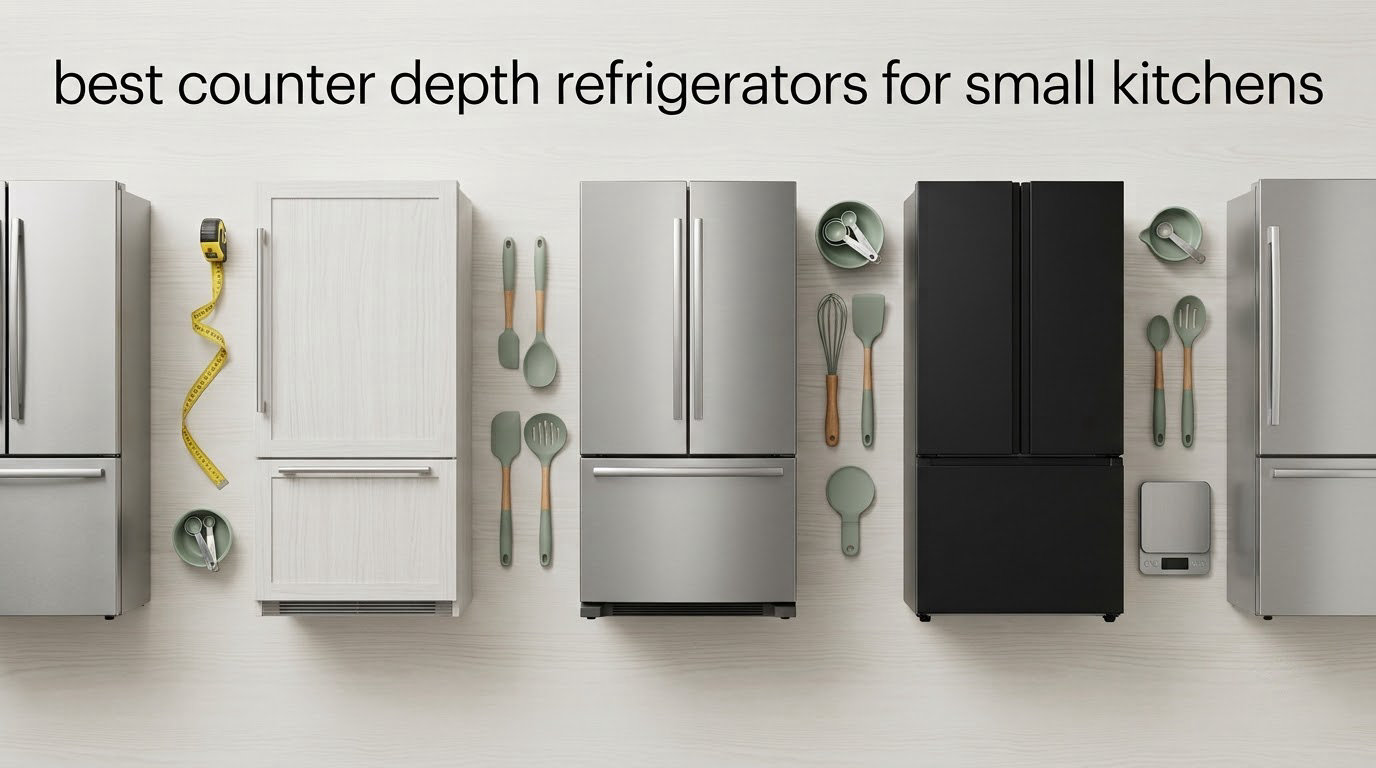
The best counter depth refrigerator for most small kitchens we reviewed is the KoolMore KM-RERFDSS-18C, a 30-inch-wide French door with an 18.5 cu. ft. interior, a 30.1-inch body and a compressor that owners rarely complain about. It costs you roughly 10 to 20 percent less usable space than a standard-depth fridge of the same width, and in a galley kitchen or a small apartment that trade is usually worth making.
We went through nine counter-depth models, pulled the published dimensions for each one, and weighed them against the fit problems small kitchens actually produce: a fridge that sticks past the counter, doors that cannot open because a wall is in the way, and ice makers that turn into repair bills. Every pick below lists its real cabinet width, total depth, capacity, and energy use so you can measure your opening before you fall for a capacity number.
Two things came out of the exercise that most appliance pages skip. First, a counter-depth cabinet buys back only 2 to 4 inches of walkway compared with a standard-depth model, so the look is often the real payoff rather than the floor space. Second, the advertised cubic footage hides a lot, because the shelves are shallower and a gallon jug can no longer slide past the crisper drawers. We spell that out for each model below.
Table of Contents
What Is a Counter-Depth Refrigerator?
Counter depth means the refrigerator cabinet, measured excluding handles, is shallow enough to sit nearly flush with standard kitchen counters, which are about 25 inches deep. True counter-depth units fall in the 23-to-30-inch range, and that shallower box is what gives you the built-in look and the few extra inches of walkway in a tight room.
There is a second category that confuses buyers. A nearly counter depth model has a cabinet close to flush but doors that sit proud of the countertop once the handles are added. If the goal is a clean cabinet line, check the total depth including handles, not the cabinet number on the spec sheet. In the lineup below, total depths with handles range from 25.04 inches to 31.25 inches.
The other definition worth memorizing is the capacity penalty. Because a shallower cabinet has less shelf depth, a counter-depth refrigerator holds roughly 10 to 20 percent less food than a standard-depth model of the same width. The number on the door does not reflect that loss, so measure a week of groceries against the actual shelf opening before you commit.
Top 3 Counter-Depth Picks for Small Kitchens (October 2026)
These three cover the most common small-kitchen situations: a balanced French door, a high-capacity French door with an ice maker, and the shallowest cabinet in the group.

KoolMore 18.5 cu. ft. French Door
- 30.1 in. counter-depth body
- 18.5 cu. ft. total
- Quiet inverter compressor
- ENERGY STAR at 465 kWh

GE 22.1 cu. ft. French Door
- 31.25 in. depth
- 22.1 cu. ft. total
- Space-saving ice maker
- Showcase LED lighting

Hamilton Beach 15.6 cu. ft. Side-by-Side
- 25.04 in. shallowest body
- Side-by-side storage
- Digital temperature control
- Slide-out shelves
All Nine Counter-Depth Picks at a Glance in 2026
Every model here is a genuine counter-depth cabinet, so the depth column is the number to compare against your opening. Features are drawn from the manufacturer listings for each unit.
| Product | Specs | Action |
|---|---|---|
| KoolMore 30 in. 18.5 cu. ft. French Door |
|
Check Latest Price |
 Bosch 800 Series 20.5 cu. ft. Four-Door Bosch 800 Series 20.5 cu. ft. Four-Door |
|
Check Latest Price |
| Hamilton Beach 15.6 cu. ft. Side-by-Side |
|
Check Latest Price |
 Hamilton Beach 17.7 cu. ft. French Door Hamilton Beach 17.7 cu. ft. French Door |
|
Check Latest Price |
 Samsung 17.5 cu. ft. Smart 3-Door Samsung 17.5 cu. ft. Smart 3-Door |
|
Check Latest Price |
| GE 22.1 cu. ft. Counter-Depth French Door |
|
Check Latest Price |
 GE Profile 23.1 cu. ft. French Door GE Profile 23.1 cu. ft. French Door |
|
Check Latest Price |
 GE 18.6 cu. ft. Counter-Depth French Door GE 18.6 cu. ft. Counter-Depth French Door |
|
Check Latest Price |
 Kenmore 30 in. 17.5 cu. ft. French Door Kenmore 30 in. 17.5 cu. ft. French Door |
|
Check Latest Price |
How to Measure Your Kitchen Before You Buy
Almost every sizing mistake we see in small kitchens comes from measuring the wrong number. The cabinet width on a spec sheet is not the number that decides whether the fridge fits, and neither is the cabinet depth. Here is what to measure and what to compare it against.
Measure the opening width at three heights. Base cabinets are rarely perfectly square, so take the narrowest point at the floor, the middle and the top. Add a quarter inch per side for leveling and hinge clearance, and check for a baseboard that eats into the opening. A 30-inch-wide opening with a recessed toe kick can be closer to 29 inches of usable space.
Check total depth including handles against your counters. Standard counters are about 25 inches deep. Anything in the 25.04-to-26-inch range lines up almost perfectly, which is exactly what the Hamilton Beach HBF1558 side-by-side delivers at 25.04 inches. From 30 inches onward you are accepting doors that sit proud of the counter, which is the deal most 36-inch French door models make.
Budget for door swing, not just depth. A French door needs clearance on both sides plus the arc of each door. The two GE 36-inch models in this group list a maximum depth with doors open of 43.37 inches, and the 18.6 cu. ft. GE lists 46 inches. If your fridge faces a wall, an island or a peninsula, measure the gap from the closed door face to the obstacle. Anything under 40 inches will stop a French door from opening past 90 degrees.
Leave ventilation room. Manufacturers specify clearance at the top and rear for airflow. Give a couple of inches behind and above unless the model is rated for a tight recess, and do not push the back of the fridge flush into the wall. Restricted airflow raises compressor run time, and that shows up in your energy bill and in the noise the compressor makes at 2 a.m.
Locate the outlet and the water line before purchase. Power goes to the back lower corner, and a through-the-door or internal dispenser needs a supply line within reach of that corner. If your water line sits in the wall cavity behind the opening, a new cabinet back or a shorter braided line may be needed. That conversion is trivial in a condo and annoying in a finished galley kitchen.
Check the route to the kitchen. The two heaviest picks here weigh 350 pounds and 333 pounds, and a body that size usually needs a second person on the move. Measure your doorways, stair turns and hallway corners before the day arrives, because a 36-inch body through a 32-inch hall is where good measurements stop helping.
1. KoolMore 30-Inch 18.5 cu. ft. Counter-Depth French Door – Best Overall Pick
KoolMore 30-Inch and 18.5 cu. ft. Counter Depth French Door Refrigerator with Three Doors and Deep Freezer in Stainless-Steel (KM-RERFDSS-18C)
18.5 cu. ft.
30.1 in. D x 29.5 in. W x 66.6 in. H
465 kWh per year
ENERGY STAR
1-year warranty
Pros
- 30.1 in. counter-depth body with a built-in look
- 18.5 cu. ft. total with a roomy 5.58 cu. ft. freezer
- Adjustable glass shelves and gallon jugs fit in the door bins
- Quiet inverter compressor that owners rarely complain about
- Door-open alarm included
Cons
- Recessed handles that let the stainless finish show fingerprints
- Interior LED lighting is dimmer than some owners want
- No dedicated cheese drawer
This is the model we would put in a small kitchen without hesitating. We spent the most time on the KoolMore KM-RERFDSS-18C out of the nine, and the reason is simple: it is the unit in the group where owner feedback is most consistently positive about the thing small kitchens care most about, which is noise. The inverter compressor settles instead of kicking on and off, and in a galley layout or an open-plan apartment that difference is audible every single night.
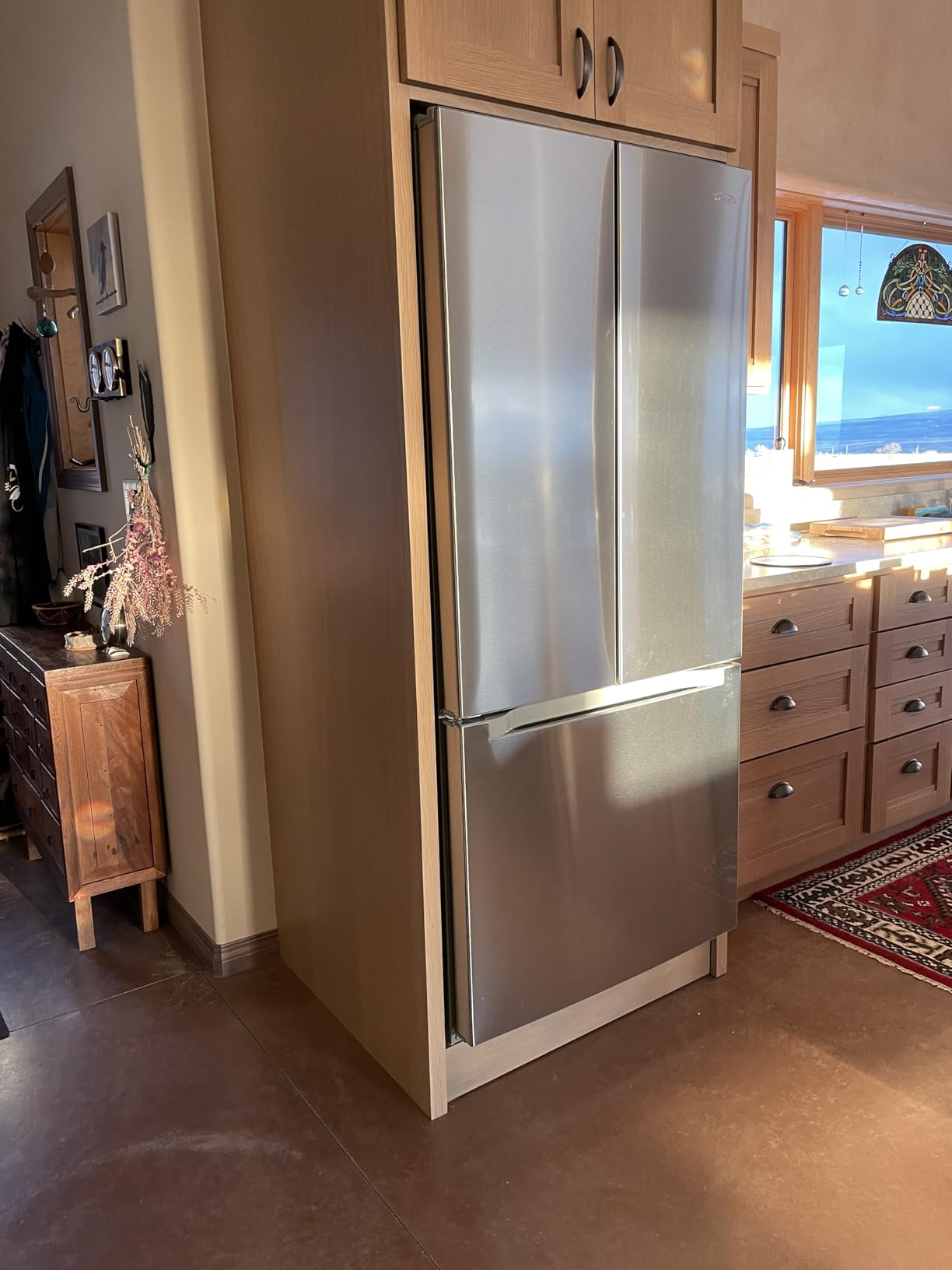
The physical numbers back up the styling pitch. The cabinet measures 30.1 inches deep by 29.5 inches wide by 66.6 inches tall, which is short enough for many low soffits and narrow enough for a standard 30-inch opening. Capacity is 18.5 cu. ft., split into 5.58 cu. ft. of freezer and the rest as fresh food space, and the unit weighs 180 pounds, which is light enough for a two-person delivery.
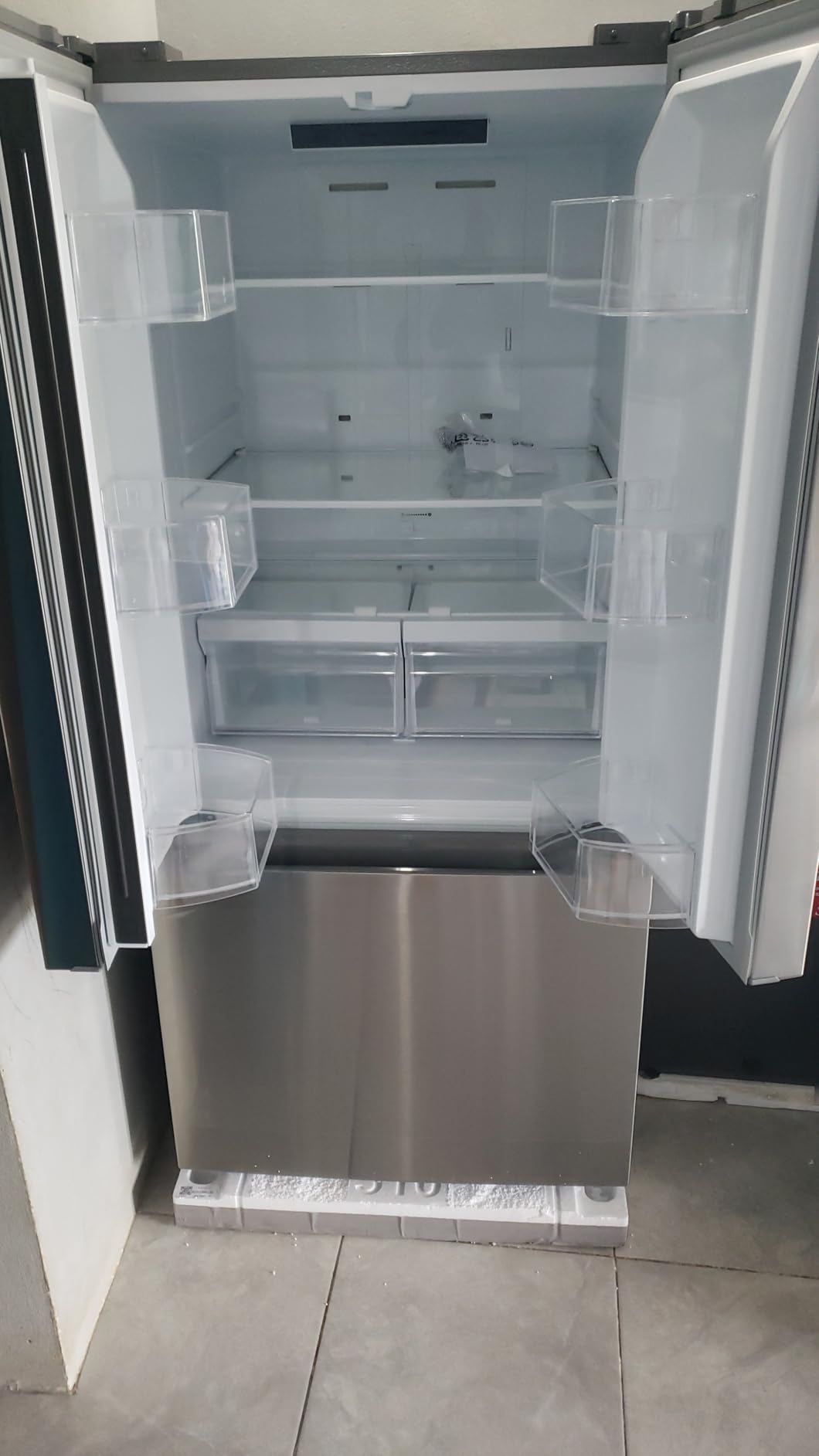
Two design choices will matter more to you than the capacity figure. The doors are flat stainless steel with recessed handles, so the fridge reads as a built-in panel when it sits next to matching cabinetry. That also means the handles pick up fingerprints, and owners who are fussy about stainless will wipe it down more often than a matte or fingerprint-resistant finish would require.
Inside, you get six door bins, two adjustable glass shelves, humidity control and a door-open alarm, and gallon jugs fit in the bins without a fight. Annual energy consumption is listed at 465 kilowatt hours, and the unit is ENERGY STAR certified with a 4-star BEE rating. The warranty is 1-year parts and labor, which is the weakest part of an otherwise strong package.
Will 18.5 cu. ft. Hold a Week of Groceries?
For one to three people, yes, with room to spare. Owners of counter-depth French doors in this range consistently report that the interior feels larger than the published number suggests, and that a weekly shop plus a freezer drawer of extras fits comfortably. For a household of five that shops twice a week, plan on a separate chest freezer or expect a second trip to the store.
Where This Pick Falls Short
The interior lighting is dim enough that several owners mention it, so if you dig for things in the back corners at night, expect to use the door bins more than the shelves. There is also no dedicated cheese drawer, so that block ends up on a shelf or in a bin. Neither issue affects food safety or daily usability.
2. Bosch 800 Series 20.5 cu. ft. Four-Door French Door – Best Four-Zone Organization
Bosch 800 Series B36CL80SNS 36 Inch Smart Freestanding Counter Depth 4 Door French Door Refrigerator with 20.5 cu. ft. Total Capacity in Stainless Steel (Bar Handle)
20.5 cu. ft.
31.13 in. D x 35.63 in. W x 72 in. H
350 pounds
ENERGY STAR
Inverter compressor
Pros
- Four separate doors divide fresh food and freezer storage
- 20.5 cu. ft. inside a counter-depth cabinet
- FlexBar removable storage rail adds adjustable space
- Internal water dispenser
- Stainless finish with bar handles
Cons
- 35.63 in. wide
- so it needs a 36-inch class opening
- 350 pounds makes installation a two-person job
- Very few owner reviews for long-term reliability
- Key lock rather than electronic control
The Bosch B36CL80SNS is the one pick here that competes on organization rather than on footprint. Four doors split the 20.5 cu. ft. interior into separate zones, so produce, deli items and frozen goods each get their own compartment instead of sharing one wide French door cavity. Owners who like to see everything at once tend to prefer this layout, and the bar handles give it an appliance-forward look rather than a built-in one.
The cabinet measures 31.13 inches deep by 35.63 inches wide by 72 inches tall, and at 72 inches it is the tallest refrigerator in this group. That height can be a real problem under a dropped ceiling or in an older apartment where the opening is 70 inches. Plan on a 36-inch-wide niche and check the ceiling clearance before you order.
Specs are strong where it counts. There is a FlexBar removable storage rail, an internal water dispenser, a rotary compressor with inverter drive, R-600A refrigerant, and an ENERGY STAR listing with a 4-star BEE rating. Automatic defrost handles the freezer, and there are four door shelves across five storage sections.
The trade-offs are physical rather than electronic. At 350 pounds this is the heaviest unit we looked at, so door removal and placement are a two-person job even with a dolly. And with only a handful of owner reviews on record, we would treat long-term reliability as unproven rather than settled. A key lock on the fresh food compartment is also old-fashioned next to the electronic locks most buyers now expect.
Is 31 Inches Deep Enough to Look Built-In?
Only partly. The cabinet is close to flush, but bar handles and a 35.63-inch width push the doors well past a 25-inch counter face. If your goal is a clean cabinet line, this is not the model. If your goal is capacity and zoned storage in a 36-inch opening, it delivers more than 20 cu. ft. in a counter-depth body, which is hard to find.
Who Should Look Elsewhere
Skip this one for a galley kitchen under 36 inches wide or any room with a low soffit. Anyone buying on a tight budget should also look elsewhere, since this is the most expensive unit in the group. The review volume is thin, so if long-term dependability is your top priority, a model with a larger body of owner reports is a safer bet.
3. Hamilton Beach 15.6 cu. ft. Side-by-Side – Best Value and Shallowest Cabinet
Hamilton Beach HBF1558 15.6 cu ft Counter Depth Full Size Refrigerator, Side Doors, Stainless
15.6 cu. ft.
25.04 in. D x 32.91 in. W x 70.08 in. H
378 kWh per year
Not ENERGY STAR listed
1-year warranty
Pros
- 25.04 in. body lines up almost perfectly with 25 in. counters
- Slide-out shelves reposition to fit taller items
- Digital temperature control
- Adjustable door-open alarm and bright interior lighting
- Attractive stainless finish that suits a value fridge
Cons
- Smaller capacity than standard-depth models of the same width
- Some listing photos imply an ice maker the unit does not have
- 1-year warranty only
- Occasional reports of units arriving dented
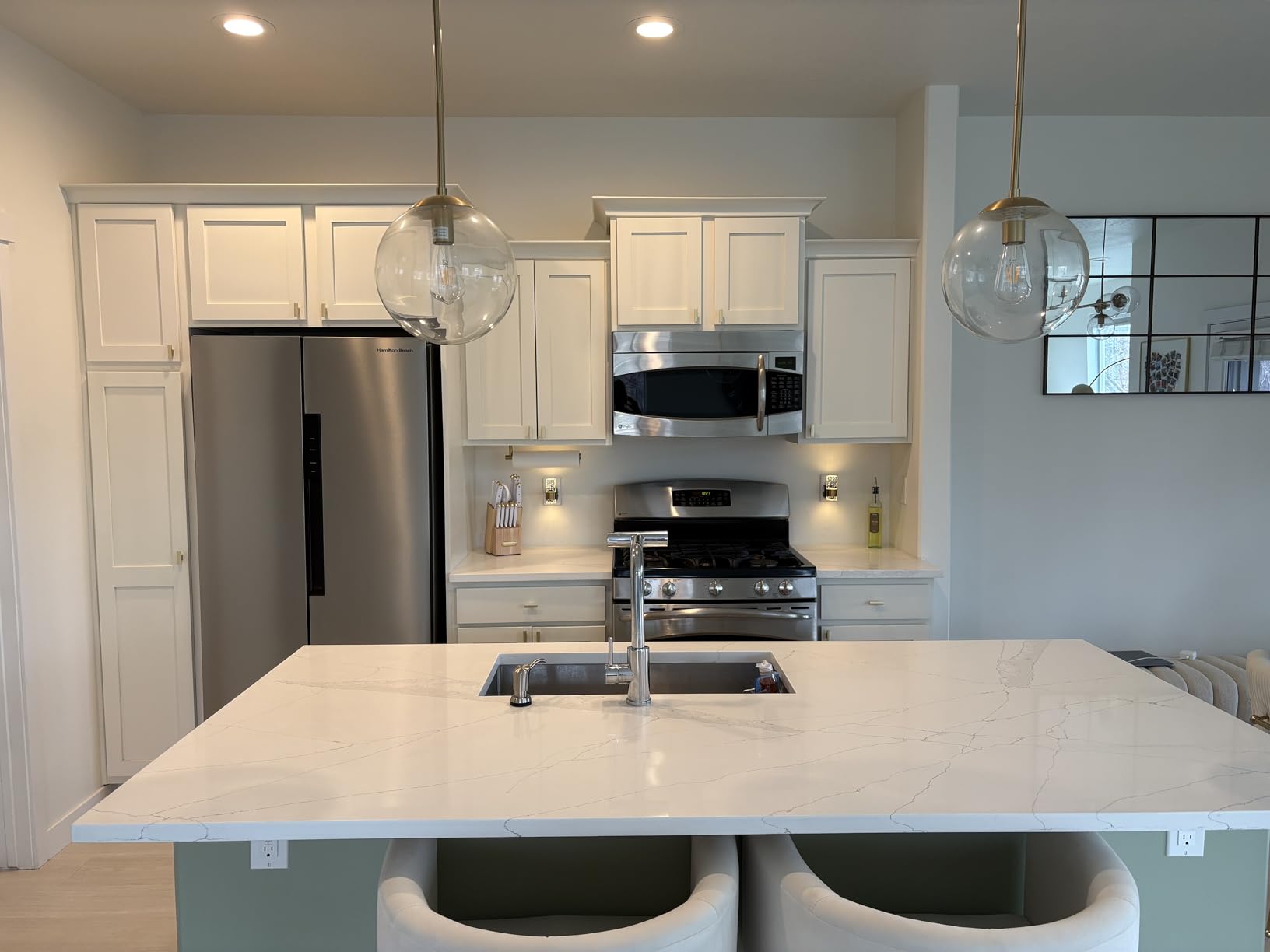
If your counters are 25 inches deep and you want the fridge to disappear into the cabinet line, this is the shallowest cabinet in the group at 25.04 inches, and no other model in our nine comes close. Owners in galley layouts specifically call out how much traffic space the profile gives back.
Capacity is 15.6 cu. ft., split into 9.54 cu. ft. of fresh food and 6.08 cu. ft. of freezer, a split that gives the freezer more room than most side-by-side layouts allow. The doors let you organize chilled and frozen items separately, and the oversized gallon-size door bins take bottles without blocking a shelf.
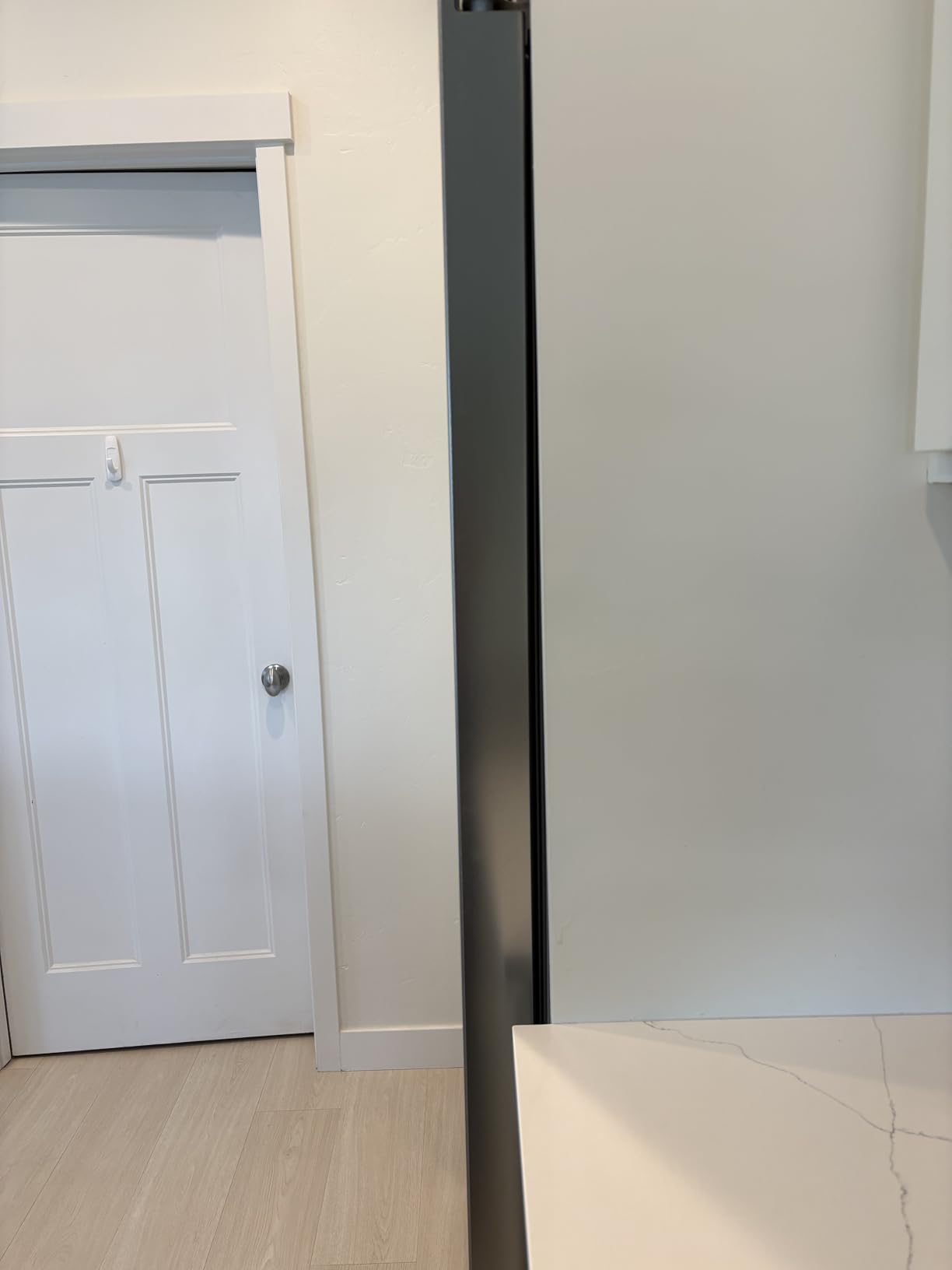
Feature-wise it is plainer than the French doors. You get slide-out shelves you can remove or reposition, a digital temperature control panel mounted inside the refrigerator door, an adjustable door-open alarm, interior lighting in both compartments and adjustable feet. Energy use is listed at 378 kilowatt hours per year, tied for the lowest figure in this group. The unit runs on 110 volts with automatic frost-free defrost.
Now the honest part. This model is not ENERGY STAR certified, and the warranty is a single year on a purchase you expect to keep for a decade. At least one owner reported a cooling failure after roughly 18 months, and there are recurring comments about units arriving with dents. Several buyers also note that the listing photos imply an ice maker that the unit does not include, so do not plan on ice from this fridge.
How Much Space Do You Give Up at 15.6 cu. ft.?
More than the number suggests, because the freezer takes 6.08 cu. ft. of the total. For two people who cook most nights, that is a good split. For a family of four, the fresh food side will feel tight within a couple of weeks, and owners in that situation often pair this fridge with a separate chest freezer rather than shop more often.
What to Check Before You Order
Confirm the width first, since 32.91 inches is wider than the 30-inch units in this list and will not fit a 30-inch opening. Then confirm that no water line or outlet sits behind the future location, because there is no dispenser here. Finally, inspect the unit for transit damage when it arrives, since that is the most common complaint in the reviews.
4. Hamilton Beach 17.7 cu. ft. French Door – Best 29-Inch French Door Fit
Hamilton Beach HBF1770 French Door Counter Depth Refrigerator with Freezer Drawer, 17.7 cu ft, Stainless Steel (Full Size)
17.7 cu. ft.
29.21 in. D x 29.88 in. W x 70.08 in. H
378 kWh per year
Not ENERGY STAR listed
No ice maker
Pros
- 29.21 in. depth with the doors fully open
- Two pull-out freezer drawers with four bins
- Three adjustable full-width slide-out glass shelves
- Gallon-size door bins and LED lighting
- Front leveling legs and rear castors make positioning easy
Cons
- No ice maker
- so ice needs a separate machine
- Not ENERGY STAR listed
- 1-year warranty
- Smaller fresh food compartment than 30 in. models
The HBF1770 is the pick if flush alignment matters more to you than capacity. The listed 29.21-inch depth is only about 4 inches past a standard 25-inch counter face, which is as close as a French door gets while still holding a real freezer. Owners in tight kitchens call that fit the best thing about it, and at 29.88 inches wide it also fits a 30-inch opening.
Storage is worth a closer look for this category. The freezer is a pull-out drawer with four internal bins, and the fresh food side has three adjustable full-width slide-out glass shelves plus a transparent crisper. The full-width shelves are the thing to note: they slide forward as a unit, so you can reach a jar at the back without unloading the door.
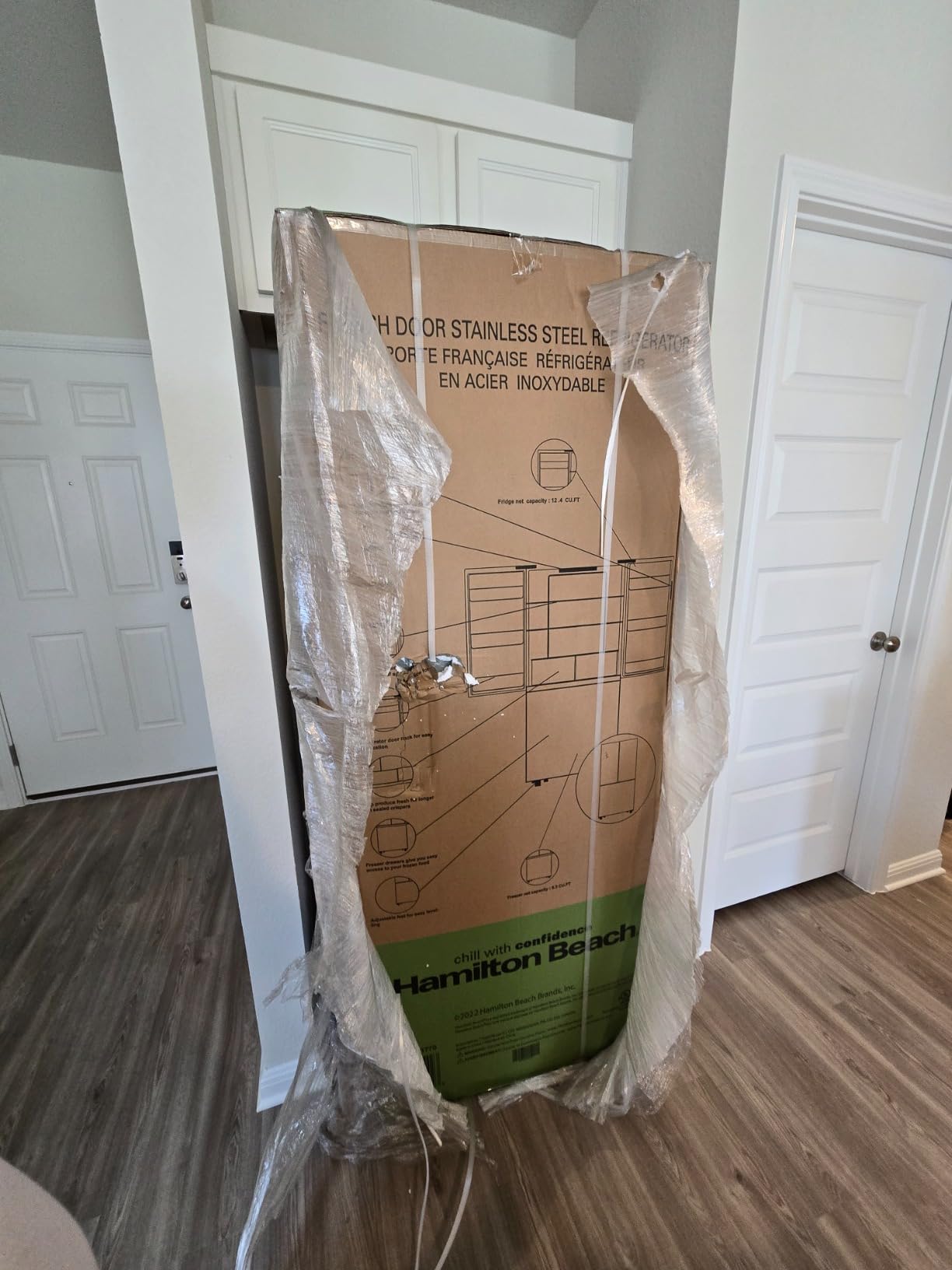
There is no ice maker, and that is a genuine limitation if your household expects ice every day. The good news is that a 378 kilowatt hour annual consumption figure is tied for the lowest in this group, so operating cost is not where this model hurts. Installation is straightforward thanks to front leveling legs and rear castors, and the digital display sits inside the refrigerator door where it stays out of sight.
Two cautions. The fresh food compartment is 12.4 cu. ft. with a 5.3 cu. ft. freezer, which is smaller than what 30-inch-wide counter-depth French doors offer. And the warranty is one year with no ENERGY STAR listing, so you are buying footprint and fit, not efficiency certification or long-term coverage.

Do You Need a Separate Ice Machine?
If you fill a few cubes a week, a countertop ice maker on a rolling cart is a cheap fix and keeps the counter clear. If you drink iced coffee or cold drinks all day, budget for a plumbed machine instead. Either way, the absence of an ice maker also means no water line to install, which is a real advantage in a rental or a finished galley kitchen.
How This Compares With the 30-Inch KoolMore
The KoolMore gives you about 0.8 cu. ft. more total capacity, brighter interior lighting and ENERGY STAR certification, but the 30.1-inch body sits roughly an inch deeper than this model. If flush fit matters more than the last 0.8 cu. ft., this is the more correct refrigerator for your opening.
5. Samsung 17.5 cu. ft. Smart 3-Door French Door – Best Connected Pick
Samsung 17.5 cu. ft. Smart Counter Depth 3-Door French Door Refrigerator, Stainless Steel, RF18A5101SR/AA
17.5 cu. ft.
28.5 in. D x 32.13 in. W x 70 in. H
595 kWh per year
ENERGY STAR
10-year compressor warranty
Pros
- 28.5 in. counter-depth body with recessed-handle doors
- Wi-Fi alerts you after a power outage or an open door
- Twin Cooling Plus runs separate fridge and freezer zones
- ENERGY STAR certified at a 4.3 BEE star
- Ten-year parts warranty on the digital inverter compressor
Cons
- 32.13 in. wide
- so it will not fit a 30-inch opening
- App-dependent alerts add a learning curve
- Higher energy use than the most efficient picks
- Owner ratings show some quality variance
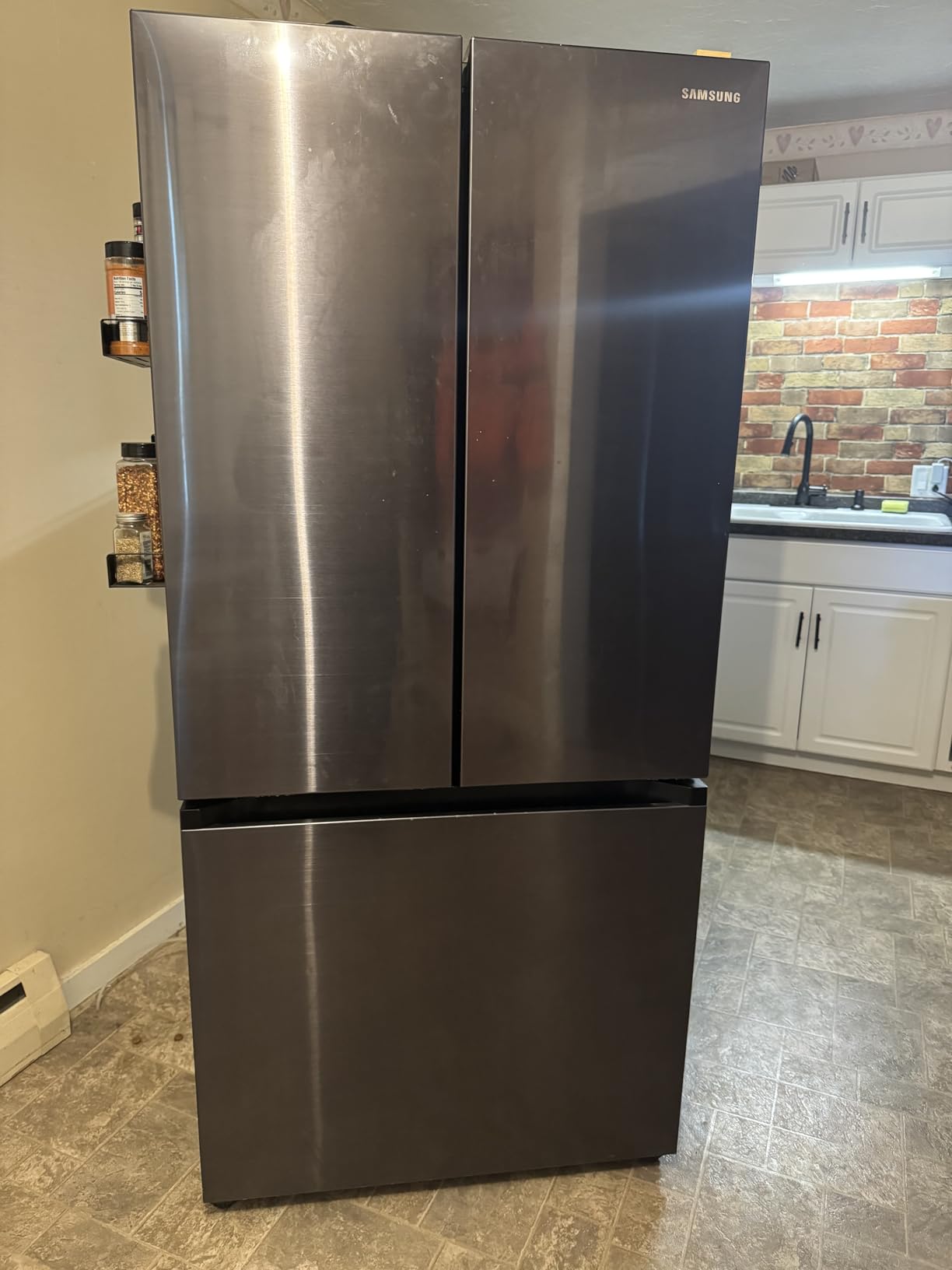
The Samsung RF18A5101SR/AA is the pick for anyone who has ever come home to a thawed fridge after a power cut. Wi-Fi connectivity pushes a notification to your phone when the temperature rises or a door is opened, which is genuinely useful in a small apartment where you are away during the day. Beyond that, the styling is the quiet second draw: flat doors and recessed handles that line up with cabinetry.
The body is 28.5 inches deep by 32.13 inches wide by 70 inches tall, so it is deep enough to look built-in but too wide for a 30-inch opening. Total capacity is listed at 18 cu. ft. with 11.7 cu. ft. of fresh food and 5.8 cu. ft. of freezer. At 205 pounds it is heavier than the other units in this 28-to-30-inch depth class but still manageable with a dolly.
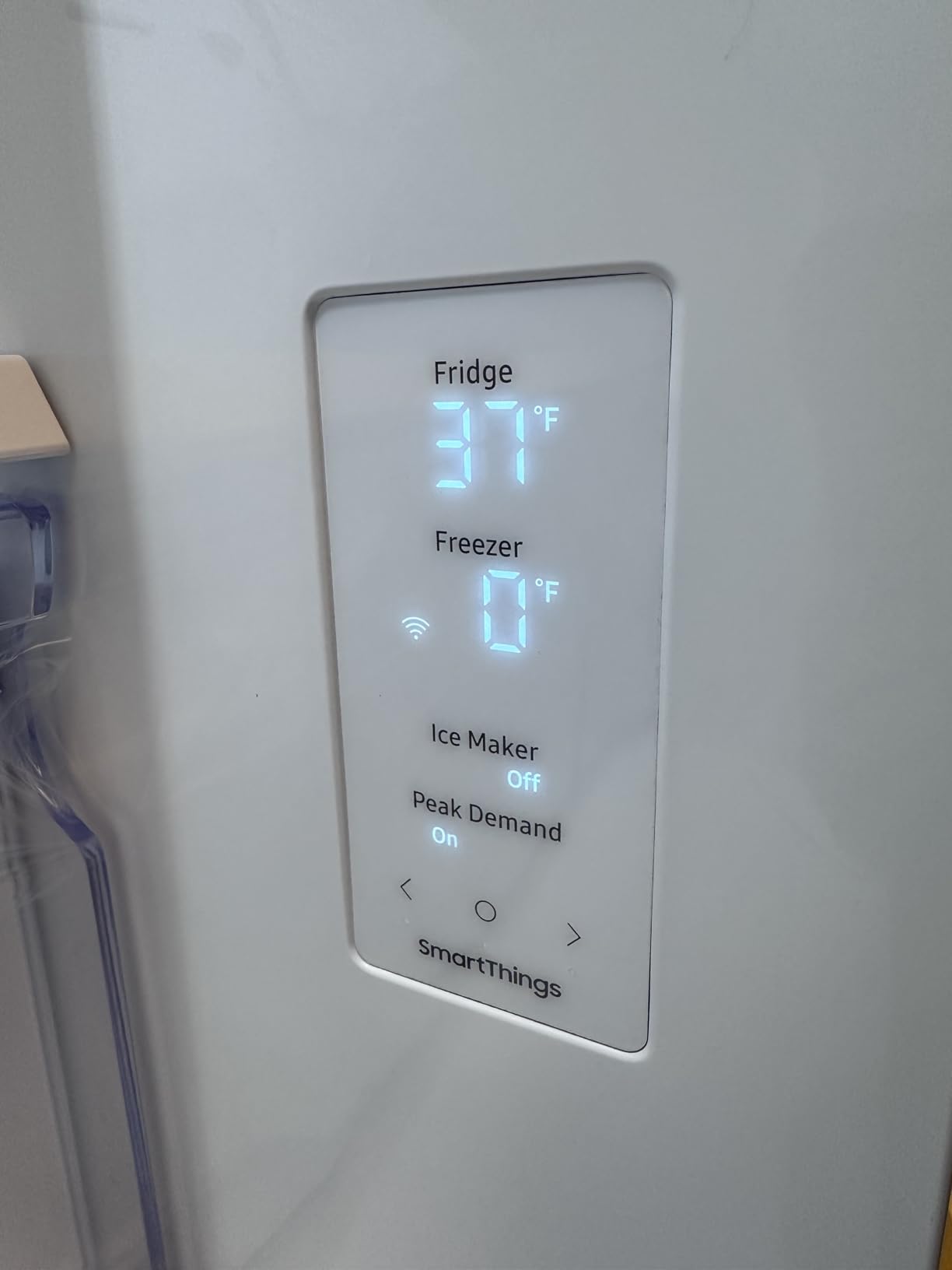
Cooling is handled by Twin Cooling Plus, which runs the refrigerator and freezer at independent temperatures and humidity levels. That is the feature that keeps produce from picking up freezer odors, and it is the reason this unit feels more considered than its 4.1-star average implies. The stainless finish is fingerprint-resistant and wipes clean with a damp cloth.
The catch is energy use. At 595 kilowatt hours per year, this draws more than every unit here except the two 36-inch GE models. The warranty, however, is the strongest in this roundup: one year on parts and labor, five years on the sealed refrigeration system, and ten years on the digital inverter compressor. Reviewers do report some variance in build quality, so inspect the unit carefully when it arrives.
Is the Smart App Worth the Energy Cost?
The outage alert is the part that pays for itself. Everything else in the app is convenience rather than necessity, and the extra kilowatt hours show up on your utility bill every month. If you already own a smart-home setup and travel regularly, that is a good trade. If you are never away for long, the same money buys a more efficient model.
What Owners Report About Reliability
Feedback on this unit is positive on styling and cooling, with a small group of owners unimpressed by the app itself. Across wider owner discussions on r/Appliances, Samsung refrigerators come up repeatedly for cooling failures and ice maker complaints, though several satisfied owners weigh in too. Treat the long compressor warranty as meaningful protection rather than assuming the worst.
6. GE 22.1 cu. ft. Counter-Depth French Door – Best Pick With an Ice Maker
GE GYE22GYNFS 36″ French Door Counter Depth Refrigerator with 22.1 cu. ft. Total Capacity Space Saving Ice Maker Showcase LED Lighting in Stainless Steel
22.1 cu. ft.
31.25 in. D x 35.75 in. W x 70.5 in. H
665 kWh per year
ENERGY STAR qualified
43.37 in. with doors open
Pros
- 31.25 in. deep counter-depth body with 22.1 cu. ft.
- Showcase LED lighting reaches the back corners
- Fingerprint-resistant stainless that wipes clean
- Space-saving internal ice maker and cold water dispenser
- ENERGY STAR qualified and ADA compliant
Cons
- Internal ice maker can be hard to pull ice from
- Water dispenser display has no backlight
- Several owners report sudden cooling failure
- Recurring ice maker and freezer reliability complaints
- 1-year warranty despite the premium tier
Among the models that include an ice maker, the GE GYE22GYNFS has the strongest owner rating, and it does something the cheaper units cannot: fit 22.1 cu. ft. into a 31.25-inch counter-depth cabinet. That is a lot of usable space from a counter-depth body, and in a small kitchen where every cubic foot has to earn its place, that is the headline.
The cabinet measures 35.75 inches wide by 70.5 inches tall, so it needs a 36-inch opening. Maximum depth with the doors open is listed at 43.37 inches, which tells you how much room you need in front of the unit for the doors to open fully. Fresh food capacity is 14.92 cu. ft. and the freezer holds 7.16 cu. ft., the second-largest freezer in this group.
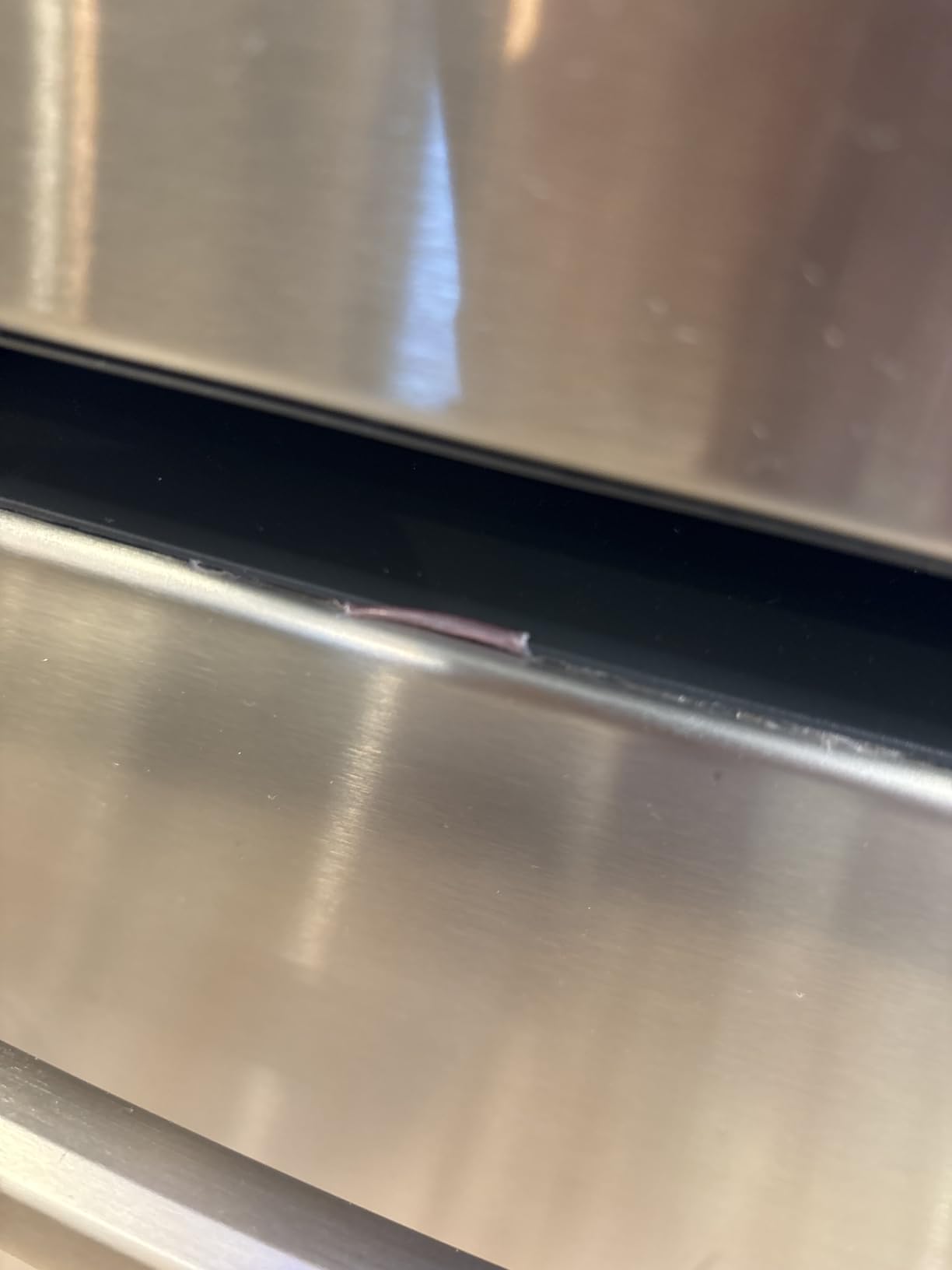
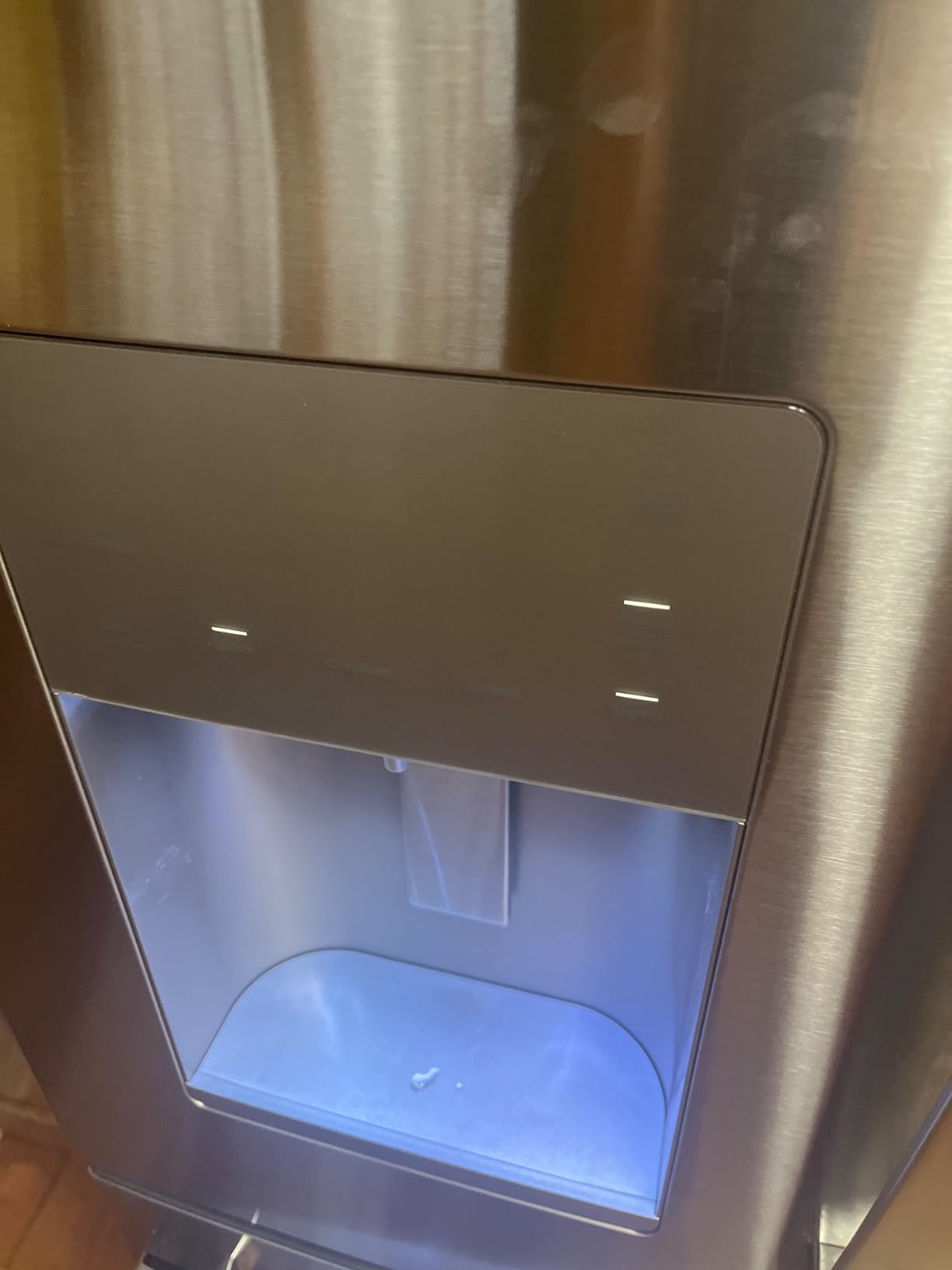
The feature list is long. Showcase LED lighting bright enough to find items in the back corners, a space-saving internal ice maker, a cold water dispenser, six door shelves, five shelves, an anti-bacterial filter, a rotary compressor, hot gas defrost, fingerprint-resistant stainless and an ADA-compliant design. It is ENERGY STAR qualified. The catch is energy use at 665 kilowatt hours per year, the highest figure among the models here.
Reliability is the thing to weigh seriously. Several owners report the cooling system failing without warning and losing everything in the compartment, and ice maker complaints recur across the reviews. The dispenser display also has no backlight, so reading it in a dim kitchen is awkward. The warranty is a limited 1-year entire-appliance term, which is thin for a unit at this level.
Is the Internal Ice Maker Worth the Reliability Risk?
Owners often report that ice can be hard to extract from the internal bin, and the freeze cycle adds noise in a quiet room. If you only need a few cubes, a portable ice maker is cheaper than one service call. If your household uses a lot of ice, the convenience is real, and you should budget for the possibility of a repair inside the warranty year.
How Does 22.1 cu. ft. Compare With a Standard-Depth 36-Inch Fridge?
A standard-depth 36-inch French door in the same class typically carries noticeably more than this, and the difference shows up in shelf depth rather than shelf width. You keep the full width of a 36-inch cabinet but lose the front-to-back room that lets a serving dish sit flat. For most households that is a fair exchange for the flush look and the floor space.
7. GE Profile 23.1 cu. ft. French Door – Best for TwinChill Dual-Evaporator Cooling
GE Profile 36 Counter Depth French Door Refrigerator with 23.1 cu. ft. Capacity Internal Water Dispenser TwinChill Evaporator and Showcase LED Lighting in Fingerprint Resistant
23.1 cu. ft.
31.25 in. D x 35.75 in. W x 69.88 in. H
596 kWh per year
ENERGY STAR
333 pounds
Pros
- Largest capacity here at 23.1 cu. ft. with a 7.9 cu. ft. freezer
- TwinChill evaporators create separate fridge and freezer climates
- Full-width temperature-controlled drawer with three settings
- Internal one-touch filtered water dispenser
- ENERGY STAR certified and fingerprint-resistant
Cons
- Recurring owner reports of compressor failures within a few years
- Freezer door reported not closing fully at times
- Water filter sold separately
- 1-year warranty on a premium-priced unit
- Second-heaviest build here at 333 pounds
The GE Profile PWE23KYNFS is the largest-capacity refrigerator in this group at 23.1 cu. ft., and it does it in a 31.25-inch counter-depth cabinet. The reason we do not rank it higher is durability, not capacity. It has the lowest owner rating in this roundup, and the complaints point at the compressor and the freezer door rather than at fit or features.
The cooling hardware is the best argument for it. TwinChill evaporators create separate climates for fresh food and frozen items, which reduces odor transfer and keeps produce fresher for longer. There is also a full-width drawer with electronic temperature control, LED lighting and three settings, so you can run a crisper zone colder or warmer depending on what is inside it.
Water comes from an internal one-touch filtered dispenser, and you should know that the filter is not included. It takes an RPWFE or XWFE cartridge, and that cartridge is an added cost on day one. The stainless finish is fingerprint-resistant and the unit is ENERGY STAR certified at 596 kilowatt hours per year, a middle-of-the-pack figure for this lineup.
Physical notes: the cabinet is 35.75 inches wide, 31.25 inches deep and 69.88 inches tall, and doors open to a maximum listed depth of 43.37 inches. At 333 pounds it is the second-heaviest unit we reviewed, so plan the delivery route and the number of helpers carefully. The warranty is one year, which is short for a unit at this tier.
What Do Owners Like Most About It?
Those who keep theirs report strong ice production, a premium look and noticeably fresher produce, and the full-width temperature-controlled drawer is consistently singled out as a genuine upgrade on cheaper French doors. The 23.1 cu. ft. figure also means a week of groceries for a family of four fits without a second trip.
Why We Rank It Seventh
Compressor failures within a few years, a freezer door that has reportedly failed to close fully, and at least one delivered unit missing a crisper roller shelf. With a 3.6-star average on a small number of reviews, we would not call the model bad, but we would not put a fridge you plan to keep for a decade near the top of this roundup on that evidence.
8. GE 18.6 cu. ft. Counter-Depth French Door – Best Compact French Door Styling
GE GWE19JYLFS 18.6 cu. ft. Counter Depth French Door Refrigerator in Fingerprint Resistant Stainless Steel
18.6 cu. ft.
31 in. D x 32.75 in. W x 69.88 in. H
547 kWh per year
ENERGY STAR
232 pounds
Pros
- 18.6 cu. ft. is roomy for a 31 in. deep body
- Internal one-touch filtered water dispenser
- Fingerprint-resistant stainless finish
- ENERGY STAR certified at 547 kWh per year
Cons
- Very few owner reviews
- so long-term reliability is unverified
- A cluster of 2-star ratings pulls the average down
- 1-year limited warranty
- 31 in. depth is deeper than the narrowest options here
The GWE19JYLFS is the compromise model for people who want French door styling and a water dispenser in a cabinet narrower than 36 inches. At 32.75 inches wide it fits a 33-inch opening, and at 18.6 cu. ft. it holds a useful amount for a 33-inch cabinet. Capacity splits into 13.59 cu. ft. of fresh food and 5.01 cu. ft. of freezer.
The body is 31 inches deep by 69.88 inches tall and weighs 232 pounds. Doors open to a maximum listed depth of 46 inches, which is the largest door-open figure in this group, so give it real clearance in front. You get four door shelves, four glass shelves, frost-free defrost and an electronic lock, plus an internal one-touch filtered water dispenser.
Energy use is listed at 547 kilowatt hours per year with ENERGY STAR certification, which is respectable for a unit of this size. The stainless finish is fingerprint-resistant, and the compact form factor is the point: it reads as a small kitchen appliance rather than a full-size block of steel. That matters visually in an open-concept space where the fridge is often the first thing you see.
The problem is evidence. There are only a handful of owner reviews, and the rating distribution is unusual, with a cluster of 5-star scores and a cluster of 2-star scores and almost nothing in between. That pattern often means some buyers get an excellent unit while others get a fit-and-finish problem. The warranty is a limited 1-year term, which is standard but not generous.
Does 18.6 cu. ft. Fill a 32-Inch Cabinet Well?
Better than most. Because the cabinet is narrower than the 36-inch models, more of the volume goes into shelves you can actually use rather than a wide, shallow cavity. If you are moving from a standard-depth unit of the same width, the 18.6 cu. ft. figure is closer to what you had before.
How to Spot Trouble Early
Run the compressor for a full day before you load it and confirm the temperature holds. Check the door alignment and the gasket seal all the way around, because that is where the 2-star reports concentrate. Keep the receipt and the packaging until you are satisfied, since transit damage and missing parts are the most common early complaints.
9. Kenmore 30-Inch 17.5 cu. ft. French Door – Best for Efficient Inverter Cooling
Kenmore 30 Inch Counter-Depth French Door Refrigerator/Freezer with Fingerprint-Resistant Stainless Steel, Adjustable Glass Shelves, Quiet and Energy Efficient Inverter Compressor, 17.5 cu. ft.
17.5 cu. ft.
29.21 in. D x 29.88 in. W x 70 in. H
435 kWh per year
ENERGY STAR
185.2 pounds
Pros
- 29.21 in. depth in a 30 in. wide cabinet
- Quiet inverter compressor with Multi Flow air distribution
- ENERGY STAR certified at 435 kWh per year
- Accela Chill accelerated cooling on demand
- Edge-to-edge adjustable glass shelves and two crisper drawers
Cons
- Listed at 240 volts
- which is unusual for a residential fridge
- Only three owner reviews
- so quality is largely unproven
- No ice maker and no external handle
- 1-year limited warranty
The Kenmore KKFDR30x17.5-SS is the efficiency pick. At 435 kilowatt hours per year it is ENERGY STAR certified and draws less than either 36-inch model in this group, and the inverter compressor with Multi Flow air distribution is built for even cooling on every shelf. If your kitchen is hot, or you are trying to hold a tight utility budget, that number matters over a decade.
Dimensions are 29.21 inches deep by 29.88 inches wide by 70 inches tall, so it fits a standard 30-inch opening and sits nearly flush with a counter face. Storage runs to three adjustable edge-to-edge glass shelves, two crisper drawers, six gallon-size door bins and two-tier freezer organization in a 30-inch-wide body. Accela Chill gives you a burst of faster cooling when you load a large shop.
We want to be direct about the evidence. There are three owner reviews on record, two of them five-star and one of them two-star, which is not enough to judge a major appliance with any confidence. The 3.5-star average is the lowest in this roundup, and the listed voltage of 240 volts is unusual for a residential refrigerator, so confirm compatibility with your kitchen wiring and outlet before ordering.
There is also no ice maker and no external handle, so plan on a portable ice machine if you need ice. The warranty is a 1-year limited term, the same as the other value units in this roundup.
Is the 240-Volt Listing a Problem?
Ask before you buy. Most North American kitchens run 120 volts at the counter, and a mislabeled specification is possible but not certain. If the unit really requires 240 volts, you need a dedicated circuit, which in a rental apartment may not be possible. Get a written answer from the manufacturer or retailer first, because retrofitting a circuit is not a small job.
Who This Pick Suits Best
A renter or first-time buyer in a 30-inch opening who wants a shallow body, an efficient compressor and a modern look, and who does not need ice. The trade is that you are buying an unproven unit, so keep expectations realistic and check it carefully during the return window.
Counter-Depth vs Standard-Depth: What You Give Up
The honest version of this comparison is that a counter-depth refrigerator buys you looks and a couple of inches of walkway, and charges you for it in capacity. A standard-depth unit of the same width typically holds 10 to 20 percent more food because its shelves are deeper, and a gallon jug can slide straight in rather than sitting at an angle.
Where counter depth wins is alignment. A unit in the 25-to-29-inch total depth range lines up with a standard 25-inch counter face, so the fridge stops reading as a steel box bolted to the end of the cabinetry. That single visual effect is why most people in small kitchens accept the capacity loss, and it is also why a recessed-handle design matters more on these models than on standard-depth units.
Where it loses is aisle space. The difference between a counter-depth and a standard-depth body is only 2 to 4 inches, so if your kitchen was tight before, it will be tight after, just slightly less so. If your real problem is a walkway blocked by a swinging door, counter depth alone will not fix it, and a single-door bottom-freezer layout will do more.
Counter-depth models also cost more per cubic foot. The reason is mechanical: a shallower cabinet needs a wider frame and a different door hinge geometry, many of the configurations are French-door only, and the production volume is low enough that manufacturers treat these as a specialty line. None of that makes a bad purchase, but it does mean you should be comparing fit and layout rather than chasing the biggest number on the door.
Which Fridge Style Fits a Small Kitchen Best?
French door gives you the widest shelves and the easiest access to fresh food, which is why eight of the nine picks use it. The cost is door swing: both doors need clearance on either side plus the arc in front, so French doors want at least 40 inches of open space in a small kitchen.
Side-by-side, represented here by the Hamilton Beach HBF1558, has the shallowest body in this group at 25.04 inches. Both compartments are full height, so a tall bottle fits easily, and only one door is open at a time, which is genuinely better in a galley kitchen where two open doors can block the walkway.
Bottom freezer puts the freezer in a pull-out drawer and leaves a single wide door above it, so nothing swings into your walkway. None of the nine picks here use that layout, but it remains the most forgiving option in a cramped kitchen and is worth a look in stores.
A fourth option you will meet in the category, door-in-door, lets you reach a drink without opening the whole cavity. It is convenient, though the extra door gasket costs you a little usable volume, and it matters more in a standard-depth body than in a compact one.
Reliability, Noise, and Service: What Owners Report
Across the nine models, the pattern in owner feedback is consistent enough to be useful. The models that draw the fewest complaints are the ones with an inverter compressor and no ice maker, and the models with a through-the-door or internal ice maker draw the most. The Hamilton Beach units carry 1-year warranties and occasional transit-damage reports, the GE units carry 1-year warranties with compressor and ice maker complaints, and the Samsung carries the longest compressor coverage here at ten years on parts.
On noise, nobody in this group publishes a decibel figure, which is a genuine gap in the category. What owner reports do support is the general ordering: an inverter compressor that ramps rather than stops and starts is the quietest, and a running ice maker is the loudest thing in the cabinet. In an open-concept space, budget for the ice maker cycle as background sound, and in a galley kitchen where the fridge backs onto your dining table, it is worth asking about a sound test.
That brings us to the odd noises people ask about most. A gurgling or clicking sound when water or ice is dispensing is usually the fill valve or the water line settling, and it is normal for a few cycles. A buzzing that continues after the compressor stops is a warning sign, as is a repeated clunk every few minutes from the back of the cabinet. Most households should not ignore a noise that changes pitch, because those usually mean the evaporator fan is failing.
On brand choice, the recurring theme in owner discussions on r/Appliances and appliance forums is that cooling failures and ice maker problems come up most with Samsung, Whirlpool and some GE lines, while Bosch and the smaller value brands draw fewer service complaints but also have thinner owner data. Whirlpool owners in particular describe noise and not-cooling issues that persisted after a damper control replacement. We would not call any of these brands a category to avoid outright, but the failure modes above are the ones to ask a service technician about first.
Serviceability is the last factor and the one most shopping guides skip. Bosch and GE have the deepest service networks in North America, which matters when a sealed system needs a technician visit. Smaller brands may rely on the retailer or a limited regional network, so before you buy, enter your ZIP code into the manufacturer’s service locator and confirm that a repair visit is available in your area.
If you want the short version on where to go next, our guides to 12V car refrigerators and portable camping refrigerators cover the opposite problem, where there is no kitchen to measure at all.
Frequently Asked Questions
What style refrigerator is best for a small kitchen?
A bottom-freezer or side-by-side layout works best in the tightest spaces because only one door opens at a time, which keeps a galley walkway clear. A French door gives you wider shelves and easier access to fresh food, but both doors need clearance on either side and roughly 40 inches of open space in front. Measure your opening width at the floor, middle and top before choosing, then add a quarter inch per side.
How deep is a counter-depth refrigerator?
A true counter-depth refrigerator measures roughly 23 to 30 inches deep excluding handles, which lets it sit nearly flush with standard kitchen counters that are about 25 inches deep. In practice the models in this roundup range from 25.04 inches to 31.25 inches of total depth. Always check the total depth including handles, because a nearly counter-depth unit has a flush cabinet but doors that still sit proud of the counter.
Do counter-depth refrigerators have less capacity?
Yes. A counter-depth refrigerator holds roughly 10 to 20 percent less food than a standard-depth model of the same width, because the shallower cabinet leaves less shelf depth. The published cubic footage does not show that loss, so measure a typical weekly shop against the actual shelf opening. Shallow models also force gallon jugs to sit at an angle rather than sliding straight onto a shelf.
Who makes the most reliable counter-depth refrigerator?
Owners report the fewest problems on units with an inverter compressor and no ice maker, and the longest warranty coverage in this roundup belongs to the Samsung RF18A5101SR/AA, with ten years on the digital inverter compressor. Bosch and GE have the deepest service networks, which matters for sealed-system repairs. The most commonly reported failure modes across brands are ice maker breakdowns, sudden cooling loss and compressor faults, so check the warranty length before you choose.
Is it safe to ignore noises from my refrigerator?
Some noises are normal. Gurgling, clicking or a brief hum during water and ice dispensing is the fill valve and water line settling. A continuous buzz after the compressor stops, a repeated clunk every few minutes, or a grinding or rattling sound that changes pitch usually mean a failing evaporator fan or a compressor problem. In a small kitchen, persistent noise is worth a service visit rather than a wait.
Conclusion
For most small kitchens, the KoolMore KM-RERFDSS-18C is the best counter depth refrigerator in this group: a 30-inch-wide French door with an 18.5 cu. ft. interior, a quiet inverter compressor and ENERGY STAR certification at 465 kilowatt hours a year. If your opening is 33 inches or wider and you want ice and the most space possible, the GE GYE22GYNFS carries 22.1 cu. ft. with a 4.3-star owner rating, and if flush alignment matters more than capacity, the Hamilton Beach side-by-side at 25.04 inches deep is the one that lines up with your counters.
Measure your opening at three heights, check total depth including handles, and allow for the door swing before you order. Then pick from the comparison table above and check the current listing for the model you want.