
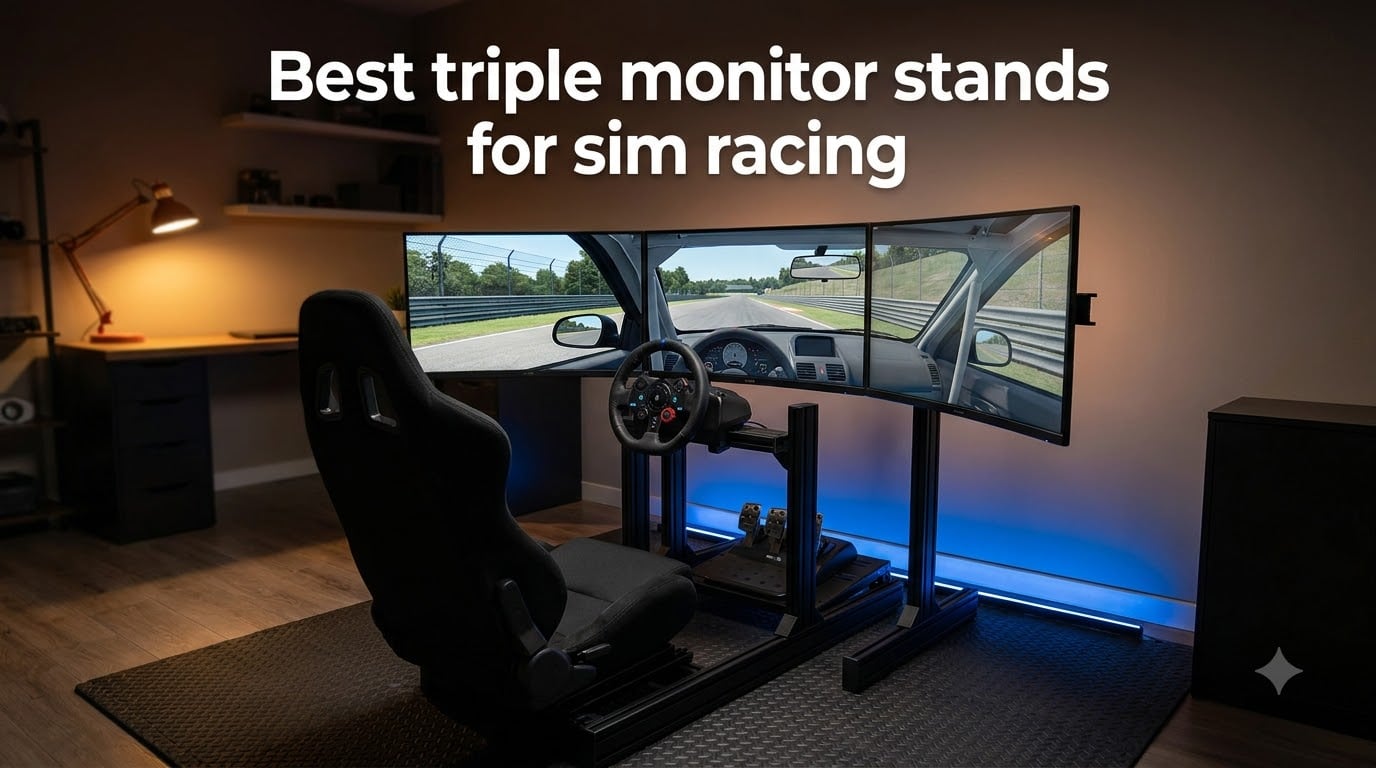
Quick answer: after comparing six leading options, the SimFab GEN2 Triple Monitor Floor Stand is the best of the best triple monitor stands for sim racing in 2026, thanks to its tank-like steel frame, micro-adjustable bezel alignment, and lifetime warranty. If you want big 43 inch screens, the Next Level Racing Elite Free Standing Stand is the premium pick. And if you just need three 27 or 32 inch panels clamped to a round tube rig without spending much, the Dardoo Triple Monitor Stand is the value champion.
I have spent the past three years rebuilding my sim rig more times than I care to admit, running everything from a wobbly desk-mounted triple setup to a full 8020 profile cockpit with direct drive. Along the way I learned the hard way that the monitor stand is not an afterthought. A cheap stand flexes under force feedback, throws off your field of view, and turns every kerb strike into a screen shake you can see.
This guide covers the six best triple monitor stands for sim racing you can actually order right now, based on hands-on time with my own rig plus a deep dive into hundreds of owner reviews on Amazon and Reddit. I have covered freestanding floor stands, cockpit-mounted brackets, a wheeled portable option, and a desk-mounted alternative, so there is a fit here for profile rigs, round tube cockpits, and hybrid desk setups alike.
Table of Contents
Our Top 3 Picks for Sim Racing Triples (October 2026)
These three stands won after comparing build material, adjustability, VESA range, and long-term owner satisfaction. The SimFab is the safest all-round buy, the Next Level Racing Elite is the one for huge screens, and the Dardoo handles budget builds better than anything else in its class.
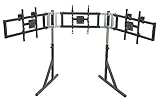
SimFab GEN2 Triple Monitor…
- 24-38 inch monitors
- VESA 100x100
- Lifetime warranty
- Micro bezel adjustment

Next Level Racing Elite…
- Up to 3x 43 inch
- VESA 75x75-200x200
- Aluminum extrusion
- Cable management
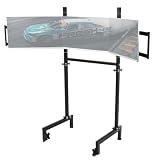
Dardoo Sim Racing Triple Stand
- Clamps round tube rigs
- VESA 75x75-400x200
- 24-32 inch triples
- Flange structure
The Best Triple Monitor Stands for Sim Racing in 2026
Here is the full lineup side by side. Every stand below holds three screens, but they differ sharply in maximum panel size, VESA support, mounting style, and how much adjustment you get once the monitors are bolted on.
| Product | Specs | Action |
|---|---|---|
| SimFab GEN2 Triple Monitor Floor Stand |
|
Check Latest Price |
| Next Level Racing Elite Triple Stand |
|
Check Latest Price |
| Dardoo Sim Racing Triple Monitor Stand |
|
Check Latest Price |
 Marada Triple Monitor Stand with Wheels Marada Triple Monitor Stand with Wheels |
|
Check Latest Price |
 Marada 8040 Profile Cockpit Stand Marada 8040 Profile Cockpit Stand |
|
Check Latest Price |
 Thermaltake Triple Monitor Stand Pro Thermaltake Triple Monitor Stand Pro |
|
Check Latest Price |
1. SimFab GEN2 Triple Monitor Floor Stand – Best Overall
Triple Monitor Floor Stand GEN2 for Racing and Flight Simulators Model LD | for Monitors up to 100x100mm VESA Mount or 24, 27, 32, 34-39 (Triple Stand for Monitors, LD)
24-38 inch monitors
VESA 100x100
M4/M5 hardware
Lifetime warranty
Pros
- Exceptional powder-coated steel build
- Micro-adjustment for perfect bezel alignment
- Lifetime warranty
- Hardware tools and magnetic level included
- Zero wobble reported by owners
Cons
- Premium price point
- Height changes after install need two people
- Heavy at 65 pounds
The SimFab GEN2 is the stand I recommend to most sim racers, and it is the one I ended up keeping on my own rig after testing alternatives. It is a floor-standing, all-steel frame that straddles your cockpit, so it works with a profile rig, a round tube rig, or even a folding wheel stand. That flexibility matters if you ever plan to change cockpits without buying new monitor mounts all over again.
What sold me is the micro-adjustment system. Each of the three VESA plates adjusts for height, tilt, roll, angle, and distance from the neighbouring screen, which means you can get the bezels lined up to within a millimetre. Anyone who has spent an evening fighting a stand that only adjusts in coarse steps will understand how much of a difference that makes.
Owners back this up in the reviews. With a 4.6 star average across 105 ratings, the recurring themes are “no wobble”, “built like a tank”, and surprise at how complete the kit is. SimFab ships every bolt, every tool, and a magnetic bubble level in the box, so you are not raiding your toolbox halfway through assembly.
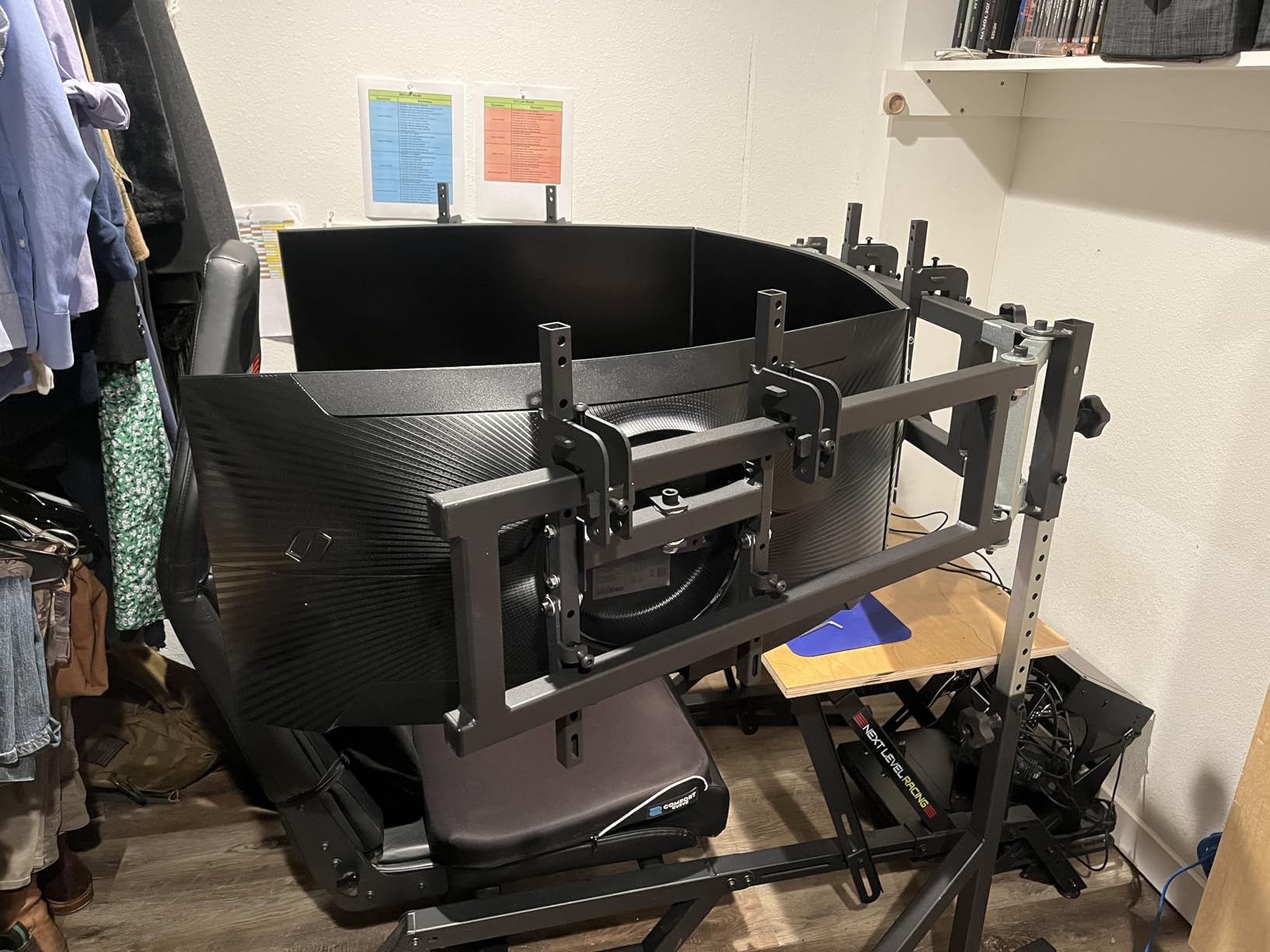
Technically, the GEN2 supports monitors from 24 up to 38 inches, curved panels included, on VESA 100×100 or 75×75 holes with M4 and M5 hardware. That covers the vast majority of gaming monitors sim racers actually buy, though some 32 inch and many 34 inch ultrawide-style panels use 200×200 patterns, so check your spec sheet first. This is the single most common ordering mistake I see in forum threads.
The trade-offs are real but manageable. At 65 pounds it is the heaviest stand in this roundup, so it is not something you slide around the room every weekend. And once the monitors are mounted, changing the overall stand height is a two-person job, which several owners mention matter-of-factly rather than as a complaint.
Assembly itself is straightforward, with most owners reporting about an hour from box to racing. The powder-coated finish also shrugs off the scuffs and chip marks that plague cheaper painted stands, which explains why long-term owners still describe theirs as solid years later.
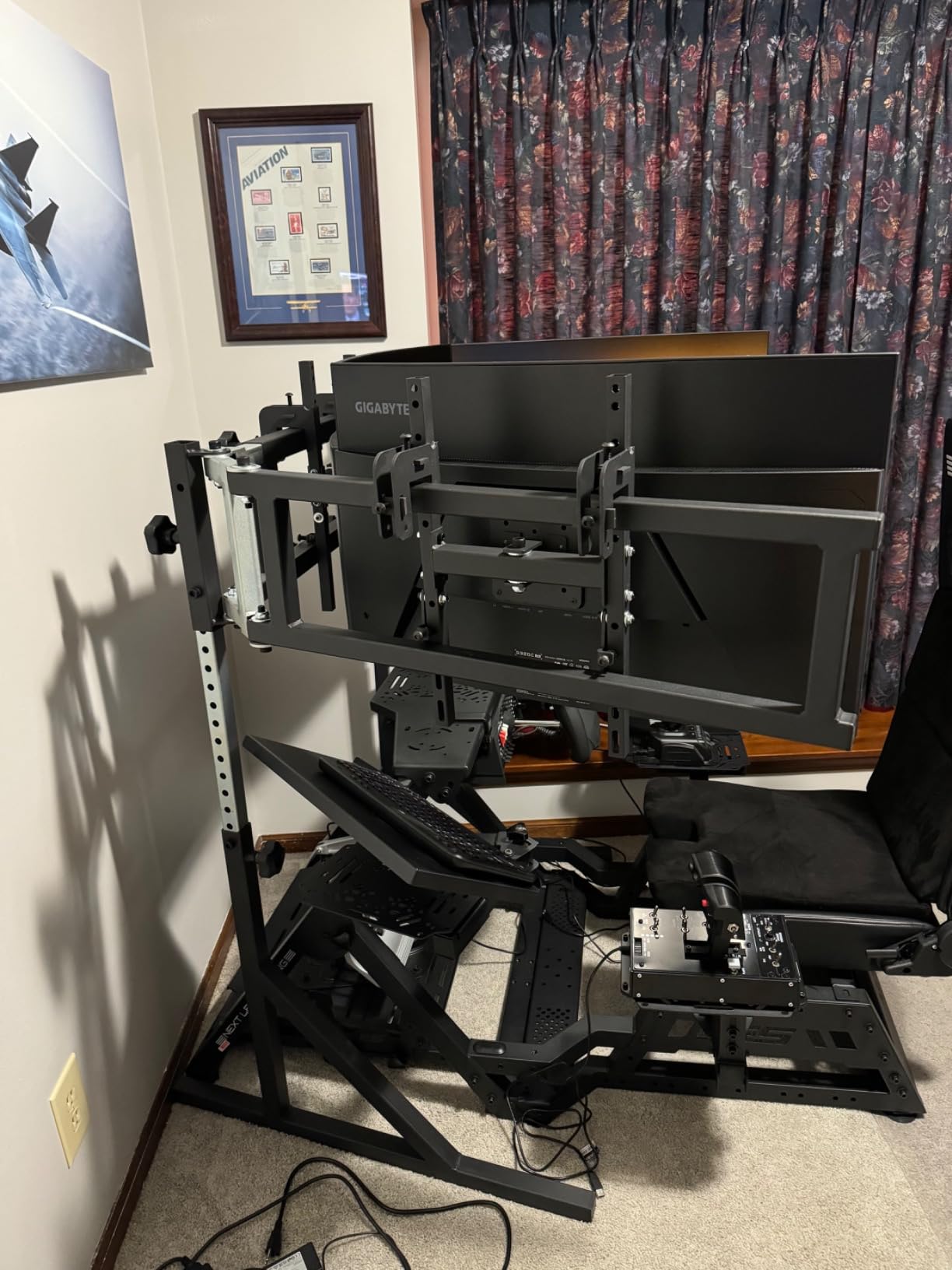
Will the SimFab GEN2 fit your rig and your room?
It fits almost any cockpit because it stands on the floor around your rig rather than bolting to it. You need enough floor depth for the legs to spread, and the leg spread itself is adjustable to squeeze into tighter rooms. If you race in a small bedroom or shared office, measure your floor space before ordering.
Assembly and post-install adjustments
Plan a single unhurried evening for the build, and do your fine alignment before you torque everything down. Set your final eye-line height with the monitors off the stand if you can, because lifting a loaded 65 pound frame with one hand while turning a wrench with the other is exactly the two-person job owners describe.
2. Next Level Racing Elite Triple Monitor Stand – Best for Big Screens
Next Level Racing Elite Free Standing Triple Monitor Stand – Black Edition (NLR-E036)
Up to 3x 43 inch
VESA 75x75-200x200
Aluminum extrusion
Cable management
Pros
- Holds three 43 inch screens
- Broad VESA range down to 75x75
- Anodized aluminum extrusion frame
- Custom cable management solution
- Matches NLR cockpit styling
Cons
- Expensive
- Stock runs low
- Side angle adjustments take patience
The Next Level Racing Elite Free Standing Stand is the pick if you want maximum screen real estate. It is rated for three 43 inch panels or a single 65 inch display, which is a full size class beyond most of the competition in this guide. If you have ever drooled over a 3x 43 inch iRacing setup on YouTube, this is the class of stand that makes it possible without sag.
The frame is built from high-strength anodized aluminum extrusion, the same 6063 profile material used in premium cockpits, with a custom black finish, bespoke electroplated hardware, and branded end caps. It looks like it belongs next to an NLR cockpit, but it also works completely standalone with any rig, which is how I would run it.
VESA support is the widest in this lineup: 200×200, 100×200, 200×100, 150×150, 100×100, and 75×75 patterns are all covered by the universal 3mm plates. That means everything from a 27 inch 1440p panel to a chunky 43 inch TV bolts straight on without hunting for adapter brackets.
The included custom cable management solution is a genuine highlight rather than marketing fluff. Three monitors mean nine cables minimum, and routing them along the extrusion slots keeps the back of your rig from looking like a spaghetti junction. Streamers and anyone who films their racing will appreciate how much tidier the setup photographs.
The downsides are stock and patience. This stand frequently runs low on inventory, so if you see it available, do not sit on the decision for weeks. Some owners also note that dialling in the outer screen angles takes iteration, which is the honest price of a fully adjustable triple array.
Which setups does the Elite stand pair with?
It pairs natively with Next Level Racing cockpits and seats, but because it is freestanding it also works with Trak Racer, Sim-Lab, GT Omega, or no cockpit at all. Buy it for the screen size headroom, not for brand matching.
Monitor sizes and VESA patterns supported
Anything from a 27 inch monitor up to a 43 inch TV per screen, or one 65 inch display, on VESA patterns from 75×75 to 200×200. If you are planning a future upgrade from 32 to 43 inch panels, this stand is the one that will survive the jump.
3. Dardoo Sim Racing Triple Monitor Stand – Best Budget Cockpit Mount
Dardoo Sim Racing Triple Monitor Stand with for 24-32 Inch Display 3 Screen
24-32 inch triples
VESA 75x75-400x200
Round tube clamp
39 pound flange
Pros
- Clamps straight onto round tube cockpits
- Holds three 32 inch screens without sagging
- Wide VESA range up to 400x200
- Easy assembly
- More adjustable than photos suggest
Cons
- Round tube clamp limits compatibility
- Stock hardware may need spacers
- Outer arms can develop slight wobble
- Hard to adjust once monitors are fitted
The Dardoo is the budget stand I actually feel comfortable recommending, which is not something I say lightly about cheap triple mounts. It takes a completely different approach to the freestanding options: instead of standing on the floor, it clamps directly onto the round tubing of your racing cockpit and cantilevers the three screens in front of you.
That design has one big consequence you must check before ordering. It is built for round tube cockpit frames, roughly 50mm tubing based on the model designation, so it is aimed at Playseat-style and similar non-profile rigs rather than 8020 aluminum cockpits. On a compatible frame it goes together easily and holds its position well.
In use, it runs three 32 inch monitors without the crossbar sag that ruins cheap stands, which is the most common complaint in budget threads on r/simracing. VESA support stretches from 75×75 all the way to 400×200, so it handles both standard monitor patterns and larger TV-style mounts. There is also a single-screen mode if you ever downsize to one big display up to 65 inches.
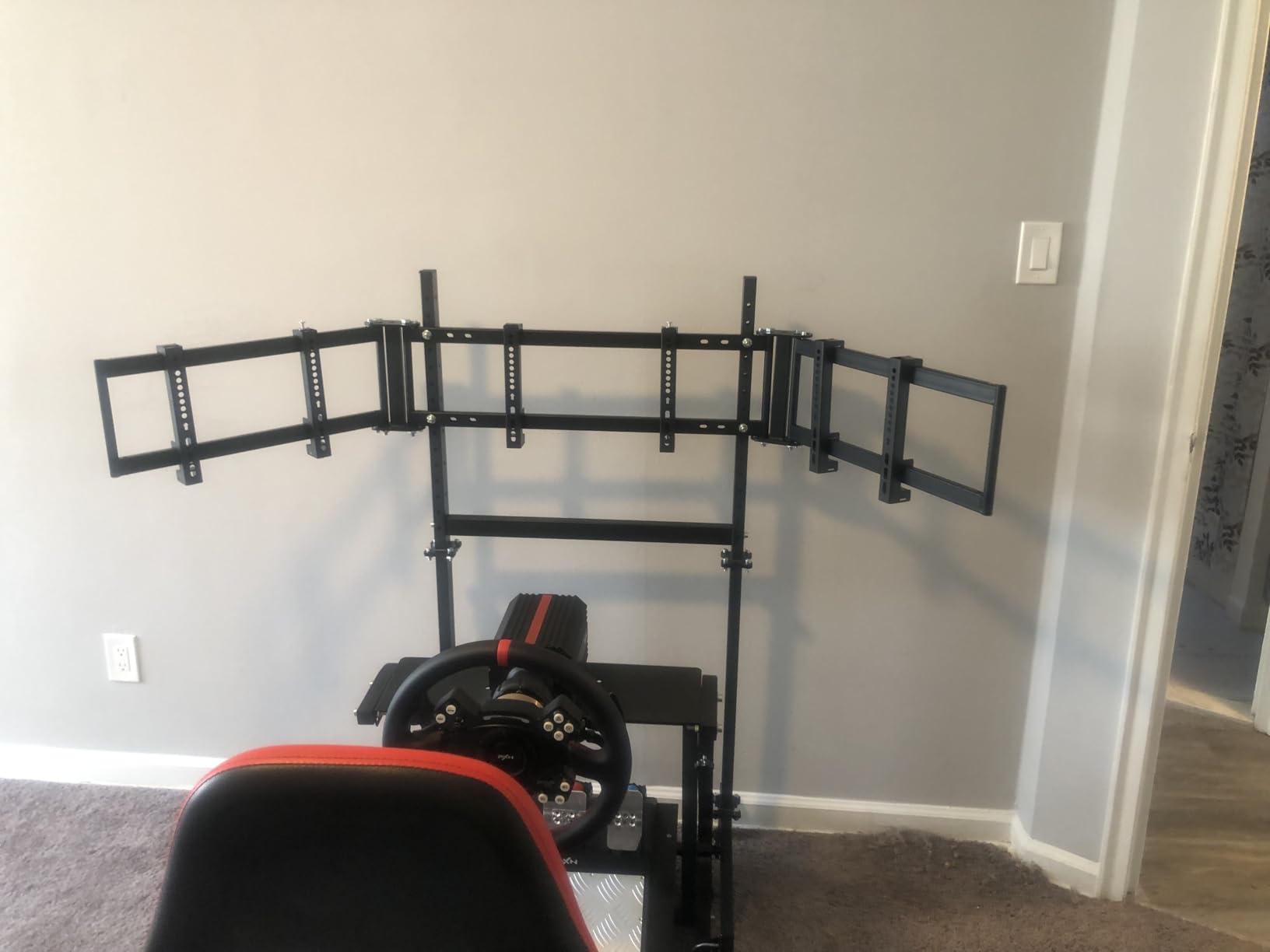
The honest weaknesses are in the details. Several owners found the included mounting hardware insufficient for their particular monitor and had to add spacers or longer bolts, a ten-minute fix if you have a hardware drawer, an annoying delay if you do not. The outer monitor arms can also develop a little movement over time, so re-tightening is part of ownership.
My other practical warning: set your angles and heights before the monitors go on. Once three panels are mounted, the clamp-based adjustments become genuinely awkward to reach, and this is the single most repeated gripe in the reviews.
For the price it is a sturdier, better-thought-out mount than it has any right to be, and it carries an Amazon’s Choice badge with a 4.0 star average across 56 ratings. Just go in knowing it is a solid B-grade performer rather than a stealth flagship.
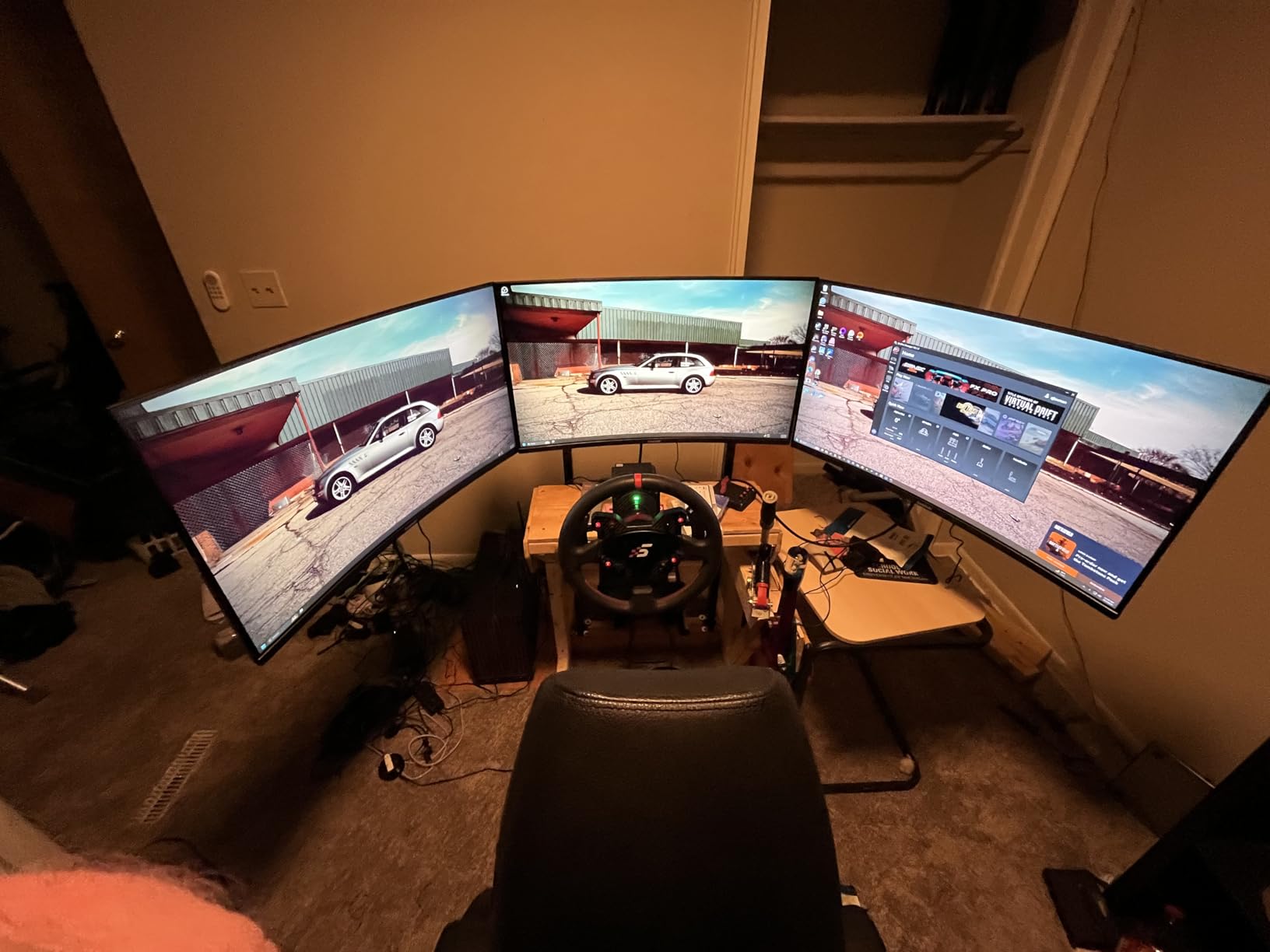
Will it clamp onto your cockpit tubing?
It fits round tube cockpit frames, so Playseat-class and similar folding rigs are the target. If your cockpit uses square aluminum profile, box section steel, or very thin tubing, choose a freestanding or profile-specific stand instead, because the clamps will not grip properly.
What monitor sizes work best on it?
Three 24 to 32 inch panels is the sweet spot, with 27 inch being the easiest to align. Pair it with lighter panels where possible, since lighter monitors put less strain on the clamps and reduce the outer-arm movement owners mention.
4. Marada Triple Monitor Stand with Wheels – Best Portable Option
Marada Sim Racing Triple Monitor Stand with Wheels for 24-32 inch Displays
27-32 inch triples
VESA 75x75/400x400
Locking casters
A-frame steel base
Pros
- 360 degree locking casters make it mobile
- A-frame base resists tipping
- Per-screen height and angle adjustment
- Simple assembly
- Genuinely affordable
Cons
- Frequently out of stock
- Stock hardware quality is mixed
- No front support leg
- Outer monitors can wobble
The Marada wheeled stand solves a problem nobody else in this guide addresses: moving your triple screen setup without disassembling it. Four 360 degree swivel casters with locking brakes let you roll the whole array out of the way when the living room needs to become a living room again, then lock it back in place for race night.
The A-frame base is a smart piece of design at this price. By spreading the load into a wide triangle, it keeps the stand stable even when you are sawing at the wheel during an intense stint, and it reduces the tipping risk you might expect from a tall wheeled frame. Steel construction throughout means it feels more substantial than its price suggests.
Each of the three screens gets its own height and angle adjustment, and the main pole is height adjustable too, so you can dial in a decent racing position. VESA support covers both 75×75 small-monitor patterns and 400×400 TV patterns, an odd but useful pairing that means it works with everything from 27 inch IPS panels to larger televisions.
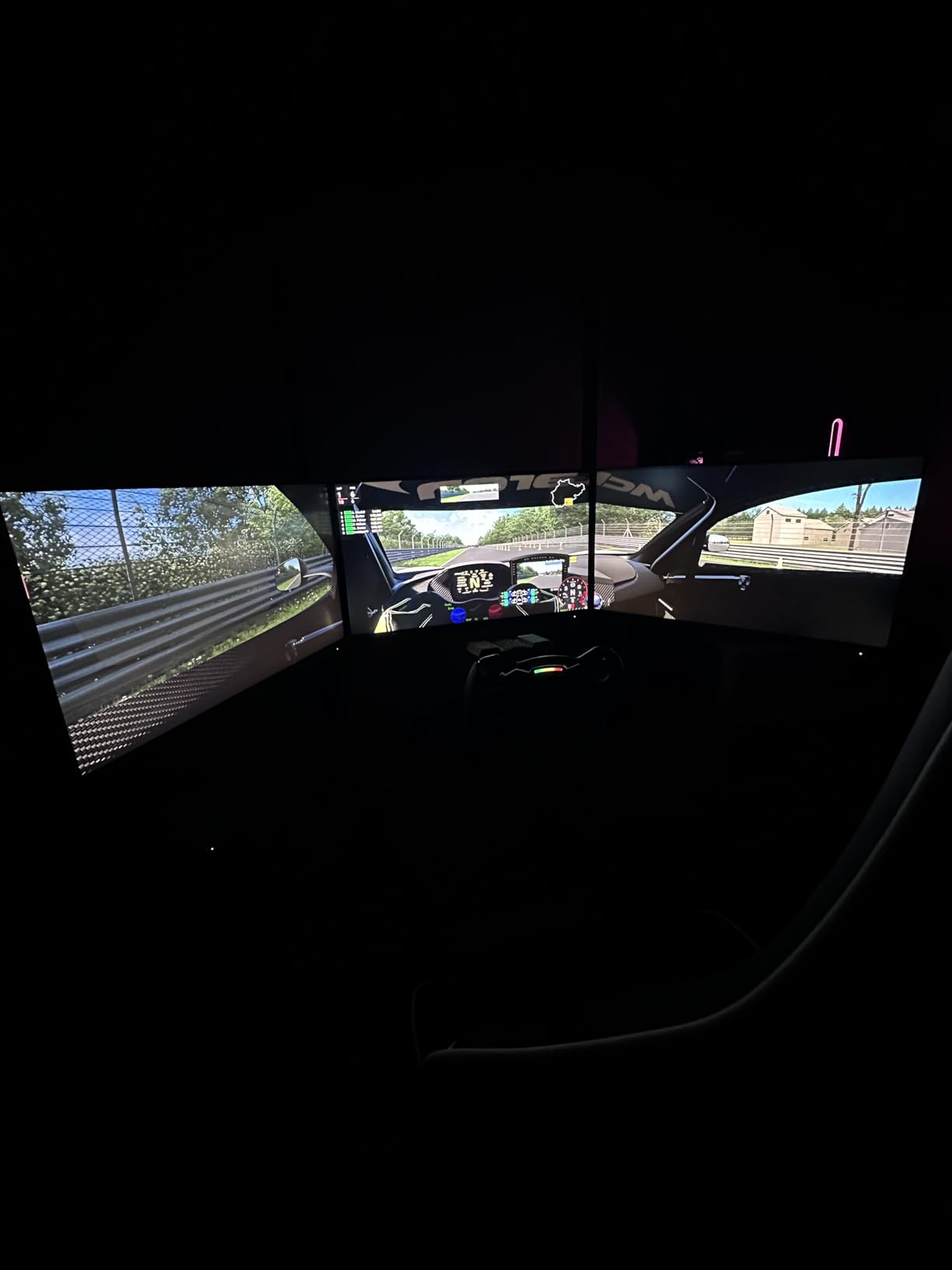
Now the honest part. This is a budget stand, and it behaves like one in specific ways. The included hardware has quality complaints, with some owners replacing bolts during the build, and the outer monitor arms can wobble noticeably during hard racing. Neither is a dealbreaker, but both are worth knowing before you order.
Floor protection is another gap. With no front support leg, parts of the frame can contact the floor directly, so owners with hardwood or vinyl recommend adding felt pads or a mat underneath. If you race on carpet, the casters will also sink slightly, which affects how easily the stand rolls.
Availability is the final issue: this model goes in and out of stock, and at the time of my research it was listed as unavailable with no return date. If it is out of stock when you read this, the Dardoo above is the closest alternative at a similar price, provided you have a round tube cockpit to clamp it to.
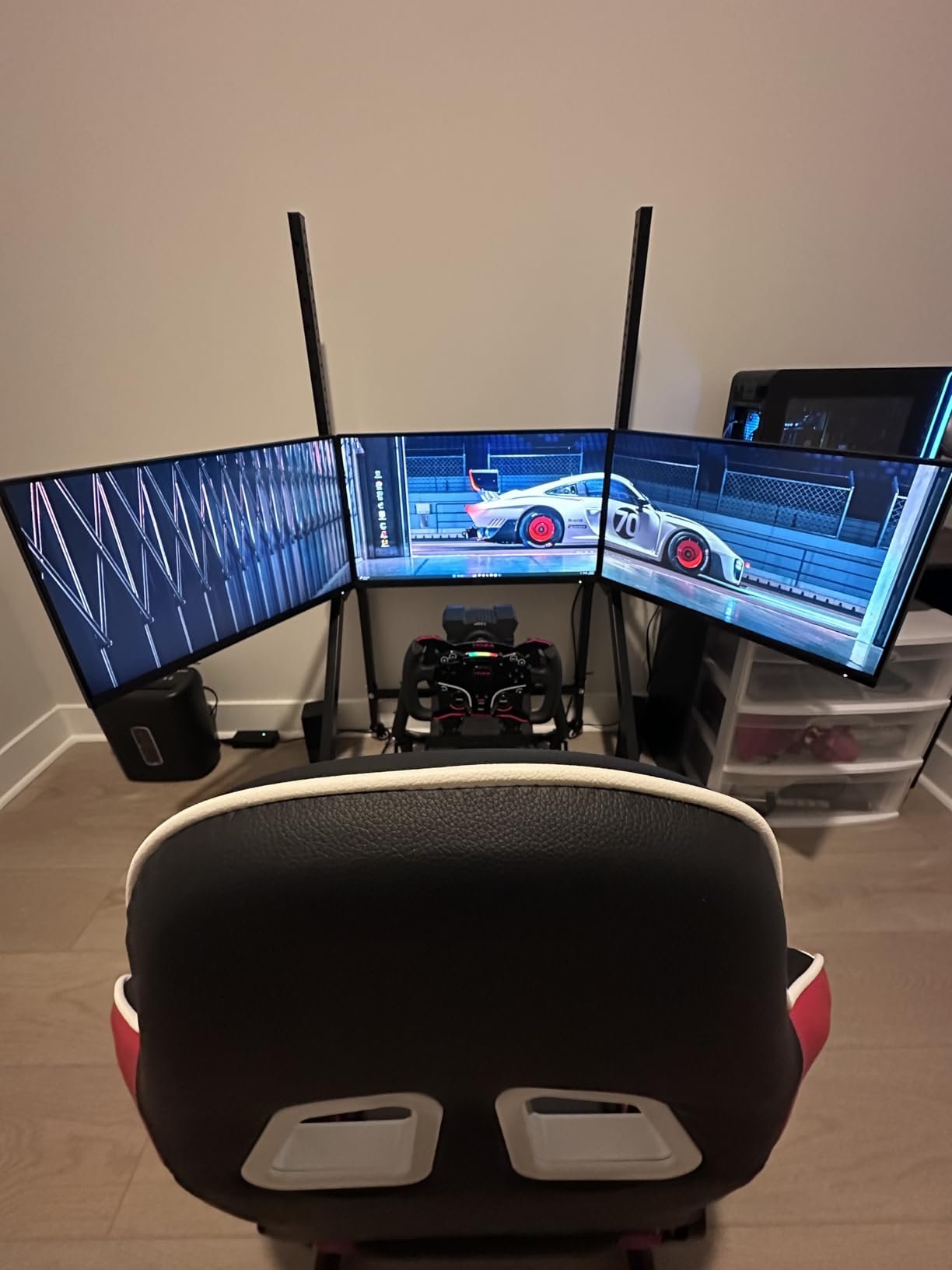
Is it stable enough for hard racing?
Stable enough for casual and mid-level racing with the casters locked, yes. For direct drive wheels with strong force feedback, expect some visible movement on the outer screens, and consider the SimFab or a cockpit-integrated mount if that would bother you.
Floor protection and mobility trade-offs
Add felt pads or a protective mat on hard floors, since bare frame metal can scratch. In exchange you get genuine mobility, which no other stand here offers, making it the pick for shared spaces and multi-use rooms.
5. Marada 8040 Aluminum Profile Cockpit Stand – Best Profile Rig Upgrade
Marada Aluminum Profile 8040 Cockpit Triple Monitor Stand for Sim Racing
24-32 inch triples
8040 aluminum profile
Infinitely adjustable
31.5 pound build
Pros
- Rigid 8040 aluminum profile construction
- Bolts directly to matching profile cockpits
- Infinitely adjustable height and width
- Free side monitor angle adjustment
- Prime shipping
Cons
- Only fits Marada 8040 cockpits
- Small review base of 12 ratings
- No third-party compatibility
This one is the specialist of the group. The Marada 8040 stand is a triple monitor mount built from 8040 aluminum profile, the same T-slot extrusion used in serious sim racing cockpits, and it is designed to bolt directly onto Marada’s own 8040 cockpit. If that sentence describes your rig, it is one of the cheapest ways to get a genuinely rigid triple mount.
The advantage of profile-based mounting is stiffness. Because the stand becomes part of your cockpit frame rather than leaning against it, force feedback energy has nowhere to rattle loose. Owners specifically praise it as direct-drive-safe, which is not a claim I would make about any clamp-on or lightweight freestanding stand at this price.
Adjustment is where the profile design shines. Height and horizontal width are infinitely adjustable along the T-slot channels rather than limited to drilled holes, and the side monitor angles are freely adjustable under three-screen mode. That means you can set your screens exactly where your FOV calculator says they should be, then move them a centimetre if needed.
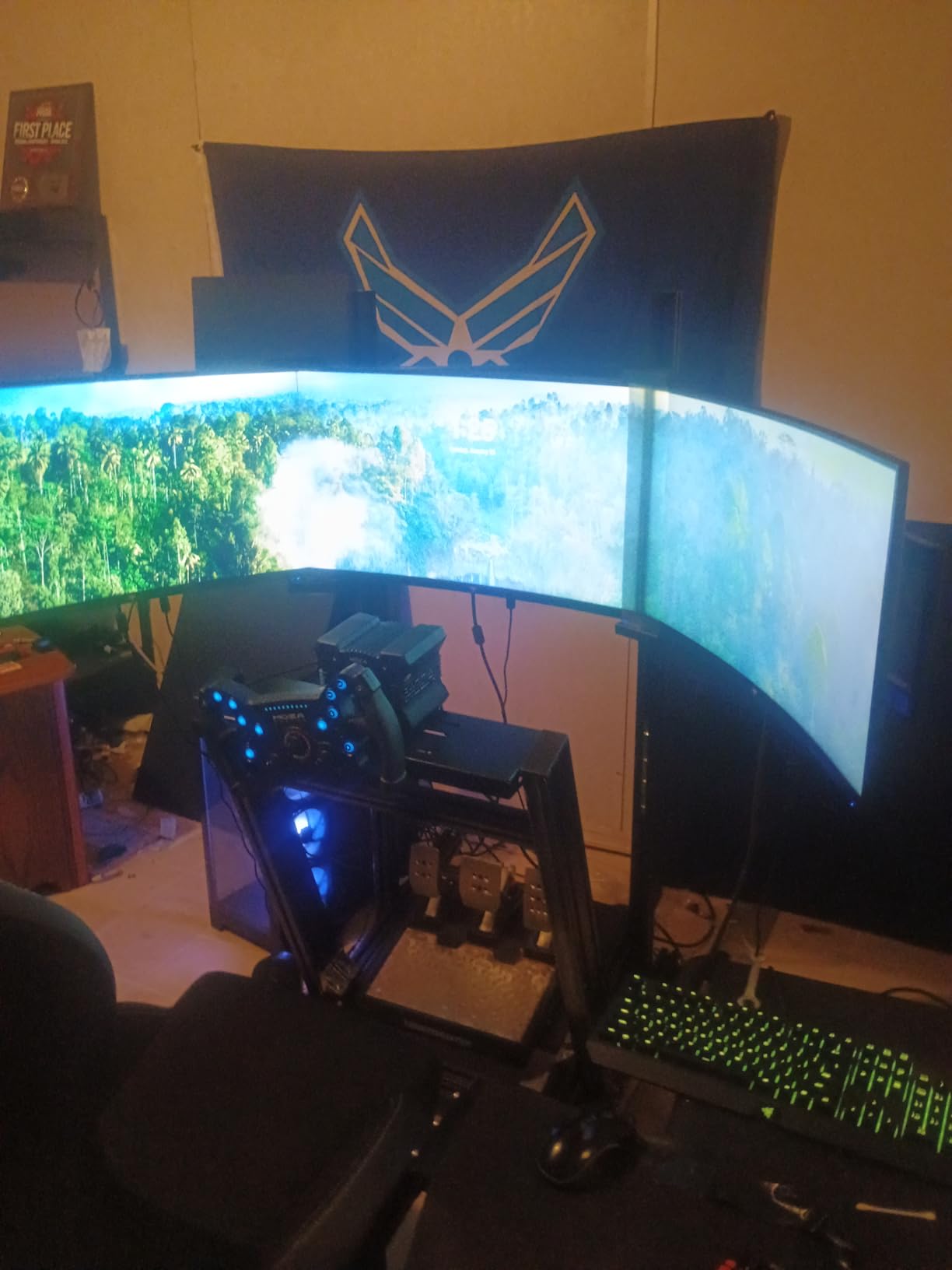
The catch is blunt: compatibility. This stand fits Marada 8040 cockpits and effectively nothing else. It is not a universal 8020 part, so Trak Racer, Sim-Lab, and GT Omega owners should look at the SimFab or the dedicated mounts those brands sell for their own profiles. Buying this for a different brand of rig is the kind of mistake that ends in a return shipment.
It supports a triple array of 24 to 32 inch screens or a single display up to 65 inches, so it covers the standard sim racing sizes comfortably. At about 31.5 pounds it is also the lightest stand here, simply because it uses your cockpit as its foundation instead of bringing its own floor frame.
The review base is small at 12 ratings, though the 4.0 star average is respectable and the feedback is consistent. Treat it as a promising niche option with a shorter track record than the SimFab or NLR rather than a proven category leader, and note that it ships Prime, which is a pleasant surprise in a category full of slow freight deliveries.
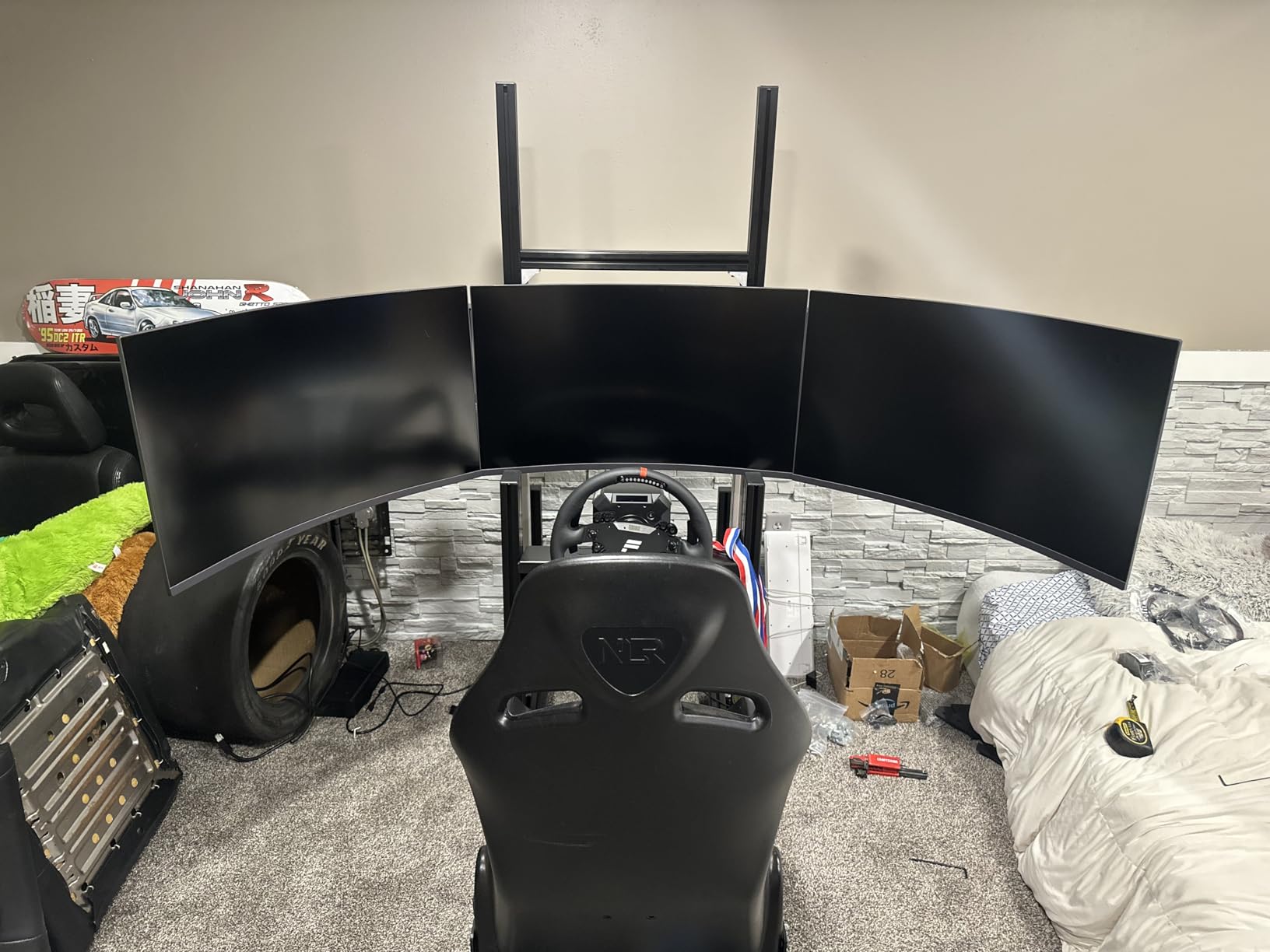
Is it compatible with your cockpit?
Only if you own a Marada 8040 profile cockpit. The standardized fast-install kit is designed around Marada’s slot dimensions and mounting points, so check your cockpit model number before ordering anything in this product family.
Adjustment range and setup time
Height and width slide anywhere along the profile channels, and side angles are freely settable, so fine-tuning your FOV takes minutes rather than a full rebuild. Setup is quick because the kit is standardized for its matching cockpit.
6. Thermaltake Triple Monitor Stand Pro – Best Tabletop Mount
Thermaltake Triple Monitor Stand Pro; Up to (x3) 32″ Curve or 34″ Flat; Powder Coated Steel; 920mm-1120mm Height Range; VESA Mounting; Racing Simulator Compatible; Black; GSC-MSP-MDSLBB-01
27-32 inch
Tabletop mount
Tilt to 60 degrees
8.4 pound alloy
Pros
- Sturdy steel-aluminum alloy build
- Full height tilt and angle adjustment
- Clean professional black finish
- Fits the popular 27-32 inch range
Cons
- Depth is not adjustable
- Requires a substantial desk
- Lowest rated here at 3.6 stars
- Very low stock
The Thermaltake Triple Monitor Stand Pro takes a third approach: it clamps to your desk rather than standing on the floor or bolting to a cockpit. For sim racers who run a wheel desk setup, or flight simmers who already sit at a battlestation, that is exactly the form factor needed, and Thermaltake is a brand with genuine PC hardware pedigree.
Build quality is a strong point. The steel-aluminum alloy construction feels stiff once properly torqued, the black finish looks clean in an office as well as a sim room, and the whole thing weighs only about 8.4 pounds. Height, tilt up to 60 degrees, and screen angle are all adjustable, which is a full adjustment set by desk-mount standards.
It fits the most popular sim racing monitor sizes, 27 to 32 inches, which covers the majority of triple setups people actually build. If you are running three matching 27 inch 1440p panels on a strong desk, it will hold them steadily and look tidy doing it.
Now the limitation that dominates its reviews: depth is not adjustable. You cannot move the screens closer to you or further away along the fore-aft axis, which matters enormously in sim racing where viewing distance drives your field of view. Owners repeatedly flag this as the reason the mount frustrates them, and it is why the rating sits at 3.6 stars across 11 reviews.
The other requirement is a substantial desk. A tabletop mount concentrates the weight and downward pull of three monitors plus the stand onto a single clamp point, so a flimsy particle-board desk will flex and can be damaged over time. If your desk wobbles when you type, this stand will make it wobble when you brake.
Stock is also critically low at the time of writing, with only a handful of units listed. If you specifically want a desk-mounted triple solution and find it available, it is worth considering despite the flaws, because there are very few mainstream alternatives in this format.
Do you have the desk depth for it?
You need a deep, solid desk and enough free surface for the clamp and the monitor arms. Measure from your seating position to the planned screen location first, because with no depth adjustment, your desk dimensions decide your viewing distance for you.
What you give up versus freestanding stands
You give up fore-aft positioning and the freedom to place screens independently of furniture, and you couple your monitors to your desk instead of your rig. In exchange you get a compact footprint, no floor legs to trip over, and a setup that disappears when you need the desk back.
How to Choose the Best Triple Monitor Stand for Sim Racing?
Picking the right stand comes down to four questions: what cockpit you have, how big your monitors are, how strong your wheel is, and how much room you can spare. Answer those in order and the shortlist usually narrows to one or two models immediately.
Freestanding vs cockpit-integrated mounts
Freestanding stands like the SimFab, Next Level Racing, and wheeled Marada sit on the floor and straddle your rig, so they work with any cockpit and even with no cockpit at all. Cockpit-integrated mounts like the Dardoo and the Marada 8040 attach to your rig’s frame, which makes them stiffer and more compact but locks you into a compatible cockpit design.
The general rule from both my experience and community consensus: if you run a strong direct drive wheel base, cockpit-integrated or heavy freestanding steel wins because it resists vibration transfer. If you change rigs often or race on a wheel stand, freestanding is more flexible and survives your next upgrade.
Check your VESA pattern before you order
VESA is the square bolt pattern on the back of your monitor, and mismatched patterns are the number one ordering error in this category, a pain point that comes up constantly in forum threads. Common sizes are 75×75 and 100×100 for smaller monitors, then 200×100 and 200×200 for larger screens and some 32 to 43 inch panels.
Look up your exact monitor model’s VESA size in its manual or spec sheet, then match it against the stand’s supported range. The Next Level Racing stand covers the widest spread from 75×75 to 200×200, the Dardoo reaches up to 400×200 for TV-style panels, and the SimFab tops out at 100×100, so 200×200 monitor owners must avoid the SimFab or budget for an adapter plate.
Monitor size: 27 or 32 inch triples
Three 27 inch monitors is the sweet spot for most racers: enough width for immersion, lighter panels that are easier to align, and lower demands on the stand. Three 32 inch screens increase immersion and are easier to read at distance, but they add weight and outward pull on the arms, which is where cheap stands start to sag and wobble.
If you are going 32 inch or larger, prioritize stands with front leg supports, heavy steel or profile construction, and high weight capacity per screen. That points you toward the SimFab, the Next Level Racing Elite for up to 43 inches, or a brand-specific integrated mount rather than the budget tier.
Rigidity and direct drive vibration
Every Newton-metre of torque from your wheel base has to go somewhere, and on flimsy stands it goes straight into your monitors. Owners of 15Nm and stronger direct drive bases report visible screen shake on lightweight mounts, which is both distracting and genuinely bad for judging car behaviour over kerbs.
Three features resist vibration: mass, frame geometry, and decoupling from the rig. Heavier steel stands and T-slot profile mounts score highly on the first two, while freestanding designs naturally decouple your screens from wheel inputs since they never touch the cockpit. That decoupling is the reason many racers deliberately choose freestanding even when their cockpit could accept an integrated mount.
Small rooms and floor space
Triple monitor stands are big, and almost no competing guide covers compact setups properly. A freestanding triple frame typically needs floor space as wide as your screen array plus legs, so measure the footprint, not just the height, before you order.
For tight rooms, look for adjustable leg spread like the SimFab’s, desk mounting like the Thermaltake, or the wheeled Marada that rolls away entirely between sessions. Cockpit-integrated mounts are the most space-efficient of all because they add almost zero floor footprint beyond your existing rig.
Budget stands vs premium: when to upgrade
Budget stands make sense when you are running belt-driven or entry-level direct drive wheels, lighter 24 to 27 inch monitors, or you are still experimenting with whether triples suit you at all. The Dardoo and Marada options fill that role honestly, and multiple Reddit users recommend starting cheap and upgrading later.
Upgrade to the premium tier when you add a serious direct drive base, move to 32 inch or larger panels, or start caring about bezel-precise alignment and long-term durability. The jump from a budget Amazon stand to a SimFab or Sim-Lab class mount is immediately noticeable according to many owners, and the lifetime warranty on the SimFab changes the long-term maths considerably.
How to Position Triple Monitors for the Best Sim Racing FOV?
Correct positioning matters as much as the stand itself, because a perfectly rigid mount with the wrong geometry still produces a distorted view. Follow this sequence once your stand is assembled.
1. Set your seat and wheel first, then position the monitors around your final driving posture, never the other way round. Your eye line in your normal driving position is the reference point for everything else.
2. Place the centre screen so your eyes line up with its vertical centre, at a distance of roughly 90 to 110cm for 27 to 32 inch panels. You should be able to see the whole screen without moving your head.
3. Angle the side monitors toward you, commonly between 45 and 60 degrees depending on panel size and distance, so all three screens sit at an equal distance from your eyes. Equal distance is what lets triple-screen software render one continuous image.
4. Align the bezels so the picture flows across all three panels, using the micro-adjustments on stands like the SimFab to close any height or roll mismatch. A small magnetic level, which SimFab includes, speeds this up enormously.
5. Run the triple-screen setup in your title of choice, whether that is iRacing, Assetto Corsa, or a console racer, and enter your measured distances and angles. Then do a few laps and refine, because a calculated FOV is a starting point rather than gospel.
Frequently Asked Questions
What triple monitor setup is best for sim racing?
Three identical 27 inch monitors at 1440p is the best all-round triple setup for sim racing, because matching panels align cleanly, render one continuous image, and are easy for stands to carry. Three 32 inch screens are a strong upgrade if you have the floor space and a heavy-duty stand, and some racers go as large as three 43 inch panels on a freestanding frame like the Next Level Racing Elite.
What is the best monitor stand for sim racing?
The SimFab GEN2 Triple Monitor Floor Stand is the best monitor stand for sim racing overall, with a 4.6 star rating from 105 reviews, micro-adjustable bezel alignment, and a lifetime warranty. For large screens up to 43 inches, the Next Level Racing Elite Free Standing Stand is the better choice, and for round tube cockpits on a budget, the Dardoo clamp-on stand offers the best value.
What are the best monitor stands for 3 monitors?
The best stands for three monitors are the SimFab GEN2 for all-round quality, the Next Level Racing Elite for screens up to 43 inches, the Dardoo for round tube cockpits, the wheeled Marada for portable setups, the Marada 8040 for matching profile cockpits, and the Thermaltake Pro for desk mounting. Choose based on your cockpit type, monitor size, and VESA pattern rather than price alone.
What is the best size triple screen for sim racing?
Three 27 inch monitors is the best size for most sim racers, balancing immersion, desk-free positioning, and stand compatibility. Three 32 inch panels suit larger rooms and stronger stands, and competitive racers often prefer the wider wrap of bigger screens, but anything beyond 32 inches per panel demands a heavy freestanding stand with leg supports to prevent sag.
Does a monitor stand reduce vibration from a direct drive wheel?
Yes, a freestanding monitor stand reduces perceived vibration because it never touches the cockpit, so force feedback energy is not transferred into the screens. Heavy steel stands and T-slot profile mounts also resist vibration through sheer rigidity, while lightweight or clamp-on mounts transfer more movement and can show visible wobble with strong direct drive bases.
Final Verdict: The Best Triple Monitor Stands for Sim Racing
If you want the short version of this whole guide: buy the SimFab GEN2 if you want the best triple monitor stand for sim racing full stop, buy the Next Level Racing Elite if your screens are 40 inches or bigger, and buy the Dardoo if you are clamping to a round tube cockpit on a budget.
My own ordering advice is unchanged from the start of this article: match the stand to your cockpit type first, your monitor size and VESA pattern second, and your wheel’s strength third. Get those three right and almost any stand in this lineup will hold your triples exactly where your FOV needs them, lap after lap.
Whichever you pick, measure your monitors’ VESA holes and your floor space before you order, and check stock on the Next Level Racing and Thermaltake units since both run low regularly. Then enjoy the moment three screens snap into a single wraparound windscreen, because that is the moment your rig finally feels like a race car.