
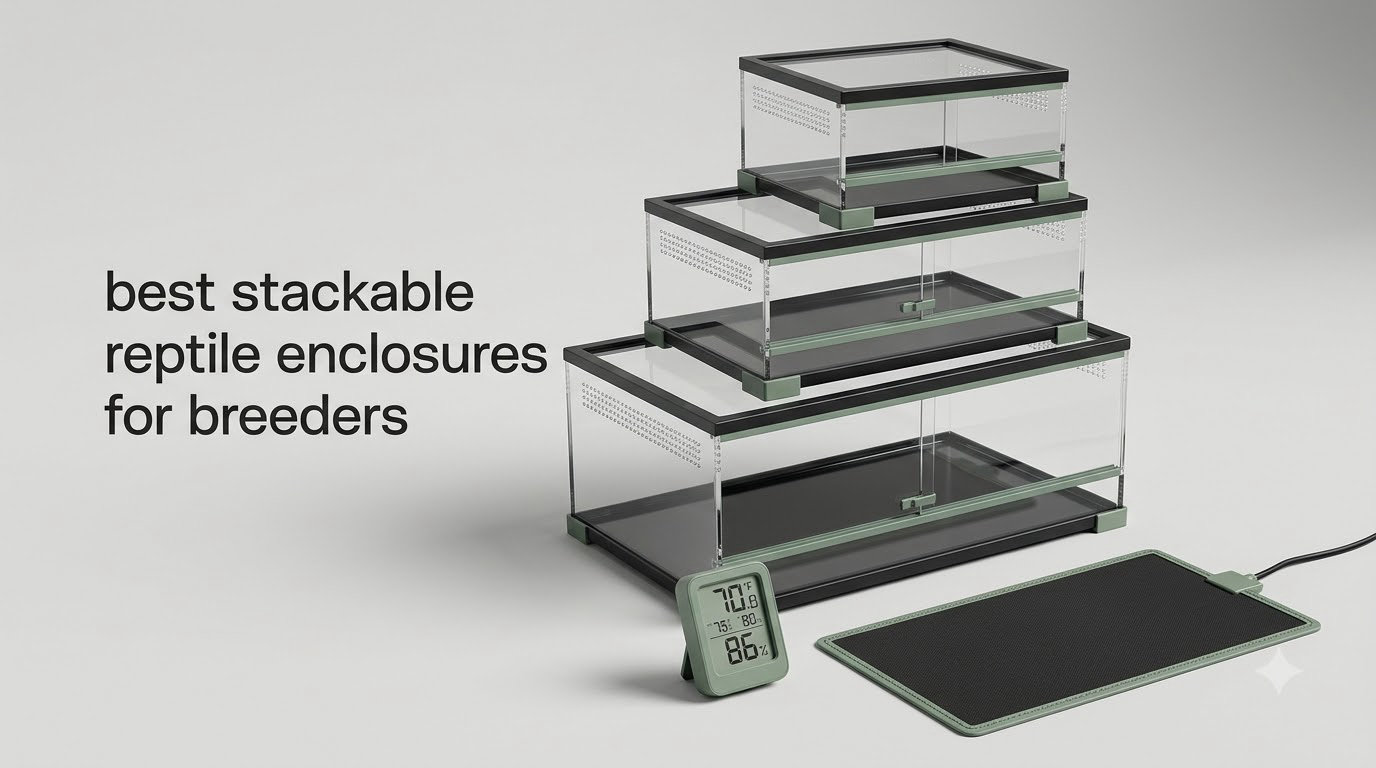
Most breeders do not actually use stackable reptile enclosures. They run wire drawer racks with solid-coloured tubs, house dozens of animals in a single column, and quietly accept that the animals are never seen. A stackable enclosure is the alternative: a front-opening habitat that locks onto an identical enclosure above or below it through moulded pin-slot stacker posts, a spacer kit, or interlocking clips, so the vertical column still gives you viewing, front access, and a separate climate in every level. That difference is not cosmetic. It decides whether a colony animal is checked properly or merely counted.
We compared nine genuinely stackable enclosures for this guide, filtering out single terrariums marketed as stackable, rack accessories sold on their own, and near-duplicate listings of the same model. What remained is a small category, and honesty means telling you upfront that nine is the real number for breeders, not a padded list of ten. Ratings in this niche are thin and inconsistent, so we leaned on specifications, build detail, and what multi-animal keepers report back after the honeymoon phase rather than on star scores alone.
Our short answer on the core question: yes, you can stack reptile enclosures, but only when each level has its own independent heat source, thermostat, and ventilation. Heat rises into the tier above, so a stack that shares room heat will cook the bottom animal and chill the top one. Below we cover the rack-versus-stack decision, thermal bleed between levels, material choice, and a nine-product field that covers everything from insect-scale breeding boxes to full 4x2x2 adult enclosures. This guide was updated for 2026.
Table of Contents
Top 3 Stackable Reptile Enclosures for Breeders in 2026
Our top three cover the three ways breeders actually buy: a single high-quality adult enclosure that stacks later, a two-tier glass rack for animals that need to be seen, and a low-cost batch unit for invertebrates and juveniles. The Phailozoo 4x2x2 takes the top slot on the strength of its 758-review base and the highest average rating in the group, and it is the enclosure we would put a breeding pair into first. The CAVACHEW double-deck glass unit is the strongest full-visibility option, and the Reptile Growth no-assembly box is the entry point for anyone running dozens of small animals.

Phailozoo 120 Gallon 4x2x2
- True 4x2x2 footprint
- Tempered glass sliding doors
- Mesh top at 28 percent shade
- Stacks with brand V2 stackers

CAVACHEW Double 34 Gallon…
- Two 34 gallon glass tiers
- Locking sliding doors
- Knock-down build
- Splits into two tanks
Reptile Growth No-Assembly…
- No assembly required
- Magnetic sliding lid
- Four stacking columns included
- Clear PC walls
The 9 Best Stackable Reptile Enclosures at a Glance
The table below lists every enclosure in this guide with its most decision-relevant features. Dimensions are exterior unless the brand states otherwise, and every product here was confirmed as genuinely stackable, either as a factory double-deck or as a unit designed to lock onto an identical enclosure.
| Product | Specs | Action |
|---|---|---|
| Phailozoo 120 Gallon 4x2x2 Stackable Enclosure |
|
Check Latest Price |
| Reptile Growth No-Assembly Stackable PC Unit |
|
Check Latest Price |
| CAVACHEW Double Stacked 34 Gallon Glass Tank |
|
Check Latest Price |
 ToxiRium 120 Gallon PVC 2-Pack ToxiRium 120 Gallon PVC 2-Pack |
|
Check Latest Price |
 ToxiRium 76 Gallon PVC 2-Pack with Spacers ToxiRium 76 Gallon PVC 2-Pack with Spacers |
|
Check Latest Price |
 ToxiRium 120 Gallon with Combination Lock ToxiRium 120 Gallon with Combination Lock |
|
Check Latest Price |
 New Age Pet ECOFLEX Two Medium with Stacker New Age Pet ECOFLEX Two Medium with Stacker |
|
Check Latest Price |
 CAVACHEW Double Stacked 20 Gallon Glass Tank CAVACHEW Double Stacked 20 Gallon Glass Tank |
|
Check Latest Price |
 New Age Pet ECOFLEX 60 Inch Mojave XL New Age Pet ECOFLEX 60 Inch Mojave XL |
|
Check Latest Price |
Two patterns jump out immediately. First, the large enclosures in this category run to a 4x2x2 footprint of 48 by 24 by 24 inches and weigh 39 to 50 pounds each, which means a two-tier stack is a genuinely heavy object that needs planning around. Second, the cheapest entries are not serious breeding enclosures at all. They are insect and juvenile boxes, and they are useful only if that is what you are keeping.
Brands in this roundup split into three camps. Phailozoo and CAVACHEW build around a metal or aluminium frame with glass, New Age Pet uses an ECOFLEX composite, and ToxiRium builds in solid PVC. Reptile Growth is a different category entirely, a clear polycarbonate box for invertebrates. The material difference is the single biggest factor in how these enclosures handle heat, humidity, and a five-year lifespan, and we break it down further down.
1. Phailozoo 120 Gallon 4x2x2 – Best Overall for Ball Python Breeders
Phailozoo 120 Gallon Reptile Tank, Stackable 4x2x2 Reptile Enclosure
48 x 24 x 24 inch footprint, 44 lb
PVC frame and tempered glass doors
Mesh top with 28 percent shade
Pros
- Metal-bolt frame with tempered glass sliding doors
- Assembles in under an hour for most owners
- Front-opening doors make feeding and spot cleaning simple
- True 4x2x2 footprint suits adult ball pythons and beardies
- Snug-fit build holds temperature and humidity
Cons
- Sliding glass doors have no locks
- Side panels are plexiglass rather than tempered glass
- Bottom is silicone sealed for strength and is not leakproof
This is the enclosure we keep coming back to because the 4x2x2 footprint is the one number that changes husbandry. At 48 by 24 by 24 inches, an adult ball python has room to stretch out along the long axis instead of curling permanently, and a juvenile beardie gets a real ground area rather than a token. For a breeder, that means fewer animals pushed into undersized housing as they grow, which is the single most common welfare failure in rack-style operations.
Assembly was the first thing we checked, and it passed. Owners consistently report an hour or less, with some finishing in under fifteen minutes, because the metal-bolt frame tightens with hardware rather than glue or plastic clips. That matters more than it sounds. A breeder who assembles enclosures during a single weekend can get a full stack running the same day rather than discovering a stripped corner two weeks later.
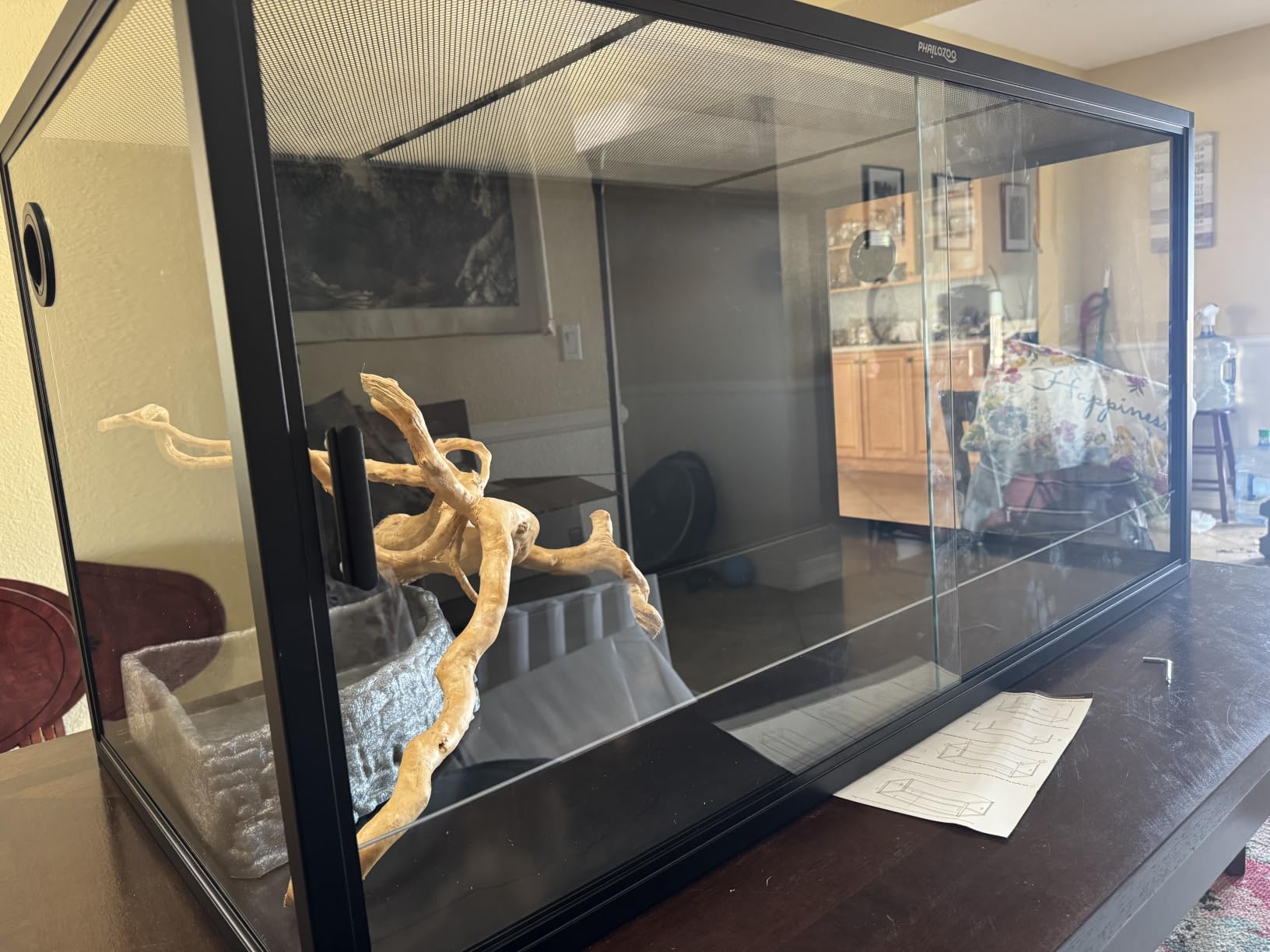
The front-opening sliding tempered glass doors are the feature that separates this from a top-loading bin. You can spot-clean, offer food, and check a coil without moving the animal, which is the difference between a five-second check and a two-minute extraction. The handle design reduces fingerprints, a small thing that tells you the panel was designed for repeated daily handling rather than a single photo.
Two things to know before you commit. The doors have no locks, and ball python owners routinely add adhesive refrigerator or baby-safety latches as a first mod, so budget for that. The side panels and the lower front strip are plexiglass rather than tempered glass, and buyers report visible wear on those surfaces after a few years of use, so inspect them annually if you run a humid room.
Why breeders pick this enclosure
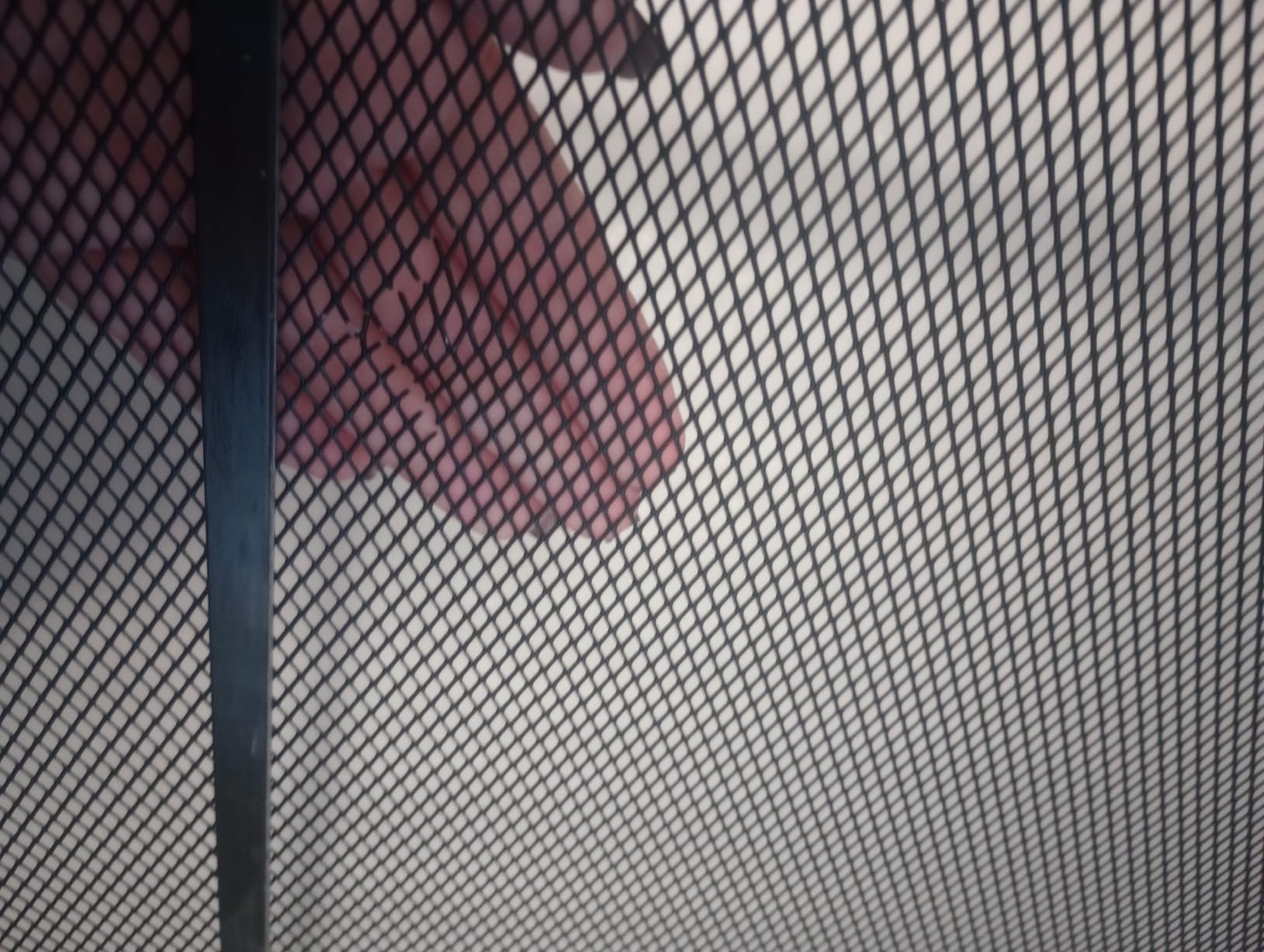
The reason multi-unit buyers describe it as their go-to enclosure is the combination of a 4x2x2 interior, front access, and a mesh top rated at 28 percent light blockage. That top blocks enough light to reduce heat gain in a stacked column while still passing UVB and basking wavelengths, which is a genuinely useful compromise in a room where the tier above is only a few inches away.
It also takes standard reptile heat lamps, humidifiers, misters, and foggers without modification, and the substrate barrier at the bottom stops a snake from flinging medium across the room. For a breeding program that means you can house a pair, cycle them, and move on without customising the box first. Breeders who want heat emitters pre-installed at the factory will not get that here, but the standard fixture fit means you can add and move emitters yourself as the season changes.
Where it falls short
The build is an assembly-style design, and that means it is not watertight out of the box. The silicone seal on the bottom is there for structural strength, not for holding water, so a bioactive setup with a drainage layer needs re-sealing before you pour anything into it. Budget an afternoon and a tube of aquarium silicone.
Stacking is brand-specific. The enclosure locks to Phailozoo V2 stackers, and those stackers do not fit other brands, so you cannot mix this with a ToxiRium or a CAVACHEW unit in the same column. That is fine if you commit to one system, and frustrating if you were hoping to mix brands to hit a particular footprint. Measure the exterior width carefully too, since the outside dimension runs slightly larger than the glass-to-glass figure most keepers quote.
2. Reptile Growth No-Assembly PC Unit – Best Budget Stack for Insects and Juveniles
【No Assembly】 Reptile Tank Enclosure with Magnetic Button.12″ * 8″ * 6″ Thicken Snake Enclosure Cage,Batch Stackable Reptile Breeding Tank for Insect,Fish,Tarantula,Hermit Crab,Jumping Spider
12 x 8 x 6 inch clear PC, 2.2 lb
Magnetic sliding lid
Four stacking columns included
Pros
- No assembly needed straight from the box
- Magnetic lid keeps feeding access simple
- Includes four stacking columns for batch setups
- Over 98 percent transparent PC walls
- Ventilation holes on the sides and top
Cons
- Stacking columns can snap under load
- Lid and magnetic buttons feel thin
- Occasional reports of injection cracks
If your breeding programme is tarantulas, beetles, hermit crabs, or juvenile reptiles under about a foot long, this is the enclosure you will actually buy in quantity, and nothing else on this list serves that purpose. It is a one-piece moulded polycarbonate box with a magnetic sliding lid, and it arrives ready to use. There is no frame to assemble, which means an afternoon of building twenty enclosures becomes twenty minutes of unwrapping.
The polycarbonate is specified at over 98 percent transparency with low yellowing, rated from minus 20 to 120 degrees Celsius, and the walls are described as explosion-proof and anti-drop. That temperature range is genuinely relevant for breeders, because a basement reptile room in summer can swing hard and a box that clouds or cracks during a heat wave ends a season’s work.
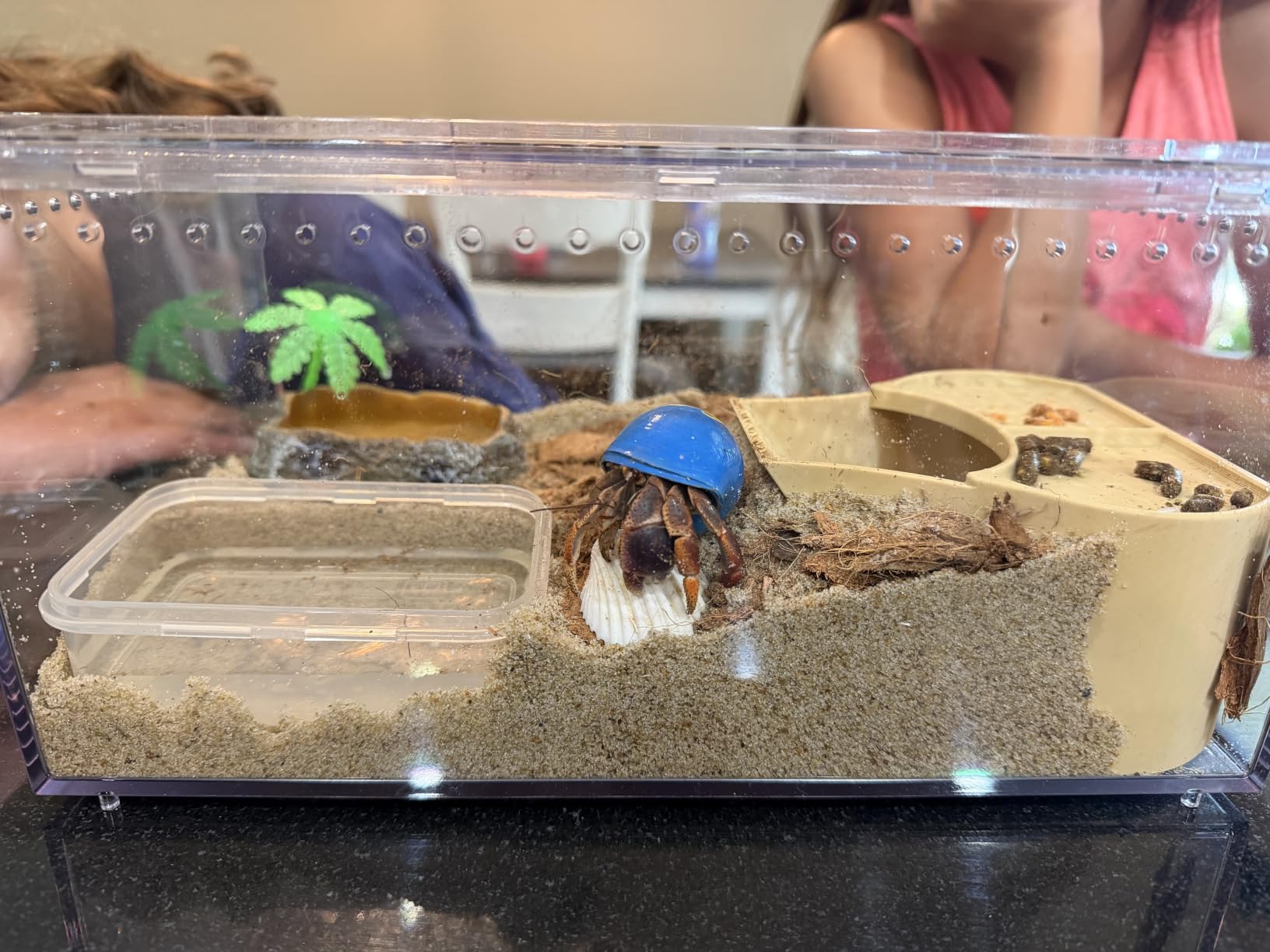
Ventilation holes are moulded into the sides and the top, which is a cross-ventilation pattern rather than a single opening. That matters for humidity control in a small box, because a magnetic lid gives you almost no ventilation on its own and a single hole creates a stagnant pocket. The box also ships with a water dish and metal tongs, which sounds trivial until you are setting up thirty of them.
The batch stacking claim comes from four included stacking columns. The columns are what let identical boxes sit one on top of another, and the magnetic lid stays closed through the stack rather than being removed to reach the animal below. The real question is whether the columns will take the load, and that is where the reviews split.
Why breeders pick this enclosure
The economics are the argument. When you are breeding something that produces dozens of offspring per cycle, per-enclosure cost dominates everything else, and this is the cheapest genuine stacking unit in the guide. The transparent walls also give you a 360-degree view, which lets you check an animal without opening the lid and losing humidity or risking an escape.
It suits a wide range of taxa. Buyers use it for tarantulas, beetles, small turtles, snails, frogs, small snakes, hermit crabs, insects, and juvenile reptiles, and the manufacturer backs it with a replacement or refund warranty. For quarantine intake of a dozen small animals, it is hard to beat.
Where it falls short
The stacking columns are the weak link, and a meaningful number of owners report them snapping under load and abandoning the stack feature entirely. If you plan to run more than two high, use a proper stand and treat the columns as an alignment guide rather than a structural member. The lid and the magnetic buttons also feel thin to some buyers, which limits how much you should trust the seal on a room with a swinging door.
There are also isolated reports of injection-hole cracking and moulded holes that are not punched fully through, plus a note that a larger variant of this box is described as cloudy with a poorer fit. Inspect each unit and test airflow before you commit a whole stack to it. This is a starter-level breeding box, not an adult enclosure, and treating it as one keeps the disappointment small.
3. CAVACHEW Double 34 Gallon Glass Rack – Best Value Full-Visibility Stack
CAVACHEW Double Stacked Reptile Tank, 24″ x 18″ x 44″ Tall Reptiles Terrarium, Front Opening, Full Vision, Knock Down, 2 Pack 34 Gallon Glass Cage for Reptile, Bearded Dragon, Lizard, Snake, Gecko
24 x 18 x 44 inch double deck, 54 lb
Two 34 gallon glass tanks
Glass door lock
Pros
- True double-deck configuration in one footprint
- Tempered glass on all sides for full observation
- Knock-down assembly with labeled panels and tools
- Sliding doors carry a glass lock
- Can be split into two separate tanks
Cons
- Sliding doors rattle in the lower track
- Loose substrate collects in the door track
- Some boxes arrive with fibre dust to wipe away
This is the enclosure to buy when visibility is the deciding factor. The whole 24 by 18 by 44 inch column is tempered glass on all four sides plus a thin wire top screen, so you are looking at the animal through glass from the front, both sides, and the back. A breeder running a display tier above a rack, or anyone who wants to actually watch behaviour rather than infer it, gets that here and nowhere else in this guide at a two-tier footprint.
It arrives as a knock-down kit with labeled panels and included tools, which means the double-deck configuration is optional. You can build it as one 68 gallon habitat or split the two 34 gallon sections apart and use them as independent tanks on separate stands, which is a genuinely useful property if your collection changes shape. The rotating fixed cable pass structure holds lighting and heating lines in position rather than letting them slip against the glass.
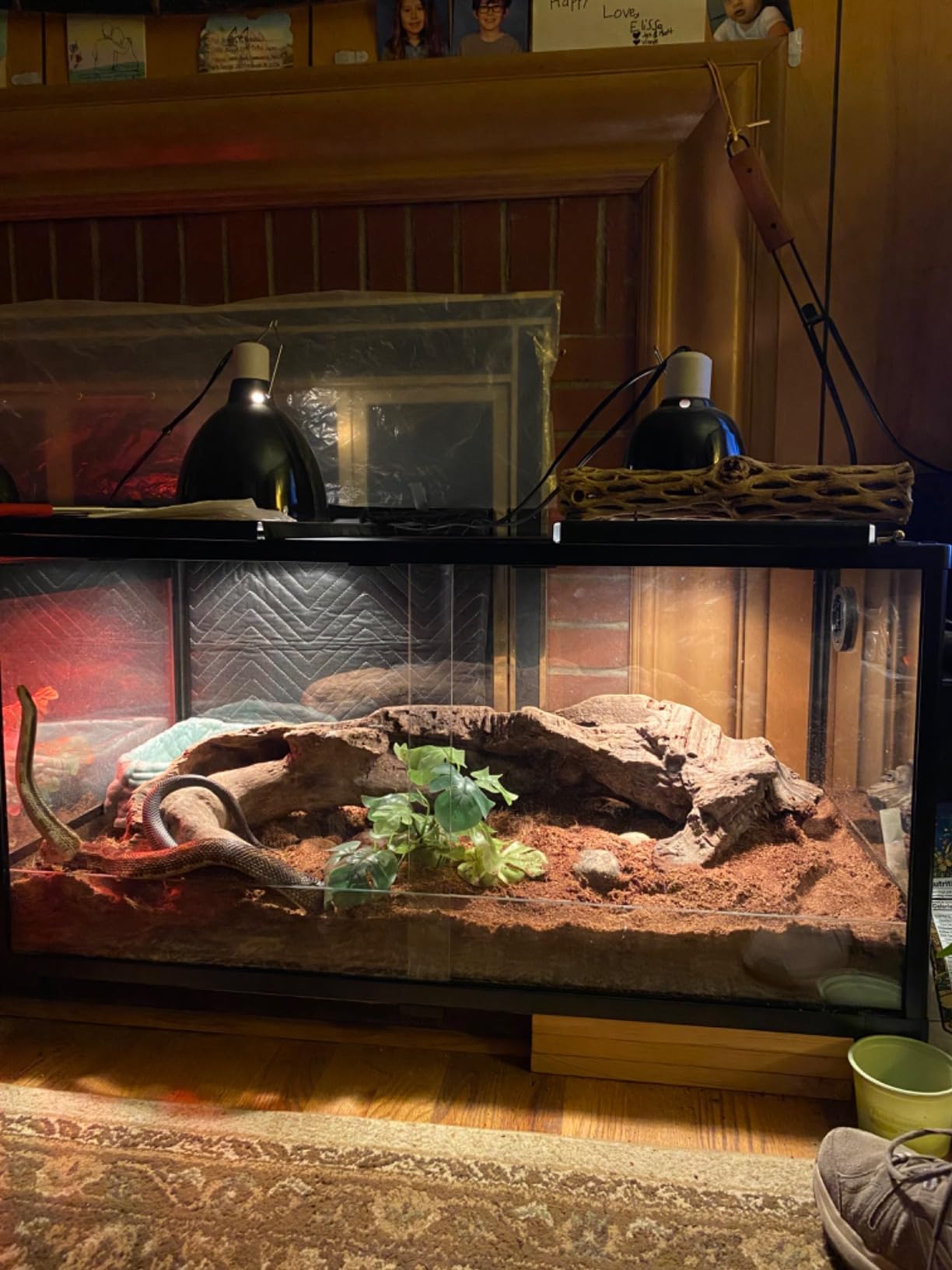
The detail we like most is the glass lock on the sliding doors. Lockable doors on a stacked glass rack are unusual, and they matter more than they might seem, because a stacked rack sits in a corner where a door that drifts open is the difference between a contained animal and a lost one. The wire top screen also lets UVB and infrared lighting penetrate, so a basking fixture mounted above the upper tier reaches the lower tier’s animal without removing the screen.
Reviewers consistently praise how the finished rack looks, which is not a frivolous point in a reptile room where the enclosure is often the largest visible object. Buyers with multiple animals describe it as an efficient way to get two viewing habitats into the footprint of one deep tank.
Why breeders pick this enclosure
Two 34 gallon enclosures in one column solves a real problem in a small reptile room. Where a wire rack gives you ten animals and zero views, this gives you two animals you can observe without opening anything, which is a genuine improvement in both welfare perception and daily husbandry. It also scales down cleanly, since you can peel the tiers apart as animals outgrow the size.
The tempered glass on all sides is a durability argument too, in a category where plexiglass scratches. For a two-tier unit weighing 54 pounds, the glass body is rigid enough that the doors and frame stay square, and the top screen gives you ventilation and lighting penetration in one part.
Where it falls short
The complaints are mechanical rather than structural, which is how you read a well-built product that has small moving parts. Sliding glass doors can rattle in the lower track, and owners add cotton or tape to stop the noise. Loose substrate falls into that same track, which needs clearing out before the doors will slide smoothly, and that is an extra step every time you spot-clean.
Some boxes arrive with loose dust or fibre residue on the panels that has to be wiped away before assembly, so plan to do that outside rather than over your floor. A minority of buyers report doors that stick or fall out of the frame within weeks, and a few find the lock and door fit awkward to operate. Check the door action the day it arrives, because that is the part that decides whether this rack works for you.
4. ToxiRium 120 Gallon 2-Pack – Best for Adult Beardies and Large Snake Pairings
ToxiRium 120 Gallon PVC Reptile Enclosure 48″x24″x24″ 2-Pack – Stackable Space-Saving Tank with Front Sliding Glass Doors & Lock for Bearded Dragon, Snake, Gecko (White Panels)
48 x 24 x 24 inch per enclosure, 50 lb
120 gallon interior each
PVC with sliding glass doors
Pros
- Two 120 gallon PVC enclosures as a matched pair
- PVC panels hold heat and humidity better than glass
- Sliding glass doors with an integrated lock
- Modular design expands vertically for a breeder room
- Interior fits hides branches and enrichment
Cons
- Newer listing with a thinner review base
- Entry cost for the pair is high
This is the pair to buy if you are running adult bearded dragons or pairing larger snakes and want each animal in a full 4x2x2 with a door that locks. Each enclosure measures 48 by 24 by 24 inches, giving a 120 gallon interior, and the two ship as a matched set specifically intended to be built into a vertical breeder stack rather than placed side by side.
The PVC panel build is the reason to choose this over a glass equivalent. PVC holds heat and humidity more consistently than glass, and at 50 pounds per enclosure it is light enough to lift into place on its own rather than needing a second person. For a breeder assembling a room over a weekend, moving a 50-pound box up onto a stacker is a very different task from wrestling a comparable glass tank.
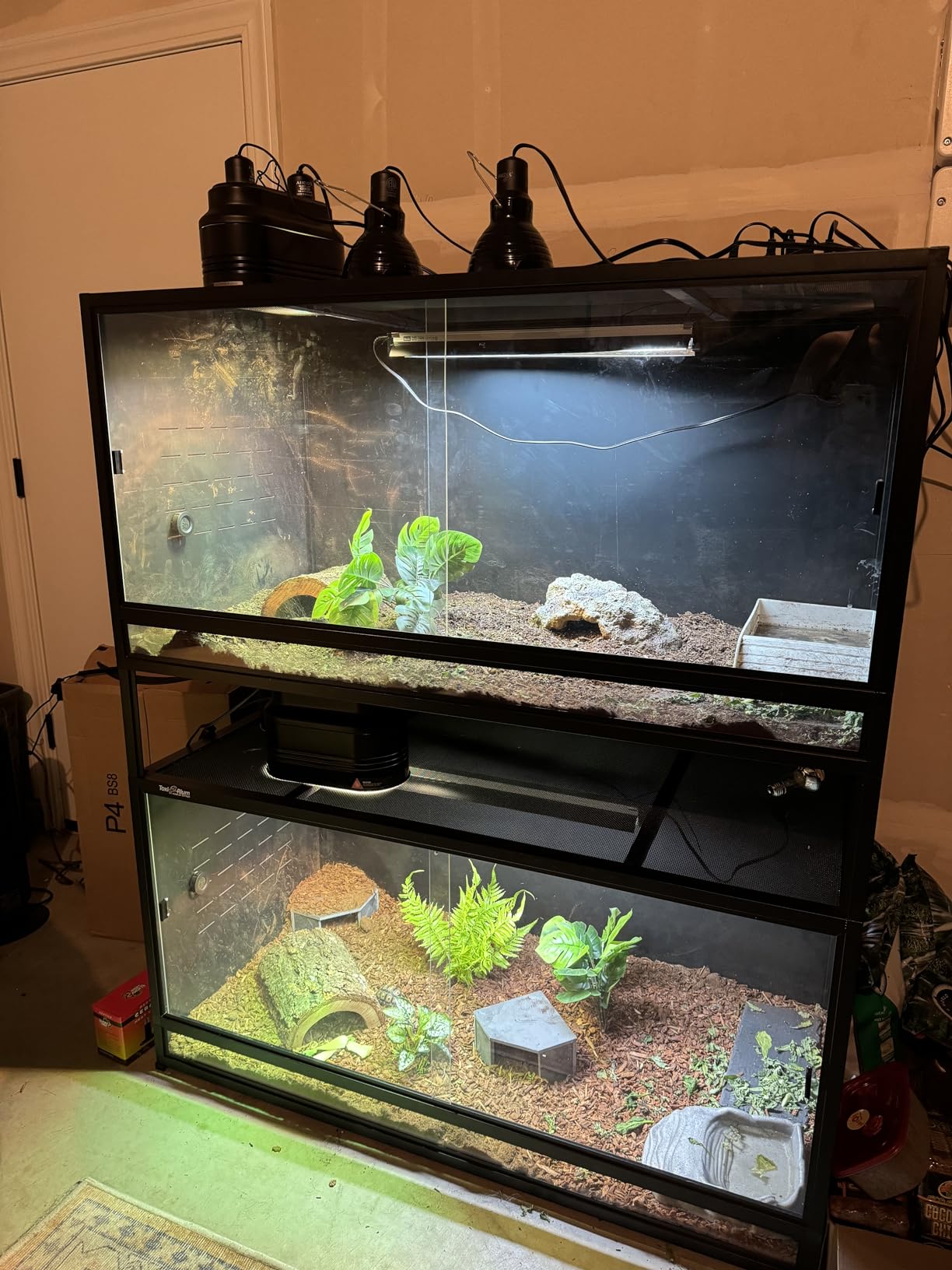
Sliding front glass doors with an integrated lock mean you do not have to add aftermarket latches as your first modification, which is the most common complaint levelled at otherwise strong enclosures in this list. The modular design expands vertically, so the pair can become a two-tier column now and a three- or four-tier column later as the same hardware pattern repeats.
The interior is sized for real enrichment rather than bare minimum. Buyers mention fitting hides, branches, and climbing furniture inside, and the panels are specified to hold a stable temperature and humidity without the swing you get through single-pane glass. That stability matters at scale, because it is the difference between one thermostat per enclosure working predictably and constantly chasing swings.
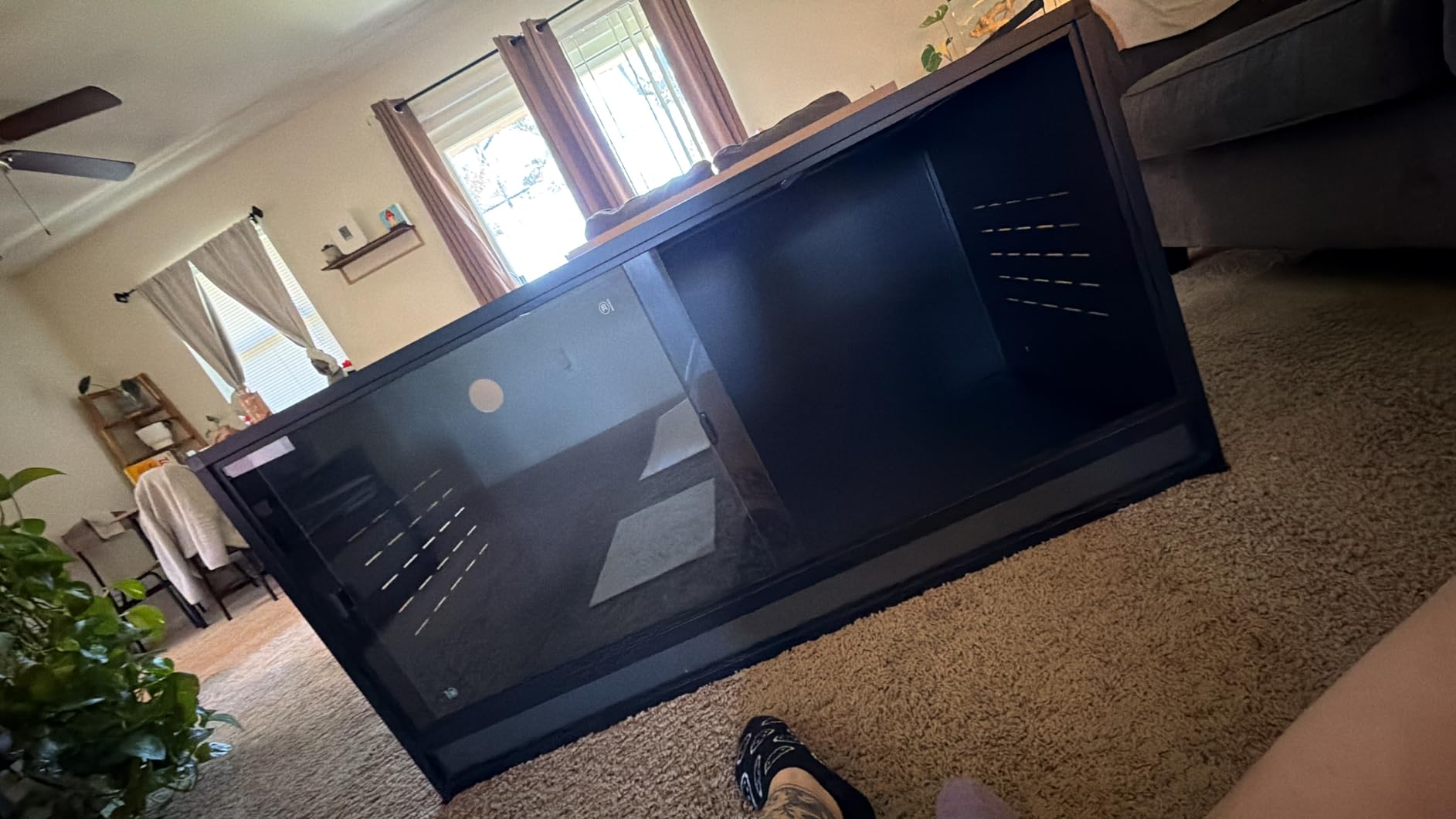
Why breeders pick this enclosure
Adult size is where stacks get expensive to get wrong. A 120 gallon enclosure gives a large adult a proper ground area, which means you can keep an animal at adult dimensions rather than cycling a constant stream of juveniles through undersized housing. For a beardie program that means fewer animals to rehouse, and for a snake program it means the adult enclosure you are heading toward is already in the room.
Two enclosures as a matched pair also solves the pairing problem. Holding a male and female together in a stackable column, both on their own thermostats with their own fixtures, is a cleaner breeding setup than splitting them across a rack where you cannot check the female without pulling the whole drawer.
Where it falls short
The review base is thinner than the established sizes in this brand’s range, and a 4.2 average with a visible share of one- and two-star ratings points to a functional but not flawless enclosure. The recurring themes in the negative reviews are door hardware and the upfront commitment of buying a pair, and both are worth weighing before you commit a full column of floor space.
Two identical enclosures also mean you cannot size-match within the pair. If your programme needs a large adult next to a smaller juvenile, this set will not do it, and you will need a second model. As with all PVC in this guide, a bioactive setup needs silicone work before it will hold water, and the enclosure is not a sealed unit out of the box.
5. ToxiRium 76 Gallon 2-Pack with Spacers – Best for Ball Python Breeders
PVC Reptile Enclosure Space Efficient 44”x20”x20” Stackable ToxiRium Large Reptile Terrarium 76 Gallons for Bearded Dragon Lizard Snake, Breeding Vivarium with Sliding Doors Lock-2pcs with spacers
44 x 20 x 20 inch per enclosure, 39 lb
76 gallon interior each
Spacers included
Pros
- Stackable pair with spacers in the box
- PVC build reduces heat loss and energy use
- Light enough to reorganise a whole row
- Support bars hold decor up to 105 lb
- Sliding doors with a lock
Cons
- Entry cost for the pair is high at mid size
- Not watertight for bioactive builds without silicone
This 76 gallon two-pack is the reference point in this brand’s range and the one most breeders end up buying more of. At 44 by 20 by 20 inches per enclosure, the footprint is a fraction under a true 4x2x2 but tall enough for a coiled adult ball python to sit properly, and it is the size most ball python keepers describe as the transition between juvenile and adult housing.
The spacers are the reason this listing is different from a plain two-pack. They are included in the box, so you can build a vertical row immediately rather than discovering that the stacker hardware is a separate line item. That distinction matters more than the name suggests, because the true total cost of a stackable system includes the hardware, and many listings quietly omit it.
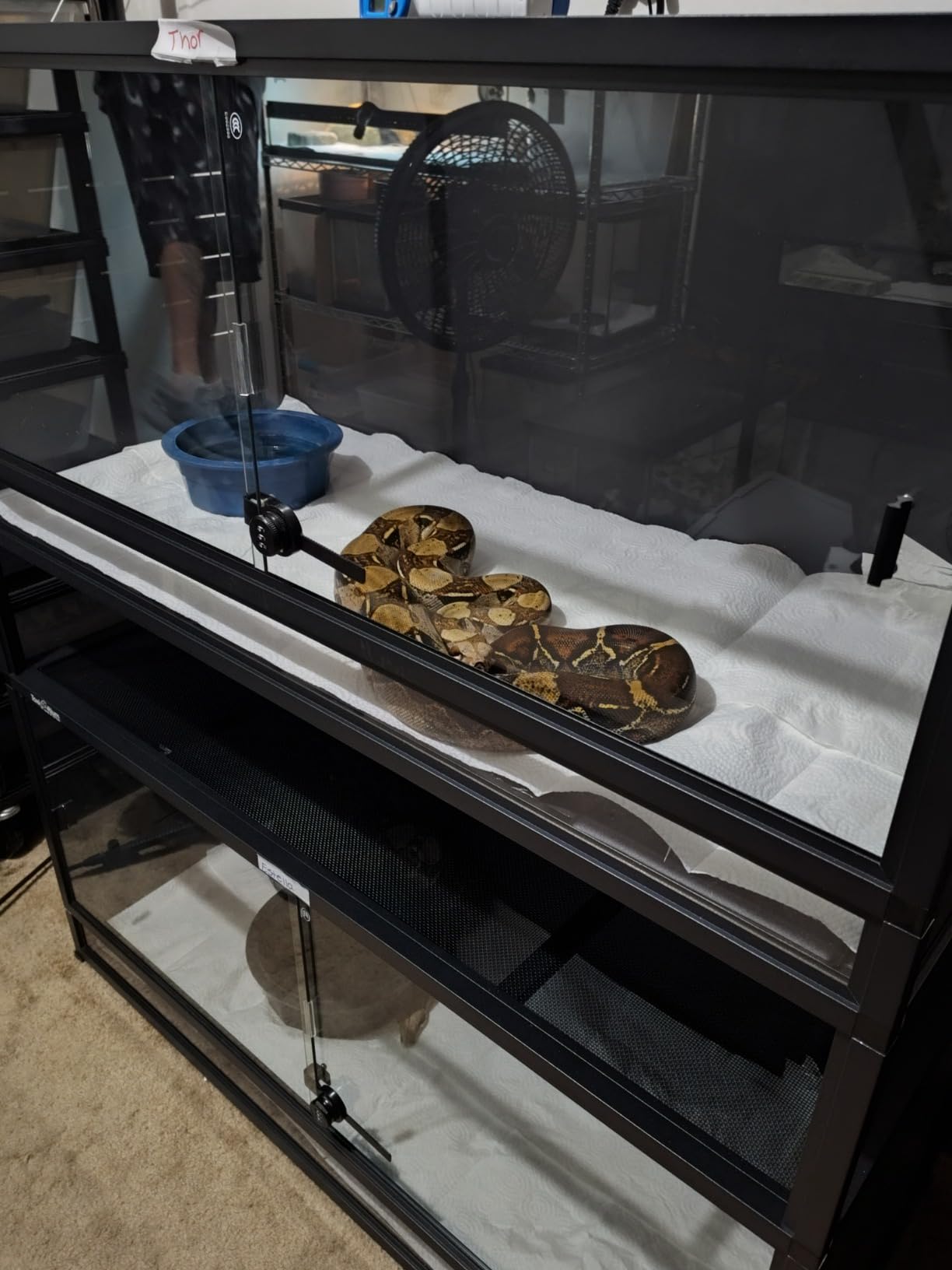
Support bars on both the top screen and the bottom panel are rated to hold decor up to 105 pounds, which is a published figure rather than a vague claim about durability. It matters because the most common failure in a stacked enclosure is not the frame, it is the top screen bowing under the weight of a heavy water feature or a stack of hides in the tier above. Published load figures let you build without guessing.
At 39 pounds per enclosure, this is the lightest of the large PVC units here, and owners highlight that as a practical advantage for reorganising a full stack. Lightweight PVC also cuts heat loss compared with glass, and breeders running this at scale report noticeably steadier temperatures in each enclosure during a night-time drop in room temperature.
Why breeders pick this enclosure
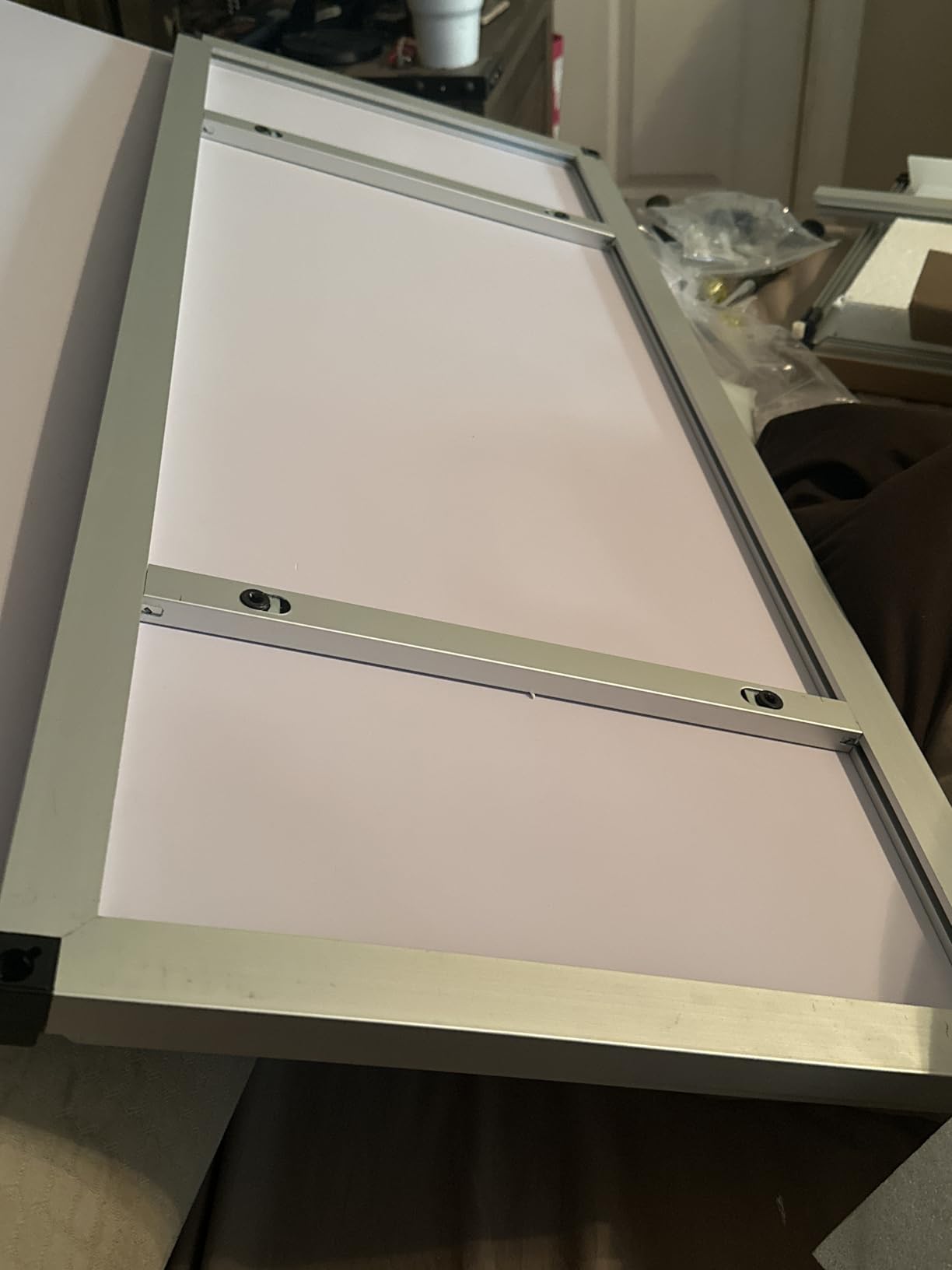
Ball python breeding is a numbers game, and 76 gallons is the size that lets you house a workable cohort without doubling your footprint. Locking sliding doors handle escape-prone animals properly, the enclosure is easy to clean, and the PVC build holds humidity well for the moderate-to-high levels most ball python rooms run at.
The listed species coverage is broad for a mid-size unit, covering bearded dragons, ball pythons, leopard geckos, desert lizards, sand boas, and small desert tortoises. That flexibility is what lets a breeder reallocate an enclosure mid-programme when a pairing finishes early instead of leaving a column standing empty.
Where it falls short
The cost of a mid-size two-pack is the headline drawback, and it lands hardest on breeders building a room in stages. If you are buying in increments, a single enclosure plus one set of spacers is a far more common path than a pair, and you should factor that into how you sequence the build.
The 4.2 average reflects a real share of one- and two-star reviews sitting alongside strong praise, and the pattern in those reviews is the same one that shows up across PVC products in this category: not watertight, needs silicone before any bioactive drainage layer goes in. Inspect the panels for warping on arrival, run a flat edge along every panel, and reject anything with visible bow rather than hoping it settles.
6. ToxiRium 120 Gallon Combination Lock – Best Door Security
PVC Reptile Enclosure 48″x24″x24″ Space Efficient Reptile Terrarium 120 Gallon Large Tank for Bearded Dragon Lizard Snake, Wide Breeding Vivarium Area with Sliding Glass Doors Combination Lock
48 x 24 x 24 inch, 120 gallon, 50 lb
PVC with combination lock doors
Pros
- Full 4x2x2 footprint for a large adult
- Combination lock is the most secure door hardware here
- Lightweight PVC moves far easier than glass
- Wide breeding area suits pairing and grow-out
Cons
- Weakest average rating in the group at 4.0
- 13 percent of reviews are one star
- Highest single-enclosure commitment in the roundup
This single 120 gallon enclosure is the security specialist of the group, and the reason is one component: a combination lock on the sliding glass doors. No other enclosure in this guide offers keyless coded entry, and for a breeding room where strong snakes push against doors, a coded lock removes the aftermarket latch step entirely. You set the code, share it with a partner, and there is no key to lose and no adhesive hardware on the glass.
The footprint is a true 4x2x2 at 48 by 24 by 24 inches and 50 pounds, described by the brand as a wide vivarium area designed for breeding activities. That phrasing matters for this size, because a wide enclosure lets you run a proper thermal gradient along the length rather than a short hot-and-cold corridor, which is the single most common setup error in oversized boxes.
The enclosure comes out of the same family as the two-pack and the 76 gallon unit, which means the same range is available in 40 by 16 by 16 inches at 44 gallons, 44 by 20 by 20 at 76 gallons, and this 48 by 24 by 24 at 120 gallons. Staying inside one range keeps your stacking hardware and panel thickness consistent across the room, which is exactly the scalability a breeder wants.
Lightweight PVC is the quiet advantage at 120 gallons. An equivalent glass tank at this size is a serious two-person job, and lightweight PVC means one person can move an enclosure out for cleaning or reconfigure a column as the programme changes.
Why breeders pick this enclosure
Coded door entry is the deciding factor for anyone housing animals that test their doors. Ball python and boa keepers in particular tend to have a snake that pushes at the door track, and a latch that has to be checked every time you close up is a latch that eventually gets left open. A combination lock removes that failure mode.
The wide interior also suits pairing and juvenile grow-out work better than a square footprint, since you can partition the length with a visual barrier without losing usable width. That is how most breeders use a 4x2x2: two animals, one half each, one thermostat and fixture per half.
Where it falls short
This is the weakest-rated enclosure in the guide at 4.0, with 13 percent of reviews at one star, and that profile reflects the single-unit 120 gallon listing specifically rather than the brand as a whole. The one-star reviews concentrate on size, cost, and the same PVC sealing caveats described elsewhere in this guide, so read them as a warning about this listing rather than a verdict on the enclosure family.
It is also the single largest commitment on the list, in a category where entry cost already runs high. A breeder building gradually gets more flexibility from a smaller unit plus a later upgrade, and the review base is thin enough at 42 that there is less long-term data on this specific size than on the 76 gallon or 34 gallon options.
7. New Age Pet ECOFLEX Two Medium with Stacker – Best for Small Rooms and Apartments
New Age Pet ECOFLEX Two Medium Reptile Enclosures with Matching Stacker Combo Set in Grey
36.5 x 18.6 x 47.8 inch stacked pair, 59.2 lb
ECOFLEX composite
Matching stacker included
Pros
- Two enclosures and a matching stacker in one box
- ECOFLEX will not warp crack or splinter
- Sliding glass doors include a working lock
- Assembles in roughly 30 minutes
- Holds heat and humidity with minimal adaptation
Cons
- The two enclosures often arrive separately and one can be missing
- No cable ports so lighting cables need drilling
- Not waterproof for humid species
This is the enclosure set for a room where floor space is the binding constraint. The stacked pair plus its matching stacker measures 36.5 by 18.6 by 47.8 inches, which is a narrow column, and the stacker allows a heat lamp per level, so both animals get their own overhead fixture instead of sharing a light source across two boxes.
The build material is ECOFLEX, a weather-resistant, non-toxic recycled wood-polymer composite. The advantage over raw wood is structural: it will not warp, crack, or splinter, which is the failure mode keepers report repeatedly with cheaper enclosures. It is also available in grey, black, and maple, and in medium and large, so the same visual language carries through a whole room.
Removable panels simplify cleaning and routine care, and ventilation is built into each enclosure rather than added later. Assembly takes roughly 30 minutes, and experienced keepers rate the value per unit highly, particularly for leopard geckos, small geckos, and other animals where two medium boxes beat one large box for monitoring and separation.
The sliding glass doors include a working lock as standard, which again removes the aftermarket modification step. Buyers consistently report the lock, the included stacker, and the assembly time as the three reasons they would buy the set again.
Why breeders pick this enclosure
Two separately housed animals in a 47-inch column is the right call for a breeder separating a pair, holding a quarantine animal, or growing out juveniles. The stacker is included in the box rather than sold separately, so there is no second order to place and no missing hardware discovered on assembly night.
Composite panels also handle humidity better than raw wood and are easier to wipe down after a spray-down routine. For an animal such as a leopard gecko that needs a humid hide but a drier enclosure overall, that combination of a working lock and a wipe-clean surface is genuinely convenient at volume.
Where it falls short
The dominant complaint in the reviews is fulfilment, not construction. Because the two enclosures travel separately, one is regularly missing from a delivery and the fix is a customer service call and a wait, and breeders report this as the single most frustrating part of the purchase. Order early, check both cartons the moment they arrive, and have a second enclosure ready so a missing box does not halt a pairing.
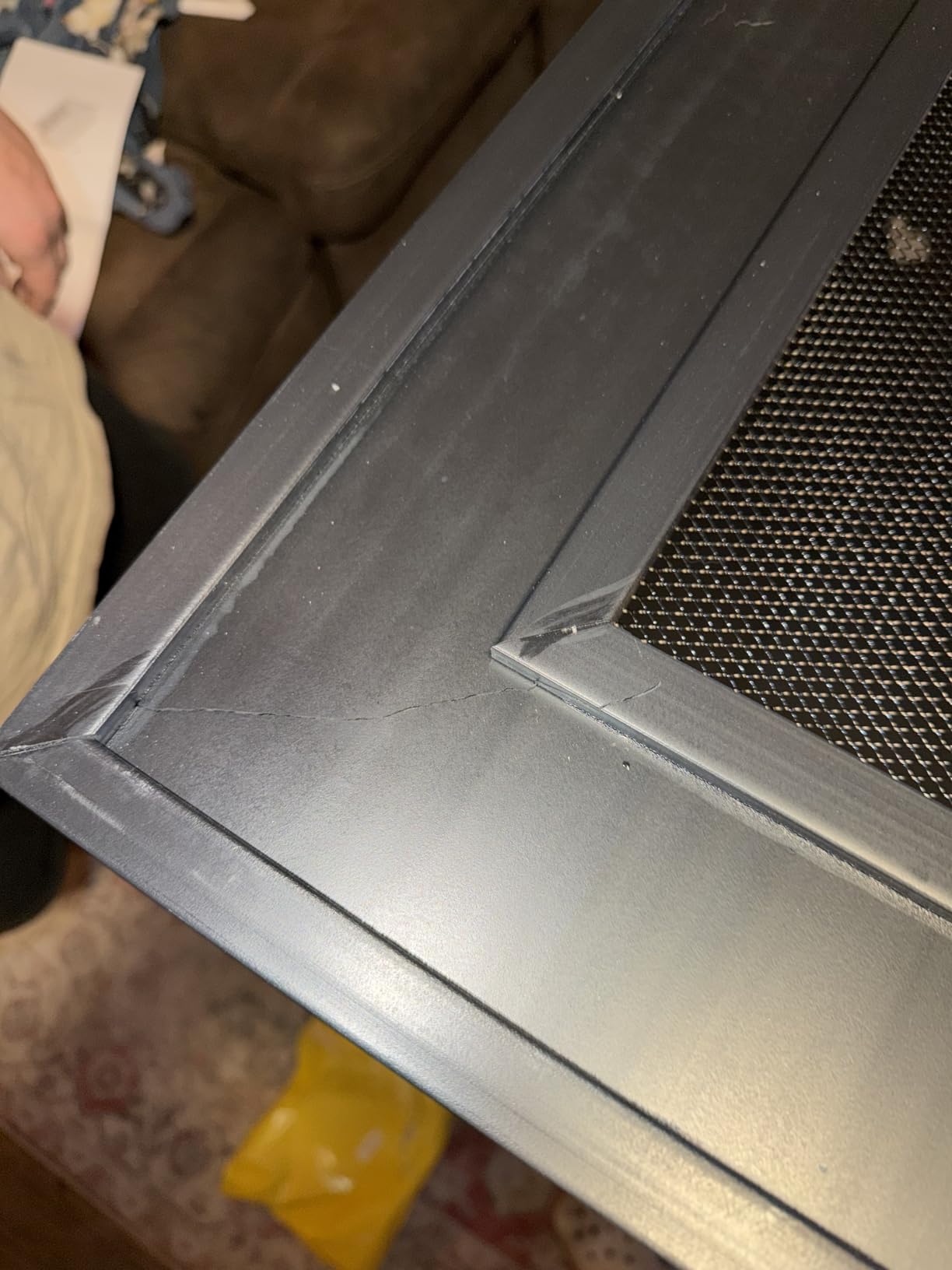
There are no cable ports or grommets, which is the most commonly cited design gap, so lighting and probe cables need drilling or a workaround. The composite is also not waterproof and needs silicone for humid species or bioactive work, and some buyers report chipped, loose, or wobbly panels that need clamping. Composite panels are less durable than PVC for animals that climb or dig hard, which is a fair reason to look elsewhere for a boa or a burrowing species.
8. CAVACHEW Double 20 Gallon Glass Rack – Best for High Humidity Species
CAVACHEW Double Stacked Reptile Tank, 30″ x 12″ x 32″ Tall Reptiles Terrarium, Front Opening, Full Vision, Knock Down, 2 Pack 20 Gallon Glass Cage for Reptile, Bearded Dragon, Lizard, Snake, Gecko
30 x 12 x 32 inch double deck, 43 lb
Two 20 gallon glass tanks
Fog holes for humidifiers
Pros
- Two 20 gallon habitats in about 32 inches of height
- Double sliding doors with upgraded locks
- Fog holes and a top screen for humidifier setups
- Knock-down design with tools included
- Reinforced foam packaging with damage replacement
Cons
- Weakest rating profile in the group with 18 percent one star
- 12 inch depth is tight for climbing reptiles
- Aluminum frame joints can weaken over time
This double-deck glass rack is the shortest column in the guide, at 32 inches tall for two 20 gallon habitats, and that height is the whole point. Rooms with a low window sill, a sloping ceiling, or a duct run overhead still have room for a two-tier stack, and footprint-sensitive setups that cannot take a 44-inch column can still double their animal count here.
The feature that makes it useful for high-humidity species is the fogging holes combined with the wire top screen, both of which support a humidifier sitting inside the enclosure. Most stacked glass racks vent only at the top, which traps condensation in the upper tier and gives you nowhere to put a fogger. Edge sealing on the top screen helps direct the vapour into the enclosure rather than letting it run up the wall behind the rack.
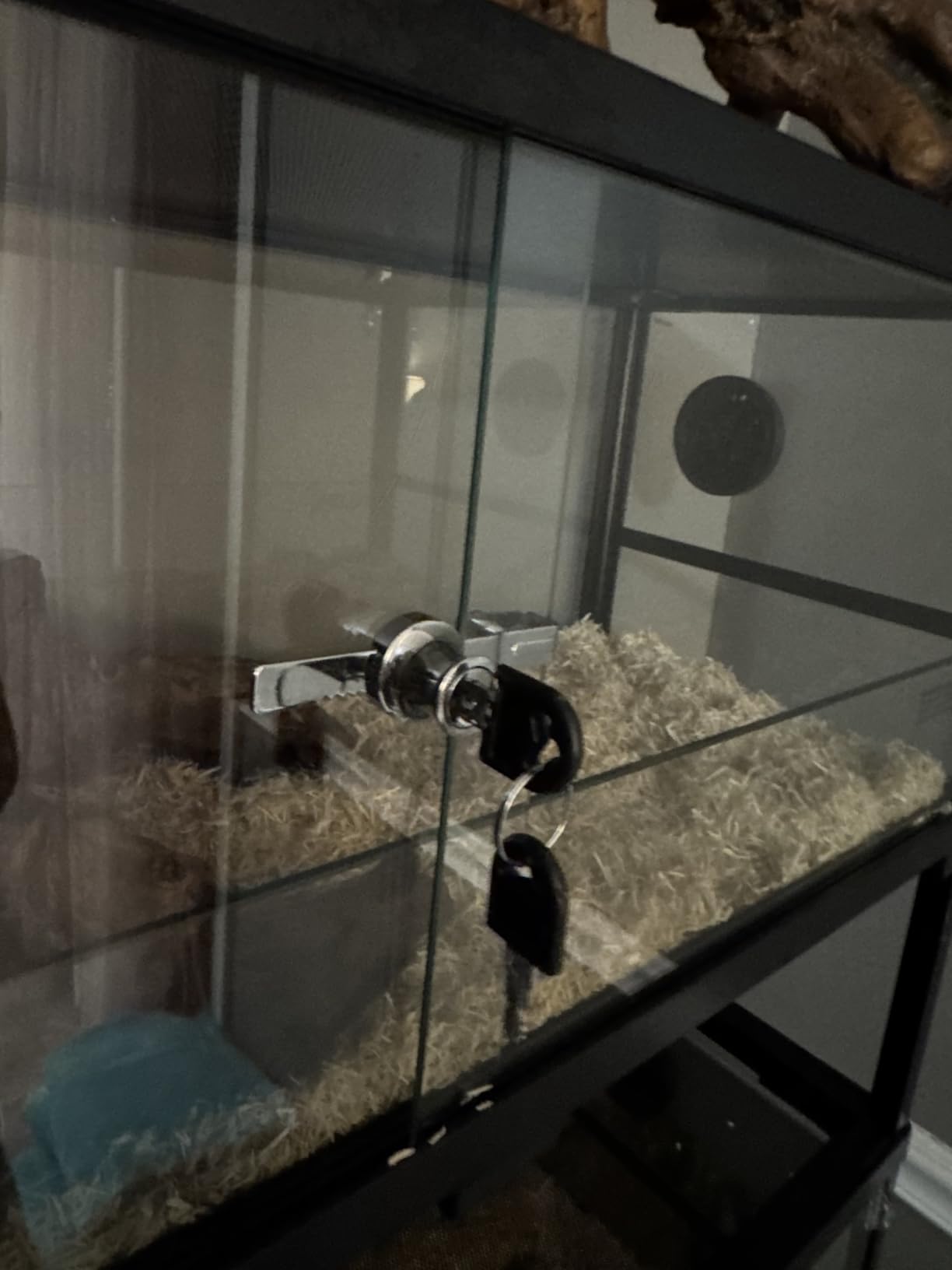
Double sliding doors with upgraded locks are uncommon on a stacked glass rack at this size, and the rotating fixed cable pass holds lighting and heating lines firmly in place. The knock-down design with included tools means you can disassemble it for a move, and the reinforced foam and cardboard packaging with a damage replacement guarantee reduces the risk of arriving with a cracked panel.
As with the larger CAVACHEW unit, the pair can be split into two separate 20 gallon tanks if a single-level setup suits you better, which gives you an exit from the stack if the room layout changes.
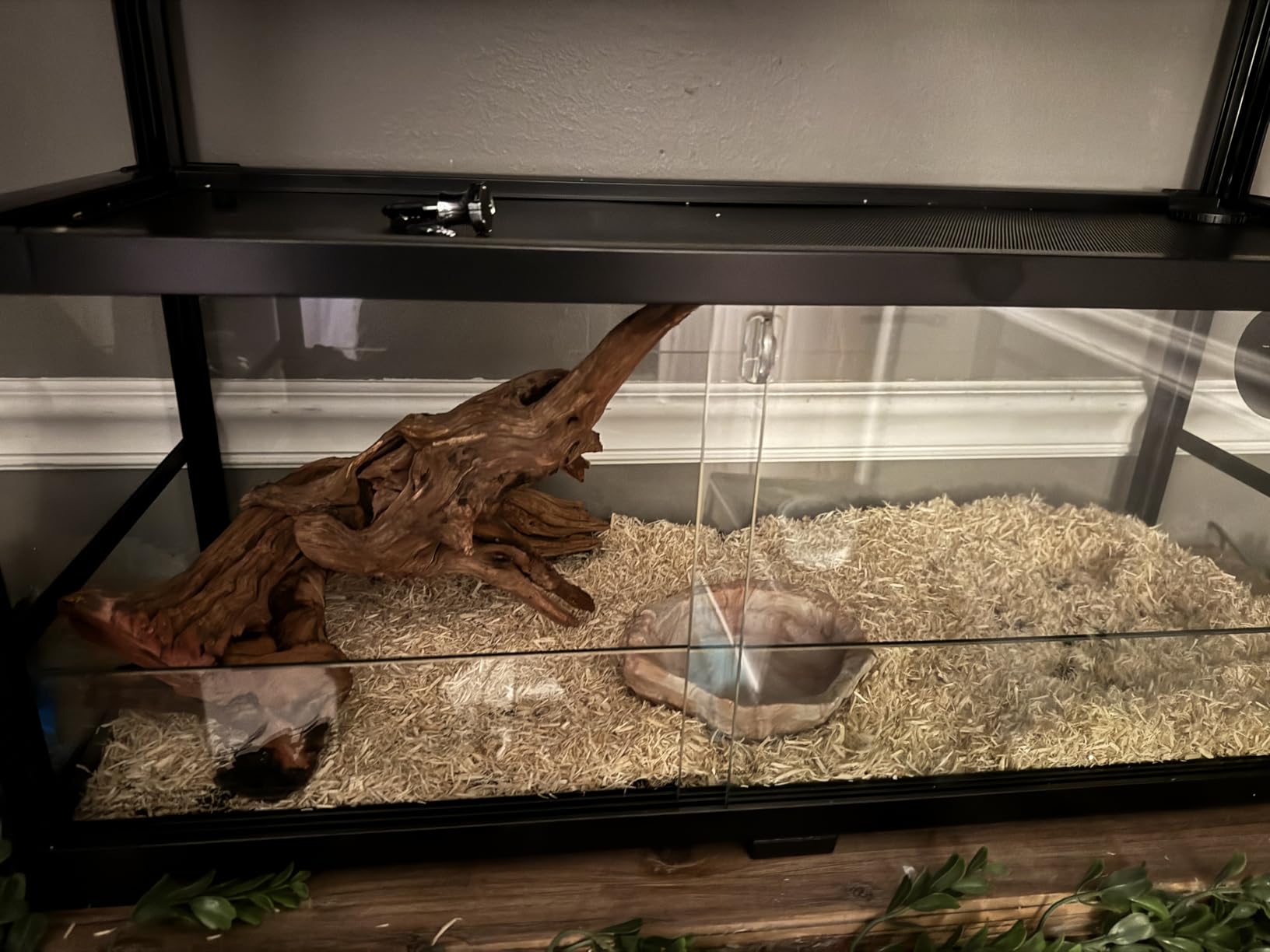
Why breeders pick this enclosure
Tropical species are the fit here. A fogger needs a port and somewhere for the vapour to go, and this rack provides both, which is more than most stacked glass units at this footprint can claim. Keeping two individually locked, individually fogged habitats in a 32-inch column is a compact solution for a small collection of juvenile tropical species.
It also works for anyone who wants two animals in a shared column but with a hard separation between them, since the doors lock individually and the two sections are independent. Glass is easy to sanitise between tenants, which matters more in a rack than in a single enclosure because you are moving animals in and out of the same volume.
Where it falls short
Twelve inches of depth is the real constraint. Buyers with anything that climbs or branches report it as tight, and while the unit is marketed for bearded dragons, lizards, snakes, and geckos, the width suits smaller animals far better than a full adult. Check your animal’s adult length against the footprint before committing, because a glass rack is not something you outgrow gracefully.
The rating profile is the weakest in the guide, with 18 percent of reviews at one star, driven by door hardware and glass build quality rather than by the stacking concept. Glass is also heavier and holds heat and humidity less well than PVC, and the aluminium frame joints can become a weak point over years of use. If humidity is the priority rather than durability, look at a PVC unit instead.
9. New Age Pet ECOFLEX 60 Inch Mojave – Best Rated Display Tier
New Age Pet® ECOFLEX® 60″ Mojave Reptile Enclosure, X-Large, Black
60 x 24 x 22.8 inch exterior, 54.2 lb
58.43 x 21.97 x 20.16 inch interior
10-year warranty
Pros
- Widest reviewed enclosure in the group with over 1800 reviews
- Dual layered panels with air gaps retain heat well
- Assembles in 20 to 45 minutes
- Tempered glass doors with a locking bracket
- 10-year warranty is the longest here
Cons
- Not waterproof and better for moderate humidity
- Mesh top bows under multiple light fixtures
- Deep front panel limits sightlines at the window
This is the category benchmark, and the reason is the review count. With more than 1800 reviews and a top-ten sales rank in reptile terrariums, it carries more real-world feedback than every other enclosure in this guide combined by a wide margin. For a breeder buying one display unit rather than a column, that depth of tested feedback is worth more than a slightly more exotic specification.
It is genuinely large at 60 by 24 by 22.8 inches on the outside, with an interior of 58.43 by 21.97 by 20.16 inches, and the interior figure is the one that matters. The construction is dual-layered PVC board with air gaps between the layers, and that trapped air is the insulation. Owners consistently report strong heat retention for the money, and this is the enclosure most often recommended to first-time buyers who are moving up from a glass tank.
Vented side panels and a large mesh top take heat lamps and lighting well, and the sliding front glass doors carry a simple, effective locking bracket. Assembly runs 20 to 45 minutes for most owners with basic tools, all hardware is included, and the manufacturer backs it with a 10-year warranty, which is the longest in this roundup by a wide margin.
It pairs with a matching 60 inch Versa Stand sold separately, which matters if you are building a column. The stand is an extra line item, and buying it at the same time as the enclosure avoids a delivery where the animal arrives before the furniture does. The brand is U.S. designed and U.S. supported, which for a breeder is a meaningful reliability signal given how many small enclosure vendors in this category have closed or gone quiet.
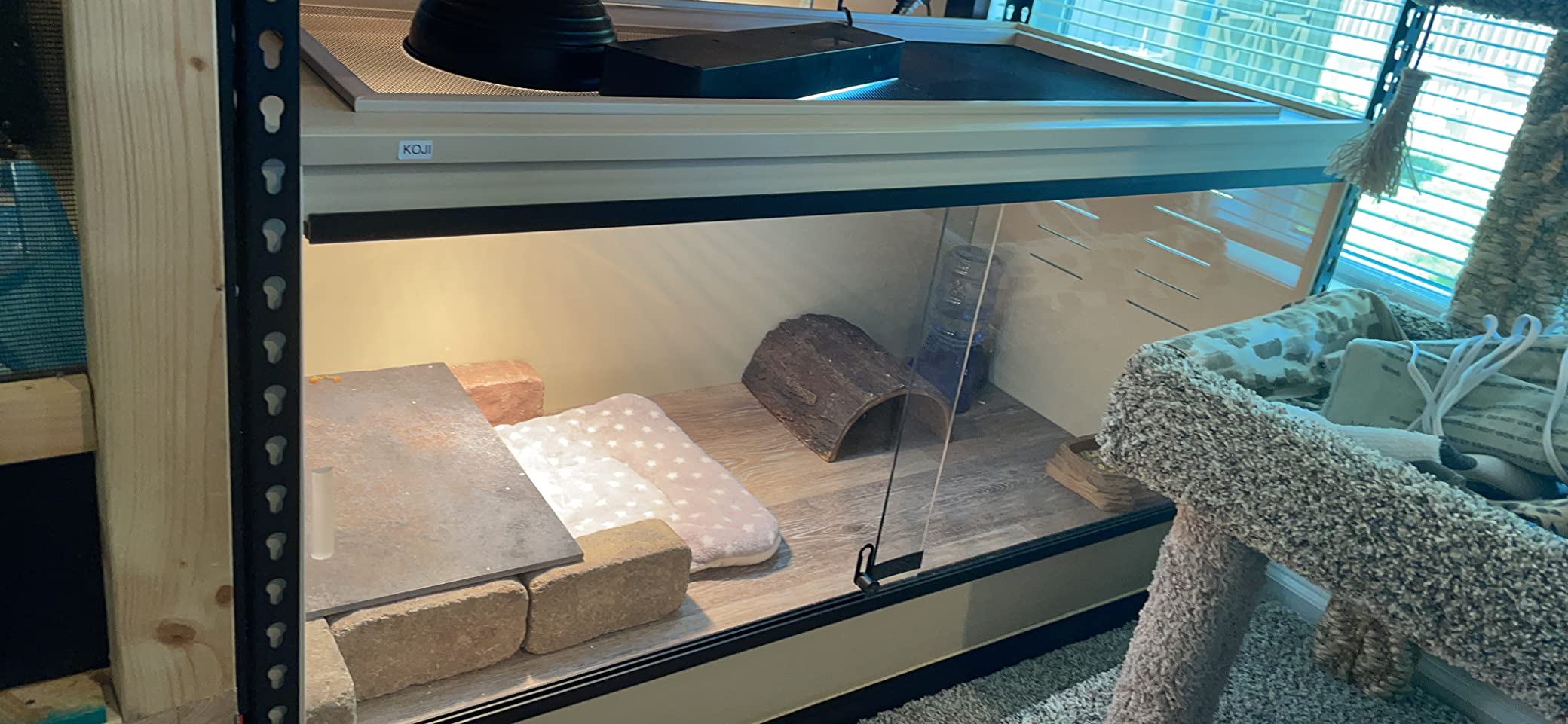
Why breeders pick this enclosure
The 60 inch length makes this the best choice in the guide for pairing. A male and a female ball python, or two adult beardies, can both occupy a 58 inch interior with a visual barrier in the middle and still have genuine ground area, which is the configuration most breeders are trying to reach and few enclosures this size support well.
The dual-layered panels also make it the easiest option here to heat. Air gaps between the layers slow heat loss, owners report steady temperatures without overdriving fixtures, and a lower-wattage basking setup can serve a large animal. That efficiency compounds in a stack, where the tier above can benefit from residual heat without relying on it.
Where it falls short
It is not waterproof, and the brand is explicit that it is best suited to low-to-moderate humidity setups. The critical mass of feedback describes it as a base kit that most owners finish: seal the seams with aquarium silicone, cover or stiffen the mesh top, and add a gasket. None of that is difficult, but it is work you should plan for rather than discover.
The mesh screen top bows under multiple light fixtures, and some buyers cover it as a result. The deep front panel also limits sightlines for an animal at the viewing window compared with earlier generations of the same design, which is a specific complaint that buyers who loved previous versions raise consistently. Small side window pieces can also pop out when pushed by a strong reptile, and seams and vents can admit feeder insects or fine sand unless sealed.
Stackable Enclosures vs Drawer-Style Breeding Racks
Stackable enclosures win on visibility, per-unit climate control, and how an operation is perceived by buyers. A drawer rack wins on animal count per square foot of floor, on the speed of daily checks, and on cost. That is the whole decision, and for most breeders the rack is the correct answer until the operation needs animals seen.
A standard breeding rack is a wire shelving unit with solid-front tubs sliding into it. The efficiency comes from the fact that the animal is never removed from its drawer to be checked, fed, or cleaned, so a keeper can run an entire room in a fraction of the time a glass-front setup demands. For a large-scale ball python or boa operation that is an operational advantage no stacked enclosure can match, and it is the reason most commercial breeders use racks.
The welfare perception problem is real and worth naming plainly. Drawer racks are widely criticised because the tubs are solid-coloured and offer no viewing, and keeping non-juvenile animals in solid tubs is widely regarded as a standards-of-care concern among keepers. Whether or not an individual animal is affected, the reputational cost lands on the operation when customers or inspectors see the housing. A breeder selling animals to the public has a commercial reason to present animals in viewing enclosures even if the rack does the daily work.
The most sensible operating model is to use both. Run the rack for grow-out and juvenile housing where animal density and check speed dominate, and place a stack of viewing enclosures above or alongside it for the animals that need to be observed, quarantined, or presented. That is why several enclosures in this guide are sold as two-packs: the pair gives you two tiers in one footprint, and a single tier can be pulled forward for display while the other holds a quarantine animal.
Cost per animal is where the rack remains untouchable. A wire rack with tubs holds more animals per pound of equipment, and there is no stacker, no spacers, and no heavy panel to replace. Stackable enclosures earn their cost back only when you are buying visibility, per-unit climate, or a quarantine capability, and the honest way to evaluate them is per usable enclosure rather than per tier.
Our rule for breeders: if every animal in the collection is a juvenile that will be re-housed within a year, buy the rack. If any animal is an adult, a breeding pair, a morph you intend to sell, or an animal under observation, it deserves a viewing enclosure. Most operations end up with a rack for grow-out and a stack of two or three enclosures for everything else.
Thermal Bleed and Ventilation Deficit in Dense Vertical Stacks
Thermal bleed is the failure mode that makes a stack dangerous, and it works like this: the warm air and radiant heat from the fixture in the lower enclosure rises into the enclosure above, which is now running hotter than its own thermostat thinks it should. The bottom enclosure ends up colder than set, the top one hotter, and the animal that suffers is usually the one in the middle tier nobody is monitoring.
The rule that follows is non-negotiable for breeders. Every enclosure in a stack needs its own independent heat source, its own thermostat, and its own ventilation. A stack that shares room heat, or a single thermostat wired to two fixtures, will produce a gradient nobody intended. If you use a ceramic heat emitter mounted inside a fixture on the top panel of the enclosure below, the clearance between it and the enclosure above is the number to measure before you build.
Ventilation is the second problem, and it is the one most people miss. A single enclosure on an open stand vents freely at all sides. In a stack, the lower enclosures sit in a dead air pocket bounded by the enclosure above, the enclosure below, the back wall, and often a curtain, so the effective airflow through the bottom tier can be a fraction of what the same enclosure would get standing alone. Dense stacks produce still air, and still air plus high humidity plus warmth is the combination behind a lot of respiratory complaints.
The mitigations are unglamorous and effective. Leave the rear gap the same at every tier rather than pushing the stack flat against a wall, keep the mesh top or vented panels unobstructed, and check the actual humidity reading in the bottom tier rather than assuming it matches the top. If you are running a high-density column in a closed room, treat the stack as a small HVAC problem and put a fan in the room.
Quarantine fits naturally into the same discussion. A stacked room gives you isolation capability that a rack drawer does not, because you can dedicate an entire enclosure to a single incoming animal with its own climate, physically separated from the rest of the column. Keep that tier at the end of the row where it is easiest to service, and do not put a quarantine animal in the middle of a stack you will need to move through every day.
A note on long stacks. Three tiers is manageable. Four works if the room has ventilation and you accept more thermal measurement. Beyond that, most experienced breeders switch back to a rack for the upper tiers, because the measurement burden grows faster than the floor space saved.
Material Guide: PVC vs Composite vs Glass for Breeding
Material is the decision that determines how an enclosure performs over five years, more than any other spec on this list. PVC holds heat and humidity and does not bow. Glass is inert, scratch-resistant, and heavy. Composite panels are the middle ground and will not splinter. Raw wood and MDF are the only options here to avoid for a humid breeding room.
PVC is the breeder’s default for good reason. It holds heat, which lowers fixture wattage and stabilises night-time drops, and it is light enough for one person to lift a 120 gallon enclosure into place. It is not watertight out of the box, and every bioactive setup in this guide needs aquarium silicone before a drainage layer goes in. PVC panels can also bow, which is the complaint that surfaces most often in community threads about budget brands, so inspect panels with a flat edge on arrival and reject visible bow.
HDPE-PVC composite, which is what the ECOFLEX enclosures use, is a recycled wood-polymer composite with dual layers and air gaps. It will not warp, crack, or splinter like raw wood, and the trapped air gives insulation comparable to a decent PVC build. Buyers consistently rate its value highly, and the 10-year warranty on the 60 inch model is the longest offered anywhere in this guide. Its limits are moisture resistance rather than waterproofing, and lower surface durability for animals that climb or dig hard.
Glass is the easiest surface to sanitise and the hardest to scratch, and full-visibility glass racks are the reason to choose it over anything else if observation is the priority. Its disadvantages are weight and thermal performance. Glass conducts heat faster than PVC, so fixtures run harder and temperatures swing more, and at 43 to 54 pounds a two-tier unit is a two-person job. If humidity control or insect breeding is the priority, glass is the wrong material.
MDF and raw wood deserve a warning rather than a recommendation. They swell in a humid room, they harbour odour, and they cannot be sanitised between tenants. You will see them in cheap furniture-style enclosures, and for a dry display animal they are tolerable. For a reptile room, they are a false economy that ends in a replacement.
One further material point that gets missed. Thickness matters more than type. A thin PVC panel flexes when warm and pushes on the door track, which is the mechanical cause of the sticking and rattling sliding doors buyers report on the glass racks here. A stiffer panel resists it, and that stiffness is also what keeps a stack square when three enclosures are bearing on each other.
How to Evaluate a Reptile Enclosure Brand
Judge a brand on four things: published specifications, honest disclosure of what is included, a warranty that outlives the enclosure’s first owner, and a vendor that answers messages. Star ratings in this category are close to useless on their own, because the most-reviewed products attract the most complaints as well as the most praise.
Breeders in community threads rank customisation depth and build quality above cost, and they are largely right. The questions worth asking a vendor before you commit are concrete. Are the stacker posts or spacers included or sold separately. What is the panel thickness. Is there a published load rating for the top screen. Can heating and lighting be pre-installed at the factory, and can lock style and door swing direction be chosen. A vendor who answers all five clearly is a vendor who has built for breeders before.
Honest disclosure is the tell. Brands that state plainly that an enclosure is not waterproof, that the screen top bows, or that the composite needs sealing are telling you what you will discover in month six anyway. Brands that describe everything as flawless are simply not describing a real enclosure.
Reliability is a genuine risk in this niche. Several custom and small-shop enclosure vendors in the hobby have closed or gone quiet, and buyers have been left mid-order with mass refunds and legal action behind them. Large established brands are safer, which is a large part of why the ECOFLEX enclosures score what they do on warranty length and support. Order early in any build, and never have an operation depend on a single unproven vendor.
Finally, look at reviews from multi-unit keepers rather than single-pet owners. A review of one enclosure says very little. A review from someone running twenty of them tells you about panel consistency, hardware failure rates, and whether the stack is still square after a year, which is the information that determines whether a breeder’s second order happens.
Can You Stack Reptile Enclosures Safely?
Yes, you can stack reptile enclosures, but only when the unit is designed for it and every level runs its own heat and ventilation. A stackable enclosure is a front-opening habitat that locks vertically onto an identical unit through moulded pin-slot stacker posts, a spacer kit, or interlocking clips, so the load of the tier above is carried by the frame below. Because heat rises between tiers, each enclosure needs its own thermostat, fixture, and airflow rather than shared room heat. Use a stand rated for the full loaded weight of the column, level it, leave a rear air gap at every tier, and check that a stacker or spacer kit is actually included rather than assumed.
Three checks before you build. Confirm the stacking hardware is in the box, because it is a separate line item often enough that plenty of buyers discover it after assembly. Confirm the load rating covers the enclosure above plus the decor inside it, not just the empty enclosure. And confirm the column fits your ceiling, because a 4x2x2 stacked two high is roughly six feet of height including the stand.
Where stacker posts and spacers differ is worth knowing. A stacker post is a vertical column that fastens to the top of one enclosure and receives the next, and pin slots along the post let you set the gap between tiers. A spacer kit is a simpler frame that sets a fixed separation, usually with a small air gap, and is enough for two or three tiers. Both are load-bearing parts, and both are the components that fail first if a column is not level.
Floor loading is the last thing to check. Three large PVC enclosures plus decor can approach 200 pounds on a small footprint, and that load is fine on a level floor in a ground-floor room and worth thinking about in an apartment or on an upper storey. Owners stacking in apartments frequently look for stands under a hundred dollars to raise the base, and that is a sensible place to spend.
Stackable Reptile Enclosure Buying Guide for Breeders
Buy for the animal you will have in two years, not the one you have this week. The most common mistake in this category is starting small because a juvenile fits, and then replacing every enclosure in the room at once. If your growth rate is predictable, size up now and use the smaller enclosure you already own for a quarantine tier.
Measure the footprint before you shop, and measure it twice. The exterior dimension of a 4x2x2 runs slightly larger than the glass-to-glass figure, and the difference is the wall. Leave clearance for a rear air gap, for the door to open fully, and for the cable pass to reach an outlet. If you are more interested in how enclosure hardware and enclosure categories work in general, our enclosure roundups cover the sizing and port-planning side in more detail.
Decide the tier count before you buy the first enclosure, because it changes the hardware. One enclosure and a plan for later means buying a stacker post or spacer kit with the first unit rather than assuming one arrives. Two enclosures as a pair is the efficient default, and three is the practical ceiling for most rooms before thermal measurement becomes a full-time job.
Set a cleaning workflow before the stack exists. Sliding glass doors collect substrate in the lower track, which is the single most common complaint on the glass racks here, and PVC and composite need more attention around seams and vents where fine sand and feeder insects escape. A wipe-down and a door-track clean on a fixed weekly schedule is a five-minute job per enclosure once it is routine.
Budget the accessories. Stacking hardware, casters or universal wheels, an extra thermostat per tier, a fogger for humid species, and the silicone needed for a bioactive build all sit outside the enclosure cost. For most breeders, the per-tier thermostat is the item people forget and then replace.
Plan the room before the column. Wall clearance, door swing, outlet access, and where the stand sits all constrain the layout, and a stack that has to be partially disassembled to get through a doorway is a frustrating thing to discover on delivery day. Related reading on building out enclosure setups and comparing formats is in our modular enclosure guide, and the storage-side fundamentals are covered in our enclosure capacity explainer.
Finally, consider the cost-per-animal framing honestly. A two-tier stack costs more than a rack of equivalent animal count, so the purchase only makes sense if you are buying visibility, per-unit climate control, isolation, or presentation. Breeders selling morphs or quality animals to the public recover that difference in presentation. Breeders producing feeder animals for a feeding program probably should not.
Frequently Asked Questions
What are the best stackable reptile enclosures available?
The best stackable reptile enclosures for breeders are the Phailozoo 120 gallon 4x2x2 for adult housing, the ToxiRium 76 gallon and 120 gallon PVC units for modular breeder columns, the New Age Pet ECOFLEX pair for compact rooms, and the CAVACHEW double-deck glass racks when full visibility matters. Choose the footprint for your adult animals, confirm the stacking hardware is included, and budget a separate thermostat for every tier.
Who makes the best reptile enclosures?
There is no single best maker, and the honest answer depends on what you are housing. Phailozoo leads on the 4x2x2 footprint and its large review base, New Age Pet builds the strongest composite panels and offers the only 10-year warranty here, ToxiRium covers the most sizes in one PVC family with consistent stacking hardware, and CAVACHEW is the choice for full-visibility glass. Evaluate on published specs, included hardware, and warranty length rather than on star ratings alone.
Can you stack reptile enclosures?
Yes, you can stack reptile enclosures, provided the unit is designed for it and every level runs its own heat source, thermostat, and ventilation. Stackable units connect through moulded pin-slot stacker posts, a spacer kit, or interlocking clips so each tier carries the load above. Because heat rises between tiers, a shared room temperature will overheat the top enclosure and chill the bottom one. Level the stand, leave a rear air gap, and check the column’s full loaded weight against your floor and ceiling height.
Are stackable reptile enclosures safe for breeding?
They can be, and many breeders use them for breeding pairs and quarantine. The requirements are an enclosure large enough for an adult animal, a door lock that holds against a strong snake, independent climate control per tier, and good airflow in the lower units. Seal PVC or composite seams with aquarium silicone before using a bioactive drainage layer, and place quarantine animals at the end of a row so they are easy to service without disturbing the rest of the column.
Do stackable reptile enclosures get too hot?
They can, and it is the most common mistake in a dense stack. Heat from a fixture or heat emitter in the lower enclosure rises into the tier above, so the middle and top enclosures drift above set point while the bottom one sits below it. Measure each tier with its own thermostat and probe, keep emitter clearance from the enclosure above, and leave a rear air gap at every level. Three tiers is manageable in most rooms; beyond that, measurement becomes a full-time task.
How many reptiles can you stack in one enclosure?
One per tier, always. A stackable enclosure is a vertical column of independent habitats, not a shared habitat, and housing more than one animal per level defeats the reason to buy front-opening housing in the first place. A two-tier stackable unit such as the 48 by 24 by 24 PVC enclosures or the CAVACHEW double-deck glass racks therefore houses two animals. Within a single tier you can pair animals with a visual barrier if the interior is long enough, as on the 60 inch ECOFLEX.
What is the best material for a reptile breeding enclosure?
PVC is the usual breeder answer because it holds heat and humidity, stays light enough to move alone, and does not bow when properly supported. A wood-polymer composite such as ECOFLEX is a good second choice, since it will not splinter and its air-gapped layers insulate well, though it is not waterproof. Glass is easiest to sanitise and best for visibility but is heavy and holds temperature less steadily. Avoid MDF and raw wood in any humid room.
What is the hardest reptile to keep?
For most new keepers the hardest species are those with demanding humidity and gradient requirements, such as dart frogs, chameleons, and some arboreal geckos, because a single enclosure has to deliver a wet zone, a dry zone, and a vertical gradient at once. Within the species breeders actually keep here, species with strict gradient requirements are harder than similarly sized species with simpler needs. Match the enclosure and stack design to the hardest species in your collection and the rest follows.
Conclusion: Which Stackable Enclosure Fits Your Breeding Room
Start with the Phailozoo 120 gallon 4x2x2 if you are housing adult ball pythons, bearded dragons, or anything that needs genuine ground area. It carries the highest average rating in this guide on the largest relevant review base, the footprint is the one that changes husbandry, and the 758-review base means the failure modes are known rather than discovered. Add locking latches as your first modification and silicone the base before any bioactive work.
Choose the ToxiRium 76 gallon or 120 gallon PVC units if you want a modular column from one brand with consistent stacking hardware and the lowest heat loss per tier. Pick the 120 gallon combination lock model if door security is your priority. For full visibility, the CAVACHEW double-deck glass racks are the only true option in this guide, and the 20 gallon version fits a low-ceilinged room that cannot take a 44-inch column. For a compact room or an apartment, the New Age Pet ECOFLEX pair ships with its stacker and gives you a narrow, light column with locking doors, though order it early because the two enclosures travel separately.
Whatever you pick, keep the stack at three tiers or fewer until you have measured the temperature and humidity in every level through a full day and night. Run one thermostat per tier, keep the rear air gap open at every level, and if you are scaling fast, keep a wire rack in the room for grow-out and put the viewing enclosures where animals and buyers need to see them. That combination is what the most efficient breeding rooms in this hobby actually run, and it costs less than doing everything in one housing type.
This guide covers the 9 best stackable reptile enclosures for breeders in 2026. Check the current listing details for each enclosure, and confirm the stacking hardware is included before you commit a whole column of floor space.