
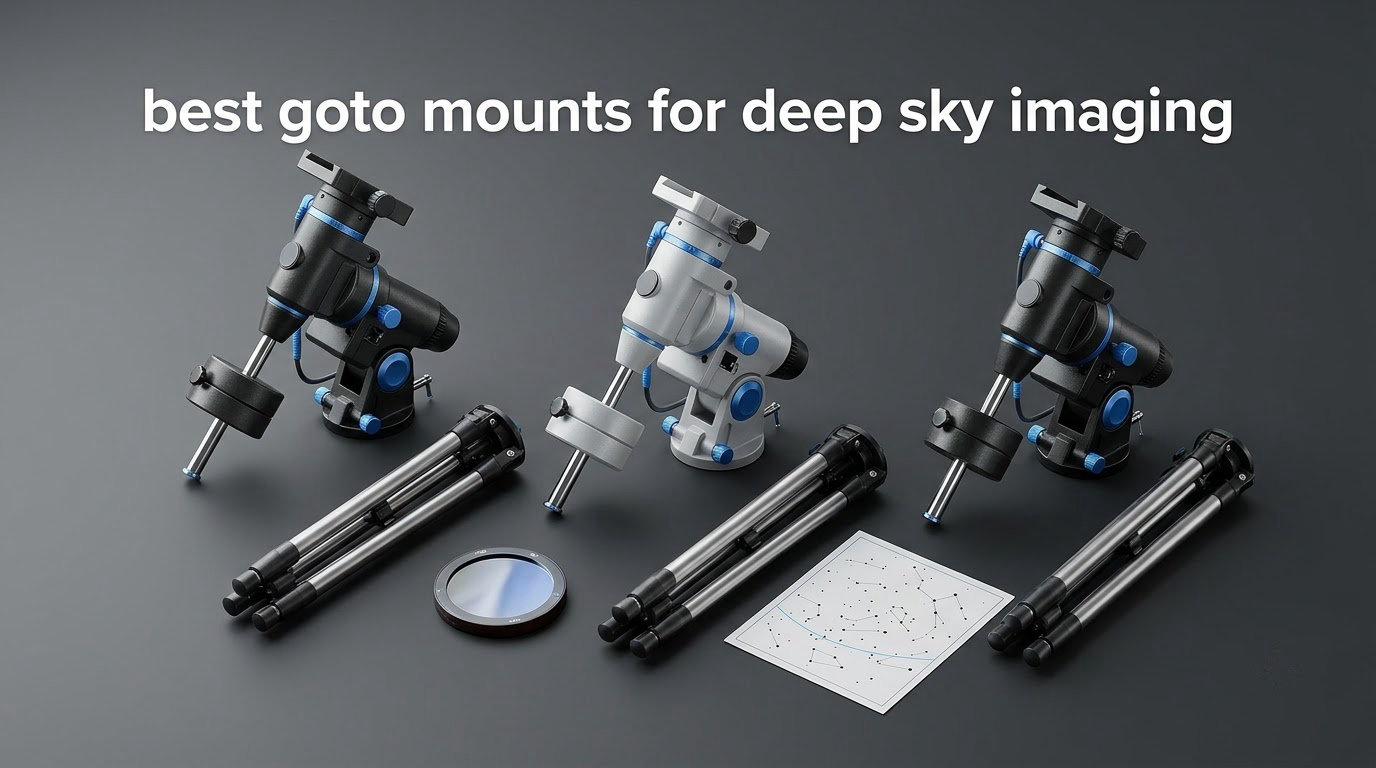
The best GoTo mount for deep sky imaging is a properly polar-aligned equatorial mount rated at roughly 1.5 times your total payload. Most imagers settle on a belt-driven worm gear model such as the Celestron Advanced VX or Sky-Watcher EQ6-R for repeatable sub-arcsecond guiding, while lighter rigs and travel setups do well with a tracker like the Sky-Watcher Star Adventurer GTi.
That answer only helps if you know what you are buying, though. Payload ratings are quoted with a headroom number attached, drive types behave very differently under a long focal length tube, and the gap between a mount’s sticker rating and its usable rating is where most disappointing first rigs come from. We went through the specifications, review patterns and failure reports for every mount in this roundup, then ranked them by how well they hold up once a camera, filter wheel and guide scope are hanging off them.
This guide covers seven GoTo equatorial mounts that clear a real quality bar, from a 26-pound portable tracker kit to a 75-pound observatory-class platform. We also explain the harmonic versus worm gear argument that dominates every mount forum, how to calculate payload headroom, and which alignment method is worth the time. Last updated for October 2026, with specifications and review counts taken from manufacturer listings and verified owner feedback.
If you are still deciding between complete telescope packages and a dedicated imaging rig, our computerized GoTo telescope roundup covers the all-in-one route. It is a different buying decision, and the mount logic below applies either way once you outgrow the tube that came in the box.
Table of Contents
Top 3 GoTo Mounts for Deep Sky Imaging in 2026
Three mounts account for most of the setups we would actually recommend to a new imager. The Celestron Advanced VX wins on proven tracking and a complete kit, the Star Adventurer GTi wins on being genuinely portable with GoTo built in, and the Sky-Watcher EQ6-R wins on raw payload headroom for long focal length rigs.

Celestron Advanced VX
- 30 lb payload
- 2 inch stainless tripod legs
- NexStar+ with 40000+ objects
- All-Star Polar Alignment and PPEC

Sky-Watcher Star Adventurer…
- Full GoTo head with tripod and pier extension
- Built-in illuminated polar scope
- Counterweight bar and 5 lb weight
- 26 lb total kit weight
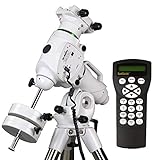
Sky-Watcher EQ6-R
- 44 lb payload capacity
- Belt-driven stepper motors
- PPEC with encoders
- EQMOD and ASCOM compatible
Two of these three sit within the middle of the pack on capacity, which is the point. Payload beyond what your rig needs does not improve the image, so buying a 75-pound mount for a 6-inch refractor is paying for capability you will not use. Match the mount to the heaviest rig you expect to own in three years, not the rig on your desk now.
Every GoTo Mount in This Roundup Compared
All seven mounts below are computerized equatorial mounts capable of sidereal tracking for long exposures. Payload figures are the manufacturer ratings, kit weights include the tripod where the listing specifies one, and the last column notes what each mount is genuinely best at.
| Product | Specs | Action |
|---|---|---|
| Celestron Advanced VX |
|
Check Latest Price |
| Sky-Watcher Star Adventurer GTi Mount Kit |
|
Check Latest Price |
| Sky-Watcher EQ6-R |
|
Check Latest Price |
 Celestron CGX Celestron CGX |
|
Check Latest Price |
 Sky-Watcher AZ-EQ6 Sky-Watcher AZ-EQ6 |
|
Check Latest Price |
 iOptron CEM40 Mount Head iOptron CEM40 Mount Head |
|
Check Latest Price |
 Celestron CGX-L Celestron CGX-L |
|
Check Latest Price |
Note the two listings at the bottom of the table carry very few customer reviews. Their specifications are impressive, but the long-term owner evidence is thin, so treat them as spec-sheet buys rather than proven-rig buys unless you already know what you are doing.
1. Celestron Advanced VX Computerized German Equatorial Mount
Celestron Advanced VX Computerized German Equatorial Mount – 30lb Payload
30 lb payload
2 inch stainless tripod legs
All-Star Polar Alignment
Pros
- Stable 2 inch stainless steel tripod legs
- 30 lb payload suits mid-size imaging telescopes
- NexStar+ hand control with 40000+ object database
- All-Star Polar Alignment and PPEC built in
- Sidereal solar and lunar tracking rates
Cons
- 47 lb bundle weight limits portability to dark sky sites
- Latitude adjustment range is narrower than higher-end mounts
The Advanced VX is the mount we keep coming back to for people building their first real imaging rig. It is a conventional worm gear German equatorial mount, which means the tracking behaviour is well understood and well documented by owners who have been using it for years. With a mid-size refractor and a cooled camera on top, guiding numbers are repeatable and the graph stays flat through a full night.
What makes it our top pick is not exotic engineering, it is completeness. The 2-inch stainless steel tripod legs are a genuine upgrade over the folding steel legs on cheaper mounts, and the 47-pound kit weight is a fair trade for that rigidity. You are not assembling a support structure from three separate purchases before the first exposure.
The NexStar+ hand controller carries a database of more than 40,000 objects, and the mount offers sidereal, solar and lunar tracking rates. For deep sky work the sidereal rate is the one that matters, but having the others means the same mount can drive a solar telescope on a quiet afternoon without a second head.
All-Star Polar Alignment is the reason this mount is as forgiving as it is. Rather than requiring a physical polar scope, it uses a three-star alignment procedure that also works in the southern hemisphere where the pole sits awkwardly. Combined with PPEC training, it produces a mount that new users can get working in an evening rather than a weekend.
Alignment and error correction both run through the same hand controller, so there is no extra box to buy. The dual saddle plate also means you can mount a guide scope alongside the imaging train, which saves you from stacking awkward extensions that change the balance every time you swap cameras.
How the Advanced VX handles a heavier payload
Thirty pounds of rated capacity sounds modest next to the 44 and 55-pound mounts further down this list, and it is. But rated capacity is measured as a bare maximum, and the useful number for imaging is closer to two-thirds of it once you add the guide scope, camera, filter wheel and cables. That puts a sensible working load around 18 to 20 pounds, which comfortably covers an 80mm refractor with a cooled camera or an 8-inch Newtonian with a lighter camera setup.
Owners report that tracking accuracy is one of the most cited strengths, with the sturdy tripod and straightforward GoTo setup coming up repeatedly. The recurring complaint is weight: at 47 pounds for the kit, this is a mount you load into a car, not one you carry to a field.
Where the Advanced VX falls short
The latitude adjustment range of 7 to 77 degrees is narrower than what heavier mounts offer. That matters if you plan to travel between latitudes, since you may find yourself unable to reach a polar alignment at extreme angles without a workaround.
Ownership feedback is otherwise warm, with most reviewers satisfied by the pointing consistency once aligned. The NexStar+ ecosystem is also mature, which means guides, cables and firmware support are easy to find. The main thing you give up versus a larger mount is headroom for a much bigger rig later.
2. Sky-Watcher Star Adventurer GTi Mount Kit
Sky Watcher Sky-Watcher Star Adventurer GTI Mount Kit with Counterweight, CW bar, Tripod, and Pier Extension – Full GoTo EQ Tracking Mount for Portable and Lightweight Astrophotography
GoTo head with tripod and pier extension
Built-in illuminated polar scope
26 lb total kit weight
Pros
- Full GoTo equatorial tracking in a portable 26 lb package
- Built-in illuminated polar scope speeds up setup
- WiFi smartphone control removes the hand controller
- Complete kit includes tripod pier extension counterweight bar and weight
- Two-year limited warranty
Cons
- Payload capacity is limited compared with full-size German equatorial mounts
- 1.5 inch tripod legs give less long-exposure rigidity than heavier mounts
The Star Adventurer GTi answers a question most roundups ignore: what if your imaging trip involves carrying the mount up three flights of stairs? At 26 pounds for the whole kit, this is the only mount in our list you can realistically move on your own, and it does full GoTo equatorial tracking rather than the manual tracking of simpler trackers.
The kit is complete as listed. You get the GoTo head, the tripod, a pier extension, a counterweight bar and a 5-pound counterweight, which removes the most common first-purchase mistake of buying a head and discovering you also need a support and a way to balance it.
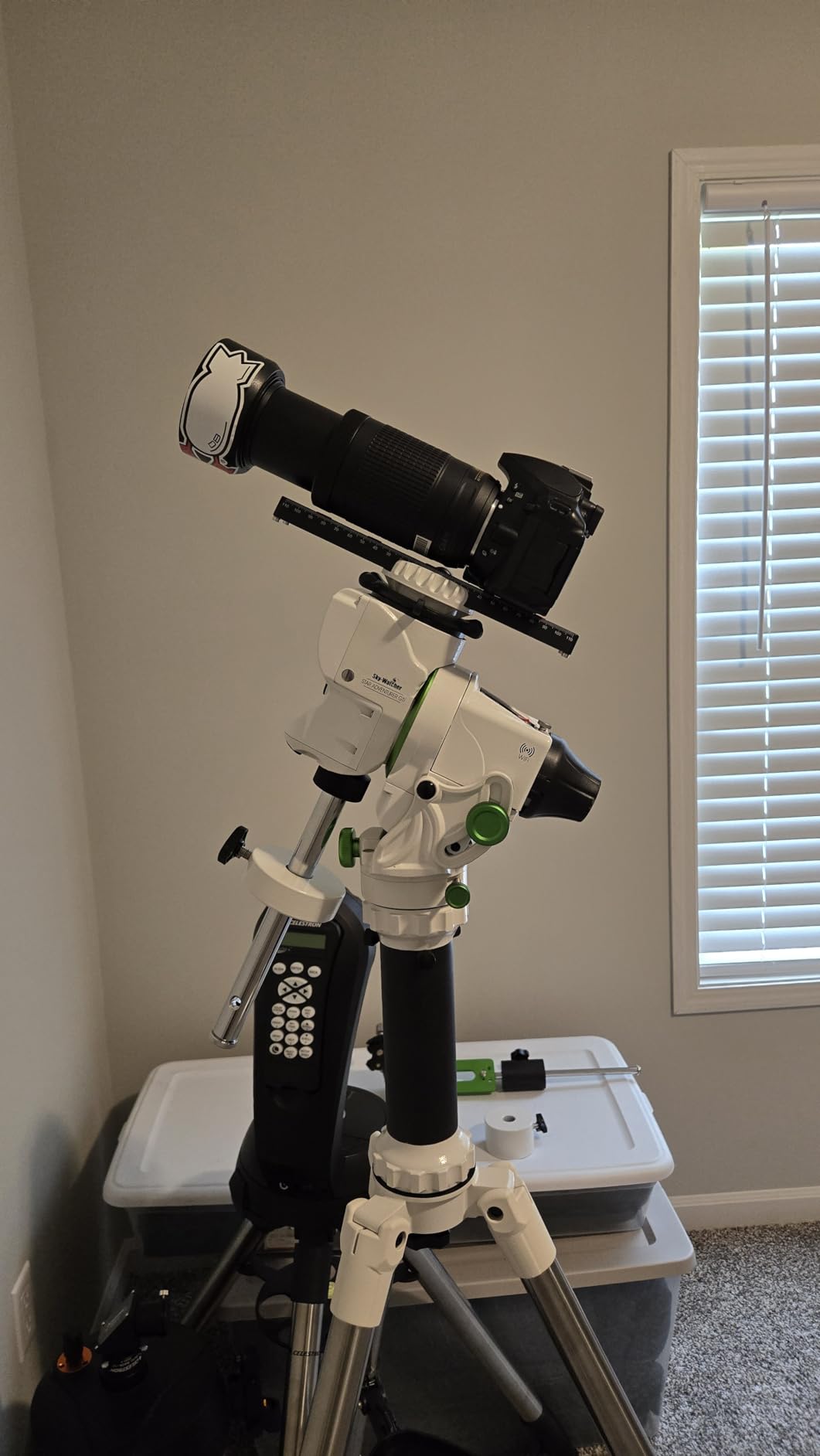
Control is over WiFi from a smartphone, so there is no hand controller to lose or replace. The built-in illuminated polar scope with its illuminator is a real convenience at a dark site where you are working by headlamp, since you are not trying to read an unlit reticle through a small eyepiece.
Reviewers consistently rate this mount highly for the combination of portability, guided GoTo accuracy and value at the entry level. A 4.5-star average across 111 reviews is a strong signal for a category where most competing trackers have no GoTo at all.
Sidereal, lunar and solar rates are all supported, and the two-year limited warranty is longer than the one-year cover common on entry-level mounts. The included pier extension is worth calling out: it raises the mount to a more comfortable working height without requiring you to buy a separate pier.
What fits on the GTi without losing tracking
Treat the payload rating as an upper bound rather than a target, because the 1.5-inch tripod legs are the limiting factor rather than the drive. A small refractor or a short imaging Newtonian with a modest camera is comfortable. A camera-and-lens kit on a small field is the sweet spot for this class of mount, which is exactly where the recurring reviewer comment about payload capacity limiting long-exposure use comes from.
That same caveat drives the long-exposure side. Guided, with a sensible exposure length for the focal ratio, the GTi produces clean results. Pushing sub-exposure time much longer on a wide field with a fast focal ratio is where flex in lighter legs starts to show as corner trailing.
Where the GTi falls short
Two limitations are worth being clear about. The payload capacity is genuinely lower than any full-size German equatorial mount in this list, so it is not a long-term solution if you plan to move to a large sensor. And the 1.5-inch tripod legs give less rigidity than the 2-inch and 2.75-inch legs used on the heavier mounts, so long sub-exposures are not its strength.
If your plan is to grow into bigger optics, the GTi is a stepping stone rather than a destination. It is a genuinely good answer to a specific question, though: how do I do deep sky imaging from a location that is not my back garden.
3. Sky-Watcher EQ6-R Computerized GoTo German Equatorial Mount
Sky-Watcher EQ6-R – Fully Computerized GoTo German Equatorial Telescope Mount – Belt-driven, Motorized, Computerized Hand Controller with 42,900+ Celestial Object Database
44 lb payload
Belt-driven stepper motors
PPEC with encoders
EQMOD and ASCOM compatible
Pros
- Consistently reaches sub-arcsecond guiding when polar aligned
- Belt-driven stepper motors slew quietly with low periodic error
- PPEC training permanently corrects periodic error
- 44 lb payload handles 8-inch class tubes and heavy cameras
- Works well with EQMOD PHD2 NINA and ASIAIR
Cons
- Heavy at about 75 lbs assembled for one-person field use
- Factory grease causes stiction until the mount is re-lubricated
- Alt-az adjustment screws at the base feel awkward
- Hand controller LCD can fail in very cold conditions
The EQ6-R is the mount that most of the imaging world treats as its default answer, and after reading through the owner reports that is not hype. Long-term users describe consistently sub-arcsecond guiding once polar aligned, with belt-driven stepper motors that slew quietly and keep periodic error low enough that guiding barely has to work hard.
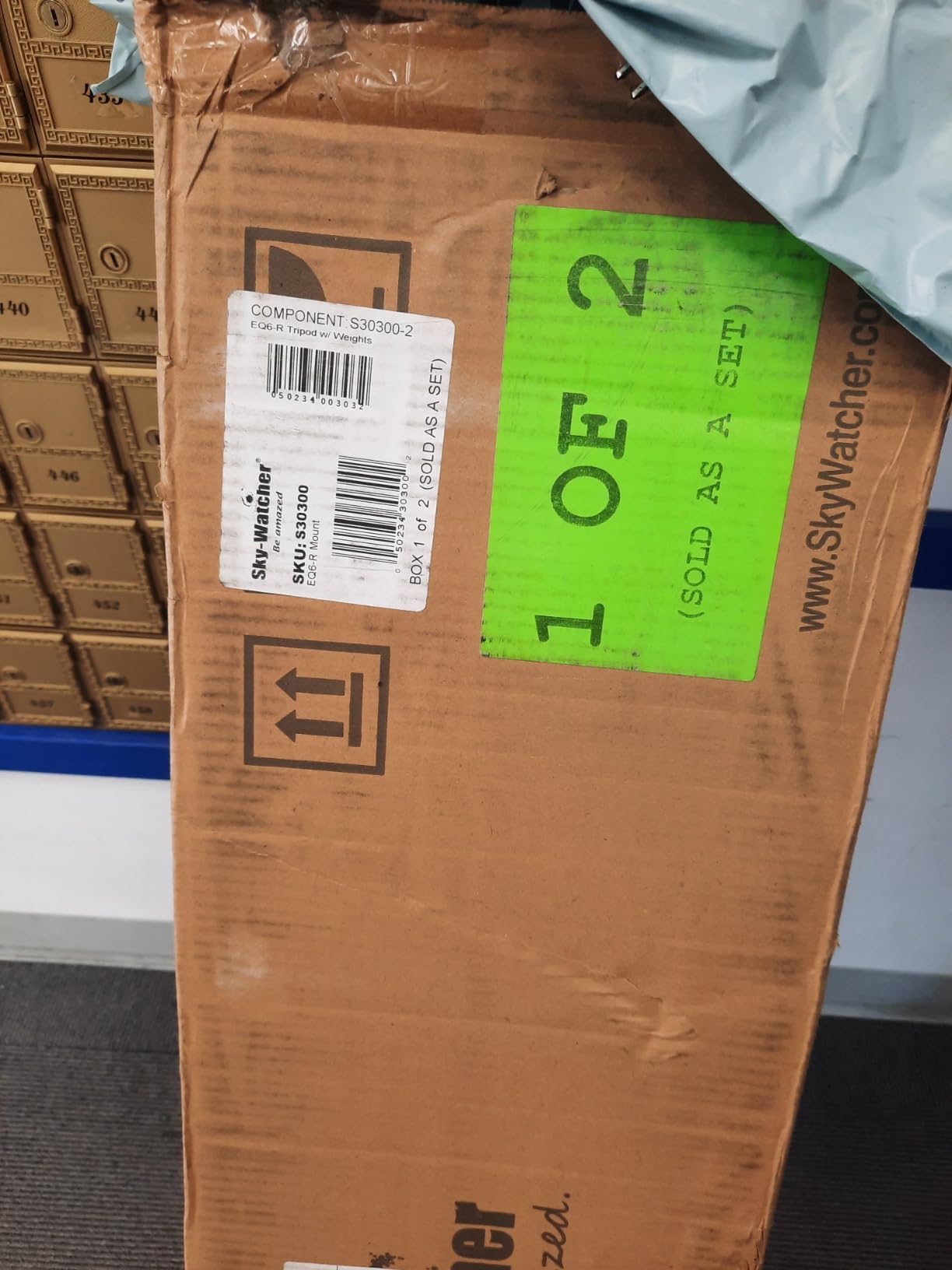
It ships as a two-box kit: the mount head with hand controller, cables and counterweight bar extension in one box, then the tripod, spreader bar and two 11-pound counterweights in the second. That matters more than it sounds, because plenty of complaints in this category are simply about missing pieces in a heavy shipment.
The SynScan hand controller carries a database of more than 42,000 objects, and the built-in illuminated polar finderscope handles alignment without extra hardware. Sidereal tracking is the mode you will use for deep sky work, and EQMOD plus ASCOM compatibility means the mount drops straight into a PC-based control stack.
PPEC is the feature that separates this from cheaper worm gear mounts. Because it has encoders on both axes, the mount learns its own periodic error once and then applies the correction permanently, which is why a lot of the guidance you will read recommends training it for a couple of hours and forgetting about it.

Forty-four pounds of rated payload is the number that matters most here. It covers an 8-inch class optical tube with a cooled camera, filter wheel and guide scope attached, which is the configuration most imagers moving beyond a small refractor end up running.
Guiding results and what to expect from PPEC
Owners report that once polar aligned, the mount reaches sub-arcsecond guiding and holds it through a session. The belt drive is the reason slews are quiet and the periodic error curve is smooth, which means the guider is making small corrections rather than chasing large errors back and forth.
That smoothness is also why the guidance in mount forums leans toward moderate aggressiveness settings rather than maximum corrections. The mount is capable enough that over-aggressive guiding makes things worse, not better. Reported workflows with EQMOD, PHD2, NINA and ASIAIR all work, so you are not locked into one software path.
Where the EQ6-R falls short
It is heavy. The 44-pound head plus tripod and counterweights puts the assembled weight around 75 pounds, which is awkward for one person to load into a car. If you are imaging from a permanent site this is irrelevant, and if you are moving monthly it is the main thing to think about.
Owners also report factory grease on the bearings and worm drive creating stiction until the mount is re-lubricated, which is a known service item rather than a defect. The alt-az adjustment screws at the base feel awkward to use, and the hand controller LCD has been reported as unreliable in very cold conditions. It also wants at least 13 volts to slew without stalling, so budget a proper power supply or power bank rather than a wall adapter.
4. Celestron CGX Computerized German Equatorial Mount
Celestron CGX Computerized German Equatorial Mount & Tripod, 55lb Payload
55 lb payload
High-torque servo motors with belt drive
Internal cabling
Pros
- Holds large rigs running 8-10 inch Newtonians and SCTs
- Flat PHD2 graphs through multi-hour sessions on 30-minute subframes
- Pointing model support in Celestron PWI and All-Star Polar Align
- Internal wiring keeps the imaging rig cable-clean
- Smooth alt-az controls make axis positioning easy
Cons
- 108 lb total weight is very heavy for field use
- Optional polar scope impedes declination range and can collide
- Belts and gears wear over years and degrade tracking
- Hand controller can hang on initializing and some units need repair
The CGX is the first mount in this list that looks like observatory equipment rather than a portable rig, and the 55-pound payload rating explains why. Owners run 8-inch and 10-inch Newtonians and Schmidt-Cassegrains with a full imaging train on top, which puts it well beyond anything the smaller mounts here can support.
Tracking is the standout. Long-exposure users report flat PHD2 graphs through multi-hour sessions on 30-minute subframes, which is the kind of result that lets you go after faint targets without fighting the mount for every frame. The high-torque servo motors with belt drive are the mechanical reason for that.
Internal cabling is an underrated feature on a mount this size. With a large optical train there are many cables to manage, and routing them inside the mount body rather than across the axes keeps the rig cleaner and reduces the chance of a snag during a slew or a meridian flip.
Software support follows the same pattern. The NexStar+ hand controller carries a 40,000-object database with guided tours and custom object filters, and the mount supports PC-based control software with pointing model capability, which lets you teach it a model of your site rather than relying on a generic alignment.
All-Star Polar Align plus a pointing model in Celestron’s control software is a genuinely good workflow. Owners with long-term experience rate the pointing model highly, since it is what removes repeated plate-solving corrections at the start of each target.
When the CGX earns its size
It pays off when the rest of your system is genuinely large. A 10-inch Newtonian with a cooled camera, filter wheel and off-axis guider can approach 40 pounds, and a mount rated below that will be operating at or past its limit for every exposure you take. At 55 pounds, the CGX leaves room for exactly this kind of build.
The 30-minute subframe results reported by owners are the practical benchmark. If your target needs long exposures to reach signal, this is the mount in our list most likely to let you take them without periodic error becoming the limiting factor.
Where the CGX falls short
At 108 pounds total weight, this is a mount for a permanent setup. Two people moving it is a reasonable assumption, and anyone planning to relocate regularly should look elsewhere. The optional polar scope is also a known problem, impeding declination range and in some configurations colliding with the mount itself, so many owners use software alignment instead.
Long-term durability is the other concern. Owners report that belts and gears wear over years and gradually degrade tracking, and worm gear backlash can develop and need occasional adjustment. There is also a small but real share of electronics complaints, with hand controllers hanging on an initializing message and some units needing repair. At 20 reviews, the owner evidence base here is thinner than the specification sheet suggests.
5. Sky-Watcher AZ-EQ6 Multi-Purpose GoTo Mount
Sky Watcher Sky-Watcher AZ-EQ6 Mount – Multi-Purpose GoTo SynScan Dual OTA Mount – EQ and Dual AZ Modes – 44 Pound Payload Capacity (S30330)
44 lb payload
German equatorial alt-az and dual-OTA modes
PPEC
Belt drive with dual encoders
Pros
- One mount serves equatorial imaging alt-az visual and dual-OTA setups
- Reports of roughly 0.5 arc-second tracking performance
- Dual encoders and Freedom Find keep alignment through manual moves
- Silent belt-driven slewing with low backlash
- Works well as a platform with an ASIAIR Plus
Cons
- SynScan hand controller GoTo slew accuracy is limited
- Northern Hemisphere polar alignment reticle and dials need extra calibration
- Head backlash in polar mode reduces alignment precision without a plate-solve scope
The AZ-EQ6 is the only mount here that does three jobs. In German equatorial mode it tracks for imaging, in alt-az mode it becomes a smooth visual mount, and in dual-OTA mode it carries two telescopes at once for comparison or for a lucky imaging run. If you want one mount to cover observing and imaging, there is nothing else in this list that does it.
Under the hood it shares the EQ6-R’s mechanical heritage, with 44 pounds of payload capacity, belt drive and permanent periodic error correction. Owners report tracking performance around 0.5 arc-seconds, which is competitive with dedicated imaging mounts in the same class.
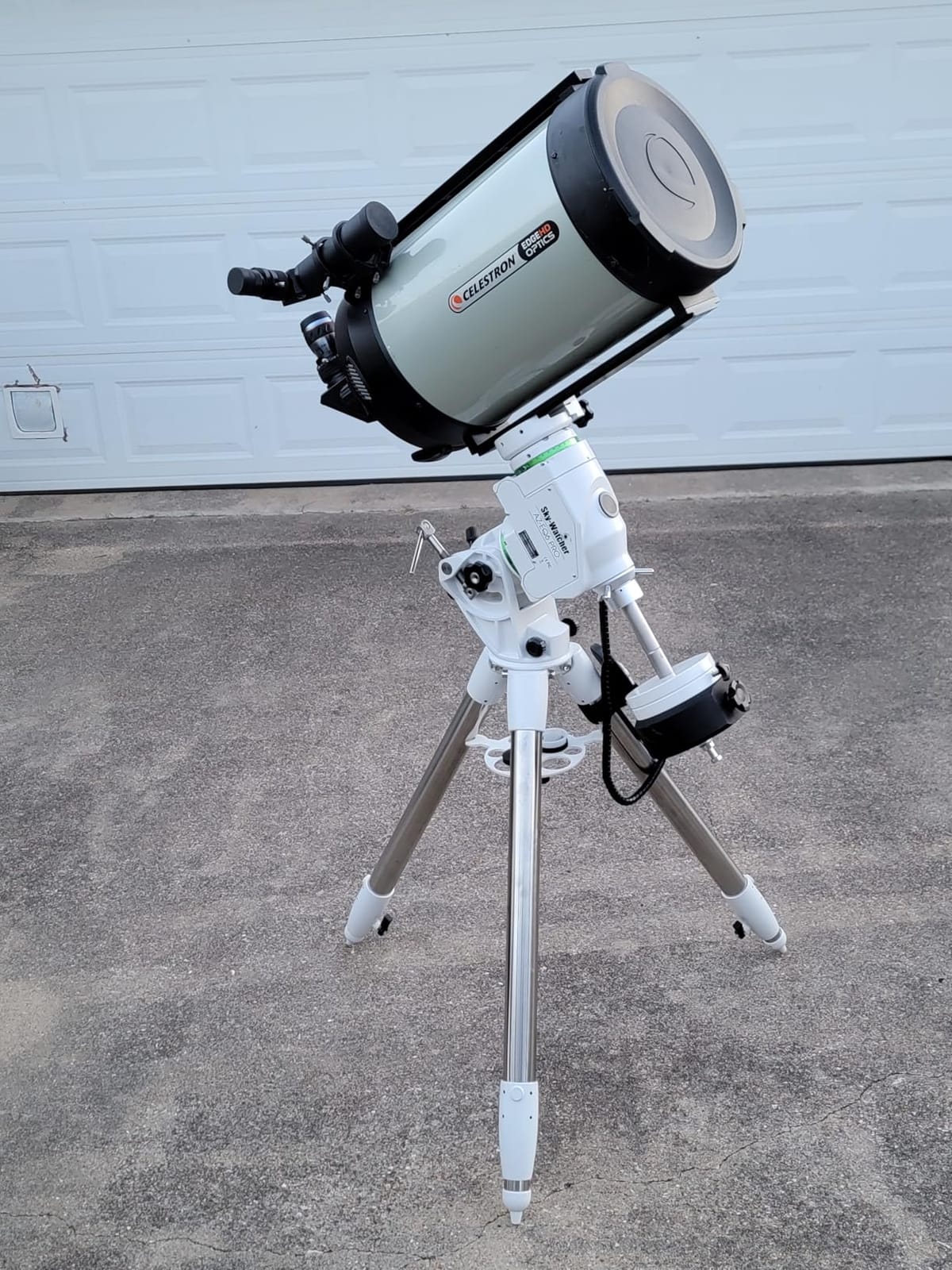
The dual encoders with Freedom Find are a genuinely useful feature rather than a spec-sheet novelty. Because the mount knows where its axes are, you can push the mount by hand to check an alignment star and have the alignment preserved when you let go. On a mount this heavy that is a real convenience.
Silent belt-driven slewing with low backlash also makes it pleasant to use for visual work, which matters if you are buying a multi-mode mount rather than a dedicated imager. The box includes the head, tripod, two 11-pound counterweights, two D/V-style saddles, DC power chord and SynScan hand controller, under a two-year limited warranty.
Switching modes without losing your setup
Switching between equatorial, alt-az and dual-OTA modes is the reason to own this mount. The dual D/V-style saddles let you set up a primary imaging train and a secondary visual instrument, and observers who want to check a target visually before committing an hour of exposure time find that workflow saves a lot of wasted imaging.
Reported use as a platform with an ASIAIR Plus suggests the control side is workable for imaging as well as visual work. The cable routing across three modes is the practical complication, and it is worth planning which accessories stay permanently attached.
Where the AZ-EQ6 falls short
The GoTo pointing is the weak point. Reviewers report limited SynScan hand controller slew accuracy, and head backlash in polar mode reduces alignment precision unless you add a plate-solve scope to correct pointing. For imaging that is manageable because plate solving recentres anyway, but it is a real difference from the mounts whose GoTo is more precise.
Northern Hemisphere users also find the polar alignment reticle and dials need extra calibration work. With only six reviews behind this listing, the owner evidence is thin, so the specification advantages are more trustworthy than the long-term reliability picture.
6. iOptron CEM40 Mount Head with iPolar
iOptron CEM40 Mount Head – with iPolar Electronic Polar Finder, Hard Case
40 lb center-of-mass payload
Internal iPolar electronic polar finder
Self-centering saddle
Pros
- Center-of-mass design keeps heavy imaging rigs balanced
- Built-in electronic polar finder removes the need for a separate polar scope
- Quiet stepper motor drives suit long imaging sessions
- Hard case protects the mount head in transport
Cons
- Tripod and counterweight must be sourced separately
- Very few customer reviews on this listing to gauge long-term reliability
The CEM40 is a different shape of answer from everything else in this list. It is a centre-balanced head rather than a counterweighted German equatorial design, so the load sits over the polar axis instead of hanging off one end of a counterweight bar. The result is a compact head that carries 40 pounds while occupying far less room on a pier than a traditional GEM would.
Because the payload is centred, you do not need counterweights to balance it, and you do not need a long counterweight shaft that swings into your tripod legs or your cables. For a fixed observatory installation that is a meaningful simplification, and the patent-pending universal self-centering saddle is designed to make swapping optical trains straightforward.
The internal iPolar electronic polar finder is the other headline. Instead of a physical polar scope that has to be removed and reinserted at different latitudes, alignment happens electronically, which removes one of the fiddliest parts of setting up a mount at a new site.
Why centre balance matters for long sessions
A centred payload imposes far less bending moment on the drive train than an end-loaded one, which is why centre-balanced designs tend to hold tracking well with heavy instruments. You also avoid the balance drift that spoils autoguiding when a rig is not properly balanced in both axes, and that problem gets worse, not better, as a session runs into the night.
The quiet stepper motor drive is designed for exactly this use case: long deep sky imaging sessions where motor noise near a sensitive camera matters. The hard case included protects the head for transport to a dark site, which is worth having given that a centre-balanced head still contains the most delicate parts of the mount.
Where the CEM40 falls short
This listing is a mount head, and the tripod and counterweight are not included. You need to source the support separately, and that support matters as much as the head. Budget for a rigid tripod or a pier rather than reusing a light alt-az base, because the centre-balanced design only pays off if the mount beneath it does not flex.
The bigger caveat is evidence. There are only two customer reviews on this listing, both five stars, which tells you very little about long-term reliability. The design strengths are real and well understood, but you are buying on specification and reputation rather than on a broad owner base for this particular package.
7. Celestron CGX-L Heavy-Duty German Equatorial Mount
Celestron CGX-L Heavy-Duty German EQ Mount & Counterweights, 75 lb Payload
75 lb payload
2.75 inch tripod legs with 46.2 lb tripod
3 to 65 degree latitude adjustment
Pros
- 75 lb payload covers large telescopes plus camera guide scope and wheel
- 2.75 inch legs and a 46.2 lb tripod damp vibration well
- Sidereal solar and lunar rates via the NexStar+ hand control
- Wide 3 to 65 degree latitude range supports northern and southern use
- Multiple auxiliary autoguide and USB ports for rig wiring
Cons
- Counterweights and balance must be handled carefully at this payload rating
- Only a single customer review exists on this listing
The CGX-L is the payload ceiling of this roundup at 75 pounds, and it is built around a genuinely different philosophy from the smaller mounts. The 2.75-inch tripod legs and a tripod weighing 46.2 pounds are a vibration-damping system, not just a stand. Mass at the base is what keeps an 8-inch or larger instrument steady through a long exposure.
Tripod height is adjustable from 35.75 to 52.75 inches, which lets you set the working height for a large instrument and helps you get a comfortable eyepiece angle for visual use as well. Latitude adjustment spans 3 to 65 degrees, so it works in the northern hemisphere and across most of the southern one.
Connectivity is thorough for a permanent installation, with four auxiliary ports, an autoguide port and a USB port. On a rig carrying multiple cameras, a filter wheel and a guiding system, port availability saves you from adapters and reduces cable clutter around the mount head.
Who actually needs 75 pounds of capacity
Roughly speaking, you need this when your imaging train with guide scope and camera exceeds 30 pounds. That means large reflectors, big Schmidt-Cassegrains with heavy cameras, or an observatory setup with permanent cabling. For anything lighter, you would be paying for headroom you will never load, and the weight becomes a pure disadvantage.
The benefit for those who do need it is the same as for the CGX: long subframes and stable tracking on large optics. Owners of heavy rigs report that the vibration damping is what allows long exposures to hold up, and a tripod that weighs 46.2 pounds is doing real work here.
Where the CGX-L falls short
Balance is the first thing to plan. At a 75-pound rating, an unbalanced rig will behave badly, and you need to be deliberate about distributing weight across the saddle rather than clamping a heavy instrument on one side. Get the counterweight arrangement right before the first alignment, not after your guiding graph disappoints you.
Ownership evidence is the bigger limitation. There is a single customer review on this listing, so this is a specification-led recommendation rather than a proven one. The listed item weight of 75.2 pounds also understates the complete system, since the tripod, counterweights and instruments all add to what you actually carry. Judge it as observatory equipment, not field equipment.
Harmonic Strain-Wave vs Worm Gear: The Central Trade-Off
None of the seven mounts in this roundup use a harmonic strain-wave drive, and that is a deliberate choice rather than an oversight. Every one of them is a worm gear or belt-driven design, because that is where the proven tracking evidence sits. The strain-wave argument is still worth understanding, since it is the single most active debate on every mount forum.
The community consensus framing, from a widely cited Cloudy Nights thread, is that a good worm drive mount usually has as good or better error than a harmonic mount, while harmonics are smaller and lighter for portability. That is the whole trade in one sentence, and it is why the forum arguments tend to run long: both sides are partly right, just about different use cases.
Periodic error is the mechanical error in a motorised mount’s tracking accuracy that produces small recurring movements of the target. Periodic error correction exists to measure that error and apply a reversing correction, and it works best when the mount can report its true axis position. Worm gear mounts with encoders can learn their periodic error precisely, which is why PPEC on the EQ6-R produces long flat graphs.
Encoderless strain-wave mounts are the weak point. On those designs, un-guided exposures get short quickly, with owners reporting periodic error around 1 arcsecond. That number matters because it sets your practical sub-exposure ceiling before autoguiding even starts, and a mount that needs guiding to reach two-minute subframes is a different proposition from one that does not.
For long focal length work, the difference is more acute. Users debating strain-wave versus German equatorial designs at long focal lengths reach different conclusions from wide-field imagers, because the same tracking error represents a larger fraction of the field at high magnification. Where the harmonic advantage sits is in size and weight, not in precision.
The takeaway for a buyer is straightforward. If your priority is guiding quality and long subframes, a worm gear mount is the safer choice and that is where every pick in this roundup sits. If your priority is carrying a rig to a dark site, harmonic designs win on being smaller and lighter, and the error trade-off is usually worth it at wide fields with short subframes.
Payload Capacity and the 1.5x Headroom Rule
How much payload do you need for deep sky imaging? Budget at least 1.5 times your measured total. A typical 8-inch refractor with a cooled camera, filters and a guide scope lands around 15 to 18 kilograms, which points to a mount rated well above 20 kilograms. Small camera-and-lens star-tracker rigs sit under 3 kilograms.
Work out your total in three steps. First, weigh the telescope, then add the camera, filters, adapters and guide scope. Second, add counterweight mass if your mount needs it, because the drive feels the whole assembly. Third, choose a mount rated at least 1.5 times that total so you have room for the gear you will add next year.
The reason for 1.5 times rather than matching exactly is gear growth. Every imager adds a filter wheel, then a second camera, then a guide scope, then a heavier telescope, and each addition takes you closer to a rating that was previously comfortable. Buying headroom once is cheaper than discovering mid-session that your guiding degrades every time the wind picks up.
Overloading rarely announces itself as a mechanical failure. The symptoms are subtler and more common: guiding graphs that get lumpy, errors that appear only under heavier payload, and vibrations that show up on longer subframes. Users often attribute these to the mount rather than to an imbalance, when the actual fix is a lighter payload or a better-balanced one.
One useful cross-check against the guide scopes. The 500 rule says exposure length in seconds should be no more than 500 divided by focal length in millimetres before stars trail noticeably, and the 400 rule is the more conservative version using 400. On a tracking mount both rules become far less restrictive, because the practical limit shifts from focal length to periodic error and tracking accuracy.
Polar Alignment: Scope, Drift and Electronic Finder
Polar alignment is the step beginners rush, and it is the step that costs them sharpness. Getting the polar axis aligned to within a fraction of a degree eliminates field rotation, which is the slow rotation of the camera frame during a long exposure that smears stars at the corners of the frame while the centre stays sharp.
There are three practical routes. A physical polar scope is the fastest at a fixed site once you have dialled in the latitude adjustment, and four of the mounts here include one. Drift alignment is the fallback that works with any mount, at the cost of several minutes per hemisphere. An electronic polar finder, like the one inside the iOptron CEM40, does the job without a removable optical tube.
Software-assisted alignment through plate solving is the fourth option, and it is what most modern imagers use routinely. The mount is roughly aligned, you slew to a bright star, plate solving works out exactly where you are pointing, and the software corrects. In the southern hemisphere this is often easier than a physical scope, since alignment centres on Sigma Octantis rather than a Polaris that barely moves.
Perfect alignment is not the goal. The goal is close enough that field rotation across a typical subframe is smaller than the seeing, which on a guided mount is a much easier target than the exact alignment a visual observer might chase. Do the alignment before the first target of the night rather than after you have already burned an hour of exposure time.
Do You Need a GoTo Mount for Deep Sky Imaging?
There are two main types of telescope mount. An equatorial mount has a right ascension axis aligned with Earth’s rotational axis plus a declination axis, so one motor can track the stars. An alt-azimuth mount moves in altitude and azimuth like a camera tripod, which is simpler mechanically but produces field rotation during long exposures.
For long-exposure deep sky imaging, you effectively need an equatorial mount. An alt-az GoTo mount rotates the field during the exposure, which caps practical sub-exposures at roughly 30 seconds and leaves uncorrected field rotation across the frame. Alt-az is fine for visual observing and for live-stacked smart telescopes, but not for conventional deep sky imaging.
That is why every mount in this roundup is equatorial, and why fork-mounted alt-az GoTo telescopes are excluded even though many of them are excellent visual instruments. It is also why the GoTo part of the mount matters less for imaging than the tracking part. A large object database helps you find things visually; during imaging, plate solving centres the target far more accurately than any hand controller slew.
So does that make GoTo pointless for imaging? No, but it changes what you should pay for. What matters is ASCOM and EQMOD compatibility, a controllable hand controller or direct USB control, and reliable sidereal tracking. Buy the mount for the mount, and treat the object database as a bonus. A mount with a modest database and excellent tracking will outperform a mount with a huge database and mediocre tracking every time you expose.
GoTo Mount Buying Guide: What Actually Matters
Balance the rig before anything else. An unbalanced mount wastes autoguiding effectiveness even when payload is within spec, and it makes motor strain visible in the guiding graph. Set the scope in its imaging position, slide the saddle until the assembly is level front to back and side to side, and check that it stays balanced as it rotates past the meridian. The 60-second version of this check saves hours of confused guiding later.
Autoguiding aggressiveness is the most repeated question on mount forums, and the answer is to treat it as a starting point rather than a dial to max out. Balance first, then begin around 30 to 50 percent on right ascension and slightly lower on declination. On harmonic mounts, dropping to roughly 15 to 30 percent on one or both axes often stops the overcorrection that produces the spiky graphs. Increase gradually only if your RMS error stays above about 1 arcsecond after a good alignment.
Balance interacts with aggressiveness directly, which is why tuning aggressiveness before balancing wastes time. If the graph is lumpy rather than oscillating, that is usually a balance or balance-drift problem. If it oscillates sharply around the target, that is overcorrection. Diagnose the shape before you change the number.
The support matters as much as the head, and it is where the weight figures in our table come from. A 2-inch stainless steel tripod is a meaningful upgrade over folding steel legs, and tripod legs of 2.75 inches with a heavy base are what make large instruments viable. If you are installing permanently, a pier with vibration damping beats any tripod, and you can then choose a lighter head without worrying about total system weight.
Total system cost is the number nobody publishes, and it changes the comparison more often than people expect. A mount head is only part of an imaging system: you also need a guide scope or off-axis guider, a controller or imaging computer, a tripod or pier, and counterweights if the design uses them. Budget for the whole rig, not the headline item, and add the accessories to your payload calculation from the start.
Finally, look at the software ecosystem before you commit. Long-term support matters more than any single specification, because a mount whose app or ASCOM driver is abandoned becomes much harder to use. Check that the mount works with the guiding software you already use, that firmware updates are available, and that the vendor has a track record of maintaining its products. Mounts tend to last decades, so a controller ecosystem that dies quietly is a real cost.
Frequently Asked Questions
What is the best mount for astrophotography?
The best mount for astrophotography is a properly polar-aligned equatorial GoTo mount rated at about 1.5 times your total payload. The Celestron Advanced VX and Sky-Watcher EQ6-R are the strongest all-round choices for proven worm gear tracking, while the Sky-Watcher Star Adventurer GTi is the best value for small rigs and travel.
Do you need an equatorial mount for astrophotography?
For long-exposure deep sky imaging, effectively yes. An equatorial mount aligns one axis with Earth’s rotation, so stars stay fixed without field rotation. An alt-az GoTo mount rotates the frame during the exposure, which caps practical sub-exposures at roughly 30 seconds. Alt-az suits visual observing and live-stacked smart telescopes instead.
What are the two types of telescope mounts?
The two main types are equatorial and alt-azimuth. An equatorial mount has a right ascension axis aligned with Earth’s rotational axis plus a declination axis, so one motor tracks the stars. An alt-azimuth mount moves in altitude and azimuth like a camera tripod, which is simpler but produces field rotation during long exposures.
What is the 500 rule for astrophotography?
The 500 rule is the traditional guideline that exposure length in seconds should be no more than 500 divided by focal length in millimetres before stars trail noticeably. Modern imagers prefer the stricter NPF rule, which accounts for pixel size and gives longer safe exposures. On a tracking mount both rules become far less restrictive.
What is the 400 rule in astrophotography?
The 400 rule says the maximum exposure in seconds before visible star trailing is roughly 400 divided by focal length in millimetres, making it more conservative than the 500 rule. With a polar-aligned tracking mount the sky no longer drifts, so the practical limits become periodic error and tracking accuracy rather than focal length.
Are harmonic strain-wave mounts as accurate as worm gear mounts?
Not quite, and the difference matters. Encoderless strain-wave mounts typically show around 1 arcsecond of periodic error, which shortens usable un-guided sub-exposures. A quality worm gear mount such as the EQ6-R usually tracks as well or better and learns periodic error more precisely. Harmonics win decisively on size, weight and centre balance.
What guiding aggressiveness should I use?
Treat aggressiveness as a starting point, not a setting to max out. Balance the rig first, then begin around 30 to 50 percent on right ascension and slightly lower on declination. On harmonic mounts, dropping to roughly 15 to 30 percent on one or both axes often stops overcorrection. Increase gradually only if RMS error stays above about 1 arcsecond.
How much payload do I need for deep sky imaging?
Budget at least 1.5 times your measured total payload. A typical 8-inch refractor with a cooled camera, filters and a guide scope lands around 15 to 18 kilograms, pointing to a mount rated 20 kilograms or more. Small camera-and-lens star-tracker rigs sit under 3 kilograms. Overloading causes tracking errors long before mechanical failure.
Conclusion: The Best GoTo Mounts for Deep Sky Imaging in 2026
The Celestron Advanced VX is our editor’s choice and the mount we would build a first serious imaging rig around, because it combines proven worm gear tracking, a genuinely good tripod and a complete package with no assembly surprises. If your rig is heavier or your subframes are longer, the Sky-Watcher EQ6-R adds belt-driven stepper motors, encoder-based PPEC and 44 pounds of capacity.
If portability is the deciding factor rather than payload, the Sky-Watcher Star Adventurer GTi gives you full GoTo equatorial tracking in a 26-pound kit with the tripod, pier extension and counterweight included. For large instruments and permanent installations, the Celestron CGX and CGX-L cover 55 and 75 pounds of rated capacity, and the iOptron CEM40 offers centre balance and electronic polar alignment for a fixed pier.
Whichever of the best goto mounts for deep sky imaging you choose, the setup matters more than the model name. Balance the rig, align properly, and start guiding at moderate aggressiveness. Updated for October 2026, and we will keep the ratings and specifications here current as owner feedback accumulates.