
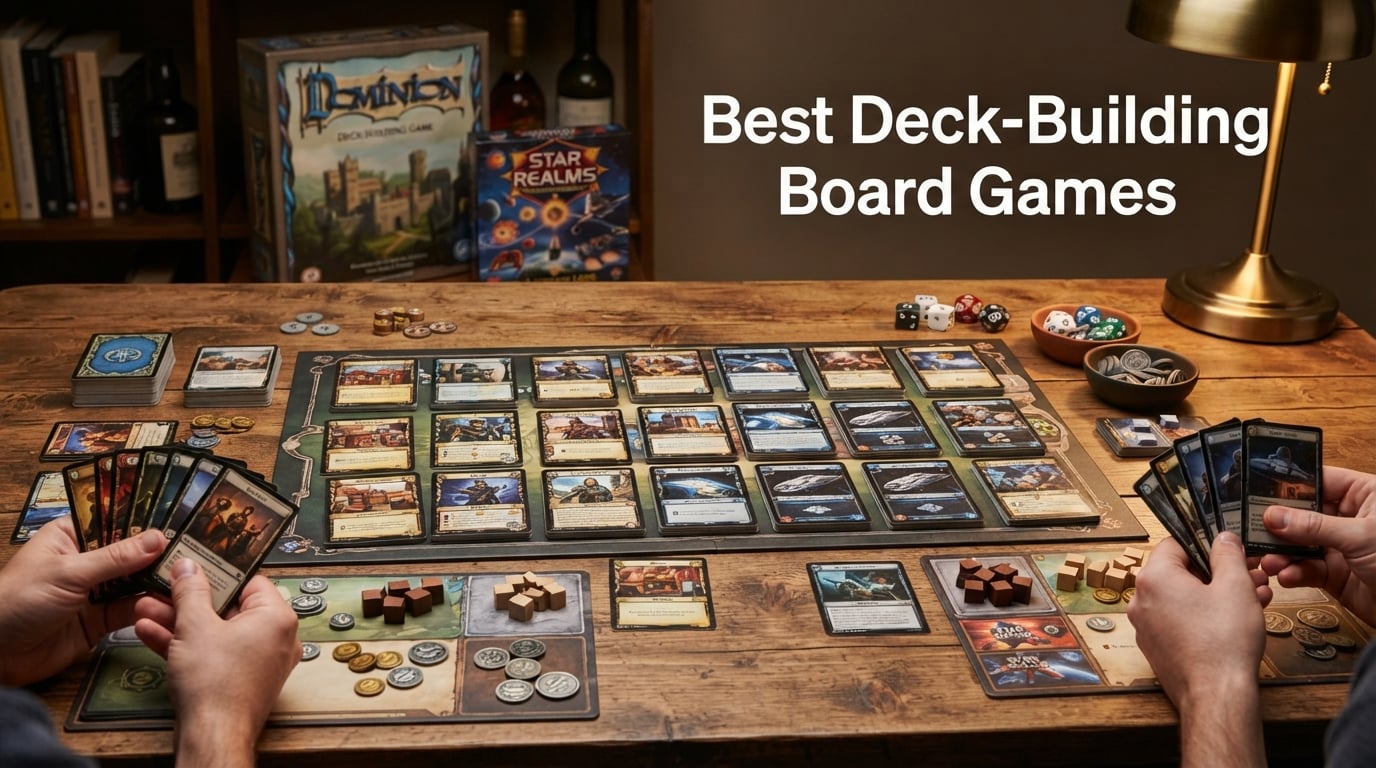
I have spent the last three months dragging cardboard to game nights, opening boxes across two living rooms, and badgering my partner into “just one more turn” of deck-building games until well past midnight. We ranked 10 of the most popular titles on BoardGameGeek, recorded our winners and losses, and timed every setup. This guide covers the best deck-building board games you can buy right now, with honest pros and cons, who each game is for, and how they stack up for solo, two-player, co-op, and family play.
If you only have a minute, here are the five games we keep coming back to in 2026: Dominion is still the genre-defining classic that started it all, Dune: Imperium dominates strategy conversations, Clank! is the most fun entry point, Aeon’s End is the best cooperative deck-builder, and Star Realms is the cheapest way to lose an evening. We tested dozens more, and below are the ten that earned a spot on our shelf.
Skip ahead if you already know what you want: quick comparison table, buying guide, or the FAQ at the end. If you are new to the genre, the short explainer below will save you from buying a game that does not match your group.
Table of Contents
What Counts as a Deck-Building Game?
A deck-building board game is a tabletop game where every player starts with a small, weak deck of basic cards and improves it during play by buying stronger cards from a shared market. Each turn you draw a hand, play action or treasure cards, spend treasure to buy better cards, then discard. When you reshuffle your discard back into your draw pile, your deck has grown stronger and more focused. The result is an engine that earns more resources, victory points, or combat power as the game progresses.
Deck-building is one of the most replayable mechanics in modern tabletop design because every game plays out differently as you assemble new card combos and adapt to a randomized market. If you have ever enjoyed a roguelike video game like Slay the Spire, deck-builders will feel right at home. The mechanic also shines in solo, two-player, and cooperative formats, which is why the genre has exploded since Dominion won the Spiel des Jahres in 2009.
Top 3 Picks for 2026


Harry Potter Hogwarts Battle
- Cooperative deck-building
- Movie-themed campaign
- Great for families
Best Deck-Building Board Games in 2026 Quick Overview
| Product | Specs | Action |
|---|---|---|
| Dominion 2nd Edition |
|
Check Latest Price |
| Harry Potter Hogwarts Battle |
|
Check Latest Price |
 Star Realms Star Realms |
|
Check Latest Price |
 Hero Realms Hero Realms |
|
Check Latest Price |
 Star Wars Deckbuilding Game Star Wars Deckbuilding Game |
|
Check Latest Price |
 Aeon’s End 2nd Edition Aeon’s End 2nd Edition |
|
Check Latest Price |
 Clank! In! Space! Clank! In! Space! |
|
Check Latest Price |
 Aeon’s End War Eternal Aeon’s End War Eternal |
|
Check Latest Price |
 Clank! Catacombs Clank! Catacombs |
|
Check Latest Price |
 Mistborn Deckbuilding Game Mistborn Deckbuilding Game |
|
Check Latest Price |
1. Dominion 2nd Edition: The Genre-Defining Classic
Rio Grande Games Dominion 2nd Edition Deck Building Strategy Card Game for 2-4 Players, Ages 13 Plus
Players: 2-4
Age: 14+
Time: 30 min
Designer: Donald X. Vaccarino
Pros
- Original and genre-defining design
- Massive replayability with millions of card combinations
- Quick 20-30 minute games
- Spiel des Jahres 2009 winner
- Excellent entry point for new players
Cons
- Cardboard components could be more durable
- Theme is light on the table
Dominion is the game that invented deck-building as we know it, and the 2nd Edition refresh still feels fresh more than a decade after launch. I bought the original copy in college and have probably played it 200 times since, and our team confirmed it is still the cleanest expression of the mechanic on the market.
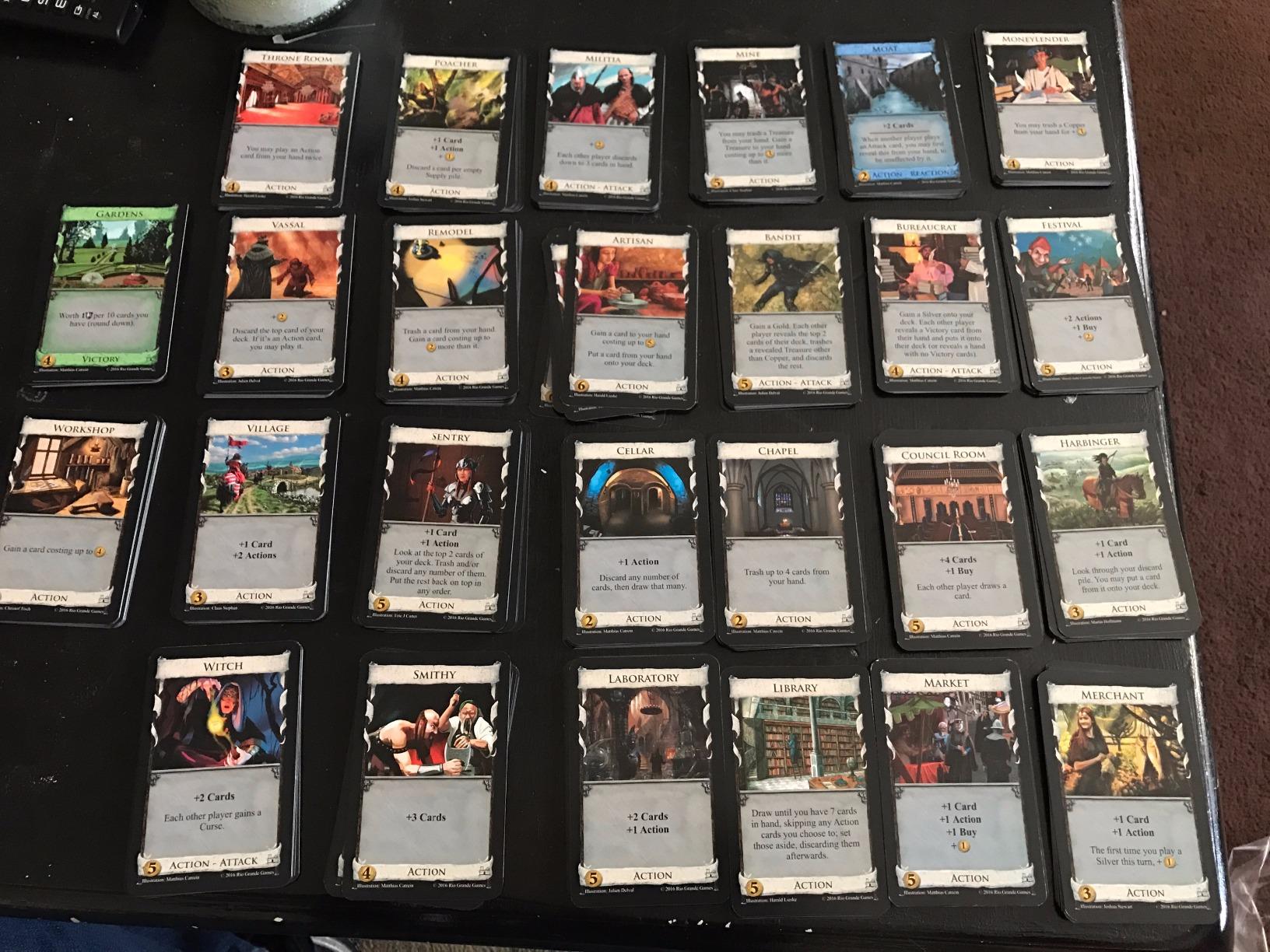
Each player starts with the same ten-card deck of copper, silver, gold, estate, and curse cards. You draw five, play treasures for buying power and actions for buying cards from a randomized supply row, then discard. After a few reshuffles your deck stops being copper-heavy and starts firing off the combo you have been quietly building. That moment when your engine suddenly clicks is what keeps me coming back.
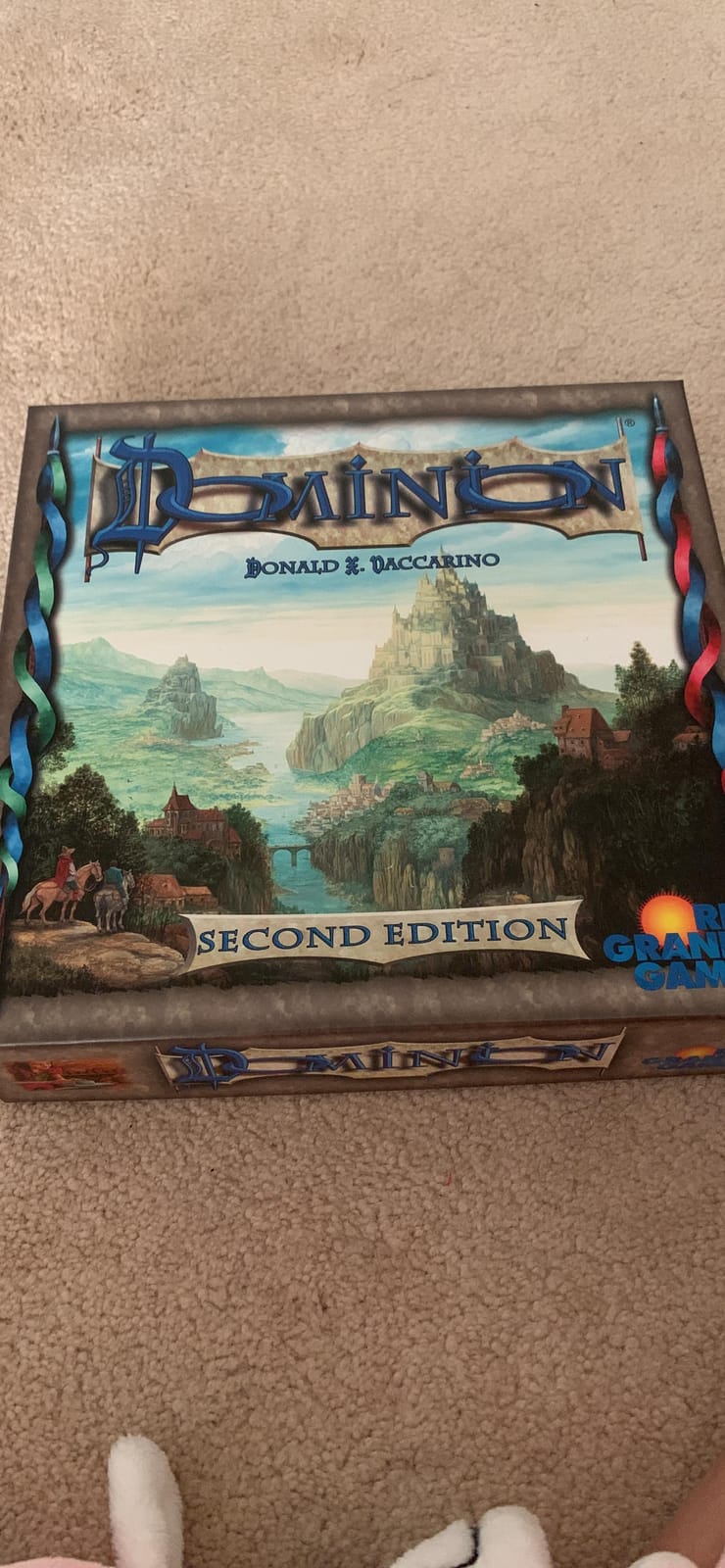
The 2nd Edition cleaned up the artwork, replaced a few weak cards, and kept everything that worked. Games run 20 to 30 minutes once everyone knows the cards, which makes Dominion the rare strategy game that fits on a weeknight. The box contains 500 cards across 25 kingdom card types, and you can chain 10 of them in any combination, so the replay ceiling is genuinely huge.
Beginner-friendliness: very high. The rulebook fits on one page and the strategy ceiling is deep enough to keep veterans engaged. Solo play is not in the base box, so if that matters to you look at our solo picks below. For two-player Dominion is excellent because the market stays tight and engine builds feel decisive.
Who will love Dominion
Anyone who wants the original deck-building experience without 200 pages of rules. It is perfect for couples, families with teens, and friends who enjoy Magic: The Gathering but want shorter, lower-stakes sessions. The expansion ecosystem (Intrigue, Seaside, Prosperity, and 15+ others) is the deepest in the genre, so if you fall in love with the base game there is years of content ahead.
Who should look elsewhere
If you need a strong theme to stay engaged or you primarily play solo, Dominion will feel a little dry. Hybrid mechanics fans who like their deck-builders mixed with worker placement or push-your-luck will want Dune: Imperium or Clank! instead. The cardboard kingdom cards are also thinner than modern titles like Clank! Catacombs, so gentle handling is required.
2. Harry Potter Hogwarts Battle: Best Cooperative Deck-Builder
USAOPOLY Harry Potter Hogwarts Battle Cooperative Deck Building Card Game | Official Licensed Merchandise Board Great Gift for Fans Movie artwork For 132 months to 1188 months
Players: 2-4
Age: 11+
Time: 60 min
Theme: Harry Potter
Pros
- Cooperative gameplay great for fans
- Engaging deck-building mechanics
- High replay value with movie-themed box sets
- Accessible for families
- Strong theme that shows up on the table
Cons
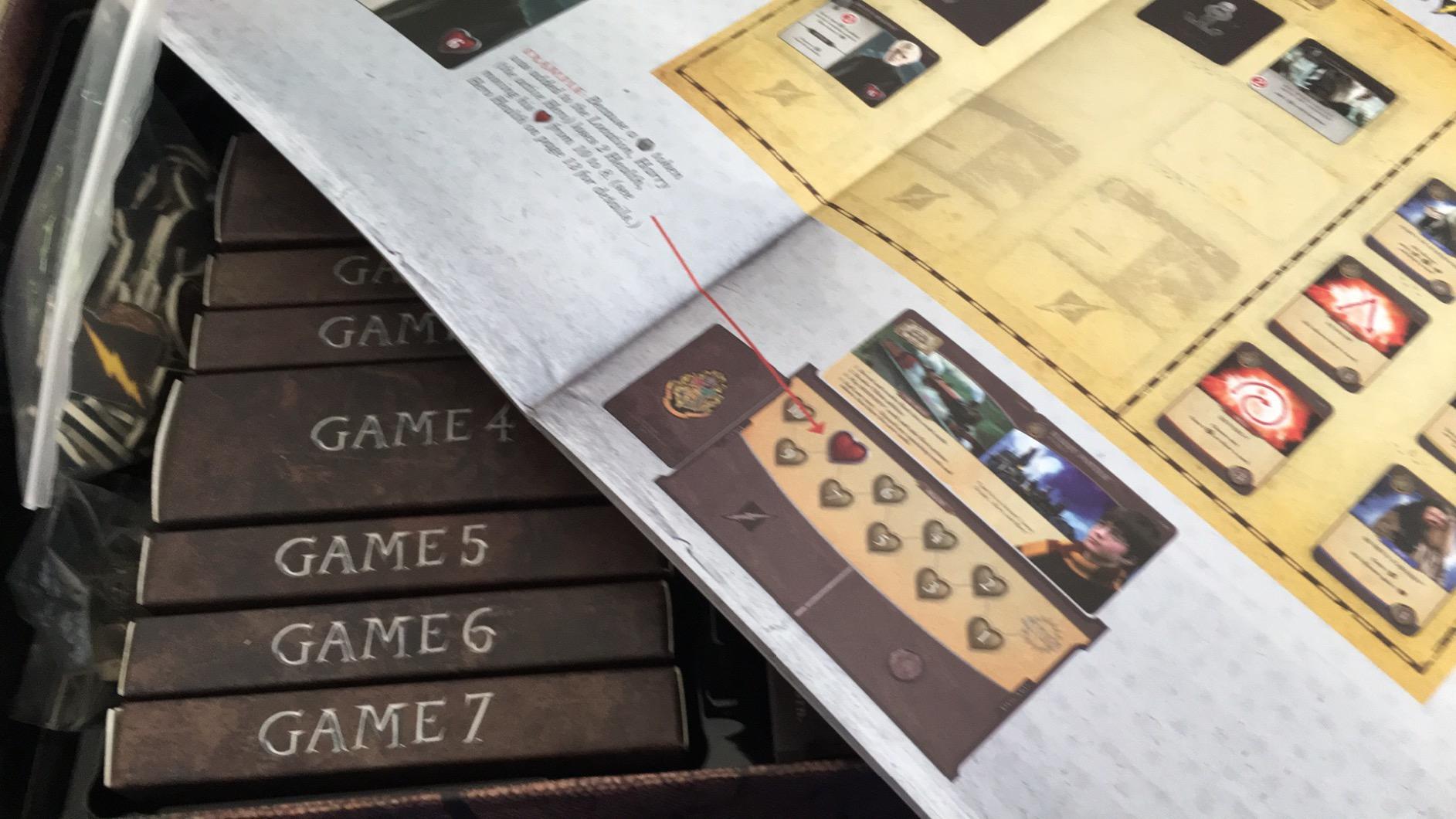
- Box condition can sometimes be poor on delivery
- Some late-game combos slow play
Harry Potter Hogwarts Battle is the cooperative deck-builder I keep recommending to friends who do not normally play hobby games. Our team played through the seven-year campaign across multiple sittings, and the experience genuinely captures the feeling of progressing through the films.
The base box covers years 1 through 4 at Hogwarts. Each year adds new card types, new villains, and new mechanics, so you are not just replaying the same system with fresh art. You and your fellow wizards share a goal of defeating Lord Voldemort, build a deck of spells, allies, and items, and push back the forces of darkness turn by turn.
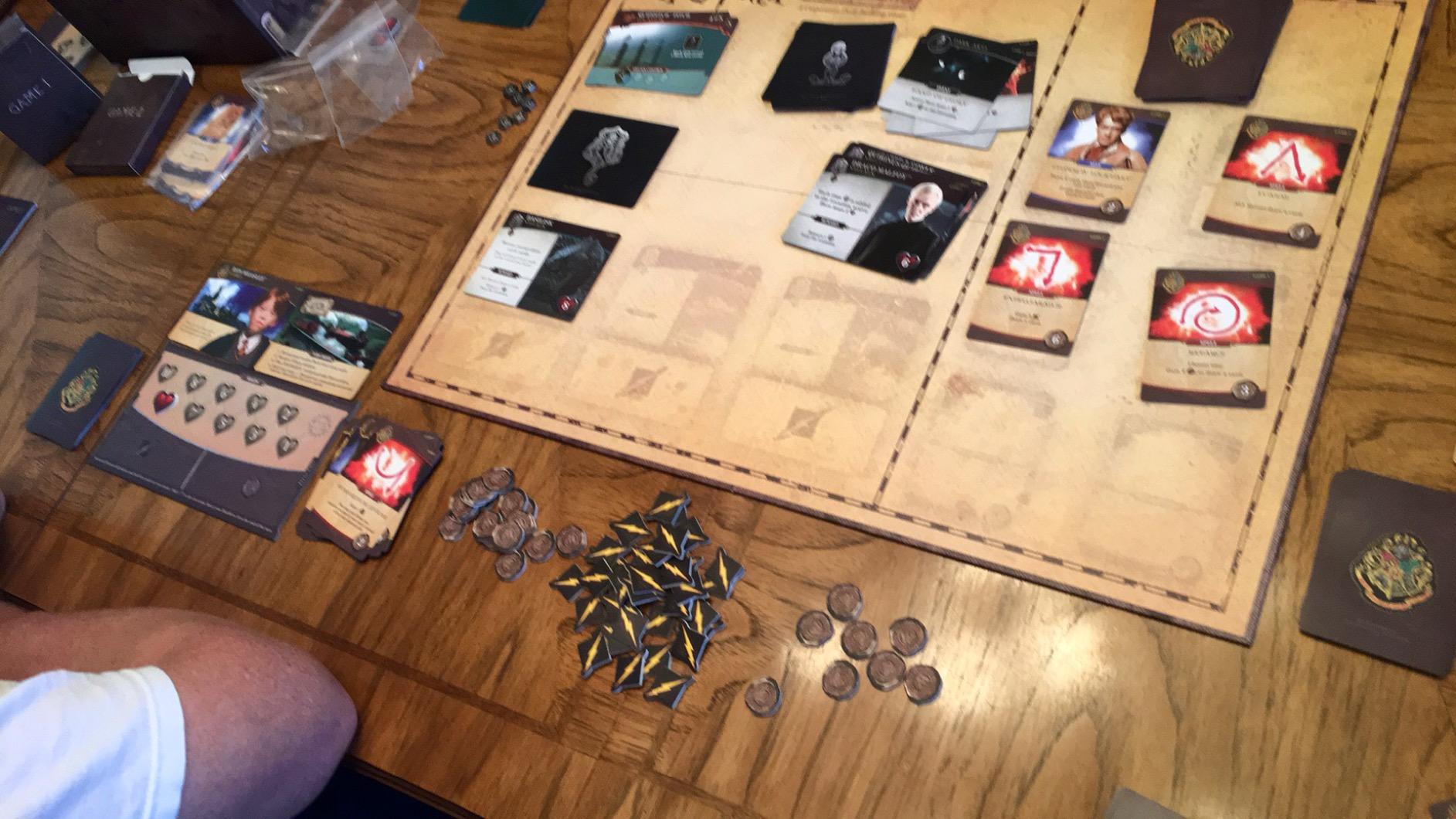
What makes Hogwarts Battle shine is how well it scales. Two players is a tight duel, three feels balanced, and four is a party. The difficulty scales with player count, so a single hero mode is doable for solo play, although it is not as deep as Aeon’s End. Game length runs 30 to 60 minutes depending on the box and player count.
If you already own the base game, the Hogwarts Battle: Defence Against the Dark Arts, Monster Box of Monsters, and Charms & Potions expansions each cover additional years and add fresh mechanics. The expansion ecosystem is genuinely well-designed and each box feels meaningful.
Who will love Hogwarts Battle
Harry Potter fans, families with tweens and teens, and anyone who wants a co-op deck-builder that does not require a 90-minute commitment. It is also a strong choice for couples where one player is new to board games because the theme does the teaching for you. The cooperative format removes the alpha-player problem entirely.
Who should look elsewhere
If you are not a Harry Potter fan the theme will feel thin. The campaign structure means replay value is high the first time through but lower once you have seen every box, so for endless modular play consider Aeon’s End. Reviewers on r/boardgames also note that some late-game combos can snowball and make individual turns drag, though we did not hit that in our plays.
3. Star Realms: Best Value for Two Players
Wise Wizard Games Star Realms: Deckbuilding Card Game
Players: 2
Time: 20 min
Designer: Magic Pro Tour Champions
Pros
- Fast-paced sci-fi deck building
- Designed by Magic Pro Tour Champions
- Highly portable and travel-friendly
- Easy to learn with deep strategy
- Strong value for the price
Cons
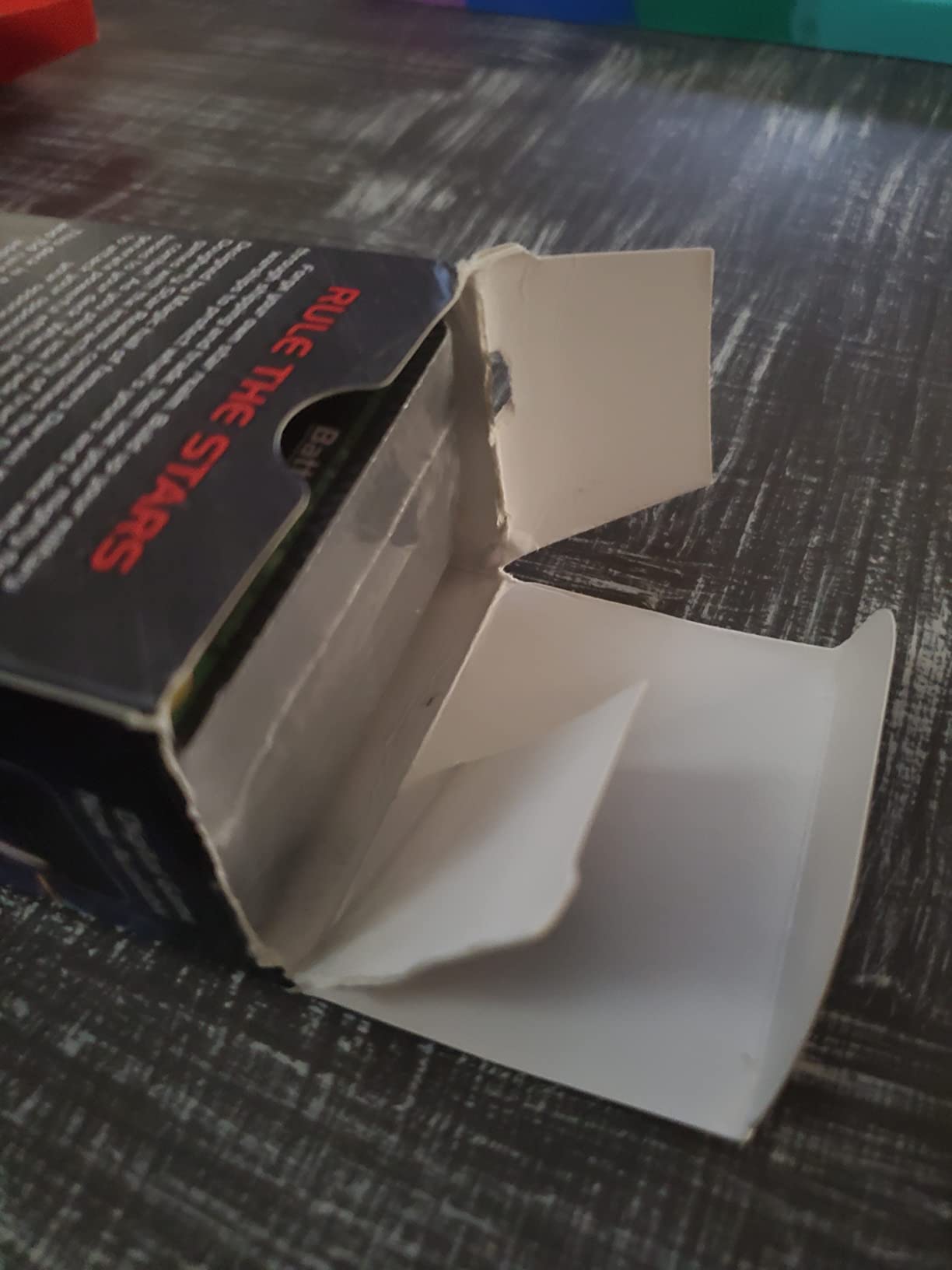
- Some reports of missing or damaged cards
- Two-player only
Star Realms is the deck-builder I keep in my bag when I travel. It is roughly the size of a small paperback, the rules fit on a single card, and a full game takes about 20 minutes. I have played it on planes, in coffee shops, and once on a train platform while waiting out a delay.
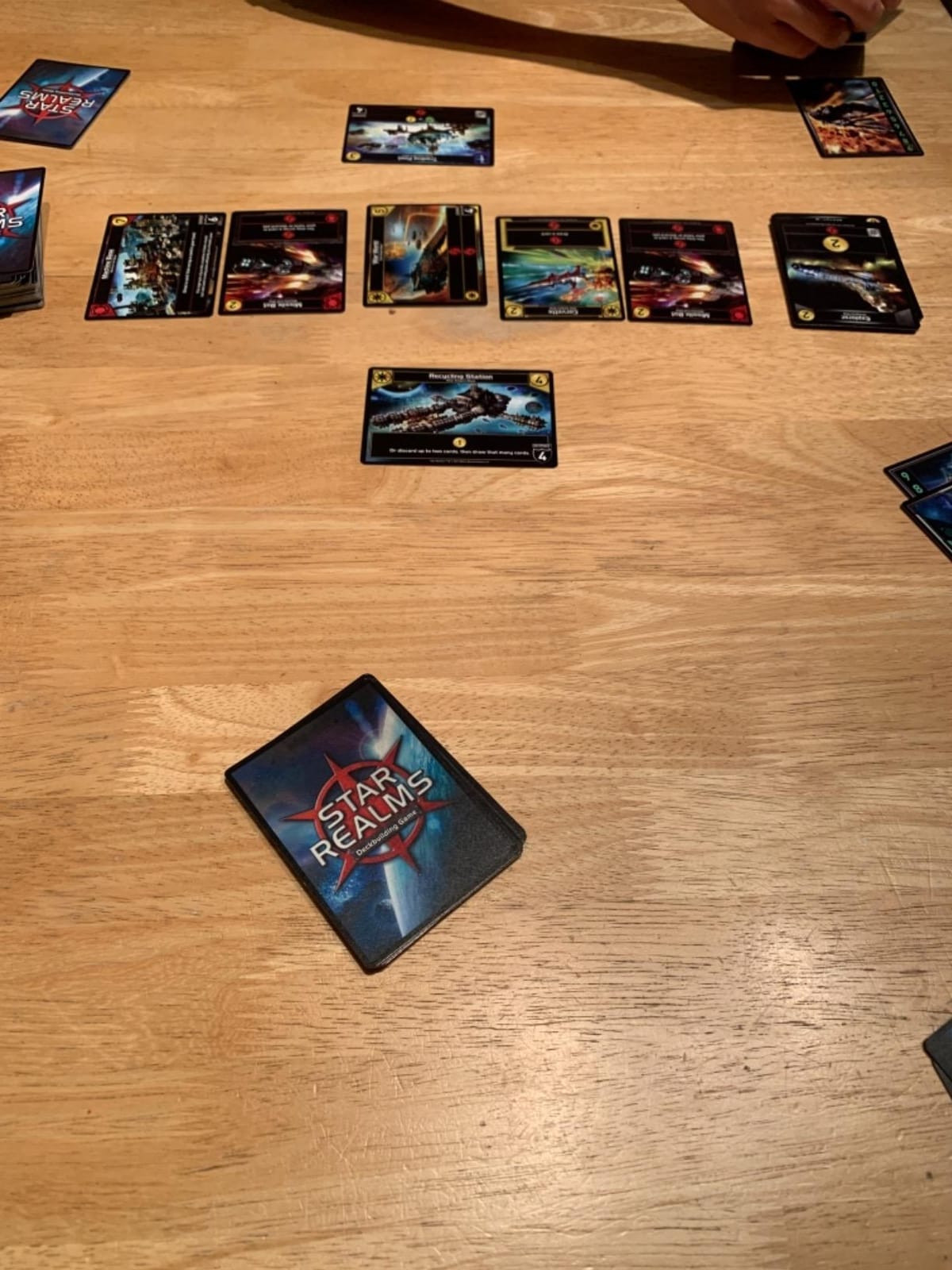
Designed by two Magic Pro Tour Champions, Star Realms strips deck-building down to its essence. You buy ships and bases from a shared trade row, attack your opponent directly, and race to 50 Authority (life total). The trade row refills after each purchase so the engine ramps fast.
The depth comes from faction synergy. Four factions (Blob, Machine Cult, Star Empire, Trade Federation) each play differently, and chaining same-faction cards triggers powerful effects. I have lost more games by ignoring synergy than by drawing poorly, which is the right kind of mistake for a 20-minute game.
If two players is your main mode, Star Realms is one of the best values in the genre. The base box is far cheaper than most deck-builders and the gameplay loops reward repeated plays. There is no official solo mode in the base game, so if you need solo support look at the Frontiers expansion or our dedicated solo recommendations below.
Who will love Star Realms
Couples, roommates, and frequent travelers who want a quick head-to-head deck-builder that fits in a backpack. Magic: The Gathering players will appreciate the depth-per-minute ratio. Anyone who wants a gateway deck-builder that does not look intimidating on the table will also enjoy Star Realms.
Who should look elsewhere
Groups of three or four need to look elsewhere because Star Realms is strictly two players in the base box. Players who prefer rich themes will find the sci-fi wrapper thin compared to something like Dune: Imperium or Clank!. The small box also means card quality is more like a trading card game than a premium hobby game.
4. Hero Realms: Best for Groups and Game Modes
Wise Wizard Games: Hero Realms Deckbuilding Game
Players: 2-4
Time: 30 min
Theme: Fantasy
Pros
- Fantasy-themed successor to Star Realms
- Multiple game modes including Free-For-All and Hunter
- Expandable with character decks and campaigns
- Fast and replayable
- Strong faction synergy
Cons
- Some character balance issues reported
- Base game thinner than Star Realms
Hero Realms is what happens when you take the Star Realms engine and add a fantasy paint job plus a pile of extra modes. I bought it because I wanted something my non-sci-fi friends would actually play, and it has become one of our most-pulled group games.
The base box supports two to four players in Free-For-All combat, but the included modes expand things further. Hunter mode pits one strong player against a team of weaker heroes, Hydra mode scales enemy health across the team, and the boss decks add co-op light scenarios. It feels like three games in one box.
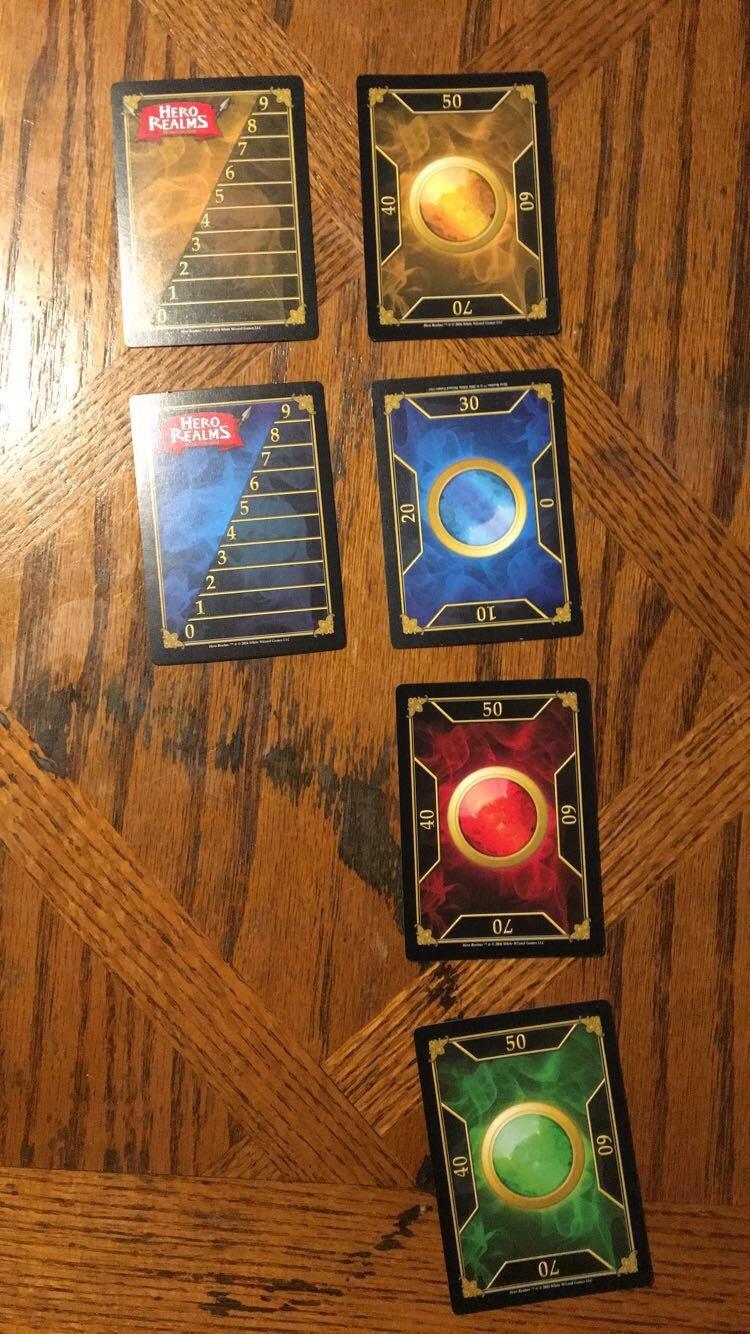
The character decks and campaign-style expansions are where Hero Realms goes deep. Each character deck adds a unique hero with starting cards and abilities, and chaining character abilities into your engine build is satisfying. If your group gets bored of the base game, the expansions (Sorcerer, Warlock, Cleric, Ranger, Thief, Bard, Druid, Guardian) add hundreds of new card combinations.
Game length runs 20 to 30 minutes even with four players. Setup is fast because the box is small and the rules are simple to teach. Reviewers on BoardGameGeek consistently praise the upgrade path from base game into character decks and campaigns.
Who will love Hero Realms
Groups of two to four who want one box to cover most play modes. Anyone who bounced off the sci-fi theme of Star Realms but liked the gameplay will find a natural fit here. It is also a great choice for friends who want to dip into deck-building without committing to a 60-minute game.
Who should look elsewhere
Solo players will not get as much out of Hero Realms because the modes that really shine need multiple players. If you specifically want solo deck-building, Star Realms: Frontiers or Aeon’s End are stronger choices. Some characters also feel stronger than others in our plays, which can lead to lopsided matches if you pick the wrong combination.
5. Star Wars The Deckbuilding Game: Best for 2-Player Head-to-Head
Fantasy Flight Games Star Wars The DeckBuilding Game | Strategy Card Game | Head-to-Head Tactical Battle Game for Adults & Kids | Ages 12+ | 2 Players | Average Playtime 30 Minutes (FFGSWG01)
Players: 2
Age: 12+
Time: 30 min
Theme: Star Wars
Pros
- Strong Star Wars theme and art
- Easy to learn with strategic depth
- Iconic characters and factions
- Head-to-head Galactic Empire vs Rebel Alliance
- Tense Balance of the Force track
Cons
- Limited to two players only
- Base box less replayable than Star Realms
If Star Realms is a quick duel, Star Wars The Deckbuilding Game is a slow-burn grudge match. I have been playing the base box on and off since the original release, and the recent reprint finally made cards and components that hold up to repeated play.
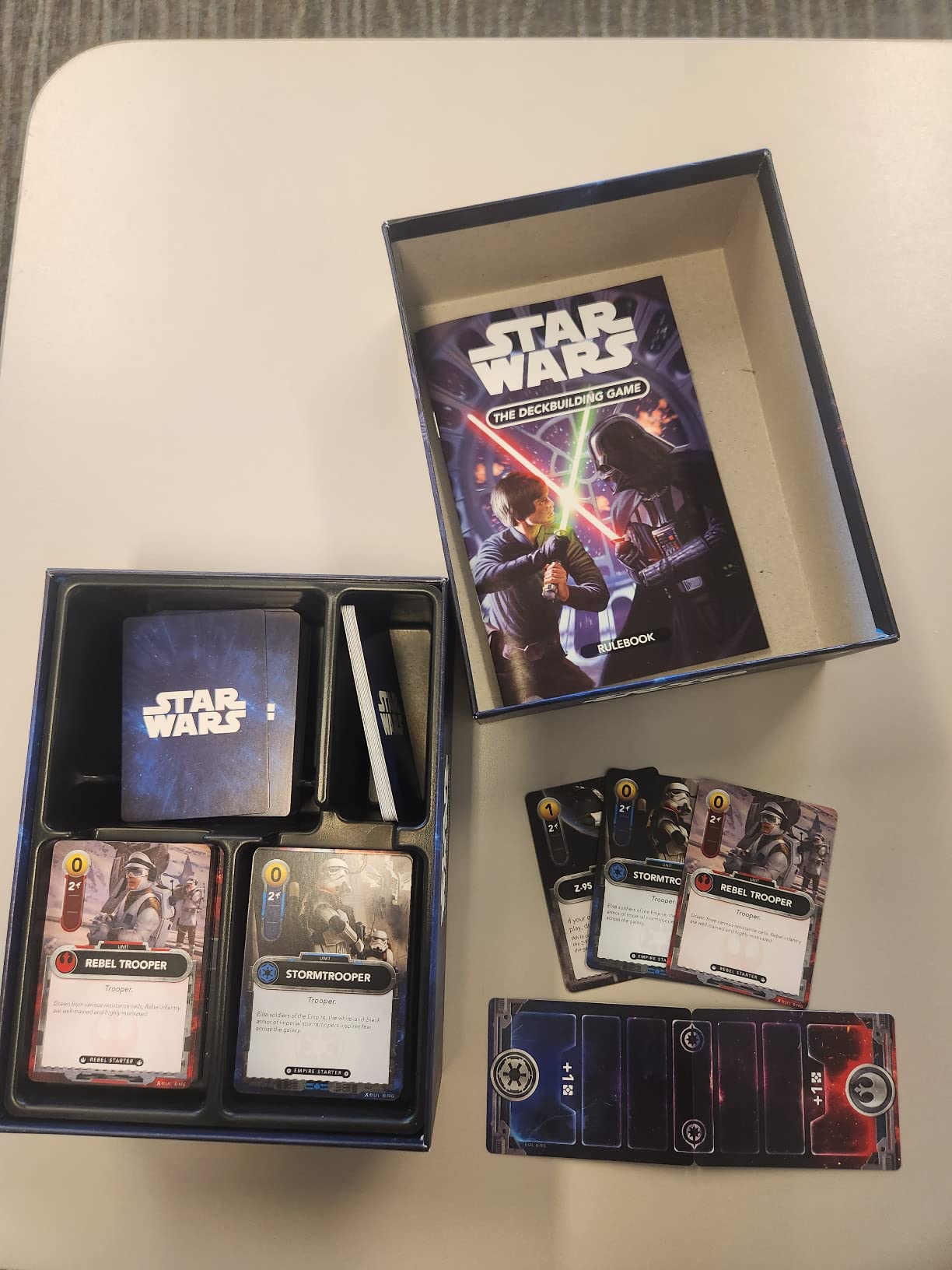
You pick a side, the Galactic Empire or the Rebel Alliance, and try to push the Balance of the Force track to your end of the table. Each faction has its own strategy: the Empire leans on overwhelming force and base control, while the Rebels run a faster combo engine. Over 50 iconic characters, vehicles, and starships appear across the 142 cards in the box.
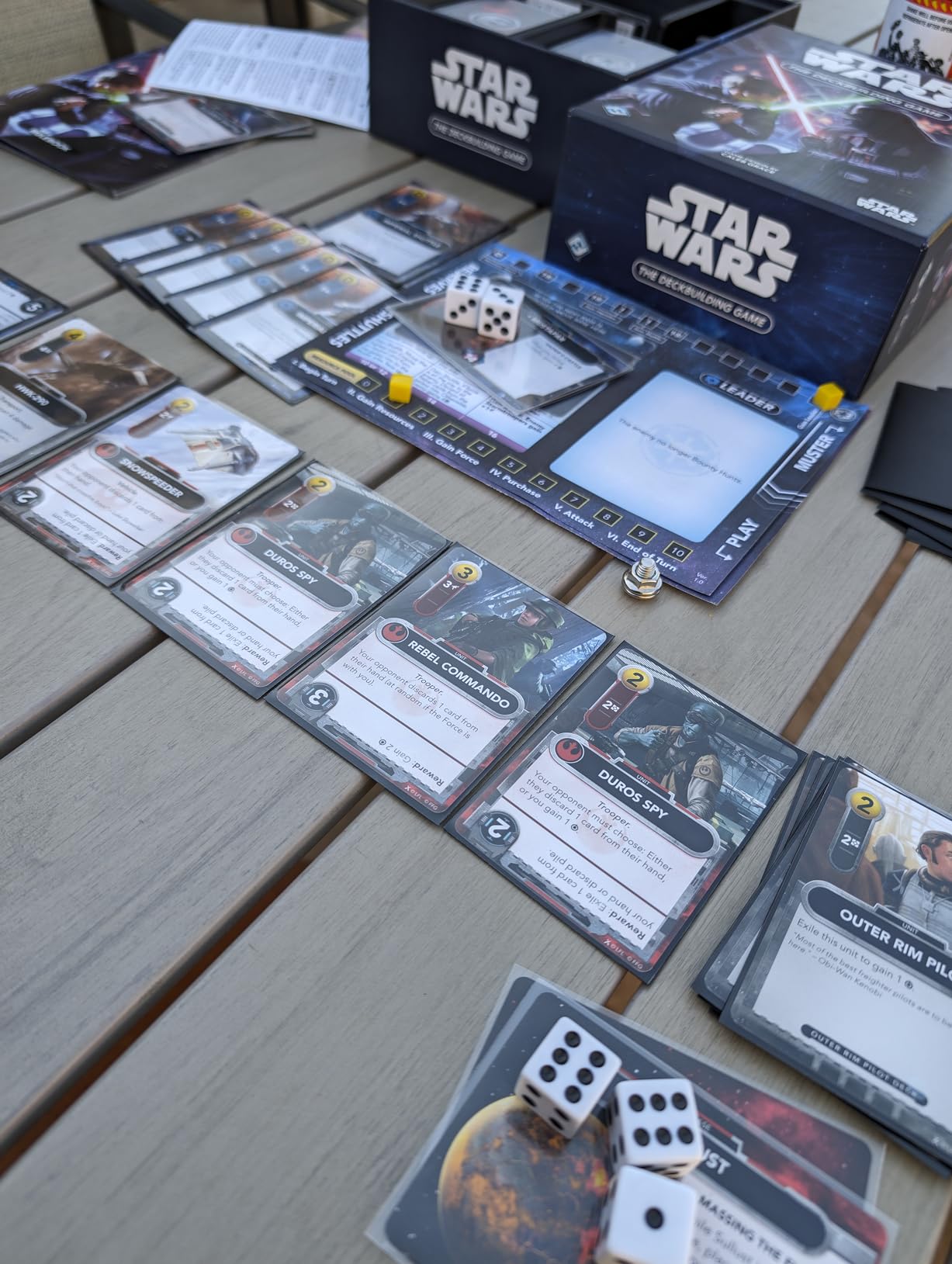
The Balance of the Force track is the twist that makes Star Wars The Deckbuilding Game stand out. You can push it toward the middle for card draw, or commit fully to your side to win. Every game becomes a tug of war where you have to read your opponent and time your commits, which is the kind of decision-making that makes deck-builders memorable.
Game length runs about 30 minutes, the rulebook is short, and the head-to-head format rewards repeated plays. Reviewers on BoardGameGeek consistently highlight how approachable the rules are and how deep the strategy becomes once you know the cards. The included Force Marker and 70 Counters also help the table stay readable during tense moments.
Who will love Star Wars The Deckbuilding Game
Star Wars fans and couples who want a theme-driven head-to-head deck-builder. Anyone who wants a two-player duel with deeper decision-making than Star Realms will appreciate the Balance of the Force track. It also works well as a gift for a Star Wars fan who is just getting into board games.
Who should look elsewhere
Groups of three or four need to look elsewhere. If you are not a Star Wars fan, the theme will not carry the experience, and a non-licensed deck-builder like Dominion or Star Realms will deliver more strategic variety. The base box also has fewer cards than Star Realms, so the engine builds can feel repetitive after 15 to 20 plays.
6. Aeon’s End 2nd Edition: Best Cooperative Solo Deck-Builder
Aeon’s End 2e, Cooperative Deck Building Card Game for Game Night, 1
Players: 1-4
Age: 14+
Time: 60 min
Theme: Gravehold sci-fi fantasy
Pros
- Innovative variable turn order system
- No shuffling of deck for deep strategic planning
- 1-4 player cooperative gameplay
- Rich sci-fi narrative and lore
- Excellent solo mode
Cons
- Higher learning curve for new players
- Setup takes longer than lighter games
Aeon’s End 2nd Edition is the deck-builder I recommend to anyone who wants to play a serious, strategic game by themselves. I have soloed the base campaign across 12 nemeses, and the experience holds up against the best strategy games I have ever played.
The biggest innovation is that you never shuffle your deck. Cards you buy go to your discard, and when you need to draw again you flip directly to your discard pile. That single rule change turns the game from a probability puzzle into a strategic planning exercise, because you always know what is coming next.
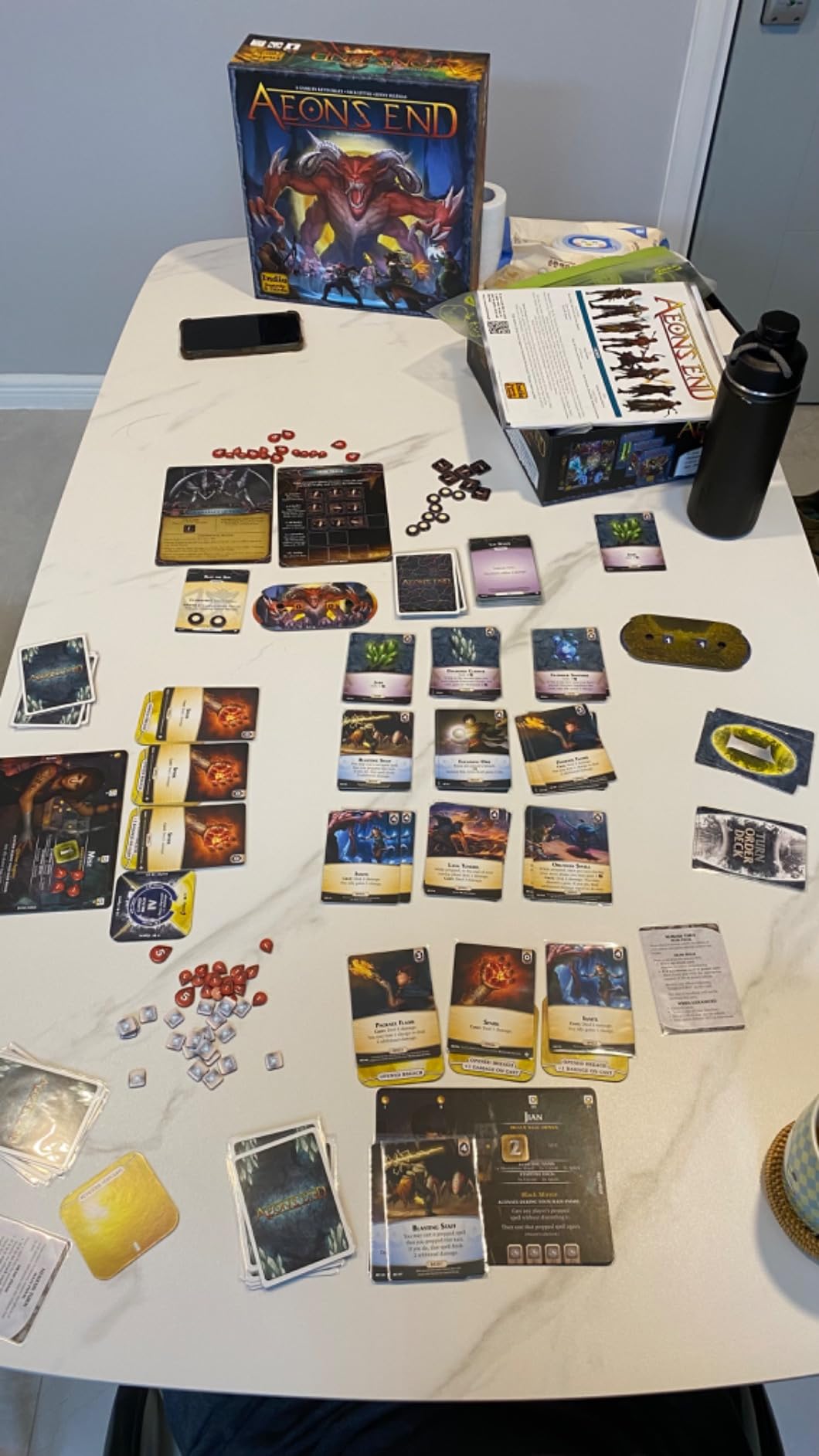
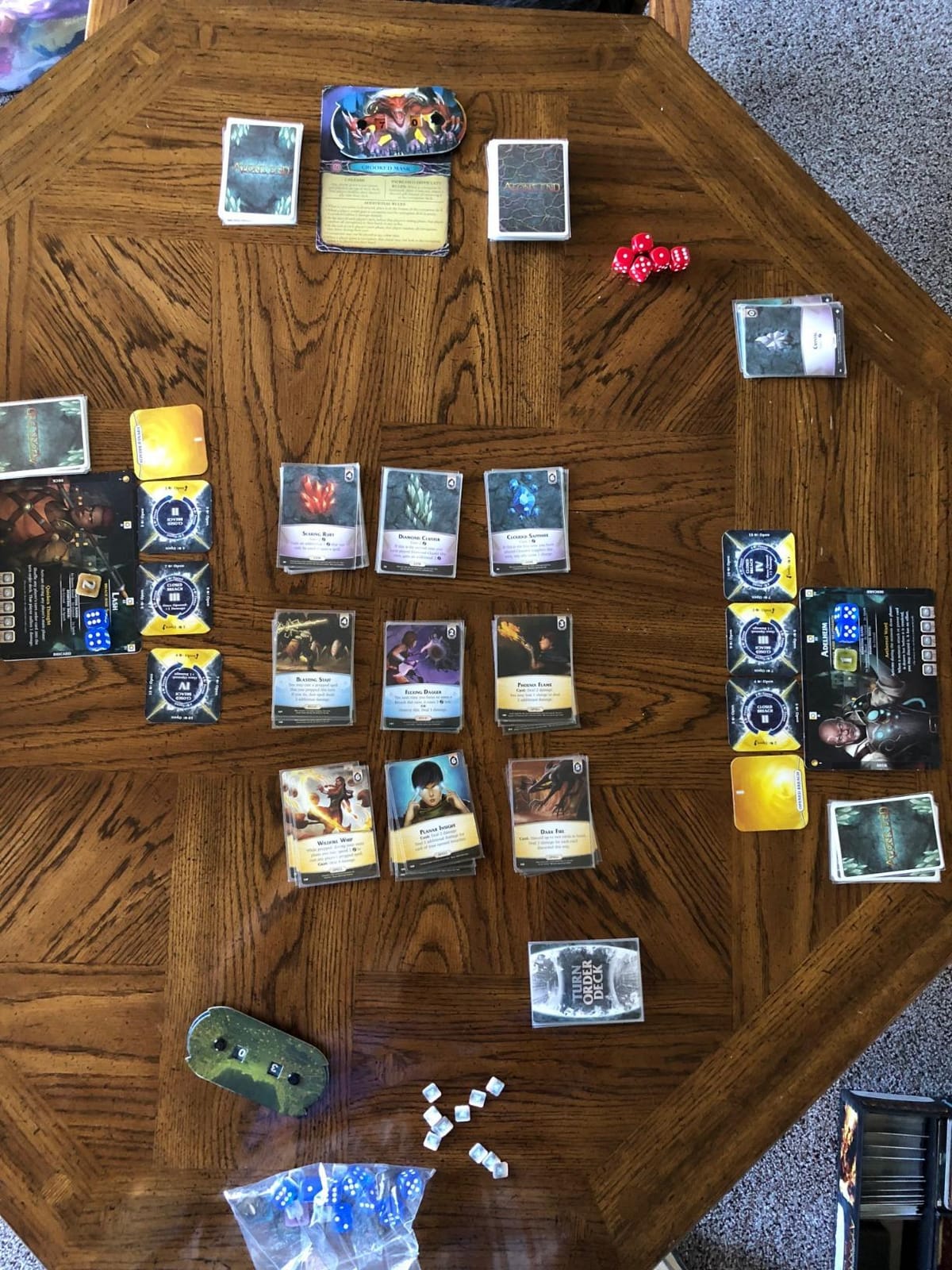
The variable turn order system is the second innovation. Instead of fixed rounds, a turn-order deck determines who goes next, which simulates the chaos of a real battle against a nemesis. Nemeses hit you with unique card combinations and bosses that escalate over the fight, so each session feels like a video game boss rush translated to cardboard.
Cooperative play for two to four players also works well, and the difficulty scales with the number of mages you bring. The base box includes four starting mages, four nemeses, and a substantial market of gems, spells, and relics. Setup takes about 10 minutes, which is longer than a typical deck-builder but pays off in the depth of the resulting game.
Who will love Aeon’s End 2nd Edition
Anyone who wants a serious solo deck-builder. Co-op groups of two to four who like planning their turns together will also enjoy the strategic depth. The Aeon’s End Legacy version is a great choice if you want a long-running campaign, and the expansion ecosystem (War Eternal, The Depths, The Nameless, Outer Darkness) is one of the richest in any co-op franchise.
Who should look elsewhere
Casual players will find the rulebook dense and the strategic ceiling intimidating. The 60-minute playtime also makes it a poor choice for short game nights. If you want a lighter cooperative deck-builder, Harry Potter Hogwarts Battle or the Mistborn Deckbuilding Game are more accessible entry points.
7. Clank! In! Space!: Best Push-Your-Luck Deck-Builder
Pros
- Modular board with high replayability
- Fun push-your-luck deck-building mechanic
- Engaging sci-fi theme with humorous card art
- Excellent solo mode via companion app
- Standalone game not an expansion
Cons
- Board pieces fit very snugly and may wear over time
- Rulebook is less clear for first-time players
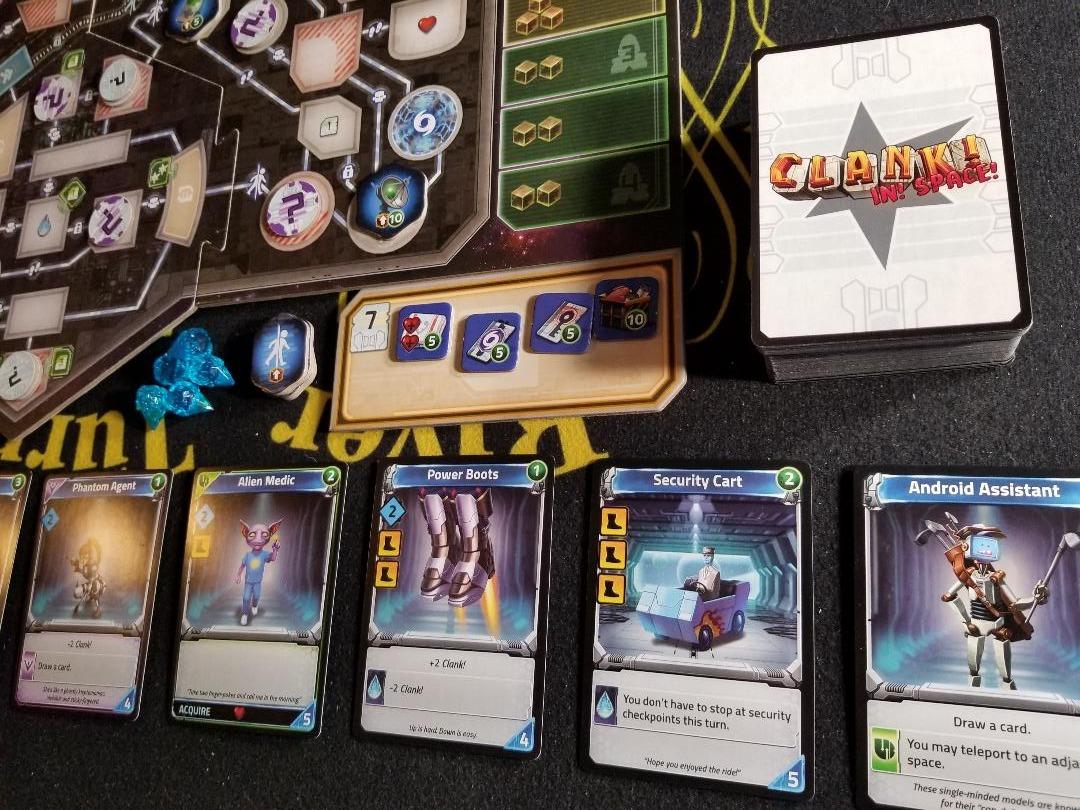
Clank! In! Space! is the sci-fi retheme of the original Clank!, and our team agreed it is one of the most fun entry points into deck-building we have ever played. The push-your-luck tension turns what could be a dry card game into a heist movie you can feel in your chest.
You are sneaking aboard Lord Eradikus’s spaceship to steal artifacts and escape before the whole thing explodes. You build your deck, buy cards, swing your sword to clank noise into a central bag, and try to grab as much loot as possible without waking the dragon. Every card you buy is also a card that adds clank to the bag, which is the genius push-your-luck loop.
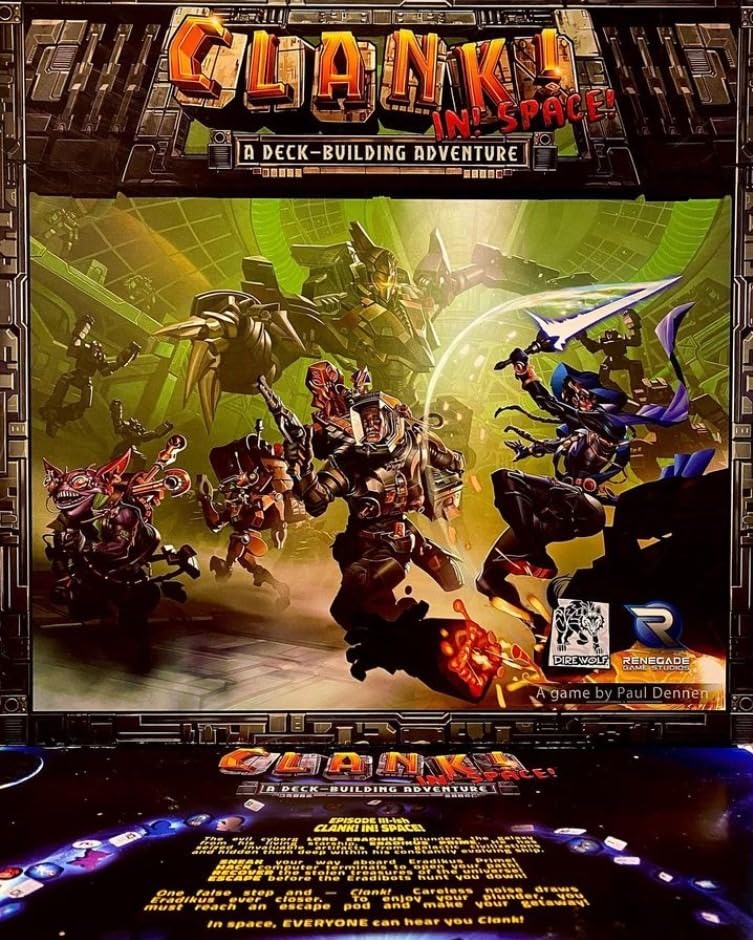
The modular board pieces snap together in 48 different configurations, so the dungeon is different every game. Reviewers on r/boardgames consistently highlight the replayability and the humor in the card art as the reasons this game stays on the table. The companion app supports a full campaign mode, which is one of the best solo deck-building experiences available.
Game length runs 45 to 60 minutes for a full table, or about 30 minutes solo with the app. The rulebook could be clearer, and the board pieces fit snugly enough that gentle handling matters over time, but those are minor issues against the amount of fun packed in the box.
Who will love Clank! In! Space!
Anyone who wants a deck-builder with real theme and a touch of humor. Couples and small groups who enjoy tense, table-driven decisions will love the push-your-luck loop. Solo players with a tablet or phone get a complete single-player experience via the companion app, which sets a high bar for solo deck-builders.
Who should look elsewhere
Pure strategy fans who dislike randomness will want to look at Dominion or Dune: Imperium. The push-your-luck mechanic means a single bad draw can derail a turn, which frustrates some players. If you prefer a non-sci-fi setting, the original Clank! or Clank! Catacombs are stronger choices.
8. Aeon’s End War Eternal: Best Cooperative Sequel for Groups
Aeon’s End War Eternal
Players: 1-4
Age: 14+
Time: 60 min
Theme: Gravehold sequel
Pros
- Excellent evolution of Aeon's End
- Standalone with tons of content
- Strong cooperative gameplay
- Scales well from solo to 4 players
- Compatible with base game and expansions
Cons
- Some content scales less well at 1-2 players
- Quality control issues with some printings
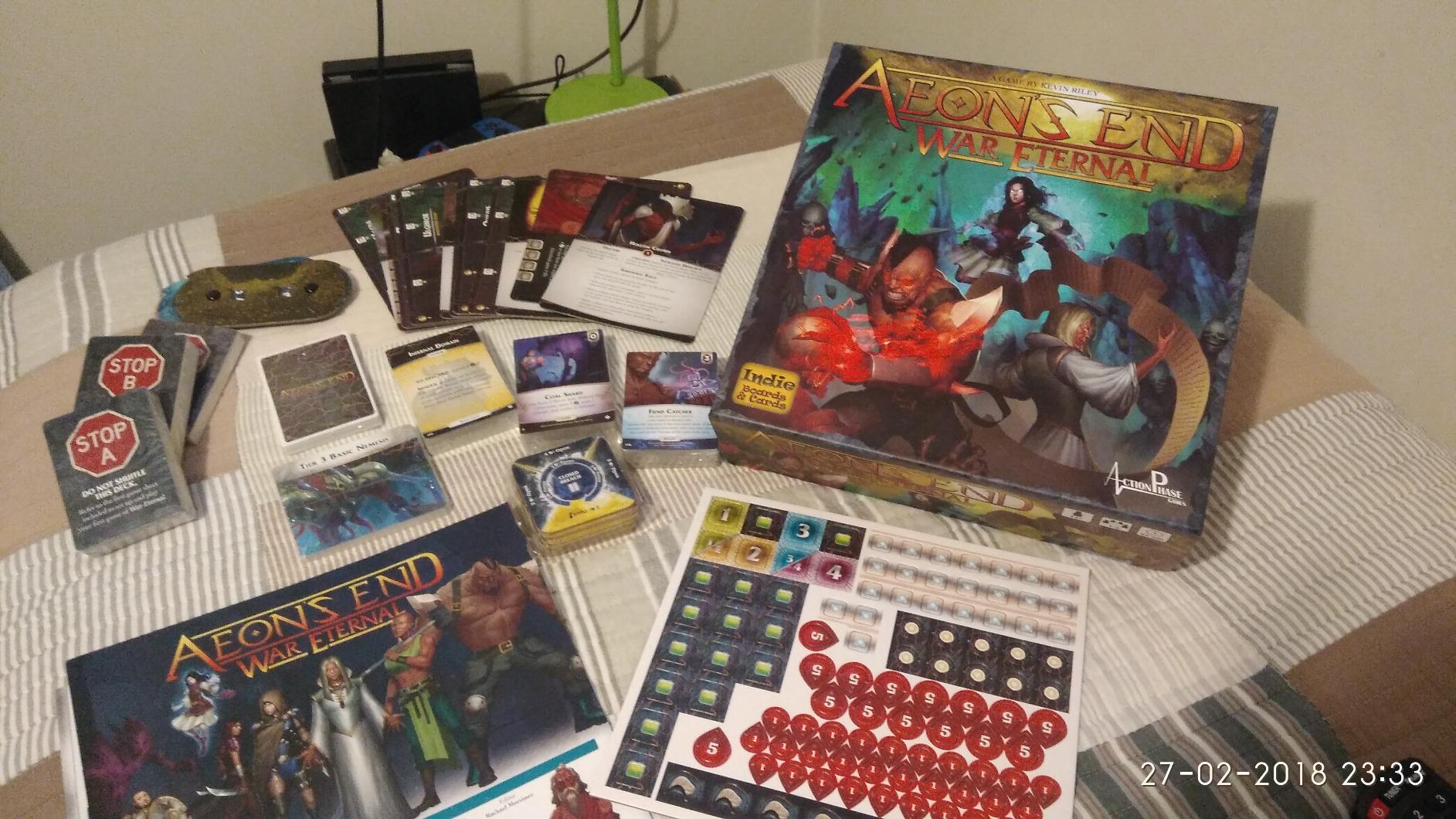
Aeon’s End War Eternal is the standalone sequel that improved on the original Aeon’s End in every meaningful way. I bought it after burning through the base game and have not looked back. If Aeon’s End 2nd Edition is your intro, War Eternal is where the series finds its full stride.
War Eternal adds new mechanics that give mages and nemeses more identity, more market cards to mix and match, and a wider variety of bosses that demand different strategies. Each game feels like a fresh puzzle because the nemesis and market configuration change every session.
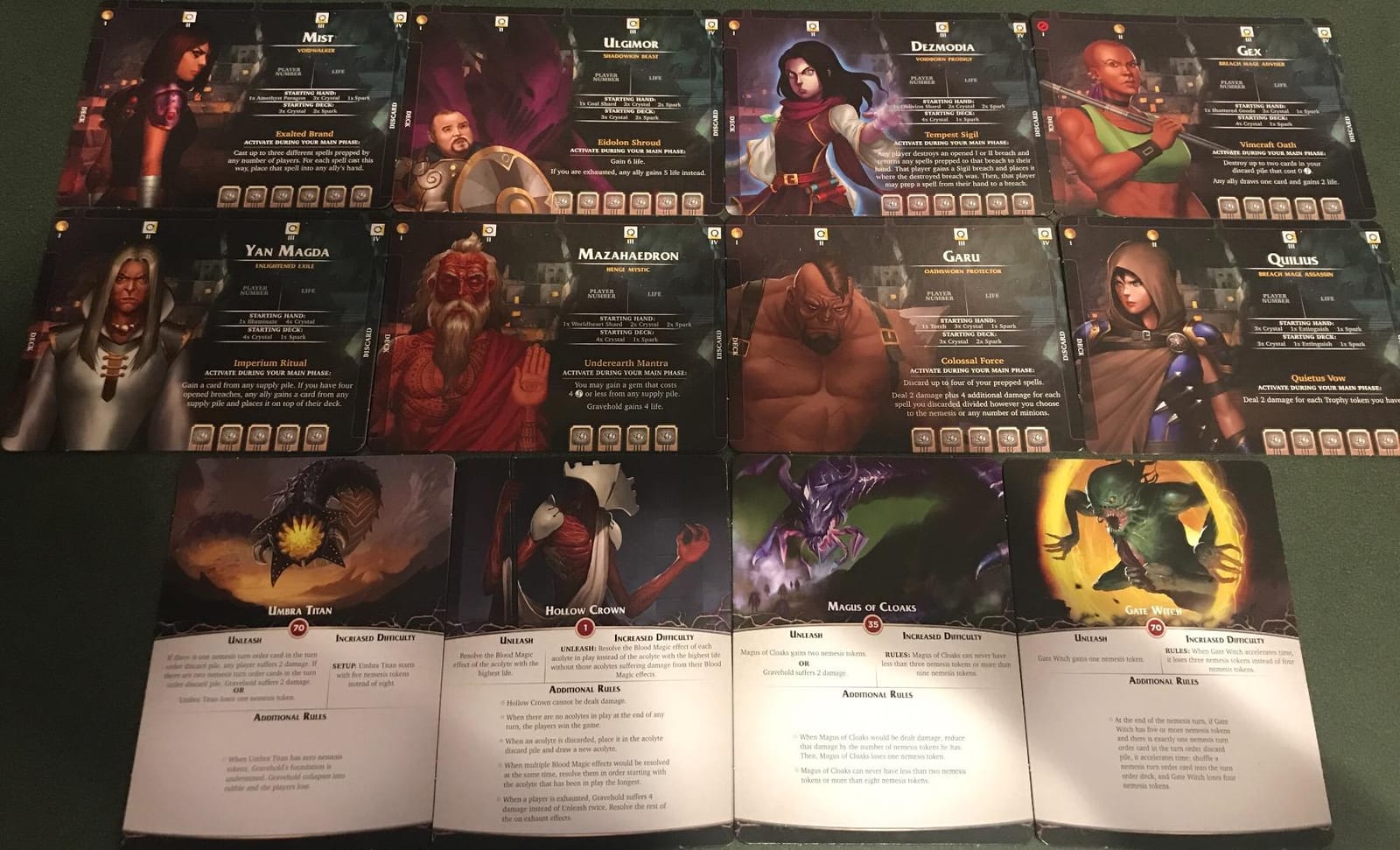
What makes War Eternal our pick for families is the difficulty scaling. Younger or newer players can use easier nemeses while veterans can crank the difficulty, and the game still feels tense and fair. The 1-4 player range also means the same box works for date night and family game night, which is rare in the deck-building genre.
Game length holds steady at about 60 minutes, the components are durable, and the box is full enough to play standalone without picking up the original Aeon’s End. That said, War Eternal is also compatible with all Aeon’s End expansions, so the franchise grows with you. Reviewers on BoardGameGeek consistently rate it as one of the best cooperative deck-builders ever released.
Who will love Aeon’s End War Eternal
Families with teens who want a cooperative strategy game that scales with skill. Solo players who finished Aeon’s End 2nd Edition and want more content without buying every expansion. Groups of two to four who like planning their turns together and enjoy long boss-fight arcs will also get a lot out of it.
Who should look elsewhere
If you have not played any Aeon’s End game, start with the 2nd Edition base box to learn the rules before jumping into War Eternal. Players who dislike long sessions will want a lighter co-op option like Harry Potter Hogwarts Battle. Some lower-count plays also feel slightly under-tuned, so a two-player game with War Eternal may be a touch easier than a four-player game.
9. Clank! Catacombs: Best Tile-Based Dungeon Deck-Builder
Dire Wolf Clank! Catacombs
Players: 1-4
Age: 13+
Time: 60 min
Theme: Fantasy dungeon
Pros
- Standalone not an expansion
- Tile-based dungeon for high replayability
- Compatible with existing Clank! expansions
- Excellent for families and groups
- Fresh Portals Wayshrines and Ghosts mechanics
Cons
- Some customers receive damaged boxes
- Setup time is longer than other Clank! versions
Clank! Catacombs is the newest standalone entry in the Clank! franchise, and our team agreed it is the most replayable version yet. I played through four full dungeons with a group of three and never once built the same map twice.
The big shift from earlier Clank! games is the tile-based dungeon. Instead of a fixed board, you lay dungeon tiles as you explore, which means the map literally grows under your hands. Every game generates a different layout, and the new Portals, Wayshrines, Prisoners, and Ghosts mechanics add strategic wrinkles that the older Clank! games did not have.
Catacombs contains 140 plus Punch Tokens, 180 plus Cards, and 29 Dungeon Tiles, so the box feels substantial. Setup takes about 10 minutes which is longer than most deck-builders, but the trade-off is the highest replayability in the franchise. The game is also compatible with every existing Clank! expansion, so your collection keeps growing.
Who will love Clank! Catacombs
Anyone who wants a deck-builder that feels different every time they sit down to play. Families with teens who enjoy dungeon-crawl themes will love the tile-laying exploration. Groups who already own Clank! or Clank! In! Space! and want the deepest version of the franchise will find a lot to enjoy.
Who should look elsewhere
If you want a quick 20 to 30-minute game, Catacombs is too long. The setup time also makes it a tough sell for casual weeknights. Some reviewers on r/boardgames have reported damaged boxes on delivery, so ordering from a seller with good packaging matters. For a lighter Clank! entry point, the original Clank! or Clank! In! Space! are better fits.
10. Mistborn Deckbuilding Game: Best Themed Cooperative Deck-Builder
Brotherwise Games Mistborn Deckbuilding Game
Players: 1-4
Age: 13+
Time: 60 min
Theme: Brandon Sanderson Mistborn
Pros
- Faithful to Brandon Sanderson's Mistborn lore
- Unique metal-burning Allomantic mechanic
- Supports solo co-op and competitive play
- Accessible to newcomers with depth for veterans
- Cinematic narrative missions
Cons
- Game contains spoilers for the Mistborn books
- Some find the game complex at first
The Mistborn Deckbuilding Game is the most narratively ambitious deck-builder on our list, and a love letter to Brandon Sanderson’s Mistborn novels. I went in as a fan of the books and came away impressed by how well the metal-burning mechanic captures the feel of Allomancy on the tabletop.
Each player burns metals like Steel and Pewter to trigger unique abilities. Steelpushing lets you pull cards from your discard pile, while burning Pewter adds combat strength. The metal system feels unlike any other deck-builder I have played, and it gives every game a clear thematic identity beyond just buying cards.
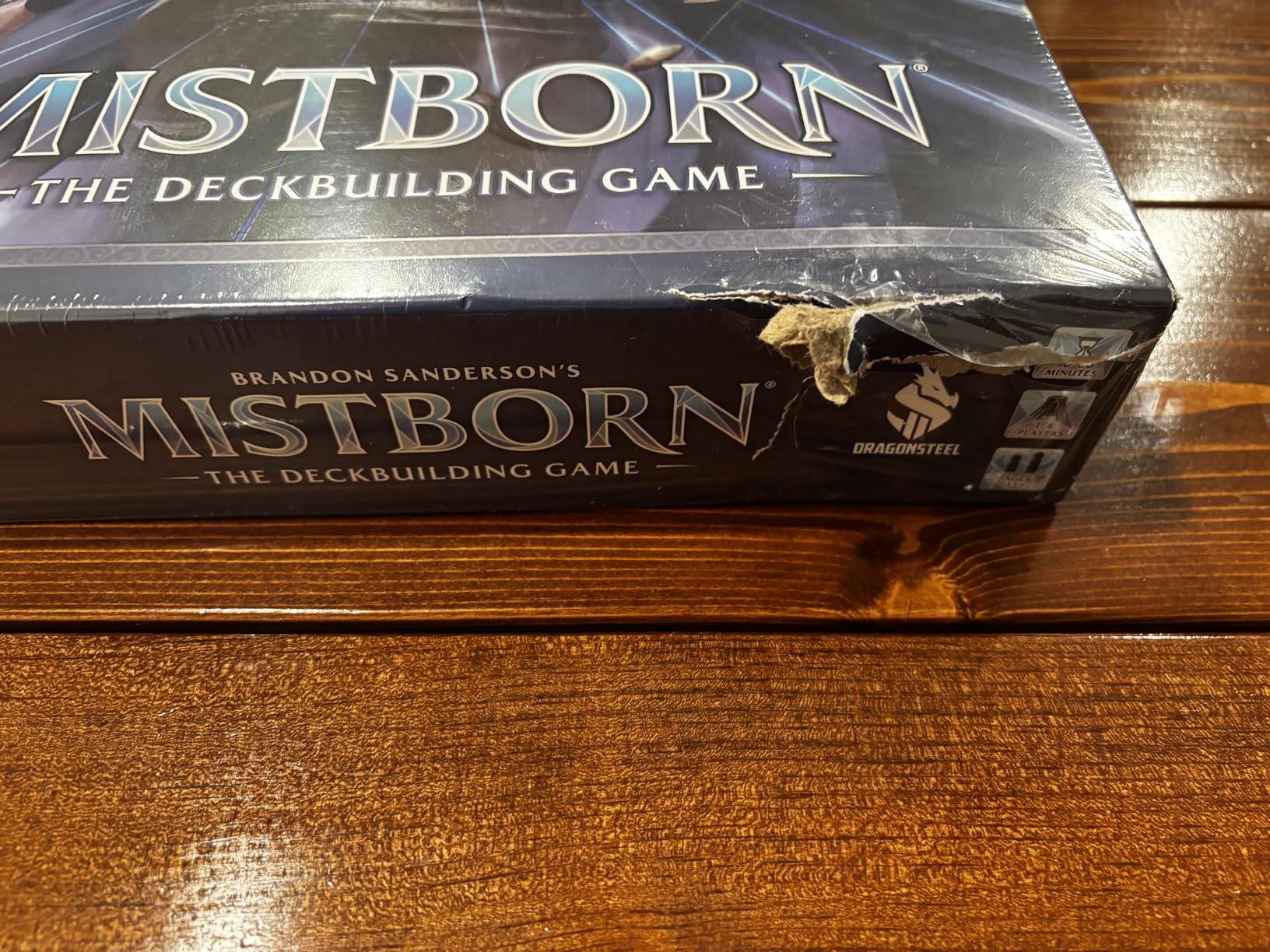
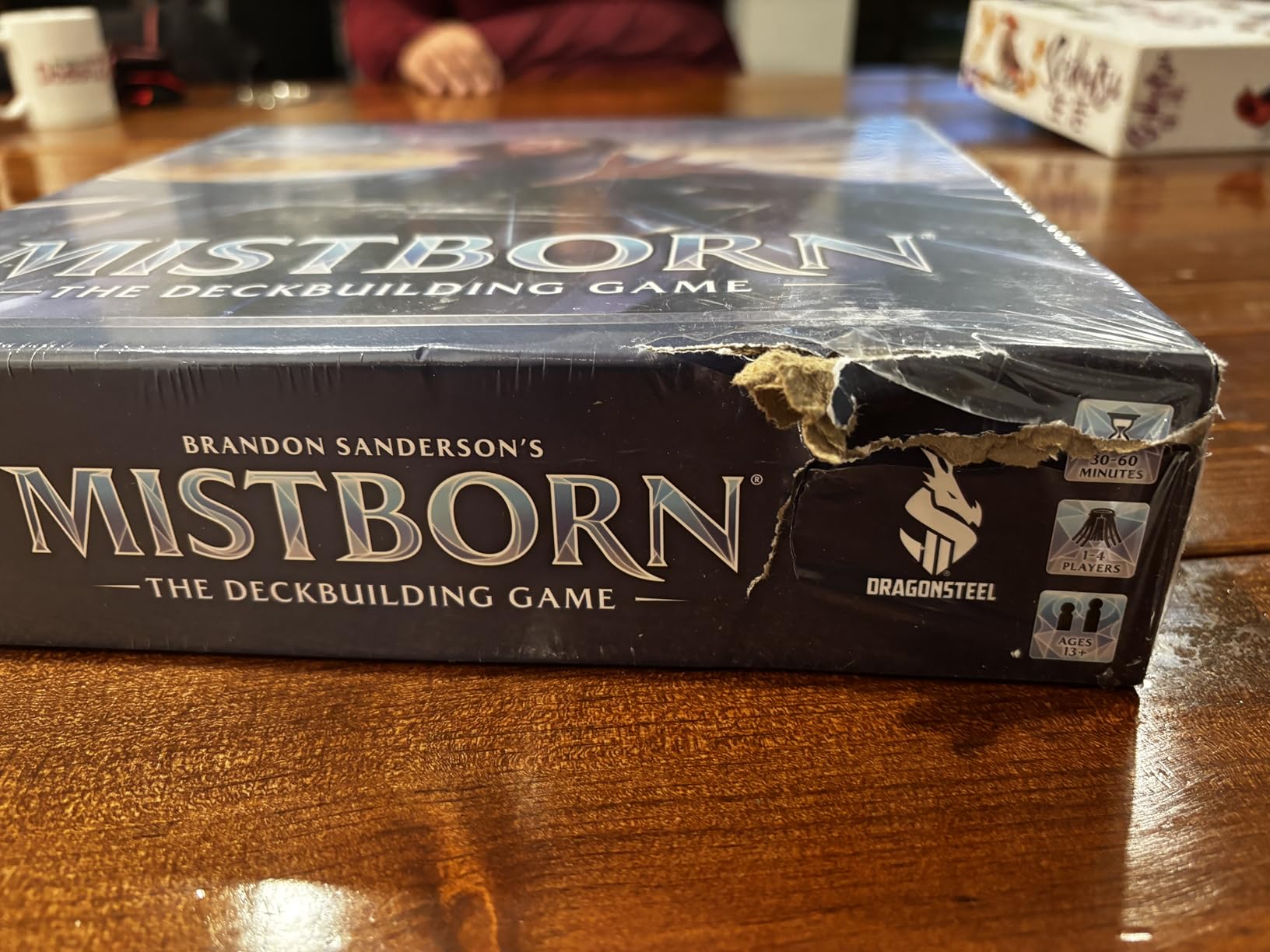
The box supports solo, cooperative, and competitive modes, so you can play through the novel’s narrative missions with friends or face off head-to-head. Game length runs about 60 minutes for a full session, and the included Card Shuffler is a nice quality-of-life touch for the metal-burning deck manipulation.
Mistborn is a Golden Geek nominee and the rules are surprisingly accessible for a game of this depth. New players can be playing in about 15 minutes, and the layered mechanics keep the experience fresh across many plays. Reviewers on BoardGameGeek consistently praise the faithful adaptation of the novels and the cinematic mission design.
Who will love the Mistborn Deckbuilding Game
Brandon Sanderson fans, narrative-driven gamers, and anyone who wants a co-op deck-builder with a unique mechanical hook. Solo players who enjoy story-driven games will also get a lot out of the included missions. Players who have finished Aeon’s End and want a fresh cooperative deck-builder will find a meaningful new system here.
Who should look elsewhere
If you have not read the Mistborn books, the story missions may feel less impactful. The metal-burning system is also slightly more complex than Dominion or Star Realms, so total beginners may want to start with a simpler entry point. As one caution we noted in our plays, certain narrative outcomes do spoil book plot points, so non-readers may want to play the missions after finishing the novels.
Buying Guide: How to Choose the Best Deck-Building Board Game
The best deck-building board game for you depends on three things: who you usually play with, how long you want a session to run, and whether you prefer a clean classic or a thematic hybrid. Below are the factors our team weighed most heavily when ranking these 10 games.
Player count and group size
Player count is the single biggest decision factor. Star Realms and Star Wars The Deckbuilding Game are pure two-player experiences, while Dominion, Harry Potter Hogwarts Battle, Hero Realms, Aeon’s End, and Clank! variants support two to four. If your primary mode is couples play, look at Star Realms, Star Wars, or Hero Realms. If your primary mode is solo, Aeon’s End, Clank! In! Space!, and the Mistborn Deckbuilding Game are your best bets.
Solo playability and quality
If you mainly play alone, our top three solo picks are Aeon’s End 2nd Edition, Clank! In! Space! with its companion app, and the Mistborn Deckbuilding Game. All three have substantial solo content in the base box. Dominion does not include solo in the base box, but the official Adventures rules or fan-made automa work. Reviewers on r/soloboardgaming consistently rank Aeon’s End at the top of the genre for solo play.
Two-player experience
Two-player is where deck-builders shine because the market stays tight and engine builds feel decisive. Star Realms and Star Wars The Deckbuilding Game are the purest two-player experiences, while Dominion, Hero Realms, Harry Potter Hogwarts Battle, and Clank! all work beautifully at two. If you want theme and tension, Clank! In! Space! and Star Wars are our top two-player recommendations.
Cooperative versus competitive
If you want to work together against the game, Harry Potter Hogwarts Battle, Aeon’s End 2nd Edition, Aeon’s End War Eternal, and the Mistborn Deckbuilding Game are your best co-op picks. Hogwarts Battle is the most accessible, Aeon’s End has the deepest strategy, and Mistborn offers the richest narrative. For competitive head-to-head or multiplayer, Dominion, Star Realms, Hero Realms, Star Wars, and the Clank! games are stronger fits.
Beginner-friendliness and complexity
If you are new to deck-builders, start with Ascension or Harry Potter Hogwarts Battle as gateway games, or jump straight to Dominion if you want the genre-defining experience. Star Realms and Hero Realms are also excellent entry points because the rules fit on a single card. Save Aeon’s End and Dune: Imperium for after you have played a few lighter deck-builders, because the depth can be intimidating for newcomers.
Budget and value
Star Realms is the cheapest way into a quality deck-builder, and Ascension offers a similar low entry cost. The mid-tier includes Dominion, Harry Potter Hogwarts Battle, and Hero Realms. Premium titles like Aeon’s End War Eternal, Clank! Catacombs, and Mistborn Deckbuilding Game cost more but pack in deeper content and longer replayability. Expansion ecosystems matter too: Dominion, Aeon’s End, and Clank! have the deepest upgrade paths in the genre.
Frequently Asked Questions
What is the best deck-building board game?
Dune: Imperium is widely considered the best overall deck-builder for its hybrid depth, while Dominion remains the genre-defining classic. For most shoppers in 2026, Dominion 2nd Edition is the safest pick because it has the deepest expansion ecosystem and a near-infinite replay ceiling. If you want theme and modern mechanics, Clank! Catacombs and Aeon’s End War Eternal are also strong contenders.
What is the best deck-building game for beginners?
Dominion 2nd Edition, Star Realms, and Harry Potter Hogwarts Battle are our top three beginner picks. Dominion teaches the core buy-build-shuffle loop in under 10 minutes, Star Realms fits on a single rules card and plays in 20 minutes, and Hogwarts Battle uses the Harry Potter theme to teach cooperative deck-building gently. All three are widely available and reviewed by thousands of players.
What is the best 2-player deck-building game?
Star Realms and Star Wars The Deckbuilding Game are the strongest pure two-player deck-builders on the market. Star Realms is portable, fast, and perfect for travel. Star Wars The Deckbuilding Game offers deeper head-to-head strategy with the Balance of the Force track. For couples who want a co-op alternative, Harry Potter Hogwarts Battle and Clank! In! Space! both scale beautifully to two players.
What is the best cooperative deck-building game?
Aeon’s End 2nd Edition and Aeon’s End War Eternal are the deepest cooperative deck-builders available, with rich boss fights, the unique no-shuffle mechanic, and a huge expansion ecosystem. Harry Potter Hogwarts Battle is the most accessible co-op pick for families, and the Mistborn Deckbuilding Game offers a strong narrative-driven alternative for solo or co-op play. Reviewers on r/boardgames consistently rank Aeon’s End as the genre leader for co-op.
Is Dominion still the best deck-builder?
Dominion is no longer the only great deck-builder, but it is still one of the best and absolutely worth owning. The 2009 Spiel des Jahres winner invented the genre and continues to deliver fast 30-minute games with millions of possible card combinations. For pure deck-building elegance and the deepest expansion ecosystem on the market, Dominion remains our editor’s choice. That said, if you want a modern hybrid with theme, Dune: Imperium, Clank! Catacombs, and Aeon’s End War Eternal have surpassed it in some categories.
The Verdict: Which Deck-Building Game Should You Buy?
If you only buy one deck-building board game in 2026, our team unanimously picked Dominion 2nd Edition as the editor’s choice. It defined the genre, plays in 30 minutes, scales beautifully from two to four players, and has the deepest expansion ecosystem on the market. Buy Dominion first and you can keep playing it for years.
From there, the right next step depends on your play style. Couples should add Star Realms or Star Wars The Deckbuilding Game to their shelf. Families should grab Harry Potter Hogwarts Battle for cooperative nights. Solo players will get the deepest experience out of Aeon’s End 2nd Edition or Clank! In! Space! with the companion app. If you want a narrative experience, the Mistborn Deckbuilding Game delivers something genuinely different.
We will keep testing new deck-builders throughout 2026 and update this guide as new releases land. For more honest reviews of board games and gaming gear, browse our other guides on Top Game Server.